
What if the most prestigious address isn’t the strongest fit for your investment objectives? A luxury home can offer exceptional design and enduring personal value, yet prestige alone can’t tell you how readily a property may be sold, what ownership could involve, or whether it suits the life you want. If you’re researching premium property options alongside Monaco, those distinctions matter from the outset.
Both markets have their own appeal. The right choice depends on more than reputation: it calls for a clear view of your purpose, time horizon, appetite for risk and personal circumstances. This article compares the principal differences between UK and Monaco property, including tax treatment, legal and residency considerations, transaction costs, liquidity and ongoing ownership. At Pimlico Homes, we believe in using a clear framework to assess a specific home against your priorities, without treating past performance or projected returns as a promise. Thoughtful design and long-term liveability matter too, particularly when a property is both a significant purchase and a place to call home.
Key Takeaways
- Compare UK and Monaco homes by purpose, ownership context and resale considerations, rather than prestige alone.
- Assess liquidity by considering the time and conditions involved in a sale, not as a guaranteed outcome.
- Use the same practical criteria to weigh a specific property against your objectives, circumstances and appetite for risk.
- Researching luxury property investment North East? Consider how a UK purchase fits your priorities alongside the distinct context of Monaco.
- Look beyond market reputation to qualities you can assess directly, including design, craftsmanship and long-term liveability.
Luxury property investment in the UK or Monaco: what are you comparing?
A luxury home can be a place to live, a carefully chosen asset, or both. The distinction matters. A luxury residential property investment is the purchase of a high-value home with an intended financial objective, while its future value, income and resale outcome remain uncertain. Buying is not a guaranteed route to a return. This comparison considers UK and Monaco residential property only; it does not assess other asset classes or provide a forecast.
For anyone researching luxury property investment North East, the same discipline applies: separate a home’s appeal from the financial case for buying it. A refined interior or distinguished address may shape the experience of ownership, but neither proves that a property will appreciate or sell quickly.
What does luxury property investment mean in practice?
Start by defining the purpose. An owner-occupier may prioritise comfort, design and long-term liveability. Someone buying a second home for occasional use may give more weight to access, maintenance and how the property will be managed while empty. An income-focused buyer also needs to examine whether letting is permitted and viable, as well as the costs and responsibilities involved.
These aims can overlap, but they are not interchangeable. A property suited to personal use may not meet an income target; a home selected for a financial objective may not be the best fit for everyday life. General Real estate investing can involve value retention, income or potential appreciation, but each depends on circumstances rather than prestige alone.
Treat potential value drivers as questions to investigate, not promises. Examine the building’s quality and condition, its setting and design, ongoing costs, buyer demand and comparable evidence. Also consider how long you might hold the property and whether you could meet its costs if your circumstances changed.
Why compare the UK with Monaco?
The comparison is useful because the two markets sit within different economic, legal and ownership contexts. The UK has a varied residential market, while Monaco’s limited geography and international profile create a distinctive setting for buyers. Neither characteristic makes one option inherently safer or superior. The individual home, purchase terms and buyer’s circumstances can change the balance considerably.
Be specific about what you want the property to do. Is the priority a principal residence, a home for occasional use, portfolio diversification or another financial objective? Residency is a separate consideration: buying in the UK does not determine immigration status, and owning property in Monaco does not itself grant residency. Your existing residence, tax position, intended use and time horizon can all affect how each option fits.
The purpose of comparing markets is not to choose a country by reputation. Identify what needs to be examined in the specific purchase, then test whether the home and its ownership context align with your priorities. That is more useful than assuming luxury means strong performance.
UK vs Monaco property: compare market context, ownership and liquidity
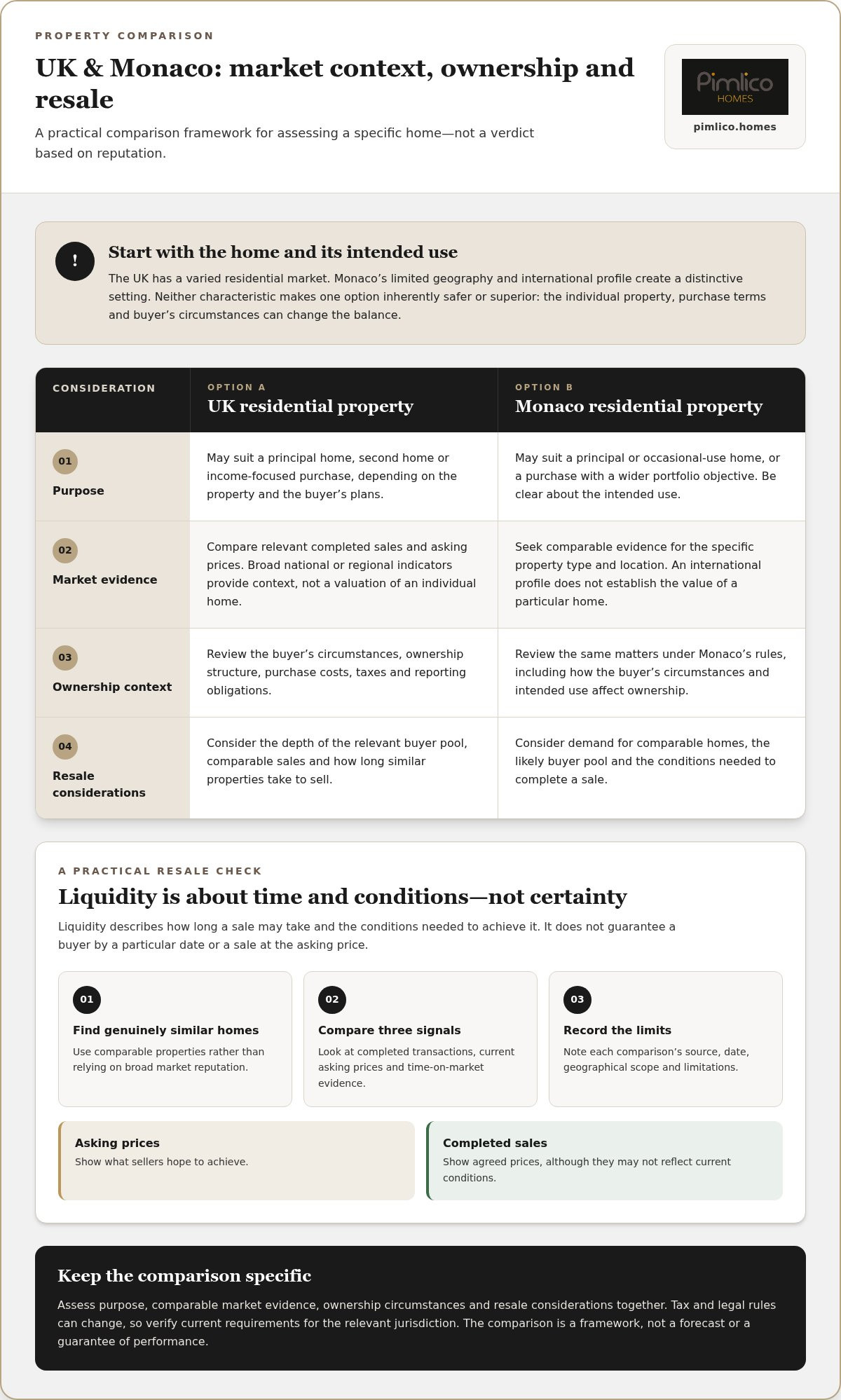
Start with the property and its intended use, not a country’s reputation. The table provides a framework rather than a verdict: market evidence and ownership conditions vary by property and buyer, while transaction, tax and legal rules can change. Verify current requirements for the relevant jurisdiction before making a decision.
| Consideration | UK residential property | Monaco residential property |
|---|---|---|
| Property purpose | May suit a principal home, second home or income-focused purchase, depending on the property and buyer’s plans. | May suit a principal or occasional-use home, or a purchase with a wider portfolio objective. The intended use needs to be clear. |
| Market evidence | Compare relevant completed sales and asking prices. Broad national or regional indicators provide context, not a valuation of an individual home. | Look for comparable evidence for the specific type of property and location. An international profile does not establish the value of a particular home. |
| Ownership context | Review the buyer’s circumstances, ownership structure, purchase costs, taxes and reporting obligations. | Review the same matters under Monaco’s rules, including how the buyer’s circumstances and intended use affect ownership. |
| Resale considerations | Consider the depth of the relevant buyer pool, comparable sales and the time similar properties take to sell. | Consider demand for comparable homes, the likely buyer pool and the conditions needed to complete a sale. |
How should buyers assess market depth and resale potential?
Liquidity describes how long a sale may take and the conditions needed to achieve it. It does not guarantee that a buyer will be found by a particular date or that the property will sell for its asking price. Compare completed transactions, current asking prices and time-on-market evidence for genuinely similar homes. For each comparison, note the source, date, geographical scope and limitations. Asking prices show what sellers hope to achieve; completed sales show agreed prices, although they may not reflect current conditions.
Broad economic conditions can help frame the UK context. The Office for National Statistics publishes UK Gross Domestic Product (GDP) data, but GDP is not a direct measure of demand for a particular home. Resale prospects also depend on the property’s individual attributes, such as condition, layout, setting and the range of buyers its features may suit.
What ownership and transaction factors belong in the comparison?
Before comparing headline prices, account for purchase taxes and costs, ongoing ownership expenses, possible tax on income or disposal, inheritance considerations, ownership structures and filing obligations. The relevant rules may depend on your residence, ownership arrangements and how you use the home. Treat a general summary as a starting point, not a personal tax or legal conclusion, and check current requirements against authoritative guidance before proceeding.
For a UK residential purchase, compare like-for-like homes and dated evidence rather than relying on broad market headlines. Buyers exploring luxury residential homes can assess design, craftsmanship and liveability directly, alongside the financial and ownership questions that shape a considered decision.
Is Monaco automatically the better luxury property investment?
No. Monaco’s exclusivity may be part of its appeal, but it doesn’t establish what a particular home is worth, how easily it could be resold or how it might perform in future. Scarcity can shape buyer interest, yet it is not proof of liquidity. The same distinction applies to any search for luxury property investment North East: market reputation is context, not a conclusion about an individual property.
Monaco’s economic profile helps explain its international draw. The Consulate General of Monaco’s Monaco’s economic overview provides wider context, but an economic overview cannot replace evidence about a specific home, its purchase terms or the likely resale market. Separate three considerations: lifestyle appeal, claims about scarcity and documented investment evidence. Each may matter, but they answer different questions.
Past performance does not establish future property returns. Historical price movements describe what happened over a stated period; they cannot guarantee future appreciation, income or a sale at a particular price. A balanced comparison weighs the possibility of value changes against the practical costs and risks of ownership.
Which risks can change the investment case?
Property is not instantly convertible to cash. If you need to sell at a particular time, market conditions, buyer demand, pricing and the home’s specific features may affect both the sale period and achievable terms. A distinctive property may have strong personal appeal but a narrower pool of potential buyers. Neither a prestigious address nor a scarcity narrative removes that uncertainty.
Ownership also brings responsibilities. Maintenance needs and associated costs can change over time, and a property may concentrate a substantial part of your wealth in one asset. If the purchase price or ownership costs are in a different currency from the rest of your finances, exchange-rate movements may affect your overall position when measured in your home currency.
Before committing, consider how you would manage a longer-than-expected resale period, changing costs or a shift in personal circumstances. For decisions involving substantial assets across jurisdictions, seek professional financial, legal and tax advice tailored to your position. General comparisons cannot settle those individual questions.
How do lifestyle priorities affect the comparison?
Begin with how you expect to use the home. An owner-occupier may value privacy, access, layout and the pleasure of living in a carefully designed space. A buyer focused primarily on financial outcomes may place greater weight on purchase and running costs, evidence of demand and the practical route to resale. The same property can suit one buyer well and another less closely.
Lifestyle value is real to the owner, but personal; it should not be counted as investment income. Equally, a decision need not be purely financial. Keep both aims visible, then weigh each property against them without assuming that luxury, exclusivity or a compelling story guarantees a particular outcome.
A practical framework for assessing a luxury property investment
A disciplined comparison begins before a viewing. Write down what you need the property to do, then test each option against the same criteria. For a luxury property investment North East or a purchase in Monaco, this approach keeps market reputation in perspective and helps expose assumptions that need evidence.
- Define your objective. Record whether the home is intended for full-time living, occasional use, income or another financial aim. Keep lifestyle priorities distinct from financial targets.
- Set your time horizon and liquidity needs. Consider how long you could hold the property and how much flexibility you need if plans change. A sale may take longer than anticipated.
- Set a purchase budget. Assess affordability against your wider finances, not just the purchase price. Allow for verified transaction costs and avoid relying on a future sale to meet immediate obligations.
- Compare like with like. Review homes with similar size, condition, specification and setting. Separate asking prices from completed sale evidence, and note the source and date of each comparison.
- Examine the specific home. Consider condition, layout, materials, design and likely maintenance responsibilities. A property’s individual attributes can affect its appeal to future buyers, but cannot guarantee resale value or timing.
- Review ownership obligations. Identify the costs and responsibilities that may continue after purchase, as well as relevant tax, legal and reporting questions for your circumstances.
What should buyers examine before comparing properties?
Keep a comparison record for each home: intended use, holding period, acceptable risk, need for access to capital, property condition and specification. Add the evidence behind each assessment. This makes differences easier to spot. Two homes described as luxury may vary substantially in upkeep, practical liveability and the range of buyers they could suit.
For purchase-stage detail on a new build, Pimlico Homes’ luxury new build purchasing guide complements this investment-focused framework.
How can buyers test assumptions without relying on forecasts?
Build cautious, central and adverse scenarios as planning exercises, not predictions. For each, consider what happens if ownership costs rise, a sale takes longer than hoped or the eventual offer is below your expectation. Keep purchase affordability, ongoing obligations and possible resale proceeds separate in your calculations, so a hoped-for future gain does not disguise a shortfall today.
Use current, documented costs relevant to your buyer status and ownership arrangements. Tax and legal rules can change and may depend on individual circumstances, so obtain independent professional advice before acting. A home should also meet your practical requirements. Thoughtful design, craftsmanship and long-term liveability are qualities you can assess directly.
To explore luxury residential homes by Pimlico Homes, consider how each home’s design and liveability align with your priorities, alongside your independent financial assessment.
Explore luxury residential property with a long-term perspective
A considered purchase depends not only on financial assumptions, but on the qualities of the home itself. Design, craftsmanship, specification and day-to-day suitability are tangible factors you can examine. They do not guarantee appreciation or a particular resale outcome; they help you decide whether the property fits your intended life and ownership horizon.
Pimlico Homes develops luxury residential properties, including detached homes, executive courtyard homes, bespoke new builds and barn conversions. Each offers a different kind of living environment, so assess the individual home rather than relying on a label or general market reputation. This matters when considering luxury property investment North East as part of a wider comparison.
What can a considered new-build purchase offer?
With a new build, you can assess the design and specification of the home as presented, from the arrangement of rooms to the finish and craftsmanship. Consider how those choices support your routines: a layout may be elegant, but it should also feel practical for the people who will live there.
Detached homes, courtyard homes, bespoke new builds and barn conversions each have distinct characteristics. The right fit depends on your priorities, not on a promise of future performance.
What is a sensible next step for a prospective buyer?
Bring your objectives to the specific property. Compare its features, condition, ownership responsibilities and documented costs with the priorities you set earlier. Keep lifestyle benefits separate from financial assumptions, and treat resale value as a consideration rather than a certainty. Pimlico Homes’ guide to the resale value of new build homes offers a related perspective on how a future sale may factor into your decision.
Keep the roles clear. Property information can help you understand a home’s design and specification; individual investment, tax and legal questions require advice suited to your circumstances. Consider whether the home remains a sound choice for you under different ownership and resale scenarios, without relying on projected returns.
Explore Pimlico Homes’ luxury residential properties and compare the character of each home with your long-term priorities. The most meaningful choice is one that fits both your practical requirements and the way you intend to live.
Choose a home that fits your next chapter
Move from broad market comparison to a clear picture of how a particular home would serve you. Imagine an ordinary week there, not only the moment of purchase: the spaces you use, the privacy you value, the practical demands of ownership and the length of time you expect to stay. Weigh those considerations against documented evidence and advice tailored to your circumstances.
For anyone weighing luxury property investment North East against an option in Monaco, the decision need not be a contest of prestige. It should reflect your priorities and remain understandable even if assumptions about future values change. You can appreciate a home’s craftsmanship and considered design directly; financial outcomes remain uncertain.
A useful decision record captures what matters most, what evidence supports your choice and which uncertainties you are prepared to accept. That clarity helps keep the purchase aligned with your life, rather than with a market narrative.
Explore Pimlico Homes’ considered approach to residential design and craftsmanship. Explore Pimlico Homes properties and consider which home best fits your plans.
Frequently Asked Questions
Is luxury property a good investment in the UK?
It can suit some buyers, but whether it is a good investment depends on the property, purchase terms and your financial objectives. For luxury property investment North East, assess an individual home’s condition, ongoing costs and relevant completed sales rather than assuming broader market performance applies to it. Consider how a long holding period or an unexpected need to sell would affect your wider financial plans.
Is Monaco property a better investment than UK property?
Not automatically. Monaco and the UK differ in market structure, ownership context and buyer circumstances, so the better fit depends on your objectives and the specific property. A buyer prioritising a home for personal use may reach a different conclusion from someone focused on portfolio diversification. Compare the full cost and practical responsibilities of ownership, and avoid treating exclusivity or tax reputation as proof of better performance.
Can you make money from luxury property investment?
It is possible, but neither income nor capital growth is assured. An eventual gain depends on factors such as the price paid, ownership costs, market conditions and sale terms. A property that rises in value on paper may produce a different result after transaction and holding costs. Build a cautious assessment around documented figures, not a promised yield or optimistic resale assumption.
What should I compare when investing in UK or Monaco property?
Compare the intended use, purchase and ownership costs, tax position, legal arrangements, ongoing maintenance and likely resale market. Then assess the specific home: its condition, layout and specification, alongside comparable completed sales rather than asking prices alone. If your finances are held in a different currency from the purchase or expenses, consider how exchange-rate changes could affect your overall position. Record the sources and dates of your evidence.
How much does luxury property investment cost?
There is no single figure: the total depends on the property, location, transaction terms and buyer’s circumstances. Look beyond the agreed price to relevant purchase taxes, professional fees, financing costs if applicable, insurance, maintenance and costs associated with ownership or eventual sale. For an overseas purchase, currency conversion may also matter. Build an itemised budget using current, property-specific information rather than a broad market estimate.
What happens if I need to sell a luxury property quickly?
A quick sale cannot be guaranteed. The time required may depend on buyer demand, the property’s appeal, its pricing and the terms you are prepared to accept. If timing is important, consider in advance how you would manage a sale taking longer than planned, and whether a lower offer would affect your finances. Avoid relying on an immediate sale to fund a fixed, near-term obligation.
Do luxury new-build homes guarantee better resale value?
No. A new build does not guarantee a stronger resale price or faster sale. You can assess its design, workmanship, specification and ongoing maintenance needs, but future demand and market conditions remain uncertain. Compare it with similar homes and consider whether its features may appeal to a range of future buyers. Treat claims about resale performance as something to substantiate, not an assured outcome.
Should I speak to a financial adviser before buying property overseas?
Yes, independent advice is sensible before committing to an overseas property purchase. A qualified financial adviser can help assess how the purchase fits your wider assets, cash needs and risk tolerance. You may also need tailored legal and tax advice on ownership, reporting and the consequences of buying or selling across jurisdictions. Seek guidance based on your residence, ownership structure and intended use, rather than relying on general online comparisons.





