
What if the strongest negotiation on a luxury new build is not a lower headline price, but a better overall proposition? A considered approach to negotiating luxury new build price UK starts with that distinction: the home’s quality and suitability matter as much as the figure on the reservation paperwork.
It is natural to wonder whether a premium builder will negotiate, or whether raising the subject could unsettle a significant purchase. The answer is to prepare, stay measured and be clear about what matters most to you. A price reduction may look attractive, but an incentive or specification choice could offer more value, depending on your priorities and the terms.
This guide explains how to assess the full value of a luxury new build, prepare evidence for a constructive conversation and compare a price reduction with incentives. It also explains how negotiating for one home differs from discussing several, where a bulk purchase may create a different basis for negotiation. The aim is to help you protect your priorities while assessing the craftsmanship and lasting value of a home.
Key Takeaways
- Approach negotiating luxury new build price UK with realistic expectations. A request does not guarantee a reduction, and bulk discounts relate to purchasing multiple homes.
- Set your priorities, review relevant evidence and decide your limits before making a proposal.
- Compare any price reduction with possible incentives and specification choices, considering your priorities and the full terms.
- Keep negotiations courteous and make sure any agreed terms are recorded clearly.
- Look beyond a discount to decide whether a detached home, courtyard home or barn conversion suits your preferences and offers lasting value.
Negotiating a luxury new build price in the UK: what is realistic?
Asking whether there is flexibility is not the same as expecting a price reduction. The scope for discussion depends on the home, the proposed transaction and the terms involved. Approach it as a conversation, not a demand, and recognise that the answer may be no.
This distinction matters in a premium purchase. A luxury home’s value is not captured by its headline price alone. Design, specification, craftsmanship and the purchase terms all shape the proposition. A lower figure may not represent better value if it means compromising on a detail that matters to you. Equally, a firm price does not necessarily mean every other part of the offer is fixed.
Before negotiating luxury new build price UK, decide what you want to improve and why. Separate essential priorities from preferences, then support any request with relevant evidence about comparable homes and transaction details. Specific, courteous questions are more constructive than unsupported claims about what a builder should accept.
Can you negotiate the price of a luxury new build?
The possibility and scope of a discussion depend on the individual transaction. Asking about flexibility is reasonable; treating a discount as certain is not. Assess the whole offer first: the home’s design and specification, the written terms and the details that matter most to your household. Then choose the point you want to discuss and prepare a clear reason for raising it. This keeps the conversation focused on value rather than simply pressing for a lower figure.
If the asking price is your main concern, say so. If a particular specification choice or term matters more, identify that instead. These are topics for discussion, not standard concessions or promises. A well-prepared request leaves room for a considered response and helps you decide whether the overall proposition still suits your needs.
When does a bulk discount with a home builder apply?
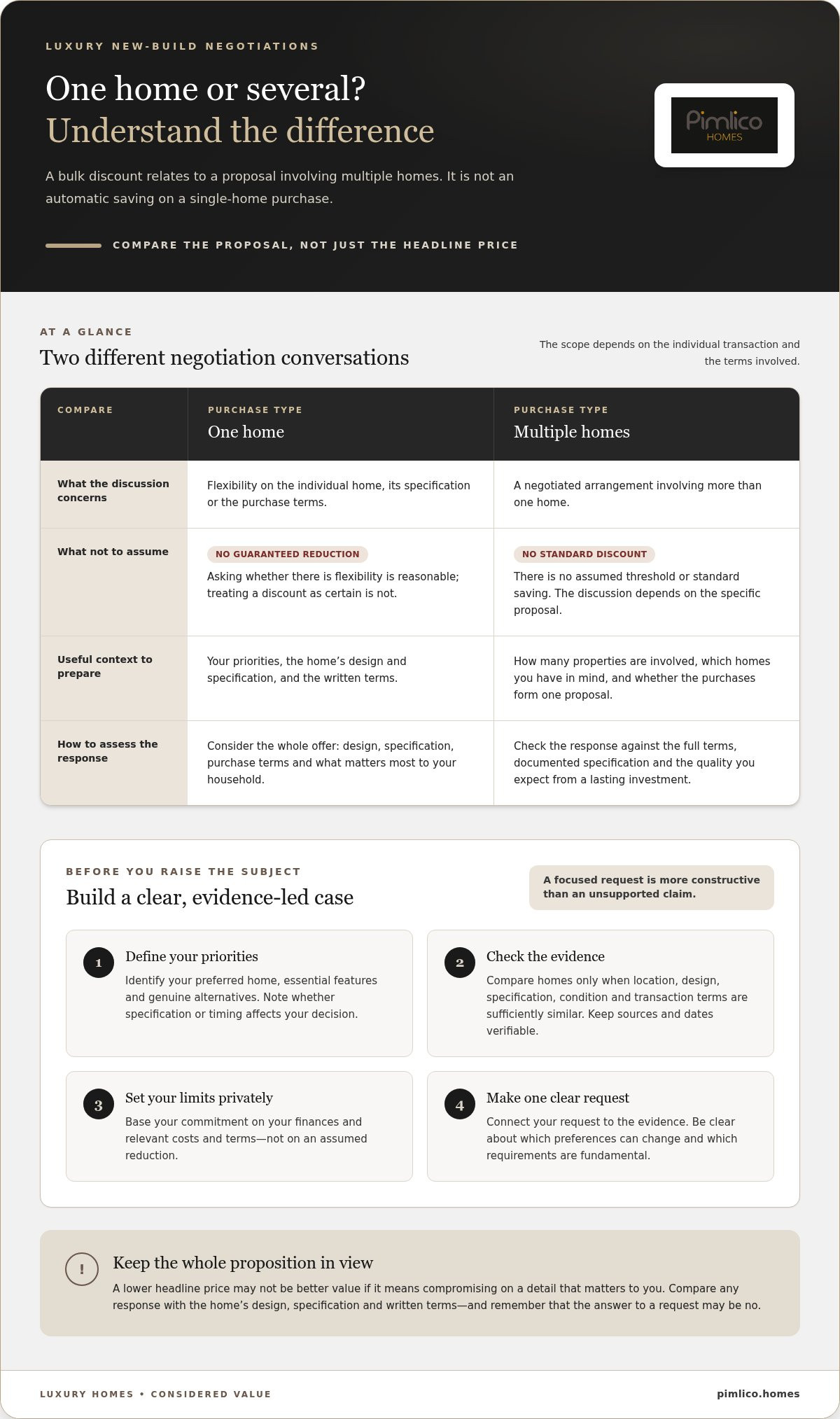
A single-home purchase and a bulk proposal are different conversations. A bulk discount describes a negotiated arrangement involving multiple homes; it is not an automatic benefit of buying one. There is no assumed threshold or standard discount. The discussion depends on the specific proposal, so do not treat it as a guaranteed saving.
If you are considering several homes, set out the intended commitment clearly: how many properties are involved, which homes you have in mind and whether the purchases form part of one proposal. That context helps define the discussion without overstating your leverage. Whether buying one home or several, assess any response against the full terms, the documented specification and the quality you expect from a lasting investment.
Prepare your case before negotiating a new build price
A persuasive proposal begins before the conversation. Preparation helps you distinguish what you genuinely need from what would simply be welcome, and keeps your decision grounded in your circumstances rather than an assumed discount. When negotiating luxury new build price UK, aim for a clear, evidence-led request that reflects both the home and the commitment involved.
Work through these steps before raising the subject:
- Define your priorities. Identify the home you prefer, the features that are essential and the alternatives you would genuinely consider. Include specification and timing if either affects your decision.
- Review relevant evidence. Compare homes only when their location, design, specification, condition and transaction terms are sufficiently similar. Record the source and date of the information so your comparison is current and verifiable.
- Set your limits. Decide privately what you can commit to based on your finances. Include costs and terms relevant to your circumstances rather than setting a limit around a hoped-for reduction.
- Plan your proposal. Choose one clear request and note the evidence behind it. Decide which preferences could change and which requirements are fundamental to choosing the home.
Set your priorities and negotiation limits
Make a short list of non-negotiables, such as a particular layout or specification requirement, and distinguish these from preferences you could adjust. Set an acceptable alternative, too. It might be another home or a different combination of terms. Keep your maximum commitment private and base it on your personal finances, not on an estimate of what a builder might concede. For mortgage, legal or conveyancing decisions, seek guidance from appropriately qualified advisers.
This exercise protects the substance of your choice. If a preferred feature contributes directly to how you will use the home, do not let a price discussion distract you from its importance. If a preference is flexible, you can consider a different proposal without losing sight of your priorities.
Build an evidence-led proposal
Comparable properties are useful only when the comparison is fair. A home with a different design, specification or set of terms may not support the same conclusion, even if it looks similar at first glance. Keep a concise record of what you compared, where the information came from and why it is relevant. Separate confirmed details from assumptions.
Then connect the evidence to a specific request. Explain which comparable details inform your position, identify the term you want to discuss and state what matters most to you. Avoid overstating your leverage or presenting another home’s asking price as proof that the same arrangement should apply.
A useful summary is: “Based on these comparable details, I’d like to discuss [specific term]. This is important because [priority], and I’m prepared to proceed on [clear basis].” Adapt the wording to your circumstances. Its strength comes from clarity, not pressure.
As you define what matters in a home, exploring luxury new homes can help you consider how design, craftsmanship and suitability shape your priorities before you make a proposal.
Compare a price reduction with incentives and specification
A lower headline price is easy to recognise, but it is not the only way an offer might change. An incentive or specification choice may suit your plans better, yet its advertised value does not automatically equal cash off the price. Compare each option with what you would otherwise pay for, use or choose, and read its conditions before deciding what it is worth to you.
For a clear comparison, record the same four points for the current offer and any proposed alternative:
- Headline price: Note the stated purchase price and any proposed reduction separately.
- Specification: Record what the written specification includes, distinguishing it from optional choices or changes under discussion.
- Terms: Note any conditions, restrictions, timing or other details attached to an incentive or proposal.
- Your priorities: Consider whether the change is useful to your household and fits your intended use of the home.
Possible topics for discussion include a price change, a particular specification choice or another term relevant to the purchase. These are examples, not standard offers or commitments. When negotiating luxury new build price UK, a side-by-side comparison helps you see whether a proposed benefit improves the complete proposition or only looks attractive in isolation.
How to assess a builder incentive against a price reduction
Start with usefulness. An incentive has value to you only if it addresses something you would genuinely choose or pay for, and its conditions are acceptable. Record what it covers, any restrictions and how it appears in the written purchase terms. Do not treat an advertised value as equivalent to cash without understanding what the figure represents and what you must do to receive the benefit.
The value of an incentive depends on its usefulness to you and the conditions attached. A price reduction and an incentive may affect the offer in different ways, so compare the actual terms rather than relying on a headline figure. Where the implications are financial or contractual, take advice from an appropriately qualified adviser.
Which specification details deserve closer attention?
Read the written specification carefully and identify what is included in the home as described. Separate those documented details from optional selections, proposed changes and assumptions based on a show home or illustration. If a feature matters to your decision, note its exact description and whether it forms part of the specification you are considering.
This distinction is useful when discussing a change: it helps you understand what would be different and whether that difference matters to your priorities. For a more detailed framework, see deciphering new-build home specifications. A precise comparison keeps the focus on the home’s design and craftsmanship as well as the purchase terms.
Make a considered offer and manage the negotiation
A clear proposal gives the discussion structure. Keep your tone courteous, explain the basis for your request and allow time for a considered response. This supports a constructive conversation without assuming a particular outcome or overstating your position.
For one home, identify the property and the one or two points that matter most. Frame a proposal involving several homes separately: state the number of properties in scope, the intended commitment and the terms you wish to discuss. Do not present a multi-home arrangement as though it were simply a larger discount on one purchase.
How to present a negotiation request clearly
Use a simple structure: identify the home, state your request, then explain its basis. For example: “I’m interested in [home]. I’d like to discuss [specific term], because [brief reason]. Could you let me know whether this can be considered?” Keep the request focused. A long list of unrelated demands can obscure the priorities that matter most.
When you receive a response, assess it against your priorities and the complete terms. If you agree on a change, make sure it is recorded clearly in the relevant documentation. Do not rely on a verbal understanding as a substitute for written terms. In a significant purchase, clarity helps protect both the agreement and your understanding of what comes next.
What to review before progressing towards exchange
Reservation documents and sale contracts serve different purposes. Read each carefully, and do not assume a reservation document contains every term that will appear in the contract. Before signing or proceeding, ask your conveyancer to explain the documents, deadlines, conditions and legal effect as they apply to your circumstances.
Conveyancing processes and legal details can differ between England and Wales, Scotland, and Northern Ireland. Do not rely on guidance written for a different part of the UK. Your conveyancer can explain the relevant jurisdiction and how the steps apply to your purchase. This matters particularly if a proposed change affects the written terms or your intended timing.
A disciplined process is straightforward: present the request, consider the response, then ensure any agreed change is properly documented and reviewed before proceeding. That measured approach is central to negotiating luxury new build price UK without letting the conversation distract from the home itself.
As you weigh a proposal against design, craftsmanship and suitability, explore Pimlico Homes properties to consider what you want from a luxury new build.
Choose a luxury new build for lasting value, not discount alone
A concession can make an offer more attractive, but it should not decide whether the home is right for you. Consider how its design supports your day-to-day life, whether the documented specification meets your expectations and whether the complete financial and contractual terms remain acceptable. Aim for a decision you can feel confident about beyond the negotiation itself.
Different homes suit different preferences. A detached home may appeal if you value a more independent setting; an executive courtyard home may suit your preferred arrangement; a barn conversion may draw you to the character of its form. None is inherently better. Suitability depends on your priorities, and craftsmanship and enduring quality deserve attention alongside negotiated terms.
A final checklist before accepting an offer
Before accepting, review the proposal against the home you actually intend to buy. This checklist can bring the decision back into focus:
- Home and specification: Confirm the property is correctly identified and that the written specification reflects what you understand to be included.
- Agreed changes: Check that any change discussed during negotiation is accurately recorded in the relevant documentation.
- Complete commitment: Review the financial commitment and contractual terms with appropriately qualified advisers, including your conveyancer where relevant.
- Personal priorities: Revisit your essential requirements and affordability. Do not accept a concession simply because it is presented as time-sensitive or because you feel pressured to proceed.
If a term remains unclear, take time to understand it before moving forward. A careful review is part of making a considered decision about a significant investment.
Explore a luxury home that fits your priorities
Negotiating luxury new build price UK is only one part of choosing well. The design, how the home will serve your household and the quality of its craftsmanship all shape its lasting value. A discount that distracts from a poor fit is not a sound reason to proceed. Equally, a home that meets your priorities may be worth considering on the strength of its complete proposition.
If you are weighing up what matters most, the guide to buying a luxury new build home in 2026 offers a useful perspective on the wider purchase. Pimlico Homes develops luxury residential homes, with high-quality craftsmanship and options including detached homes, executive courtyard homes, bespoke homes and barn conversions. Take time to consider which type of home and setting best reflects your priorities.
Explore Pimlico Homes and discover homes to consider as you refine your priorities.
Choose the home that feels right for what comes next
A considered purchase is not defined by the size of a concession. It comes from confidence that the home, its terms and your plans belong together. Keep that perspective as you move from negotiating luxury new build price UK to deciding where you want to create the next chapter of your life.
Pimlico Homes is a specialist residential developer of luxury new builds and bespoke homes. Its portfolio includes detached homes, executive courtyard homes and luxury barn conversions, each with a different setting and character. Consider which best reflects your priorities, and give enduring quality as much weight as the purchase terms.
Explore Pimlico Homes to discover a range of luxury homes and find a home that suits your priorities.
Frequently Asked Questions
Can you negotiate the price of a new build before it is completed?
Yes, you can raise the question, but the construction stage alone does not determine whether the price or terms can change. When negotiating luxury new build price UK, focus on the particular home and transaction rather than assuming an unfinished property gives you leverage. Explain your request and its basis clearly. If the seller agrees to a change, have it recorded in writing and ask your conveyancer to review it before proceeding.
Is a bulk discount available when buying more than one new build home?
A bulk discount is not automatic when you are interested in several homes. It is a separate commercial discussion, and the terms depend on the specific transaction. For a useful proposal, set out how many homes you are considering, the type of properties, your intended commitment and any timing requirements. Assess the written terms for each property, and do not make financial plans on the assumption that a particular discount will be offered.
Can negotiating a new build price affect a mortgage valuation?
A negotiated purchase price and a lender’s valuation are related, but they are not the same assessment. An agreed figure does not guarantee that the lender will value the property at that amount or approve a particular borrowing level. Before relying on proposed terms, discuss them with your mortgage adviser and conveyancer. Make sure the purchase price and any incentives are accurately represented in the documents and information supplied for your mortgage application.
Should I negotiate the specification or the headline price on a luxury new build?
Choose what to discuss by considering which outcome matters most to you. If a particular feature will materially improve how you use the home, compare the written specification with the proposed change and clarify exactly what would be included. If price is your priority, assess that separately. A specification change is not automatically better value. Its benefit depends on your needs, the detail agreed and how the change is documented.
Can I negotiate after paying a reservation fee on a new build?
You may be able to raise a request, but the effect of paying a reservation fee depends on the agreement and the circumstances. Read the document to identify the stated deadlines, conditions and any terms relevant to changes. Do not rely on an informal conversation to establish what has been agreed. Ask your conveyancer to explain the agreement’s effect before acting, particularly if you are considering changing a term or the purchase timetable.
Do new build incentives have to be disclosed to a mortgage lender?
Incentives can be relevant to a lender’s assessment, so give your mortgage adviser and conveyancer accurate details. How an incentive is treated, and what information is required, depends on the lender, your application and the specific offer. Share the written terms, including any conditions, so your advisers can explain what needs to be disclosed and ensure the purchase documents reflect the arrangement accurately.
Is it better to use an estate agent when negotiating with a home builder?
The support that suits you depends on the advice you need and the nature of the purchase. An estate agent may advise on property-market matters, while a conveyancer deals with the legal aspects; one role should not be assumed to replace the other. Be clear about the questions you need answered, use appropriately qualified professionals for their respective areas and ensure any agreed changes are reflected in the written terms.





