
What if the new build detached house that looks most impressive in photographs feels less convincing once you imagine living there? With new build detached houses, a polished finish and generous rooms are only part of the picture. The plot, the connection between indoor and outdoor spaces, and the way the layout supports everyday routines all matter. A home can photograph beautifully yet still feel wrong for the life you want to lead.
Choosing well means looking beyond the first impression. This guide explains what distinguishes a detached new build, how to assess the house and its plot together, and which practical details can shape comfort now and flexibility later. We’ll consider layout, outdoor space, light, privacy and the qualities that are harder to judge from a listing alone. Pimlico Homes develops luxury detached homes with a focus on high-quality craftsmanship. Use the guidance below to decide whether a home feels right not only on viewing day, but for the years ahead.
Key Takeaways
- Assess new build detached houses as a complete proposition: consider the home, its plot and its surroundings together.
- Use the site plan to understand the home’s position, outdoor areas, access and boundaries before deciding how the setting may work for you.
- Compare detached, semi-detached and courtyard homes by considering privacy, plot arrangement and how each layout supports your routines.
- Follow a viewing sequence from the approach and plot through to room flow and outdoor spaces, then review the relevant documents separately.
- Look beyond first impressions to whether the home and plot suit your daily life and longer-term priorities.
What makes a new build detached house a considered choice?
A detached house stands apart from neighbouring houses rather than sharing a wall with another home. That describes its building form, not the full experience of living there. The plot, position within a development, outlook and surrounding spaces all influence how the home feels and functions.
A new build detached house is a newly constructed home that stands apart from neighbouring houses, with its own character, layout and relationship to its plot. The definition is simple, but the details are individual. “New build” describes the home’s construction, not a fixed architectural style or floor plan. For a general overview of types of houses, Wikipedia provides useful background. Choosing a home, however, means paying close attention to the particular property.
That distinction matters. A striking exterior may suggest space and separation, but neither the appearance nor the detached form alone tells you how rooms connect, how the garden is arranged or how close neighbouring homes feel. Consider the building and its setting as one proposition.
Detached does not mean one standard layout
Some homes place the main living spaces across one floor; others arrange bedrooms and shared rooms over several storeys. Hallways, staircases and doorways affect how you move around, while the position of kitchens and living areas influences how the home works throughout the day. A design feature is useful when it supports the way you expect to use the space.
Nor does a detached house guarantee complete privacy. Windows, boundaries, neighbouring properties and the home’s orientation all play a part. Look beyond the façade. Consider what you can see from the rooms you’ll use most and how easily you can move between indoor and outdoor spaces.
Who may find a detached new build suits them?
A detached home may appeal if you value a clear sense of separation, want rooms that can serve more than one purpose, or prefer a home with a distinct relationship to its outdoor areas. That flexibility can matter as routines change, whether you need a quieter place to work, room for shared activities or spaces that can adapt over time.
No household is automatically suited to this form. The home still needs to fit the people who will live in it. Pimlico Homes focuses on luxury detached homes and high-quality craftsmanship, with attention to the home as a place for everyday life. Before shortlisting, weigh the particular plot and layout against your priorities. The next step is to understand how those features work together.
How the plot and layout shape life in a new build detached house
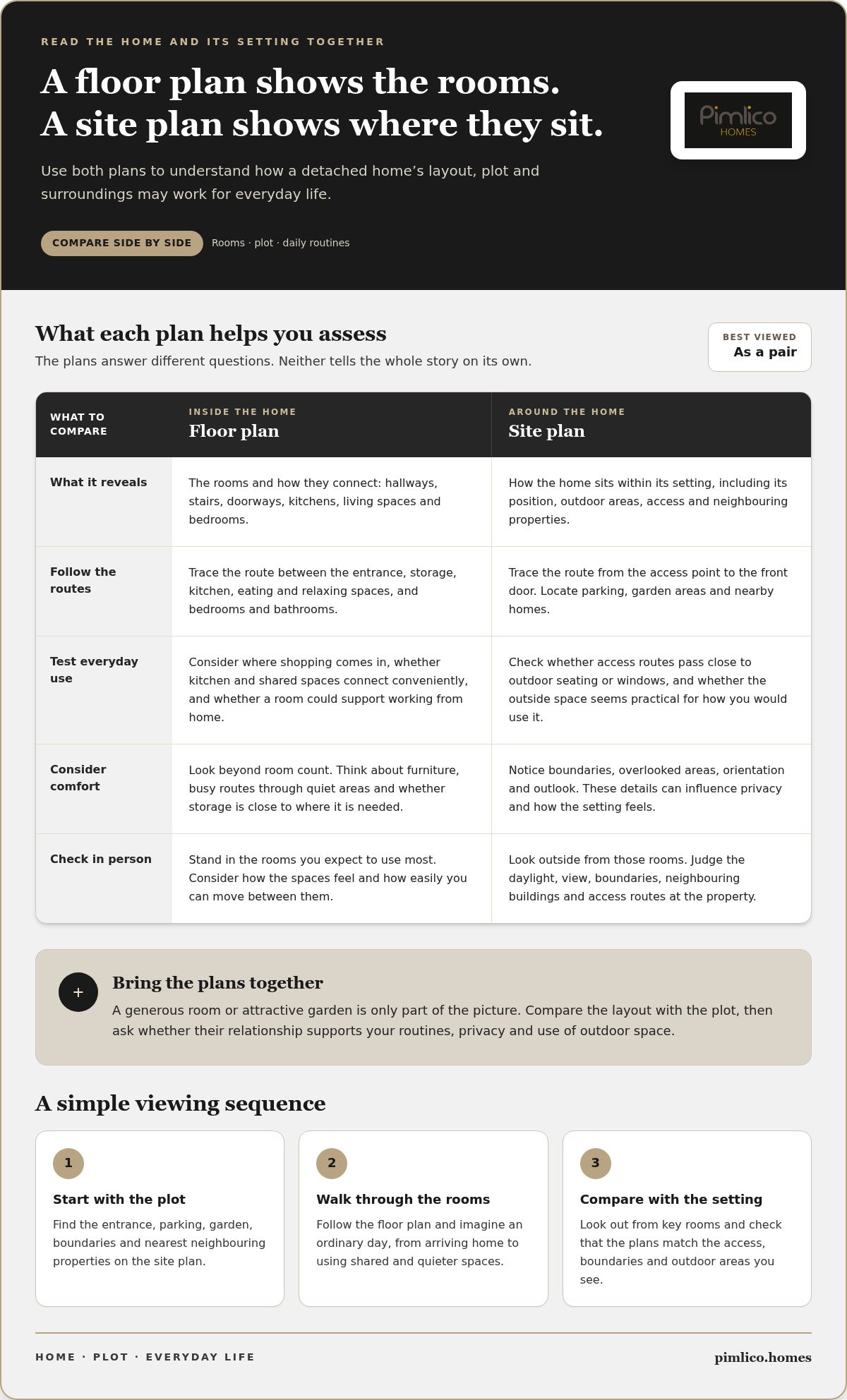
A floor plan shows the rooms; a site plan reveals how the home sits within its setting. Read them together. The position of the entrance, parking, garden and neighbouring homes can affect daily convenience and how much use you make of outdoor space. For buyers considering new build detached houses, looking at the plot and layout as a pair turns an appealing image into a more practical assessment.
Read the plot as carefully as the floor plan
Start with the site plan. Trace the route from the access point to the front door, then locate parking, garden areas and the nearest neighbouring properties. Notice which parts of the plot are overlooked, how boundaries are arranged and whether access routes pass close to outdoor seating or windows. These details help you judge privacy and how practical the outside space may be.
Orientation and outlook deserve attention in person. A plan or photograph can suggest where daylight falls or what a window looks towards, but you can judge the view and feel of a space best at the property. Stand in the rooms you expect to use most, look outside and consider how the boundaries, neighbouring buildings and access affect the setting. Resources from the National Association of Home Builders offer broader context on home building, while the specific property’s plans and setting should guide your assessment.
Test the layout against everyday routines
Walk through an ordinary day in your mind. Where would you enter with shopping? Is the kitchen conveniently connected to the spaces where you eat and relax? If you work from home, could you use a room without disrupting shared areas? Consider storage near entrances, the route between bedrooms and bathrooms, and whether circulation space feels practical rather than simply generous on paper.
Functional flow matters as much as room count because the relationship between spaces determines how easily a home supports everyday routines. Floor area alone won’t show whether furniture fits comfortably, whether a busy route cuts through a quiet area, or whether storage is close to where it is needed.
Use plans and property descriptions as guides, then compare them with the home you are viewing. Check that the entrances, boundaries and outdoor areas shown on the plan match the setting, and note anything that could affect how you use the space. When exploring Pimlico Homes’ luxury detached homes, consider how each home’s design and setting work together, not just how the rooms look individually.
Detached, semi-detached or courtyard: compare the whole home
The label describes a building arrangement, not a guarantee of privacy, garden size or a particular lifestyle. Compare the home, its plot and the wider development together. The broad distinctions below can help frame that comparison, but the experience of each property depends on its specific design and setting.
What a detached format can offer, and what to assess
With no adjoining house wall, a detached home offers physical separation. That does not guarantee complete privacy or quiet: neighbouring outlooks, window positions and activity around the plot all matter. Look closely at boundaries and garden placement, then consider whether the external space feels manageable within your routine. For buyers weighing up new build detached houses, the details of the individual plot matter as much as the appeal of the format.
When a connected or courtyard home may fit better
A semi-detached home may suit buyers who are comfortable with a shared wall, provided the relationship between that wall, the rooms and outdoor areas works for them. Courtyard living offers a different arrangement, with homes set around a shared space rather than assessed only in relation to a private plot. Pimlico Homes also develops executive courtyard homes.
The right choice rests on your priorities and the specific development. Compare privacy, access, outdoor space and room arrangement in context, then decide which balance best supports the way you want to live.
What to assess when viewing a new build detached house
A viewing is most useful when you follow the same order each time. Begin with the approach, move through the rooms, then return to the outdoor space. This helps you judge the home as a whole instead of letting an impressive finish or a single appealing room dominate your first impression.
A practical viewing sequence for the home and plot
Start outside. Notice how you reach the property, where parking sits in relation to the entrance, and how boundaries and neighbouring homes shape the plot. Consider whether the route to the front door feels straightforward and whether the position of the windows and garden suits your preferences.
Then walk through the home in the order you might use it. At the entrance, look for somewhere practical to leave coats and everyday items. Follow the route to the kitchen, living spaces and bedrooms. Observe how daylight varies between rooms, whether circulation feels natural and where useful storage is placed. An empty room can look generous, so picture where furniture would go and how you would use the space.
Finish outdoors. Consider how easily you can reach the garden from the rooms you expect to use, and whether its shape and boundaries suit your plans, from quiet seating to shared meals or gardening. With new build detached houses, a considered visit tests the relationship between the home and plot, not just the interior presentation.
Questions to resolve through documents and research
Some points need more than a visual inspection. Read the specification alongside the particular home you viewed, noting which finishes, fittings and features apply to it. Review the tenure information and warranty documents carefully, and use current authoritative UK guidance to understand relevant terms. Planning and building-standard details can vary by project, so avoid treating them as universal assumptions.
After each visit, record what worked and what gave you pause. Compare your notes with a short list of priorities, such as room arrangement, outdoor space, storage and setting. This makes it easier to distinguish a lasting fit from a strong first impression.
For broader purchase considerations, read The Ultimate Guide to Buying a Luxury New Build Home in 2026. If you are ready to explore homes shaped around considered design and craftsmanship, discover Pimlico Homes’ luxury detached homes.
Find a new build detached house with lasting fit
A lasting choice is not simply the home with the most striking finish or the longest list of features. It is the one where the layout, plot and setting work with your daily routines and longer-term priorities. A considered shortlist helps you judge new build detached houses against what matters to you, rather than against the strongest first impression.
Turn priorities into a considered shortlist
Before comparing homes, write down your essential requirements. These might include a particular room arrangement, a practical route from parking to the entrance, or outdoor space that feels usable. Separate these from features you would enjoy but could live without, such as a preferred outlook or an additional reception area. This distinction makes it easier to weigh trade-offs calmly.
Then assess each shortlisted home against the same criteria. Consider how the rooms support your routines, how the plot relates to the house, and whether the setting feels right for the way you want to live. Keep brief notes after each viewing. Over time, your notes can show which details matter consistently and which appeal mainly in the moment.
Explore Pimlico Homes’ detached-home approach
Pimlico Homes specialises in luxury detached homes and high-quality residential projects, with a focus on craftsmanship. This puts the emphasis on the home as a considered place to live, not simply a collection of rooms or an attractive exterior. As you explore your options, look at how the design, plot and experience of moving through the home relate to one another.
Ultimately, lasting fit is personal. A home should feel well suited to your life now, while offering the flexibility and setting you value for the years ahead. Keep your priorities in view, compare each property on the same terms and let the details guide your decision.
Explore Pimlico Homes to discover its luxury detached homes and developments.
Choose a home that feels right for the years ahead
The strongest choice is not defined by its detached form alone. It comes from the fit between the home, its plot and the way you live. Assess the setting and room flow alongside the features that matter to your daily routines, then compare each option against the same priorities.
New build detached houses can offer a distinct sense of separation, but each home has its own layout and relationship to its surroundings. A thoughtful viewing, followed by careful review of the relevant documents, helps you look beyond polished presentation and consider whether the property could suit your longer-term needs.
Pimlico Homes develops luxury detached and executive courtyard homes, with a focus on high-quality craftsmanship in premium residential projects. If you are ready to explore a considered approach to home and setting, explore Pimlico Homes. Your next home should feel not only impressive, but genuinely suited to the life you want to lead.
Frequently Asked Questions
What is a new build detached house?
A new build detached house is a newly constructed home that stands separately from neighbouring houses, without sharing an adjoining wall. The term describes its construction and building form, not a standard design. Room arrangements, number of storeys, plot size and outdoor spaces vary between properties. Assess the specific home and its surroundings together, since detached form alone doesn’t establish how private or spacious it will feel.
Are new build detached houses more private than semi-detached homes?
They may offer more physical separation, as a detached house doesn’t share a wall with the next home. However, privacy depends on more than building form. Window positions, neighbouring properties, boundaries and garden outlook all affect how exposed a home feels. A semi-detached layout shares one wall, but its impact depends on which rooms adjoin it. Compare the individual property and plot rather than assuming either format guarantees a particular level of privacy.
What should I look for when viewing a new build detached house?
Begin outside by assessing access, parking, boundaries and the position of neighbouring homes. Then walk through the rooms in the order you might use them, noticing circulation, daylight and storage. Consider how the kitchen, living areas and bedrooms relate to one another, and whether garden access suits your plans. Review the plans and specification alongside the home you’ve viewed, then compare your impressions with your written priorities.
Do new build detached houses come with a garden and parking?
Not necessarily. Garden provision, outdoor-space arrangements and parking vary by property and development, so don’t rely on the detached label or listing images alone. Use the site plan and property particulars to understand where these areas sit in relation to the house, entrances and boundaries. During a viewing, consider whether the outdoor space suits your plans and whether the parking location makes everyday arrivals and unloading convenient.
Are new build detached houses energy efficient?
Energy performance can differ between homes, so a new build label isn’t enough to establish how efficiently a particular property will run. Review its Energy Performance Certificate and specification for details such as heating, insulation and windows. Consider how the home is designed to retain warmth and which systems are installed. These documents provide a more useful basis for comparison than assuming every new build has identical energy performance or running costs.
What documents should I review before buying a new build detached house?
Review the plans, property specification, tenure information, draft contract and title documents, alongside the Energy Performance Certificate and warranty information. Check that the documents relate to the particular home and reflect the details you’ve been shown. Read the paperwork carefully before proceeding, as plans, tenure and contractual terms are specific to the property.
Can I make changes to a new build detached house before moving in?
Changes may be possible, but this depends on the property, its construction stage and the terms agreed for the purchase. Options can differ, and you should not assume that a home’s specification is flexible. Review the written specification and contract to see what has been agreed, including any recorded choices or alterations. Ensure any agreed change is documented clearly so expectations for the finished home are understood before moving in.
Explore Pimlico Homes’ luxury detached homes and find a home that suits your priorities.





