
A gate can shape who enters a development, but it cannot, by itself, guarantee privacy or security. That distinction matters when considering new build gated community homes, where controlled access is only one part of the picture.
A sense of arrival, considered design and shared spaces can all contribute to an attractive setting. Everyday value, however, depends on how the development works in practice: how visitors enter, which areas residents share and maintain, and what responsibilities come with ownership. Look beyond the entrance and consider whether the details suit your routines as well as your expectations.
This guide explains what gated living can offer and where its limits lie. You’ll learn how to assess access arrangements without mistaking them for a wider security guarantee, what to consider about shared facilities and their management, and how to weigh lifestyle benefits against ongoing responsibilities. We’ll also explore how design and craftsmanship contribute to a home that feels right beyond viewing day.
Key Takeaways
- For new build gated community homes, distinguish controlled entry from broader promises about safety, privacy and resident behaviour.
- Trace how residents, visitors and deliveries move through the entrance, shared areas and private homes to see how access fits daily life.
- Compare gated and non-gated settings by looking beyond the entrance to shared-space management, convenience and home layout.
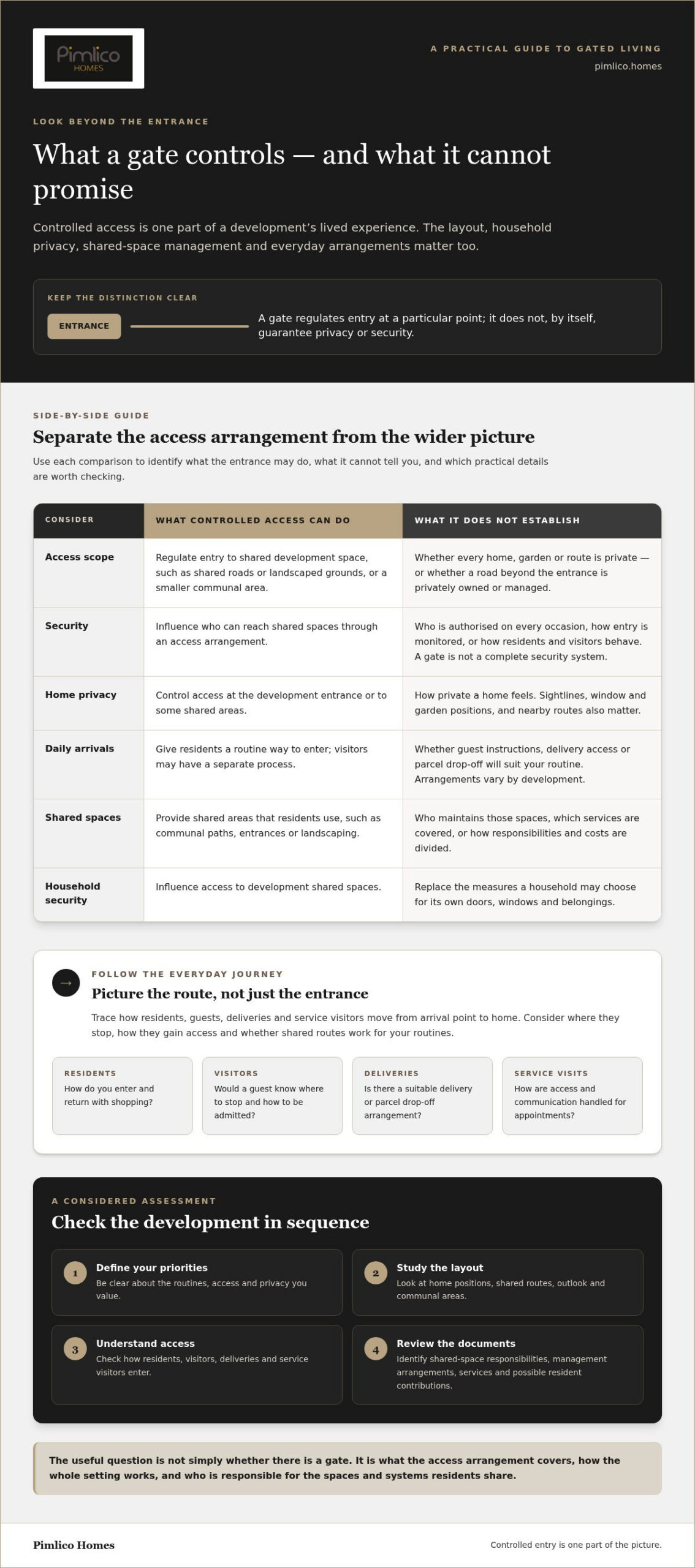
- Assess a development in sequence: define your priorities, study the layout, understand access arrangements and review the management documents.
- Consider how thoughtful design and craftsmanship shape everyday living, whether you are exploring luxury detached, executive courtyard or bespoke new-build homes.
New build gated community homes: what the gate does, and does not, mean
A gated community controls access to shared development space. That is the essential distinction: a gate regulates entry at a particular point, but it does not, by itself, promise safety, privacy or particular behaviour from residents and visitors.
Gated community homes are homes within a development where access to shared areas is controlled at an entrance. This arrangement does not, on its own, define the security or privacy of each home. The term can describe different layouts and access systems. A useful overview of the concept, including its forms and criticisms, appears in Gated community.
What does “gated community” mean in a new-build setting?
In one development, a gate may sit across the main approach to shared roads or landscaped grounds. In another, it may control entry to a smaller communal area. Neither arrangement automatically means every home, garden or route is private. Nor does a gated entrance prove that a road beyond it is privately owned or managed.
The experience depends on how entry is organised. Residents may have a routine way to enter, while visitors may need to follow a separate process. Deliveries might require access instructions or a suitable drop-off point. These details affect ordinary arrivals just as much as the appearance of the entrance.
What a gate cannot tell you about security
Controlled entry is one part of a wider picture, not a complete security system. A gate alone cannot tell you who is authorised to enter on every occasion, how access is monitored or how residents behave once inside. Nor does it determine how private a home feels. Sightlines, the position of windows and gardens, and the routes passing nearby all matter.
Household security is separate from development access. A controlled entrance may influence who can reach shared spaces, but it does not replace the measures a household may choose for its own doors, windows and belongings. Avoid treating a gate as a guarantee. Instead, look at the arrangements described for the development and consider what they cover, as well as what remains each household’s responsibility.
Design and management also shape daily life. The position of homes in relation to shared routes can affect outlook and movement, while the design of communal areas influences how residents use them. Management arrangements determine how shared spaces and access systems are looked after. These practical details may be less striking than the entrance, but they help define the lived experience.
For buyers considering new build gated community homes, the useful questions are how access works in practice, what space it controls, and how the design and management support the routines and privacy you value.
How access, shared spaces and management shape gated community living
The entrance is only the first part of the journey. In new build gated community homes, everyday experience also depends on how residents move from the entrance to their front door, how visitors are received and how shared areas are cared for. Picture an ordinary weekday arrival, not just the carefully presented first impression.
Access arrangements in everyday use
Residents, guests, delivery drivers and service visitors may all encounter the entrance differently. Residents might use a key, code, remote control or another method, while guests may need to be admitted or follow instructions. Deliveries could rely on the resident being available or on a designated place for parcels. Service visits, such as maintenance appointments, raise similar questions about access and communication.
These are examples, not standard features. Each development sets its own access methods and operating arrangements, so consider how they fit your routines. Would a visitor know where to stop? Can a delivery reach a suitable point without disrupting shared routes? What happens when you arrive on foot or return with shopping? Practical answers help reveal whether the system will feel straightforward day to day.
For a broader perspective on how access arrangements relate to a development’s sense of security, read Pimlico Homes’ guide to security and serenity in gated developments. An entrance can feel reassuring, but its value depends on how it works as part of the whole setting.
Shared areas, management and resident responsibilities
Shared entrances, landscaping, communal paths and other common areas need ongoing attention. Depending on the development, a management company may arrange maintenance, oversee shared facilities or administer access-related arrangements. The specific structure varies. Some responsibilities may sit with a management company, while others may fall to residents or another party under the development’s arrangements.
Before deciding, read the relevant documents carefully. Look for how shared spaces are defined, which services are covered, how decisions are made and what costs residents may be expected to contribute towards. Understand how responsibilities are divided rather than assuming that a tidy communal area takes care of itself. Clear arrangements help you identify who looks after a shared route or entrance and how concerns are handled.
- Trace the route: imagine a resident, guest and delivery arriving, then follow each route to the home.
- Look at shared areas: note which spaces residents use and how their upkeep is described.
- Read the documents: identify responsibilities, management arrangements and any charges connected with shared facilities.
These details are part of choosing a home that works well in daily life. Buyers looking for considered design alongside practical arrangements can explore Pimlico Homes’ new-build homes, including luxury detached, executive courtyard and bespoke homes.
Gated and non-gated new build homes: compare the everyday trade-offs
A gate is one feature of a development, not a measure of a home’s quality or the lifestyle it will provide. To compare settings fairly, consider how access, shared areas and layout affect your own routines. A well-planned home can feel considered in either setting. The difference is how the wider arrangement suits you.
| Consideration | Gated setting | Non-gated setting |
|---|---|---|
| Access | Entry to some shared areas may be controlled, with a process for residents, visitors and deliveries. | Arrival may be more direct, without a controlled entrance to pass through. |
| Shared-space management | Communal routes or landscaped areas may involve management arrangements and resident responsibilities. | There may be fewer shared areas, though any communal space still needs clear arrangements. |
| Privacy | Depends on the position of homes, gardens, windows and shared routes, not the gate alone. | Likewise shaped by the site plan, outlook and relationship to nearby routes and homes. |
| Daily convenience | Access procedures may add a step for guests or deliveries, depending on how they work. | Arrivals may be simpler, while parking and access still depend on the layout. |
Where gated living may suit a buyer’s priorities
A defined entrance may appeal if you value a clear point of arrival and a distinction between shared development space and the wider surroundings. Communal landscaping or routes may also suit buyers who appreciate a planned shared setting, provided the management arrangements match their expectations. Consider the specifics rather than relying on the label: the route from the entrance, the location of your home and how shared areas are maintained all shape the experience.
When a different new-build setting may feel more practical
A non-gated layout may feel more straightforward if you prefer direct access or want fewer shared areas to consider. That does not automatically mean more privacy or greater convenience. A home set back from a route may feel more secluded than one close to a busy communal path, whether or not the entrance is gated. Study the site plan and imagine approaching the front door, using the garden and receiving visitors.
The right setting depends on how access and shared responsibilities fit your priorities, not on whether a development is gated. Buyers considering new build gated community homes can use the same practical test as buyers exploring a non-gated setting: picture an ordinary day, then assess the home’s layout, outlook and shared arrangements together.
How to assess a new build gated community before making a decision
A clear assessment moves from personal priorities to the fine print. For new build gated community homes, consider the home and development together. A convenient entrance cannot compensate for a layout that conflicts with your need for privacy, and attractive shared areas come with arrangements worth understanding before you commit.
Review the site plan and your everyday routines
Start by defining what matters most: a direct arrival, a secluded outlook, accessible routes or well-maintained communal areas. Then use the site plan to locate the home in relation to the entrance, shared spaces, visitor routes and neighbouring properties. Look for paths that pass near windows or gardens, and note the distance between the entrance and your front door.
Picture a typical day. Consider how household members arrive at different times, where guests might pause, how deliveries could reach you and whether regular service visits fit the access arrangements. If privacy or convenience is a priority, test it against the plan rather than relying on a general impression of the development.
Work through the assessment in order:
- Define your priorities. Decide which features matter most to your household and which trade-offs you would accept.
- Review the layout. Trace the route from the entrance to the home, noting shared routes, outlook and the position of communal spaces.
- Understand access. Consider how residents, visitors, deliveries and service visits enter and move through the development.
- Read the management information. Identify how shared areas and access arrangements are managed, and what responsibilities and charges are described.
Understand shared responsibilities before committing
Read the relevant development and purchase documents closely. Look for descriptions of shared areas, access arrangements, maintenance responsibilities and how management is organised. Where charges are stated, note what they relate to and how their purpose is explained. Do not assume that a particular service or responsibility is included simply because it appears to be part of the development.
If wording is unclear, a solicitor or conveyancer can advise on how the documents apply to your purchase. Arrangements differ between developments, so avoid assuming that one set of terms applies everywhere. A luxury new-build buying guide can offer further context when considering a new home purchase.
Bring your priorities, the site plan and the written arrangements together before making a decision. For a different perspective on considered design and craftsmanship, explore Pimlico Homes’ luxury new-build homes.
A considered new build: finding the home and setting that fit
The entrance is only one part of a home’s setting. A considered choice takes in the wider surroundings, layout and the way a home supports daily routines, alongside any shared spaces and management arrangements. Whether you are weighing new build gated community homes or a different kind of development, look at the whole picture rather than letting one feature define your choice.
That perspective also leaves room for a broader choice of home. A gated setting is not the only route to thoughtfully designed new-build living, and a home’s character is not defined by the presence or absence of an entrance gate.
Match the home type to the life you want to lead
Luxury detached homes may appeal to buyers who value an individual home and want to consider how its design and setting suit their household. Executive courtyard homes offer another form of new-build living, with their own relationship between the home and its surroundings. Neither description determines whether a property sits within a gated development. Focus instead on how each home type aligns with your priorities.
Think beyond the initial impression. Consider how the rooms, approach to the home and outdoor setting might support everyday life, from quiet time at home to welcoming guests. The best choice is personal: it should feel considered now and continue to make sense as your needs and routines evolve.
Explore a thoughtfully designed new-build home
A home is a significant, lasting investment. Considered design and quality craftsmanship matter because they shape the experience of living in a space, not simply how it looks at first glance. Look for a relationship between the home’s design and its setting, and imagine the everyday details that will make the space feel distinctly yours.
Pimlico Homes specialises in luxury detached homes, executive courtyard homes and bespoke new builds. Each offers a different starting point for buyers considering a home shaped by thoughtful design and craftsmanship. The question is not whether one setting is inherently superior, but whether the home, surroundings and practical arrangements reflect what you value.
As you explore your options, keep your priorities in view: the right home should suit the way you live, and its setting should feel equally considered. Explore Pimlico Homes’ residential developments to discover its approach to new-build homes.
Choose a setting that feels right for the years ahead
Picture the life you want your home to support, then let that guide the details you value. A development should feel considered not only on arrival, but in the way its setting, design and shared arrangements fit the ordinary patterns of living. This perspective can help you weigh new build gated community homes without allowing the entrance alone to define your choice.
A lasting sense of belonging begins with a home that suits you. Pimlico Homes specialises in luxury detached homes, executive courtyard homes and bespoke new builds, with an emphasis on high-quality craftsmanship in its residential developments. These are options for buyers looking for a home shaped around design, quality and everyday life.
Take time to explore what feels distinctive in a home and setting, and what will continue to matter as life changes. Explore Pimlico Homes’ considered new-build homes and take the next step towards a home that feels truly your own.
Frequently Asked Questions
Can visitors and delivery drivers enter a gated community?
Usually, visitors and delivery drivers can enter, but the process depends on the development’s arrangements. A guest might need a resident to admit them, while a delivery driver could call ahead or use a designated drop-off point. Before moving in, consider how you would handle a parcel when nobody is home or welcome an unexpected visitor. The development information should explain the procedures residents and their guests are expected to follow.
Who is responsible for maintaining shared gates in a new-build development?
Responsibility depends on the development’s management arrangements and ownership documents. A management company may organise upkeep, or the documents may assign responsibilities differently. Look for details on routine maintenance, repairs and how residents can report a fault. If the documents refer to a management company, check what role it has and how it communicates with residents. A solicitor or conveyancer can help interpret relevant terms before you commit.
Are service charges common in gated communities?
Residents may contribute towards shared areas or facilities, but arrangements vary between developments. The documents should state whether charges apply, what they cover and how payment is arranged. Look beyond the amount: consider whether the described services match the areas you will use, such as a shared entrance or communal landscaping. A solicitor or conveyancer can clarify how the charge provisions apply to your purchase.
Can residents personalise the exterior of a new-build home?
Sometimes, but changes to the exterior may be subject to restrictions in the property documents or development arrangements. Before altering a front door, boundary, planting or external finish, review the relevant terms and establish whether approval is required. Keep a written record of any permission received. This helps avoid investing in a change that conflicts with the agreed appearance or management of the development.
What happens if a gated entrance or access system stops working?
The response depends on who manages the entrance and what procedures the development has set out. Find the named contact and fault-reporting route in the resident or management information, and note any alternative entry instructions. If a fault affects your ability to enter, follow the stated procedure rather than trying to bypass the system. Understanding the escalation route before an issue arises can make an inconvenient interruption easier to manage.
Are gated community homes suitable for households with children or older residents?
They can suit some households, but suitability depends on the individual home and layout, not the gate alone. For new build gated community homes, consider step-free routes, the distance from parking to the front door, crossing points, lighting and places to pause. Families may also want to assess where children can play and how shared routes are used. Walk the approach in person and consider each household member’s needs, now and over time.





