
What if the contract for your new home is not a purchase contract at all? If you’re commissioning a home to be designed and built, a JCT Design and Build agreement sets the terms for that construction project. This new build purchase contract guide UK explains the difference and the documents to review before signing.
A JCT Design and Build contract generally gives one contractor responsibility for both design, or completion of the design, and construction. This can make roles clearer, but it does not remove the need to understand the detail. Design responsibilities, changes, payment, delay, completion and the documents defining the work all deserve careful attention.
This guide explains the purpose of the contract and the roles of client and contractor, then sets out practical checks to discuss with a solicitor. It also compares commissioning a home with buying a developer’s new build, where the focus is the property purchase and the journey from reservation to handover. Pimlico Homes’ Pimlico Pledge describes customer service from reservation through handover of keys. Establishing which route applies is a useful first step towards an informed decision.
Key Takeaways
- A JCT Design and Build contract governs a construction project. A home purchase contract concerns buying a completed or developing property.
- Compare drawings, specifications and schedules with the agreed scope, and check that the documents are consistent and complete.
- Use this new build purchase contract guide UK to identify payment, changes, delay, completion and dispute provisions to discuss with your solicitor.
- Before signing, check the parties, incorporated documents, design responsibilities and change procedures, then seek independent legal review.
- Consider how much involvement in design and construction you want when weighing a commissioned build against buying a developer’s new home.
JCT Design and Build contract: what it is and isn’t
The JCT Design and Build Contract is a standard form of agreement for a construction project in which a contractor undertakes design, or completes design work, as well as building. The current JCT edition is DB 2024. For a private client commissioning a home, the signed contract sets out the construction arrangements and the parties’ responsibilities. It is not a standard contract for purchasing a home from a developer.
A JCT Design and Build contract governs the commissioned design and construction of a home. A purchase contract sets the terms for buying a completed or developing property and its eventual transfer to the buyer. The difference is practical as well as legal: the documents address different responsibilities, and signing one route should not be mistaken for entering the other.
Who signs a JCT Design and Build contract?
The client commissioning the project is usually called the Employer in the JCT contract. The Contractor agrees to carry out the work described in it. These terms identify the two principal parties to the construction agreement. They do not describe an employment relationship.
Design responsibility depends on the signed terms. The contractor may take responsibility for the design, or for completing design work, to the extent assigned by the contract. An architect, engineer or other specialist may also have a separate appointment with the client or contractor. Identify who is engaged, what work they are responsible for and which document governs it. Do not assume every consultant is covered by the same agreement.
How does it differ from buying a developer’s new build?
Commissioning a home starts with a project to be delivered. The client and contractor agree what is to be designed and built, along with the documents and procedures governing the work. The client’s involvement in design and decisions during construction depends on the contract and project arrangements.
Buying a developer’s new build is a property transaction. A buyer may reserve a home and later enter into purchase arrangements, including when the property is still being completed. Those terms address the purchase and transfer of the home. They are not a substitute for the construction agreement between a developer and its contractor. Equally, a buyer’s purchase contract does not make the buyer the Employer under a JCT contract.
This is the central point of any new build purchase contract guide UK: first establish whether you are commissioning construction or purchasing a home. The right paperwork follows from that route, not simply from the fact that the property is new.
For buyers considering a developer’s home, Pimlico Homes’ luxury new-build buying guide explores the purchase journey from reservation towards handover. Keeping that process distinct from a private building commission helps you focus on the responsibilities and documents relevant to your decision.
What a JCT Design and Build contract says about design and project documents
A JCT Design and Build contract sets out the agreed construction scope and the design responsibilities assigned to the contractor. The signed wording and the documents it incorporates determine who is responsible for a particular design decision or deliverable. A general description of the contract cannot settle that question. For background on the form and its project documents, see Understanding the JCT Design and Build Contract.
Think of the agreement as a connected set of records, not just a signature page. Contract particulars may identify the parties and project-specific selections, while schedules and other incorporated documents may describe the work, design information or procedures. The documents included can vary. A drawing or specification is not automatically part of the contract just because it was shared during discussions.
Which documents make up the agreement?
Start with the contract’s list of documents and any wording that incorporates them. Depending on the agreement, these may include drawings, specifications, schedules or other written information. Match each reference to an actual document and version. A missing attachment, vague reference or drawing number that does not match the supplied set is a point to resolve before signing.
Read the documents together. A plan might show a room layout, while a written specification describes finishes or fittings. Drawings show the intended form; written specifications define details that a plan may not capture, so read them together to understand the agreed project. For example, a kitchen plan may show the arrangement without fully describing the specified surfaces or appliances. Check the contract’s document-priority wording too. If two items conflict, do not assume which one takes precedence. Ask your solicitor to review gaps, inconsistencies and any hierarchy clause.
How are design changes and approvals handled?
Find the process for proposing, instructing and recording changes. The contract may state who can issue an instruction, what form it must take and how the parties record an agreed revision. Keep the relevant drawing or specification version with the written approval so there is a clear record of what changed and when.
Design development is not necessarily the same as a formal variation. Some contracts distinguish between completing design within the agreed scope and changing that scope. The signed terms determine whether and how that distinction applies. For example, moving a partition could affect related drawings and specifications. Do not assume a change is agreed because it has been discussed, or that it has no effect on the project. Ask your solicitor to explain the approval, valuation and timing provisions in your contract.
For this part of a new build purchase contract guide UK, the practical discipline is straightforward: identify the documents defining the work, check that they correspond and understand how revisions become binding. If you are weighing a developer’s home purchase instead, explore Pimlico Homes’ luxury new-build homes as a separate buying route.
JCT contract clauses to compare: payment, changes, delay and completion
Review the contract as a set of connected procedures, not as a collection of reassuring headings. Payment, changes, delay and completion provisions can affect one another. For instance, a design change may alter the work to be valued or the time required. Use the table as an agenda for a solicitor. Exact clause references and legal effects depend on the contract edition, amendments and project documents, so check the signed form rather than relying on generic clause numbers.
| Topic | What to locate in the contract | Question for the solicitor |
|---|---|---|
| Payment | The stated payment mechanism, stages or valuation process, required applications and notices, and any supporting records. | What triggers each payment, and what steps or deadlines apply if the amount or valuation is disputed? |
| Changes | Who may instruct a change, how approval must be recorded, and how the contract treats its effect on the work and programme. | How should an instruction be authorised, and what contractual consequences could follow? |
| Delay | Notice requirements, the process for seeking an extension of time, and the events or circumstances addressed by the wording. | What notice must be given, by whom and when, and how is a request assessed? |
| Completion and handover | The contract’s completion criteria, inspection or certification steps, and any handover requirements. | What establishes contractual completion, and what obligations remain afterwards? |
| Disputes | The stated procedure for raising and resolving disputes, including any required preliminary steps. | What route applies, and what should the parties do before starting it? |
Payment and changes: what should the wording make clear?
Payment arrangements are contract-specific. Trace each stage from the event that starts the process to any application, assessment, notice and payment date described in the signed terms. Do not assume a familiar JCT label tells you how the chosen contract operates after amendments are included.
For changes, look for a clear path from proposal to authorised instruction and written record. A conversation about moving a doorway is not necessarily an agreed contractual change. Check how it should be assessed and recorded, and whether related drawings or specifications need updating. Do not treat approval as consequence-free: the contract and project circumstances determine its effect.
Delay, completion and dispute provisions
Understand how delay notices and extension-of-time provisions work together, then clarify what the contract means by completion and handover. These are construction obligations. They are not the same as a developer’s completion-on-notice provision, which concerns the buyer’s purchase transaction. A reservation deposit also belongs to the home-purchase context, not automatically to a JCT payment mechanism.
The current JCT Design and Build form is the 2024 edition, but clause numbering and wording can differ where another edition or amendments are used. In this new build purchase contract guide UK, the practical step is to have a solicitor identify the applicable version, explain the remedies and dispute route, and check how each provision works with the project documents. This is a review of your particular contract, not a prediction of how a dispute would be decided.
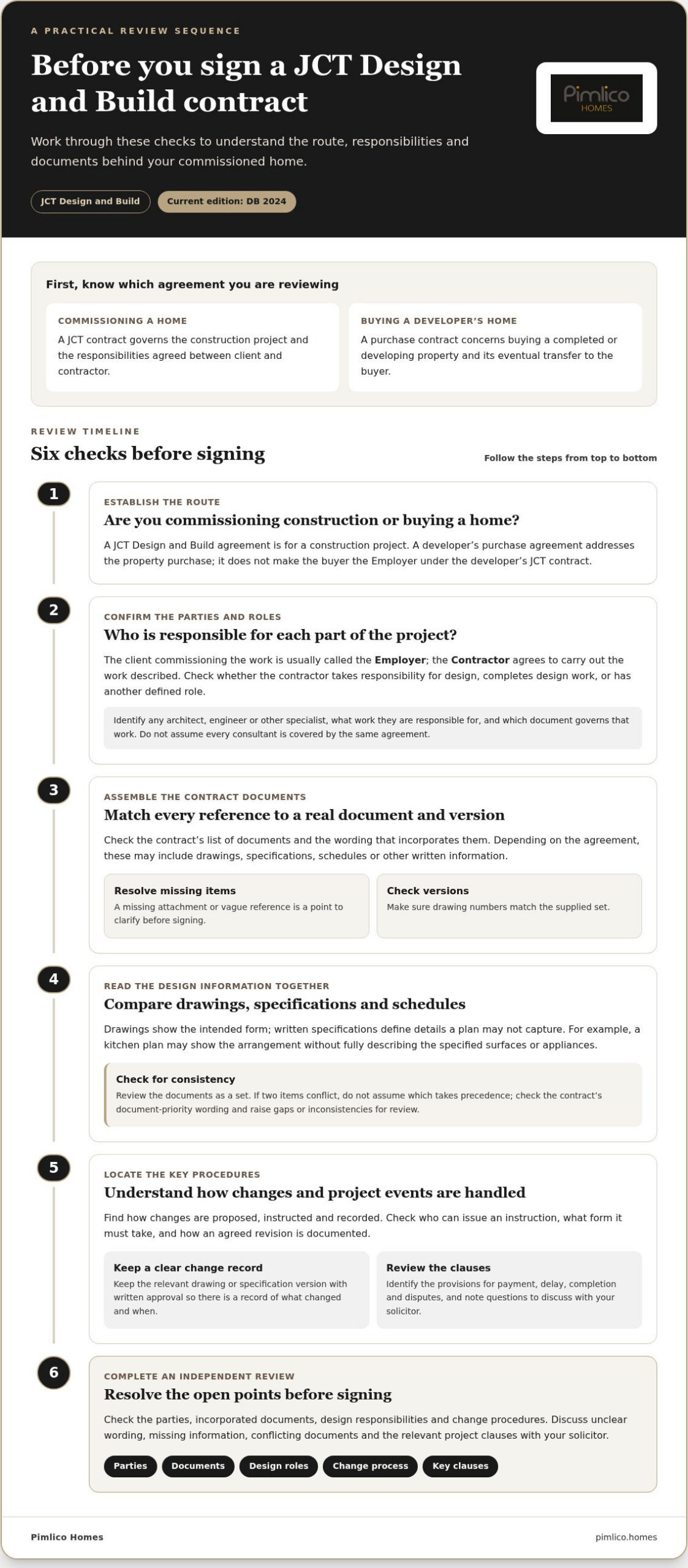
Before signing a private-home JCT contract: a practical review sequence
A methodical review makes a complex agreement easier to assess. Work through the project information first, then take the complete document set and your questions to an independent solicitor. This checklist helps you prepare. It is not legal advice or a substitute for advice on your particular contract.
- Define the agreed scope. Summarise what the project is intended to deliver, including the work and design information you understand to be included. Note assumptions or exclusions that need clarification.
- Check the parties. Confirm the legal names and roles of the Employer and Contractor. Identify whether consultants or specialists have separate appointments relevant to the work.
- Match the documents. Gather the draft contract, referenced schedules, drawings and specifications. Check references and versions, then flag missing documents or differences between a plan and the written scope.
- Trace design responsibility. Identify who is responsible for each design element under the signed wording, and how submissions, reviews and approvals are documented. Do not rely on informal descriptions of who will “handle” design.
- Follow the change process. Locate how changes are proposed, authorised and recorded. Note who can issue instructions and how related design documents are updated.
- Prepare for legal review. Ask your solicitor to explain the payment mechanism, insurance provisions, delay and extension-of-time process, completion and handover requirements, and dispute procedure as they apply to the project.
A document check before legal review
Keep the documents together and make a short list of queries. If a drawing shows a feature that the specification does not mention, record both references rather than deciding which one governs. Include unclear terms, missing attachments and differing document versions. Ask your solicitor to identify the contract’s document hierarchy and explain what it means if incorporated documents conflict. This preparation keeps the review focused on the wording and the work it is meant to describe.
Questions to resolve with your solicitor
Ask who carries each design responsibility, how approval is evidenced and what happens if the design develops or the agreed work changes. Clarify how payment assessments, delay notices, completion and handover are addressed. Ask which insurance provisions and dispute steps need particular attention. Clause references and legal effects depend on the contract edition and amendments, so have the applicable wording checked rather than relying on a general guide.
Checklist summary: reconcile the signed contract with every incorporated project document, then have your solicitor explain any gaps, conflicts or responsibilities that remain uncertain. If your decision is between commissioning a home and buying a developer’s property, explore Pimlico Homes’ new build homes as a separate purchase route.
Choosing the right route: commissioned build or a Pimlico Homes new build
The choice is not simply between a more individual home and a more straightforward purchase. It is a choice between different roles, documents and decision-making journeys. Commissioning construction places you at the centre of a project governed by a construction contract. Purchasing a developer’s new build is a property transaction with its own purchase terms and stages. The best fit depends on how you want to take part and which responsibilities you are prepared to manage.
For readers using a new build purchase contract guide UK, this distinction is a useful decision point. Consider whether you want to shape a project through a construction process or select a home through a developer’s buying journey. Then focus your legal review on the contract that governs that route.
When commissioning construction may suit your priorities
A commissioned build may suit someone who wants to develop a home through a defined project brief and is prepared to engage with design decisions and construction arrangements. The JCT contract sets out responsibilities between the client and contractor, but the extent of design involvement depends on the agreed scope and signed terms. It does not, by itself, promise unlimited design choice.
Before committing, understand who is responsible for each design element, how changes are authorised and recorded, and how the payment process works. These details shape the working relationship throughout the project. A solicitor can explain how the contract provisions apply to your arrangements.
What to expect when purchasing a Pimlico Homes property
Buying a Pimlico Homes property follows a purchase journey rather than a private construction appointment. The Pimlico Pledge describes customer service from reservation through handover of keys, giving buyers context for the stages of their experience. The homes reflect the company’s emphasis on craftsmanship, innovation and timeless design.
As a buyer, your focus is on the home and the terms governing that transaction, rather than taking on the Employer role in a JCT construction contract. The buying experience has its own documents and milestones, so consider it on its own terms.
To explore this distinct route, including considerations involved in choosing and purchasing a home, read Pimlico Homes’ luxury new-build buying guide. It provides context for the journey from reservation towards handover.
As you weigh the options, ask yourself:
- Do you want to participate in a construction project and understand its design and change procedures?
- Would you rather assess a developer’s home and follow the purchase arrangements for that property?
- Have you identified which contract governs your responsibilities and what independent legal advice you need?
Choose with clarity. A considered decision begins by matching the contract to the home-buying route you intend to take.
Choose your next step with confidence
A significant home decision deserves a clear understanding of the route ahead. If you’re commissioning a property, use the contract review to establish what you’re agreeing to and where you need project-specific legal advice. If you’re considering a developer’s home, focus on the purchase journey and the commitments that shape your experience as a buyer. The distinction at the heart of this new build purchase contract guide UK can help you move forward with greater certainty.
For a considered new-build purchase, Pimlico Homes presents Award Winning Homes shaped by craftsmanship and timeless design. The Pimlico Pledge describes customer service from reservation through handover of keys, providing a clear point of reference as you explore the buying journey.
Explore Pimlico Homes and discover a considered new-build buying journey. Your next step can be thoughtful, well-informed and centred on the home you hope to make your own.
Frequently Asked Questions
What is a JCT Design and Build contract for a private home?
It is a construction agreement setting out the parties’ responsibilities for a home-building project. For a private commission, the signed contract and its incorporated documents establish what the contractor undertakes and how the project is administered. For example, check whether a particular design package or specialist item is included in the defined work. The contract’s title alone cannot answer that. Have a solicitor explain the actual wording before signing.
Is a JCT Design and Build contract the same as a new-build purchase contract?
No. A JCT agreement concerns construction responsibilities, while a purchase contract governs a buyer’s transaction with a developer. If a property is still being built, that does not by itself make the buyer a party to the construction contract. In this new build purchase contract guide UK, the useful first step is to identify the document and the parties named in it, then ask your solicitor what transaction it covers.
Who is responsible for design under a JCT Design and Build contract?
The contract allocates design responsibilities, so the answer depends on its terms and incorporated documents. A contractor’s design obligation may not cover every element in the same way. For instance, an item shown on a drawing may be subject to a separate consultant’s appointment or a stated design assumption. Ask your construction solicitor to map responsibility by design element and explain who reviews or approves submissions, rather than relying on the contract label alone.
What should I check before signing a JCT contract for a house build?
Check that the parties, scope and referenced documents match the project you intend to commission. Note any missing attachments, inconsistent versions or assumptions that could affect what is delivered. Ask your solicitor to review the design, change, payment, delay, completion, insurance and dispute provisions in the context of the chosen form and its amendments. If a referenced schedule has not been supplied, for example, record it as an item to resolve before signing.
Can a JCT Design and Build contract be changed after signing?
Changes may be possible, but the contract governs how they are proposed, approved and recorded. Before acting on a revised layout or specification, establish whether the relevant instruction has been authorised under the agreed process. Keep a record of the written decision and any updated project documents. A discussion or marked-up drawing may not, by itself, establish an agreed contractual change. Ask your solicitor how the specific clause applies before proceeding.
Does a JCT contract guarantee a fixed completion date?
Not necessarily. The effect of a date depends on the signed wording, including how completion and delay are addressed and whether the contract has been amended. A date in project correspondence may not have the same contractual status as one stated in the agreement. Ask your solicitor to identify the relevant completion obligation, notice requirements and any remedies available under the actual terms. Do not make plans on the assumption that a target date is guaranteed.
Do I need a solicitor to review a JCT Design and Build contract?
Independent legal review is strongly advisable before signing, because amendments and project-specific documents may affect how the contract operates. Ask a solicitor familiar with construction contracts to explain unfamiliar wording, identify inconsistencies and clarify the responsibilities you are taking on. Make the review more focused by providing the complete document set and a list of questions. A general guide cannot determine the legal effect of your particular agreement.





