
Can a masterpiece of architecture truly be considered complete if its future remains unshielded against the unseen? For the discerning homeowner, a property isn’t just a residence; it’s a significant life investment that demands an uncompromising level of protection. You’ve likely spent months, perhaps years, refining the vision of your perfect home, yet the fear of latent structural defects appearing long after the final stone is laid can cast a shadow over that achievement.
Having this new build structural warranty explained is the first step in ensuring your peace of mind remains as solid as your foundations. We understand that whilst your standard buildings insurance covers immediate perils like fire or theft, it won’t protect you against the intricate failures of design or workmanship that might only surface in the years to come. This article provides a definitive guide to the 10-year protection cycle, clarifying how a robust warranty partner secures your home’s structural integrity. You’ll discover how these protections function across different phases, how to identify a developer committed to excellence, and why this security is a vital asset for maintaining long-term resale value.
Key Takeaways
- Learn how a structural warranty acts as a 10-year quality covenant that shields your capital investment from latent construction defects.
- Gain clarity on the 10-year protection timeline with the new build structural warranty explained, specifically the transition from developer liability to insurance cover.
- Identify the critical load-bearing elements and weatherproofing systems that are protected, ensuring your home’s integrity remains uncompromised.
- Understand why elite build quality is your primary defence, whilst the warranty serves as the ultimate safety net for your peace of mind.
- Discover how robust structural protection supports the future resale value and long-term prestige of your luxury residence.
What is a New Build Structural Warranty?
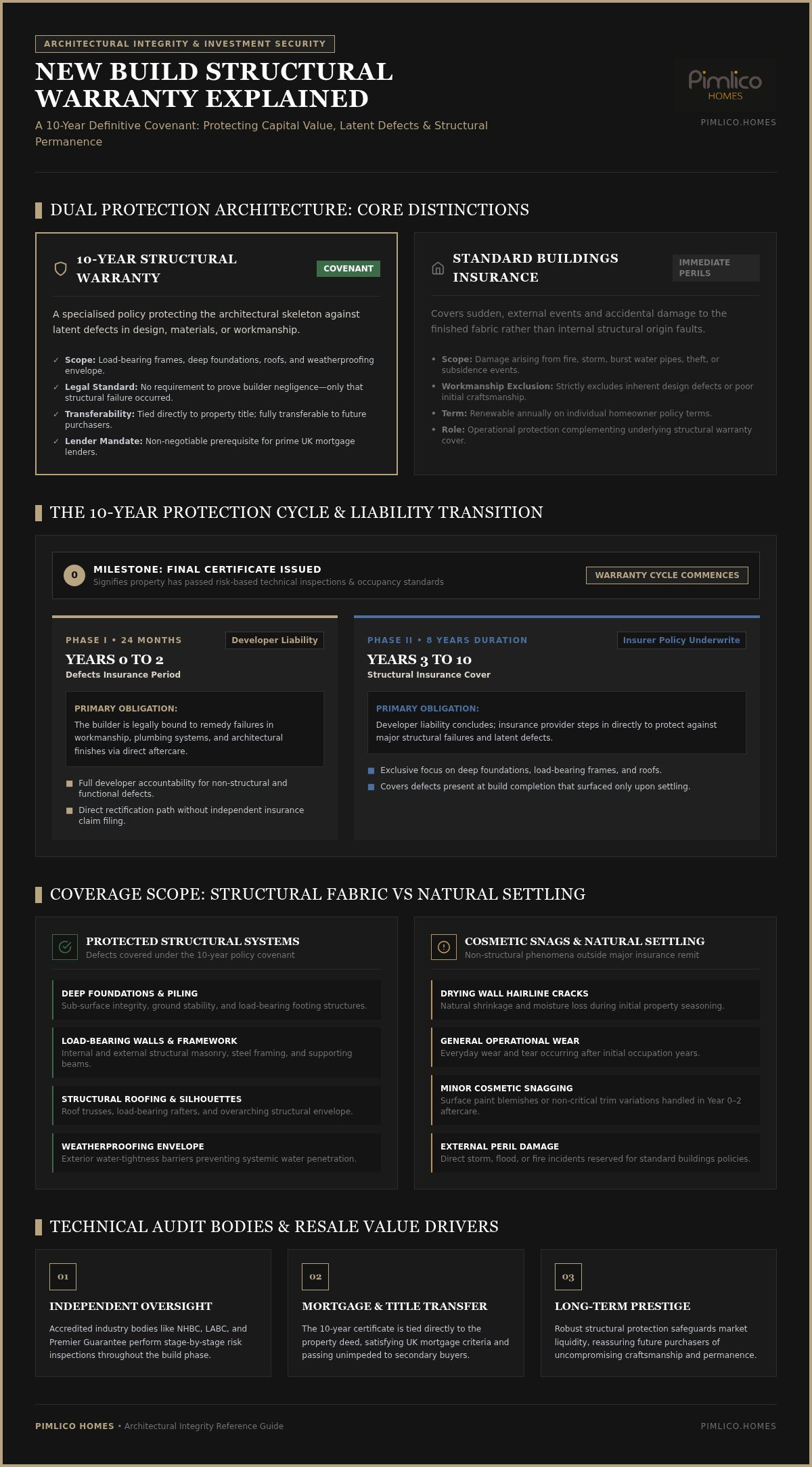
Beyond the aesthetic allure of a bespoke residence lies a fundamental requirement for structural permanence. A structural warranty is a specialised insurance policy, typically spanning a decade, designed to protect the very skeleton of your home. Having this new build structural warranty explained reveals its true nature: it isn’t merely a document, but a quality covenant that safeguards your investment against latent defects. These are hidden flaws in design, materials, or workmanship that may not become apparent until years after the final stone is laid.
For most mortgage lenders in the UK, this protection is a non-negotiable requirement for any new property. It serves as a seal of approval from an independent body, confirming that the building has been constructed to an exacting standard. Because the policy is tied to the property rather than the owner, it remains entirely transferable. This feature enhances the liquidity of your asset, offering future purchasers the same reassurance of quality and security that you enjoyed upon completion.
The Purpose of Structural Protection
The primary objective of this protection is to ensure that every element of your home meets rigorous technical requirements from the moment foundations are poured. It provides a streamlined legal path for redress. Unlike traditional litigation, you don’t need to prove negligence on the part of the builder; you simply need to demonstrate that a structural failure has occurred. It’s vital to distinguish between minor cosmetic snags and major failures. Whilst a hairline crack in a drying wall is a natural part of a home’s settling process, a defect in the load-bearing frame or the weatherproofing envelope represents a significant failure that this warranty is specifically designed to remedy.
Who Provides the Warranty?
Quality is never accidental. It’s the result of meticulous oversight by leading industry providers. Organisations such as the National House Building Council standards, LABC, and Premier Guarantee are the primary guardians of these benchmarks. These bodies act as independent auditors, conducting a series of risk-based inspections throughout the construction phase to verify that every detail aligns with the highest specifications.
A developer’s choice of warranty partner says much about their commitment to excellence. By partnering with reputable providers, a master craftsman ensures that their output is scrutinised by the best in the field. This collaborative approach between the visionary creator and the technical auditor ensures that your Bespoke Luxury Home isn’t just a vision of beauty, but a bastion of enduring quality.
The 10-Year Protection Timeline Explained
The journey of a luxury home is one of evolution. A residence doesn’t simply exist; it breathes and settles into its landscape over time. Understanding this progression is key to having a new build structural warranty explained effectively. The protection begins the moment your home receives its Final Certificate. This document signifies that the property has met every stringent standard required for occupancy. From this point, the warranty unfolds in two distinct phases, each offering a specific layer of security.
Years 0-2: The Developer’s Responsibility
During the initial twenty-four months, the developer remains your primary guardian. This phase, known as the Defects Insurance Period, places the onus of rectification squarely on the builder. It’s a comprehensive safety net. Whether it’s a minor adjustment to an architectural finish or a functional plumbing issue, the developer is legally bound to resolve defects in workmanship. For those investing in luxury detached homes, this period is often characterised by a seamless, white-glove service where excellence is maintained through dedicated aftercare. A reputable builder ensures that these early years are defined by quiet enjoyment rather than administrative burden.
Years 3-10: The Insurer’s Structural Cover
As the home enters its third year, the nature of the coverage shifts. The developer’s direct liability ends, and the insurance provider takes the lead. This eight-year stretch focuses exclusively on the major structural integrity of the building. We’re talking about the foundations, load-bearing walls, and the complex roofing structures that define the home’s silhouette. This phase protects against latent defects. These are faults that were present at completion but remained invisible to the naked eye until the building settled.
The Financial Ombudsman Service guidance on building warranties provides a clear framework on how these policies operate independently of your standard home insurance. It’s a vital distinction. Whilst the builder’s initial responsibility covers a broad range of issues, the subsequent insurance period is a specialist shield for the home’s core stability. It ensures that the most critical components of your investment are protected against the rarest but most significant risks.
A home is a permanent legacy. The 10-year timeline ensures that as your property matures, its value remains insulated from the unpredictable. It provides a structured path of accountability that moves from the intimate care of the craftsman to the institutional strength of the insurer. This transition reflects the natural life cycle of a premium build, ensuring that the confidence you felt on move-in day persists for a decade and beyond.
Structural Warranty vs Home Insurance
Distinguishing between these two pillars of protection is essential for any high-net-worth homeowner. Whilst they may appear to overlap, they serve entirely different masters within the lifecycle of a property. Standard home insurance is designed to shield you from “perils,” which are unforeseen external events such as fire, flood, or theft. Conversely, having a new build structural warranty explained highlights that its focus is on “faults.” These are inherent failures in the original construction, design, or materials that compromise the building’s architectural integrity.
Think of it as a dual-layered shield. One layer protects the lifestyle you’ve built within the walls, whilst the other protects the walls themselves. In the event of a significant claim, such as a major roof failure, the two policies may interact. If the damage was caused by a sudden storm, your home insurance would likely take precedence. However, if the roof fails because the trusses were incorrectly specified or installed, the structural warranty becomes the primary vehicle for redress. You don’t just need one; you need both to ensure your luxury residence remains an unassailable sanctuary.
Key Differences in Coverage
The structural warranty is concerned with the “skeleton” and “envelope” of your home. It monitors the foundations, load-bearing masonry, and the waterproof integrity of the facade. Buildings insurance, by contrast, focuses on the more immediate and tangible. It covers your internal fittings, accidental damage to glass, and the consequences of escaped water from pipes. Mortgage lenders are particularly insistent on the structural warranty because they view the property as collateral. They require a guarantee that the building’s core remains sound, regardless of external circumstances.
The Investment Perspective
From a financial standpoint, insurance protects your current liquidity, whilst the warranty protects your long-term capital asset. The legal necessity of these protections is underscored by Section 144 of the Building Safety Act 2022, which establishes the mandatory framework for developer accountability. This statutory requirement ensures that even the most bespoke builds are held to a rigorous national standard, providing a clear path for rectification without the need to prove builder negligence.
This protection is also a vital component of your exit strategy. A valid, transferable policy significantly enhances new build home resale value. Future buyers and their legal teams will scrutinise the warranty as a primary indicator of the home’s pedigree. For high-specification bespoke builds, ensuring your policy is robust enough to cover the full reinstatement cost of unique architectural features is not just a formality; it’s a strategic move to preserve your legacy.
What is Covered (and What is Excluded)?
Precision in construction demands equal precision in protection. To truly have a new build structural warranty explained, one must look beyond the broad 10-year promise and examine the specific architectural elements that fall under its remit. This policy is not an all-encompassing safety net for every minor blemish; instead, it is a targeted shield for the home’s most critical components. It focuses on the fundamental integrity of the build, ensuring that the primary frame remains as robust in a decade as it was on the day of completion.
Core Structural Components
The warranty’s primary focus is the “skeleton” of the property. This includes the foundations, load-bearing masonry, and the intricate steel or timber frames that define the home’s silhouette. In executive homes, this protection extends to the internal floor structures and the primary staircases, ensuring that the internal flow of the house remains secure. Equally vital is the “envelope” of the building. The policy covers the weatherproofing integrity of the roof and external walls, protecting your investment from water ingress that could otherwise compromise the internal finishes.
For those who have invested in luxury barn conversions, the coverage takes on a more complex dimension. These projects often blend heritage structural elements with cutting-edge modern additions. A robust warranty ensures that the interface between the original masonry and the new architectural features is perfectly executed and protected, maintaining the refined rural luxury that such properties represent.
Common Warranty Exclusions
When having a new build structural warranty explained, it becomes clear that the policy is a guardian of quality, not a substitute for regular care. Understanding the limits of your cover is just as important as knowing its strengths. The policy is designed to protect against latent defects, not the natural effects of time or occupancy. General wear and tear, such as the fading of external finishes or the minor shrinkage cracks that appear as a home settles, are typically excluded once the initial two-year developer liability period has passed.
Maintenance remains the responsibility of the homeowner. If a structural issue arises because a drainage system was left uncleaned or a roof was neglected, the insurer may decline the claim. Similarly, any alterations or extensions made by the owner after completion are not covered by the original policy. For significant events like natural disasters, your buildings insurance remains the primary source of protection. If you are ready to explore a vision of excellence that prioritises this level of detail, we invite you to view our latest luxury new build homes.
Choosing a Developer with Uncompromising Standards
A structural warranty is a vital legal safeguard, yet for the discerning investor, it represents the final safety net rather than the first line of defence. The true measure of a residence lies in the meticulous craftsmanship that precedes the policy. Elite build quality acts as a proactive shield, ensuring that the structural integrity of the home is never in doubt. Having this new build structural warranty explained within the context of a premium development reveals that the policy is a testament to the builder’s confidence. A master craftsman welcomes third-party scrutiny because their work is designed to exceed the minimum benchmarks set by insurers. It is a commitment to permanence that begins long before the first inspection takes place.
The Pimlico Approach to Quality
At Pimlico Homes, we believe that excellence is a habit. Our process involves rigorous internal inspections that often surpass the mandatory requirements of warranty providers. We blend traditional heritage values with innovative architectural thinking to create spaces that are both timeless and technically superior. By partnering with elite providers like NHBC and Premier Guarantee, we ensure that every luxury new build is subject to the highest level of institutional oversight. This commitment to high-specification construction standards is what defines our 25-year legacy. We act as the primary guardian of your investment, overseeing every detail from the depth of the foundations to the precision of the roof trusses.
Securing Your Future Peace of Mind
The value of a developer who manages the snagging process with proactive care cannot be overstated. Clear communication during the handover process ensures that you understand the full scope of your protection from day one. A robust warranty is more than a requirement; it is a hallmark of excellence. It signals to future purchasers that the property was built by a visionary creator who prioritised longevity over expediency. For those seeking a bespoke luxury home, the warranty serves as a permanent record of quality. It provides the ultimate assurance that your investment is protected by a guardian who remains invested in your satisfaction. This legacy of care ensures that your home remains a prestigious asset for decades to come.
Securing the Future of Your Architectural Legacy
A luxury residence is far more than a collection of curated materials; it’s a profound commitment to your future. Having this new build structural warranty explained provides the clarity needed to view this protection as a hallmark of excellence rather than a mere formality. Whilst the ten-year policy offers institutional security against the unforeseen, the true guardian of your investment remains the developer’s dedication to high-specification construction standards. Excellence begins with the first pour of the foundations and continues through every meticulously crafted detail.
With over 25 years of architectural excellence, Pimlico Homes stands as a visionary creator of executive courtyard developments and bespoke designs. We ensure that every property we deliver carries the weight of 10-year structural peace of mind, allowing you to focus on the life you’ve built within its walls. We invite you to discover our portfolio of exquisitely crafted new homes and take the first step toward a future defined by security and prestige. Your vision of a perfect home is within reach, protected by a legacy of quality that lasts a lifetime.
Frequently Asked Questions
Is a structural warranty the same as building regulations approval?
No, these are distinct requirements. Building regulations approval is a statutory check by local authorities to ensure a property meets minimum safety and energy standards. A structural warranty is a private insurance policy that protects you against latent defects. Whilst building control confirms the home is legal to occupy, the warranty provides the financial mechanism for repairs if a structural failure occurs years later. Both are essential for any premium residence.
Can I sell my new build home before the 10-year warranty expires?
You can certainly sell your property at any time. The warranty is tied to the structure rather than the owner, making it fully transferable to any subsequent purchaser. Having this new build structural warranty explained to potential buyers acts as a significant advantage. It provides them with the same decade-long peace of mind you enjoyed, which often supports a higher resale value and ensures a smoother legal transition.
What happens to the warranty if the building company goes bust?
The warranty remains valid even if the developer ceases trading. Because the policy is underwritten by an independent insurance provider like NHBC or Premier Guarantee, your protection is decoupled from the builder’s financial status. This is the primary reason why mortgage lenders insist on these policies. It ensures that the funds required for major structural rectifications are available from the insurer, regardless of the developer’s long-term corporate viability.
Does a structural warranty cover plumbing and electrical issues?
Standard policies typically only cover mechanical and electrical systems during the initial two-year developer liability period. Once you enter the structural insurance phase in year three, the focus narrows to the load-bearing elements and the weatherproofing envelope. Some bespoke policies for luxury homes may include riders for high-specification systems like ground-source heat pumps. It’s vital to review your specific policy schedule to understand these intimate technical details.
How do I make a claim on my new build structural warranty?
Making a claim depends on the age of your residence. In the first two years, you should approach the developer to rectify any defects under their initial liability. From year three onwards, you deal directly with the warranty provider for structural failures. Having this new build structural warranty explained clarifies that you’ll need to provide evidence of the defect, after which the insurer coordinates the necessary technical investigations and repairs.
Are luxury barn conversions covered by the same 10-year warranties?
Luxury barn conversions are eligible for 10-year structural protection, though the policies are specifically tailored for converted dwellings. These warranties focus on the interface between the original heritage masonry and the new structural elements. Providers like LABC or ICW offer specialist schemes that account for the unique risks associated with conversions. This ensures your rural retreat possesses the same level of security and prestige as a ground-up bespoke new build.
Do I still need a home survey if the property has a structural warranty?
A professional survey is always a prudent investment, even with a warranty in place. Whilst the warranty provides a safety net for major failures, a snagging survey at completion identifies cosmetic or functional issues that the builder should resolve immediately. For high-value acquisitions, an independent surveyor offers an extra layer of scrutiny, ensuring that the exquisite craftsmanship promised by the developer has been delivered to your exact and uncompromising standards.
Does the warranty cover damp or timber rot?
Coverage for damp or timber rot is contingent upon the underlying cause. If the issue stems from a latent structural defect, such as a failure in the damp-proof course or the roofing envelope, it’s typically covered under the structural insurance period. However, dampness caused by poor ventilation, condensation, or a lack of homeowner maintenance is generally excluded. A robust warranty protects against construction failures rather than the natural consequences of occupancy or neglect.





