
The most polished show home isn’t necessarily the strongest choice. For buyers purchasing prime new build property UK, the more important question is what lies behind the first impression: the quality of the design, the care in the craftsmanship and how confidently the home will serve its owners over time.
A beautifully presented interior can make a property feel immediately compelling. It’s also reasonable to want clarity on the practical and legal details before making a significant commitment, especially when comparing a completed home with one still under construction. Prime should mean more than prestige: it should be supported by evidence and a genuine fit with the way you live.
This guide offers a practical framework for assessing and comparing prime new builds across the UK. It covers the details to examine, the stages of purchase and the due diligence that can help you make an informed decision. From layout and workmanship to completion arrangements and future needs, you’ll find a considered way to judge whether a home feels right not only today, but for the years ahead.
Key Takeaways
- When purchasing prime new build property UK buyers should look beyond price and prestige, weighing design, craftsmanship, setting and long-term suitability.
- Organise due diligence around the property, legal documents, finances and practical needs, with your conveyancer reviewing the contract and title.
- Compare completed homes with properties under construction by considering what you can inspect directly, the timing and the documentation available.
- Follow each purchase stage methodically, from setting your brief and reviewing evidence to exchange and completion, while allowing for differences between transactions.
- Explore how luxury detached homes, executive courtyard homes and bespoke barn conversions offer different approaches to considered design and craftsmanship.
What makes purchasing a prime new build property in the UK a considered decision?
Prime is often used as shorthand for price or prestige. Neither is enough to establish that a home is right for you. A considered assessment looks at the coherence of the design, the quality of the materials and workmanship, the setting, and how well the property supports the way you intend to live. The strongest choice is not necessarily the grandest; it is the home whose qualities stand up to close inspection and suit your priorities.
A prime new build is a considered home purchase, not simply a price category: it brings together thoughtful design, evidence of quality and a lasting fit with the owner’s needs. Attractive finishes and an emotional connection can make a viewing memorable, but practical evidence and future requirements should shape the decision too. Consider whether the layout will work as your household changes, and which less visible qualities need further examination.
A new build is newly constructed and generally intended for its first occupation. A previously occupied property comes with a history of use, upkeep and alterations to consider. Neither is automatically the better choice, but each calls for a different assessment. For context, Property law in England and Wales provides a starting point for understanding the legal framework. Property law differs across the UK, so the relevant jurisdiction matters during a purchase.
Which qualities matter beyond the asking price?
Look past the styling and picture an ordinary day in the home. Notice how natural light moves through the rooms, whether the layout creates privacy where you need it, and whether storage is practical rather than merely decorative. Consider how the kitchen, living areas and quieter spaces relate to one another. A striking entrance is appealing; a plan that supports daily routines is valuable every day.
Materials and craftsmanship deserve the same close attention. Look at visible finishes, junctions and details, and distinguish what you can inspect from what relies on plans or written information. Design appeal is immediately experienced, but it does not by itself demonstrate construction quality or settle questions about the completed property. Record observations and evidence separately so that an elegant presentation does not substitute for facts.
How should you define your own priorities before viewing?
Before arranging viewings, write down what the home needs to do for you. Rank your requirements for location, space, accessibility and likely future household needs. Then divide the list into essentials and preferences. A ground-floor room that can serve changing needs may be essential, while a particular finish or an extra reception space might be desirable but flexible.
Use the same brief at every viewing. It keeps comparisons grounded in your life rather than in whichever property made the strongest first impression.
- Essentials: requirements you would not compromise on, such as suitable access or enough usable space.
- Preferences: features that would enhance the home but could change without undermining its suitability.
- Future needs: household changes or routines the layout should accommodate over time.
This simple discipline gives purchasing prime new build property UK a clearer basis: assess what you can see, identify what needs evidence, and measure each home against a brief shaped around your life.
What due diligence should you complete before buying a prime new build?
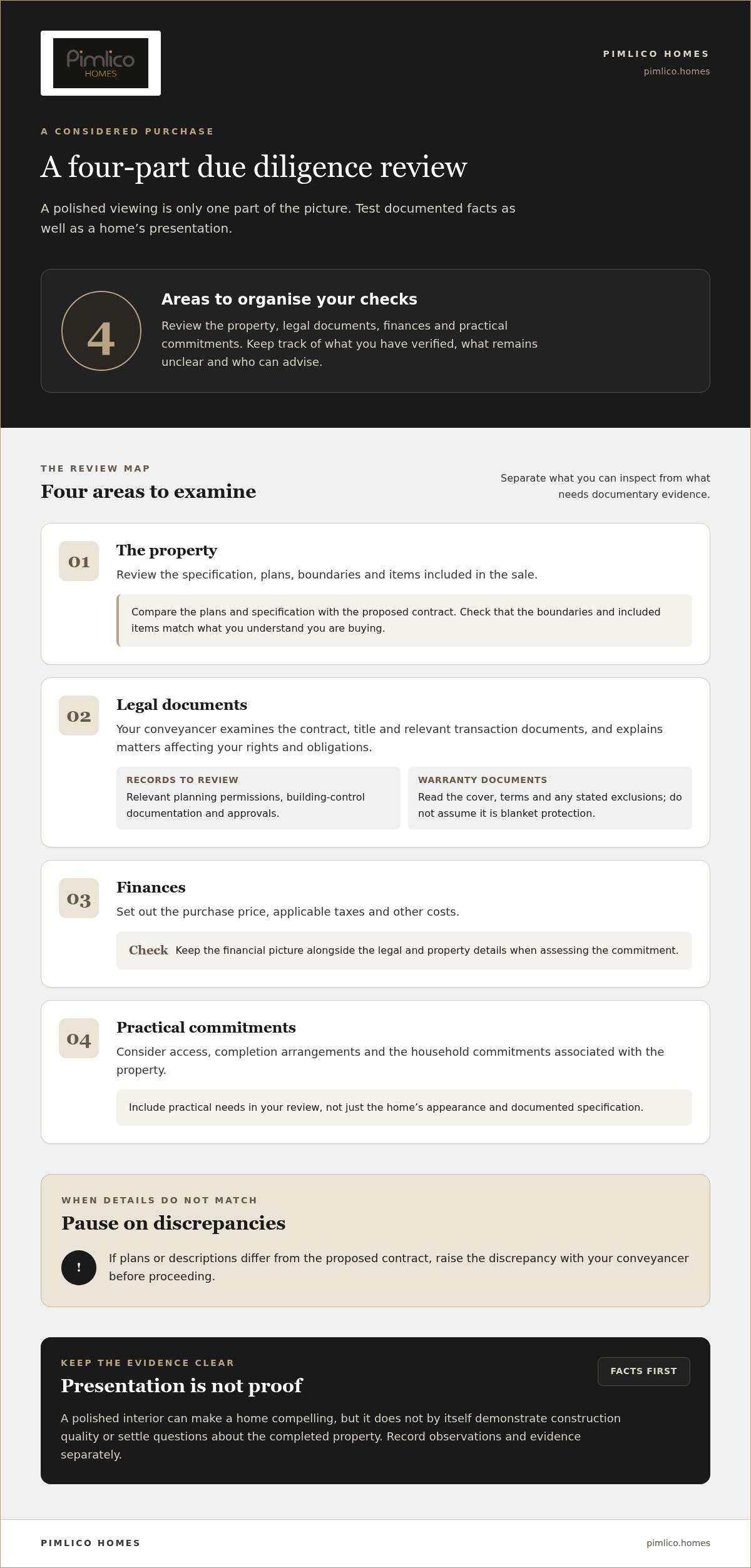
A polished viewing is only one part of the picture. Due diligence tests documented facts, not just a home’s presentation. For a substantial purchase, organise your checks into four areas: the property itself, legal documents, finances and practical commitments. This structure helps you identify what you have verified, what remains unclear and who can advise on the next step.
Property checks cover the home’s specification, plans, boundaries and items included in the sale. Legal review considers the contract, title and relevant transaction documents. Your conveyancer examines these materials and explains matters that affect your rights and obligations. Financial checks cover the purchase price, applicable taxes and other costs. Practical checks include access, completion arrangements and the household commitments associated with the property.
Which documents and details deserve careful review?
Compare the property specification and plans with the proposed contract. Check that the boundaries shown correspond with the property you believe you are buying, and that items described as included appear in the transaction documents. If plans or descriptions differ, raise the discrepancy with your conveyancer before proceeding. The RICS advice on new build home considerations can also help you approach property-specific checks carefully.
Ask your conveyancer to review relevant planning permissions, building-control documentation and approvals for the property. These records help establish the basis on which the home was developed; their relevance depends on the property and transaction. Review any warranty documentation too. Read what it covers, its terms and any stated exclusions rather than treating the word “warranty” as blanket protection.
For a home still under construction, the available documents may be especially important because you can’t inspect every finished detail. Keep a record of questions and answers, and note which information appears in plans, is set out in the contract or still needs to be evidenced. This makes it easier to understand what you are relying on.
How can you assess costs and commitments responsibly?
Build a personal cost schedule instead of relying on a single headline figure. Separate each category so you can consider both the upfront commitment and the ongoing cost of owning the home.
- Purchase: the agreed price and any items included in the transaction.
- Transaction: applicable property taxes and legal costs.
- Moving: removals and other arrangements for taking possession.
- Ongoing: expected household commitments, based on information relevant to the property.
Tax treatment depends on where the property is situated, your circumstances and the rules in force at the time of purchase. SDLT applies in England and Northern Ireland; Scotland and Wales have separate property transaction tax systems. Confirm the current position with a suitably qualified tax adviser or conveyancer rather than relying on a general estimate. Careful preparation is central to purchasing prime new build property UK, because it makes the financial picture part of the decision, not an afterthought.
Once you have a clear framework, Pimlico Homes’ high-end residential developments offer a starting point for considering homes shaped by design and craftsmanship.
Completed or not yet finished: how should you compare prime new builds?
A completed home and one still under construction offer different kinds of evidence. The first can be experienced in person; the second must be assessed more heavily through plans, specifications and contract terms. Neither stage is automatically safer or better. The right comparison depends on what you need to establish before committing, how important timing is to your plans and how comfortable you are relying on documented details.
Use the same criteria for each property. Separate what you have observed or read in a signed document from what you are assuming about future work, finishes or the surrounding development. This makes purchasing prime new build property UK a more grounded decision, particularly when two compelling homes are at different stages of completion.
| Consideration | Completed home | Future completion |
|---|---|---|
| What you can inspect | Rooms, light, finishes and indoor-outdoor flow as they stand. | Plans and any accessible areas; the finished result is not yet fully visible. |
| Timing | The home is physically complete, but your transaction and move still have their own timetable. | Review the contract’s completion arrangements; do not treat an informal estimate as a confirmed date. |
| Documentation | Compare the property with its specification, contract and relevant records. | Give close attention to plans, specification, contract terms and stated arrangements for completion. |
| Buyer priority | Direct experience of the actual home. | Confidence in the documents and flexibility around timing and the unseen finished details. |
What can you assess more directly in a completed home?
Walk through the property with your viewing brief in hand. Notice whether room proportions feel as expected, how natural light changes between spaces and how the home connects with any outdoor areas. Examine visible finishes closely. Make a note of questions about fixtures, boundaries or defects for appropriate follow-up rather than assuming that a viewing settles them.
Then compare the physical home with its marketing material and contractual description. If a feature shown in promotional images is not apparent, establish whether it forms part of the sale through the relevant documents. A completed home offers direct inspection, not a substitute for document review.
What needs particular attention when completion is in the future?
For a home that is not yet finished, review the plans, specification and contract with your conveyancer. Identify what the documents say about materials, finishes, included items and completion arrangements. Treat visualisations as illustrations, not proof of the final result, unless the relevant details are also reflected in the contractual documents.
Changes, delays and any remedies depend on the signed contract; there is no universal guarantee of a particular outcome. Ask your conveyancer to explain the provisions that matter to your transaction. Consider whether the available evidence and stated timing suit your plans, including any commitments that depend on moving by a particular date. A careful comparison turns uncertainty into specific questions, helping you decide whether the purchase stage fits your priorities.
From viewing to a confident UK new-build purchase
A well-organised purchase moves through decision gates, not simply a series of forms. Start with a clear brief, view the property, review the available evidence, then consider a reservation or make an offer. If you proceed, the contract is reviewed before the relevant commitment stage, followed by the legal steps towards completion. The precise order and terminology can vary with the transaction, contract and UK jurisdiction, so follow your conveyancer’s guidance for the process that applies to your purchase.
In transactions where exchange of contracts applies, exchange and completion are distinct stages. Exchange is the point at which the parties become bound by the contract; completion is when the purchase is finalised and ownership transfers. The detail and process differ across the UK, so don’t assume that terminology or timing is identical everywhere. Your conveyancer can explain what each milestone means for your transaction.
Before committing, confirm that the home fits your brief, key claims are supported by evidence, contract terms are understood and the financial and timing arrangements work for you.
What should you record during a viewing?
Use the same checklist at every viewing, whether you are seeing a finished home or a show property. Note how rooms could function in daily life, where storage is available, how access and privacy feel, and the standard of visible finishes. Consider whether the design suits your household now and could accommodate anticipated changes, such as working from home or using a room differently.
Keep observations separate from statements that need documentary support. You might note, “the garden appears private from the main living area” as an impression, but record a boundary question or an item said to be included as something to verify against the relevant documents. Write down unanswered questions promptly, while the details of the visit are fresh.
How can you keep the purchase stages organised?
Keep a single purchase record, digital or on paper. Track documents requested and received, questions for your conveyancer, milestones in the contract and actions agreed with the relevant parties. Note who provided each answer and whether it was a conversation, written confirmation or contractual term. This can prevent an assumption from becoming part of your decision unnoticed.
Before paying a reservation fee or signing a reservation agreement, read the actual terms and have your conveyancer explain their effect. Payment conditions, deadlines, refund provisions or consequences of withdrawing depend on the agreement and applicable rules; don’t rely on a general promise or standard assumption. Keep copies of the agreement and related correspondence with your transaction records.
As you progress, revisit the decision gates rather than letting momentum carry you forward. Confirm that outstanding questions have been answered to your satisfaction, understand the contract before signing and know what the next milestone requires. For buyers purchasing prime new build property UK, that measured process brings design ambitions and practical decisions into alignment. Explore Pimlico Homes’ high-end new homes as you consider the qualities you want your next home to embody.
How can Pimlico Homes help you explore a prime new build?
A considered purchase begins with knowing what matters to you, then looking for those qualities in the home itself. Pimlico Homes develops high-end residential properties with a focus on design and craftsmanship, giving buyers a thoughtful starting point for exploring different forms of new-build living. The same evaluation framework applies: consider how a home is designed, what you can establish about its quality and whether its character suits your priorities.
There is no single format that defines a prime home. A luxury detached home, an executive courtyard home and a bespoke barn conversion each offer a different architectural proposition. The right fit depends on your preferred balance of privacy, space and character, and on how the property’s actual layout and setting support the life you intend to lead.
What can a considered development offer a discerning buyer?
Architectural character can make a home distinctive, but its lasting value to you is also practical. Look beyond a striking exterior and consider how the design organises the rooms, creates a sense of arrival and supports everyday routines. Craftsmanship deserves the same close attention: assess the visible materials and details, and use the relevant property information to understand what cannot be established from appearance alone.
Different home formats may suit different preferences. A detached home may appeal to someone prioritising a standalone property; courtyard living may attract a buyer drawn to a more connected arrangement; a barn conversion may appeal to someone seeking architectural character. These are starting points for comparison, not assumptions about specific layouts or features. Review each property on its own merits and against your written priorities.
That distinction reflects Pimlico Homes’ approach to high-end residential development: considered design and craftsmanship are central to its work, while the suitability of an individual home depends on the buyer’s needs and the evidence available for that property. Let your priorities guide the viewing, rather than allowing an impressive first impression to make the decision for you.
What is a sensible next step after reading this guide?
Turn your criteria into a short list before exploring Pimlico Homes’ developments. Identify the home format that interests you, the practical qualities you value most and the questions you would want answered during a viewing. Then compare the information available with those priorities, distinguishing confirmed property details from features you still need to assess.
For readers focused on purchasing prime new build property UK, a measured next step is to explore the available information and decide which homes merit closer consideration. The luxury new build purchasing guide offers further context for approaching the process. Explore Pimlico Homes’ developments at your own pace, with your priorities in view and the next decision guided by evidence as well as aspiration.
Take the next step with confidence
A home purchase becomes meaningful when it feels right in daily life, not only on viewing day. As you consider purchasing prime new build property UK, make your next step a thoughtful one: identify the homes that align with your priorities, then explore their details with the same care you would bring to any significant decision.
Pimlico Homes is a specialist developer of luxury residential properties, with a focus on high-quality craftsmanship across detached homes, courtyard homes and bespoke barn conversions. These distinct forms offer different architectural character and ways of living, giving you a considered place to continue your search.
Explore Pimlico Homes’ considered new-build developments and see which homes speak to your plans. Take time to discover the possibilities, refine what matters most and move forward when the right fit becomes clear.
Explore Pimlico Homes’ considered new-build developments
Frequently Asked Questions
Can I negotiate when purchasing a prime new build property?
Yes, you can make an offer or discuss the terms of a purchase, though the seller’s position and the property’s circumstances will affect what may be agreed. Negotiation need not focus only on the purchase price; it may include items or timing, provided any agreement is recorded clearly. Before relying on a verbal discussion, ask your conveyancer how agreed terms should be reflected in the transaction documents.
Do I need a survey when buying a new build home?
A survey can still be useful for a new build, as newly constructed does not automatically mean every aspect has been independently assessed for you. The appropriate inspection depends on the property’s stage and the questions you want answered. A surveyor can explain which survey or inspection is suitable, while a separate snagging inspection may identify finishing issues. Check what any existing warranty covers rather than treating it as a substitute for independent advice.
What happens if completion of a new build is delayed?
Your options depend on the contract, including any provisions dealing with anticipated completion, notice and delay. If the date changes, contact your conveyancer promptly and ask them to explain the contractual position before making decisions about removals, existing accommodation or other commitments. Keep written records of updated dates and related correspondence. Avoid assuming that a delay automatically gives you a right to withdraw or receive compensation; the signed terms and applicable law matter.
Is a reservation fee refundable on a new build property?
It depends on the reservation agreement and the circumstances in which the reservation ends. Before paying, read the terms carefully, including any stated period, conditions for cancellation and provisions for returning or retaining the fee. Ask your conveyancer to explain wording you do not understand, and keep a copy of the agreement and receipt. Do not rely on a general statement that a fee is always refundable or always non-refundable.
Can I make changes to a new build before moving in?
Possibly, but the answer depends on the property’s construction stage, the specification and the terms agreed with the seller. Some choices may no longer be practical once work has progressed, and changes can affect cost or timing. Set out any request in writing and establish whether it will alter the agreed specification or contract. Do not assume that a verbal discussion changes what you are legally buying.
What should I compare when two prime new builds seem equally suitable?
When purchasing prime new build property UK, compare the less obvious differences: how each home feels at different times of day, the flexibility of its rooms and the practical commitments attached to ownership. Revisit your essential priorities and note which property better supports them. If the choice remains close, compare the clarity of each home’s documentation and purchase terms, then decide which trade-offs feel more acceptable over time.





