A low estimate can be a warning, not a saving. The red flags in new build service charge agreements include vague budgets, unclear calculation methods and costs with no explanation. In England and Wales, leaseholders may apply to a tribunal to challenge a charge they consider unreasonable, linked to unsatisfactory work or not payable, according to the UK Government.
Review the estimate before exchange, while you can still raise concerns as part of your purchase decision. Read the lease terms carefully: agreeing to a charge, or having the dispute dealt with elsewhere, can limit an application to a tribunal. Stopping payment also carries risks, as a landlord can take a leaseholder to court over a charge they are responsible for.
This article explains what to look for in the estimate and lease, how residents can request supporting information and challenge charges, and why disputes and non-payment need careful handling. Use it to frame questions before exchange and understand possible next steps if a charge later appears unreasonable.
Key Takeaways
- Read the lease alongside the estimate, focusing on how charges are calculated, what services they cover and whether costs can change.
- Before exchange, identify unclear budget items and raise specific questions while your purchase terms are still under review.
- If a charge seems unreasonable, use the lease and supporting paperwork to understand the basis for a challenge before deciding how to proceed.
- Understand the limits on tribunal applications and the potential consequences of withholding payments before taking action.
1. Limits on tribunal applications and risks of non-payment
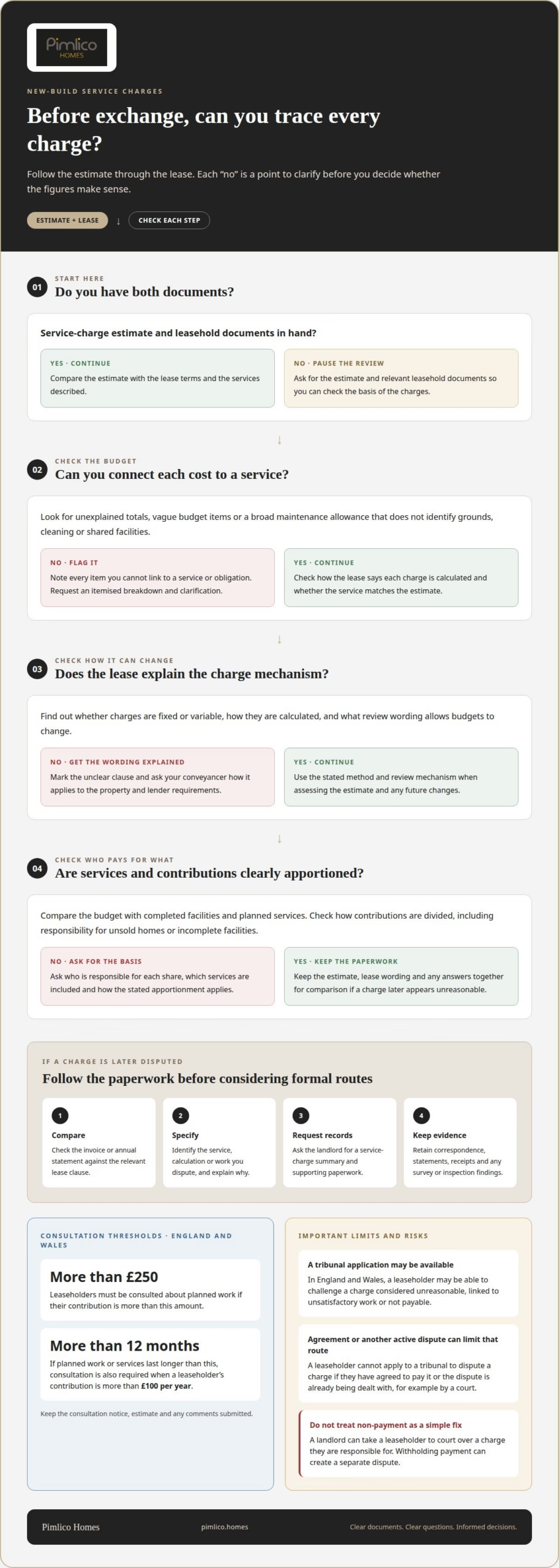
In England and Wales, a leaseholder cannot apply to a tribunal to dispute a charge if they have agreed to pay it or if the dispute is already being dealt with, for example by a court. A landlord can also take a leaseholder to court if they stop paying a charge they are responsible for. Withholding payment can create a separate dispute rather than resolve the original one.
Before taking action, read the lease and identify the charge, payment date and complaint process. Keep correspondence, statements and receipts together. If you dispute an amount, explain which service or calculation you challenge, and request the service-charge summary and supporting paperwork. A documented complaint gives both parties a clear basis for resolving the issue.
Leaseholders who pay a service charge can request a summary and supporting paperwork from the landlord. Use these records to compare the charge with the lease, budget and services provided. Keep ground rent separate from service charges, as they are distinct payments. For example, assess a cleaning charge against the service delivered and the terms governing the property.
Who controls the managing agent after a new-build development is completed? The management company’s structure and voting rights shape who can influence decisions, including the appointment and oversight of an agent. A buyer may automatically become a member of the management company from completion, where applicable. Review the lease and company documents to understand owners’ rights.
Payment schedules and retainage belong to the building contract, not the resident’s service-charge account. For construction payments, written stage breakdowns should state what triggers each payment. A construction agreement may provide for holding back part of a payment to encourage completion. It gives 50% at foundation completion and 25% upon framing as example stages. Make the VAT element clear: the stated rate is 20%. Record every payment and retain its receipt. These safeguards help clarify the condition for payment and reduce disagreement over construction work, without changing service-charge obligations.
2. Resident guidance on challenging service charges
Start with the charge itself. Compare the invoice or annual statement with the relevant lease clause, then identify the service, calculation or work causing concern. A clear written challenge is more useful than a general objection: describe the issue, give the relevant period and explain what document would help resolve it. Keep copies of replies from the managing agent and any survey or inspection findings.
In England and Wales, leaseholders may be able to apply to a tribunal if they consider a charge unreasonable, linked to unsatisfactory work or not payable, according to the UK Government. The tribunal route is not a substitute for first setting out the dispute clearly. For example, a resident disputing a cleaning charge can describe the service received and explain why the amount or quality appears inconsistent with the lease terms.
Consultation rights matter before work begins. In England and Wales, leaseholders must be consulted about planned work if their contribution is more than £250, according to The National Archives (legislation.gov.uk). A consultation notice gives residents an opportunity to consider the proposal and respond; retain the notice, estimate and any comments submitted. If planned work or services last more than 12 months and a leaseholder’s contribution is more than £100 per year, consultation is also required.
Housing Ombudsman cases show why it is worth scrutinising the calculation. Equal division of a charge increased some residents’ bills, while a landlord later accepted that cleaning no longer represented value for money after a complaint. These examples highlight allocation and service quality as practical issues, not just technical contract terms. A clause recording acceptance of a charge may also complicate a later dispute, so read carefully before agreeing to a revised amount.
Keep the steps orderly: record the disputed line, state the reason, request a written response, then consider formal resolution options. If you are also weighing a purchase, explore new build homes with the lease and service arrangements firmly in view.
3. Reviewing service charge estimates before exchange
Before exchange, make sure you have the service-charge estimate and assess whether its assumptions seem reasonable. Red flags in new build service charge agreements can include unexplained totals or budgets that do not match the services described. Compare the estimate with the leasehold documents. A broad maintenance allowance that does not identify grounds, cleaning or shared facilities needs clarification. Request an itemised breakdown and note any costs you cannot link to a service or obligation.
Are there limits on service charge increases for new-build flats in England and Wales? The lease states whether charges are fixed or variable and explains how they are calculated. Read the review mechanism and any wording that allows budgets to change. These terms determine how increases are assessed. A conveyancer can explain how the clause applies to the property and lender requirements.
Can a developer charge service fees for unsold flats or incomplete facilities? The lease and budget should show how contributions are apportioned and which services are included. Compare the estimate with the development’s completed facilities and planned services. Ask your conveyancer to identify who is responsible for each share and how the stated method applies to unsold homes. A mismatch may lead to a dispute.
Can freeholders or developers add estate charges for roads, parks and shared spaces? Check whether the lease or other property documents provide for their upkeep. Look for wording on shared areas, maintenance responsibilities and how costs are divided. For roads, establish the Section 38 adoption status: if roads are not adopted, residents may have to fund maintenance.
What is a reasonable service charge for a new-build flat in the UK? It depends on the services, budget detail, calculation method and history of major works. A solicitor can compare these details with the lease and advise whether the estimate is supported by it. Review reserve-fund provisions and planned works as well. Treat red flags in new build service charge agreements as prompts to understand the calculation, not as figures to accept simply because they appear in the purchase papers.
4. What should a new-build lease say about service charges and how they are calculated?
The lease should identify the services the landlord provides and how each leaseholder contributes. In the United Kingdom, service charges are payments towards services provided by a landlord. The lease or tenancy agreement states whether charges are fixed or variable. Check the calculation method, payment dates and any process for adjusting the amount. A broad clause covering “all management costs” deserves close attention if it gives no clear basis for allocating them.
For variable charges, check how the budget becomes a bill. The lease should make clear which costs are shared, how each home’s proportion is calculated and whether actual spending is reconciled against estimates. Compare the stated method with the development: an equal split, floor-area calculation or separate charge for particular facilities can affect residents differently. Your conveyancer can interpret the lease wording alongside the property’s title and purchase documents.
Fixed charges need scrutiny too. Confirm which services the fixed sum covers and whether the lease allows it to change. If a separate reserve or sinking fund is collected, check its stated purpose and how it may be spent. Leaseholders in England and Wales will not usually get reserve-fund contributions back when they move, so understand the fund’s terms before accepting them.
Also read the management provisions. They should identify the landlord or management company responsible for arranging services and explain residents’ role, where relevant. A buyer may become a member of the management company from completion, if applicable; the company structure and voting rights can shape oversight. The Leasehold and Freehold Reform Act 2024 is relevant to UK service charges and management, according to The National Archives (legislation.gov.uk).
For a home purchase, clear service-charge terms belong alongside the design and ownership details. Explore a considered approach to your next home while keeping the lease provisions central to your decision.
Pimlico Homes: Luxury Detached Homes
Pimlico Homes develops luxury detached homes and executive courtyard homes for buyers seeking a distinctive setting for everyday life. Once you have examined the lease, service-charge terms and management arrangements, consider what kind of home suits your priorities. Options include a detached residence, an executive courtyard home, a bespoke luxury home or a luxury barn conversion.
Each type of home offers a different relationship between architecture, space and setting. Consider how its design supports your routines and long-term plans, alongside the ownership documents you have reviewed. A considered purchase brings together practical details and the feeling of a place that is truly your own.
To discuss your next home, contact Pimlico Homes or visit pimlico.homes.
Choose your next home with clarity
A purchase is more than a set of documents. It is a decision about the home, its long-term responsibilities and how confidently you can make it your own. Treat red flags in new build service charge agreements as prompts to resolve uncertainty before you commit, not as reasons to dismiss a home that otherwise suits you.
Set out any remaining questions in writing and ask your conveyancer to explain how the lease affects your position. That conversation can help you distinguish a manageable obligation from a term that changes the nature of ownership. Take time to make a considered, informed decision aligned with the life you want to build.
If you are exploring your next home, discuss your plans with Pimlico Homes. A considered beginning can shape a home you feel proud to call your own.
Frequently Asked Questions
Which service charge costs should be itemised in a new-build budget?
The budget should identify each service and its estimated share, rather than rely on one unexplained total. Look for separate entries for cleaning, building insurance, communal-area upkeep, grounds maintenance and management, where applicable. Compare each item with the facilities and responsibilities described in the lease. If a cost covers several services, ask how it is divided so you can assess what your contribution funds.
What red flags appear in service charge estimates, reserve funds and sinking funds?
Watch for a reserve fund with no stated purpose, no explanation of how contributions are calculated or no indication of who controls spending. A budget that includes future works without describing their scope also merits scrutiny. For example, a general repairs allowance is difficult to assess if the documents do not identify the assets concerned. Leaseholders in England and Wales will not usually recover reserve-fund contributions when moving, so understand the terms before committing.
Can leaseholders challenge unreasonable or unexplained service charges at the First-tier Tribunal?
In England and Wales, a leaseholder may be able to ask a tribunal to consider a charge they believe is unreasonable, relates to unsatisfactory work or is not payable, according to the UK Government. Gather the lease, invoices and relevant correspondence to show what you dispute and why. An application may be restricted if the leaseholder has agreed to pay or the dispute is already being handled elsewhere.
What service charge terms should buyers check before exchanging contracts on a new-build?
Check which services are covered, how each home’s share is calculated, when payments are due and how estimates are reconciled with actual spending. Read clauses on reserve funds, estate areas and management arrangements, including any resident voting rights. For example, establish whether a separate estate charge covers shared roads or landscaped spaces. Ask your conveyancer to explain how the wording affects your obligations before exchanging contracts.