
What looks like a confirmed development on a map may be no more than an early proposal. When you’re researching future development plans for an area, the challenge is not simply finding information. It’s knowing which official source to trust and how much weight to give each update. For anyone weighing a property decision, that distinction matters.
Planning information can be spread across council portals, Local Plans and technical documents, with unfamiliar maps and application terms adding to the uncertainty. A submitted application is a proposal, while approval still doesn’t guarantee that a scheme will be built. Careful research means tracing each plan to its source, checking its current status and noting what remains unknown.
This practical guide explains where to find relevant plans, applications and decisions, how to assess a proposal’s stage and conditions, and what to check when judging its possible effect on an area. The aim is not to predict the future with certainty, but to help you make a more informed property decision, with development research as one part of the picture.
Key Takeaways
- Start with the relevant local planning authority’s website to find Local Plans, policy maps, application registers and committee records.
- When researching future development plans for an area, distinguish emerging allocations and submitted applications from decisions and active construction.
- Use application documents to check proposed land use, scale, access, transport, local services and environmental evidence.
- Separate documented effects from assumptions, and note what remains uncertain before drawing conclusions about a proposal.
- Record useful sources and dates, compare updates and seek clarification where the public record is unclear.
Why research future development plans for an area before choosing a home?
A home is part of a wider setting that can change over time. A new road, housing site or community facility may affect how an area looks and functions. Proposed changes to nearby land can also raise practical questions about access, privacy, traffic or local services. Researching future development plans for an area helps you establish what is recorded and what still needs checking before you commit.
A planning proposal describes development being considered; a completed development is one that has actually been built. That distinction is central. Official records can show intentions, applications and decisions, but they cannot predict every future change or guarantee that a scheme will go ahead as drawn.
What counts as a future development plan?
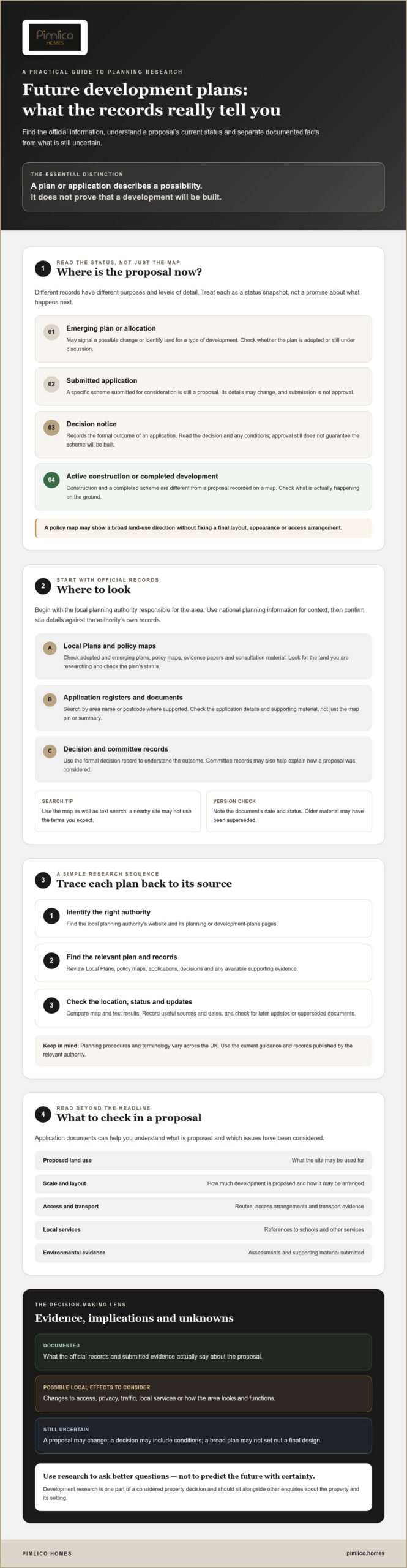
There isn’t one document that sets out every future change. Long-term planning policy, including a council’s Local Plan, gives direction on how land may be used and where development could be appropriate. Emerging proposals may signal possible changes before policy is settled. Planning applications describe specific schemes for consideration, while a decision notice records the formal outcome of an application.
Each source has a different purpose, level of detail and place in the decision-making process. A policy map may identify land for a type of development without fixing the final layout, appearance or access arrangements. An application may contain more detail, but it is still not the same as a completed scheme. The broader principles of urban planning help explain how land use and development are considered across an area.
What can area research tell a homebuyer?
Records can help you identify proposed land use, the possible scale of a scheme, planned access routes and references to transport, schools or other services. Supporting material, such as maps and assessments, can show which issues have been considered and what evidence has been submitted. These details give you a more informed basis for asking questions about a property and its surroundings.
They don’t settle every question. Proposals may change, decisions may include conditions, and broader plans may not specify a final design. Treat research as a way to identify possibilities and uncertainties, not as a forecast of exactly what your future surroundings will be.
Planning procedures and terminology vary across the UK’s nations, so check the guidance and records published by the relevant local planning authority. For a significant home purchase, this research is one part of due diligence, alongside your other enquiries about the property and its setting.
Where to find official future development plans and planning applications
Start with the council responsible for planning in the area. Its official website is the main source for local policies, applications and decisions. When researching future development plans for an area, use national planning information for context, then confirm details against the relevant authority’s records. Portals and terminology vary across the UK, so check that you’re using the correct authority and guidance for the nation in question.
For an accessible introduction to planning in England, GOV.UK’s Plain English guide to the planning system explains the broad framework. It can help make unfamiliar terms easier to follow, but local documents provide the detail for a particular site or application.
Search local plans, policy maps and consultations
Follow this sequence and note what you find at each stage:
- 1. Identify the local planning authority. Find the relevant council’s website and locate its planning or development-plans pages.
- 2. Find plan documents and maps. Look for adopted and emerging Local Plans, planning policy maps, evidence papers and consultation material. Check whether a plan is settled or still under discussion, and what it says about the land you’re researching.
- 3. Search by location. Try the area name or postcode in the council’s search tools, where supported. Use the map as well as text search, since a nearby site may not be described using the terms you expect.
Check the publication date and status shown on each document. An older version may have been superseded, while consultation papers can describe proposals that have not been adopted. Planning terms and processes differ across the UK, so verify terminology against current official guidance rather than assuming that a document has the same status everywhere.
Find planning applications, decisions and committee records
Use the authority’s planning application register to search for proposals near the property. Search by postcode, street or application reference if those options are available. Open the original entry and review its supporting documents, plans and decision notice. A short portal summary may not explain the full scope or current position.
Where councillors have considered an application, check the authority’s committee agendas and minutes. These records can add context about the discussion and decision, but read them alongside the application itself. News reports and third-party summaries can help you spot a possible lead; confirm important details in the council’s source documents.
Keep a simple record of each useful item: its title, publication date, application reference and responsible authority. This makes it easier to compare updates and return to the exact source when questions arise. As you consider the wider setting around a home, you can also explore Pimlico Homes’ residential developments as part of your property search.
Judging the Likelihood of a Proposed Development
A site marked for possible development can look more certain on a map than it is in practice. To judge what the records actually show, distinguish between an idea in a plan, an application being assessed, a formal decision and work on the ground. Each stage provides different evidence, but none should be treated as a promise of completion.
Planning status is evidence of process, not a guarantee that a development will be completed.
What is the difference between a proposed and approved development?
A proposal is a suggested use or design, either identified in planning policy or submitted for assessment. An approval records a decision on an application, but its scope is defined by the decision notice and approved documents. Conditions may require further details or action. For a fuller view, check whether relevant conditions have been discharged and whether an appeal or subsequent application has affected the position. Planning procedures differ across the UK, so confirm status through the relevant authority’s records.
How should you read plans, drawings and status updates?
Check the application reference, document date, drawing revision and any note describing a plan as indicative. Compare the latest approved drawings with earlier submissions, since revisions can alter layout, access or scale. Visualisations can make a possible scheme appear fixed, but an illustration is not necessarily a definitive picture of what will be built. Treat the status label as a prompt to inspect the underlying documents, rather than as a complete account of the proposal.
When researching future development plans for an area, follow the record over time rather than relying on a single status label. A decision, its conditions, any appeal and later updates together provide a more grounded view of what is known and what remains uncertain.
How to assess what a future development could mean for the area
A proposal’s effect depends on more than its headline description. A group of homes, for example, could have different implications depending on its scale, access arrangements, construction phases and relationship to existing services. Review the supporting application material rather than relying on a summary or concept image. The approved scheme, any conditions and whether it is delivered all matter.
Which parts of a proposal deserve closer attention?
Use this checklist to focus your review on details that could shape everyday life around a property:
- Proposed use and scale: What is the site intended for, and what overall form or number of buildings is shown? Compare the site plan with elevations and sections where available.
- Access and transport: Check vehicle, pedestrian and cycle access, parking provision and any submitted transport assessment. Note what the documents say about traffic and connections to nearby routes.
- Services and infrastructure: Check whether application material discusses capacity or changes involving services such as schools, healthcare, water or drainage. Don’t assume a service will be expanded unless the record supports that conclusion.
- Environmental evidence: Look for relevant reports on ecology, noise, drainage, trees, flood risk or other site-specific matters. Note which topics are addressed and what evidence or mitigation is described.
- Phasing and related proposals: Where details are available, note when different parts are intended to proceed. Search the register for later revisions or linked applications that may alter the overall picture.
A missing or outdated document is an unanswered question, not proof of harm. Record what the application actually states separately from your own concerns or assumptions. Check that drawings and reports refer to the same proposal and that you are reading the latest available versions.
How can you verify findings and record uncertainty?
Keep a dated log with the authority’s name, application reference, document title, publication or revision date, decision and any follow-up questions. Cross-check council summaries against the application documents, decision notice and relevant consultation responses. If a proposal has changed, compare revisions to see whether its layout, access or scale has shifted. Treat visualisations as illustrations, not definitive promises of the completed development.
For a material concern or an unclear record, ask the planning authority where to find the relevant information. An appropriately qualified property professional may help you consider how the findings fit into wider home-buying due diligence. As you weigh the setting around a potential home, explore Pimlico Homes’ residential developments as one part of your property search.
How to use development-plan research in a considered home decision
Good research is most useful when it leads to clear next steps, rather than a prediction about what an area will become. Before making a significant property decision, work through the evidence in order: verify the source, compare documents, record what you’ve found, ask about anything unclear, then review the records again. Plans and applications can change, so an earlier search may not reflect the latest position.
A final checklist before making a property decision
- Verify: Confirm the proposal’s current status with the relevant planning authority and open the latest official documents.
- Compare: Check whether drawings, decisions or conditions have changed since the documents you first reviewed.
- Record: Separate confirmed information from uncertainty. Note unanswered questions and where you found each detail.
- Ask: Contact the planning authority if the public record is unclear. For questions about how findings relate to the purchase, seek advice from an appropriately qualified independent property professional.
- Review: Revisit the authority’s records before committing, particularly if time has passed or a proposal is still at an early stage.
Connect area research with wider home-buying due diligence
Researching future development plans for an area is one strand of due diligence, not a substitute for assessing the home itself. Consider the property’s condition, specification and suitability alongside your findings about its surroundings and your legal checks. Planned change may prompt useful questions about access, noise or services, but it isn’t a standalone measure of a home’s suitability or value.
For a broader view, consider the purchase alongside guidance on buying a luxury new-build home, as well as your own enquiries. Area research can inform your judgement, but it cannot settle every question about a property or its future setting.
Keep the conclusion measured. Official records can help you understand what is proposed, decided or changing, but they cannot guarantee what will ultimately be built. If you’re considering a new home, explore the homes available from the developer as one part of a carefully considered search.
Make your next home decision with confidence
Researching future development plans for an area can bring greater clarity to an important decision, provided you treat each record as evidence rather than a promise. Start with official council sources, distinguish an emerging proposal from a decided application, and check supporting documents for details that could affect the area. Then weigh what you’ve found alongside the home itself, including its condition, specification and legal checks.
Plans can change, and no search can predict every outcome. The aim is to understand what is known, identify what remains uncertain and ask the right questions before committing. This measured approach makes area research a useful part of due diligence, not a substitute for it.
Pimlico Homes is a specialist developer of luxury new-build homes, including detached homes, executive courtyard homes and bespoke barn conversions. If you’re exploring a new home, discover Pimlico Homes’ residential developments and consider which setting and style may suit your plans. Review the available homes and get in touch with Pimlico Homes to explore your options.
Frequently Asked Questions
How can I find out about future development plans in an area?
Start with the official website of the local planning authority responsible for the area. Search its Local Plan, policy maps, planning application register and committee records. When researching future development plans for an area, note each document’s date and any application reference, then open the original material rather than relying only on a summary. For a proposal, check its current status and look for later decisions, appeals or revised submissions.
Is a site in a Local Plan guaranteed to be developed?
No. A Local Plan or site allocation can indicate that development is being considered or supported by policy, but it does not itself grant permission or guarantee that building will take place. Site availability, detailed proposals, assessment and later decisions all affect what may happen. Check the authority’s current documents and status information. Treat a plan as evidence of a possible direction for an area, not certainty about a completed scheme.
Can I see planning applications for a property or area online?
Often, yes. Many planning authorities publish online application registers containing reference numbers, submitted documents and decision information. Search the authority responsible for the location, using its available address, map or postcode search. Portal features and records vary, and older or incomplete entries may not be easy to find. If an application is missing or the online record appears incomplete, contact the planning authority for guidance.
What is the difference between a proposed development and planning permission?
A proposed development is a scheme being considered or submitted, so its details and acceptability may still be under review. Planning permission is a formal decision recorded by the relevant authority, and it may include conditions or other requirements. Permission does not establish that construction has started or will be completed. Read the decision notice and check subsequent records for relevant conditions, appeals or changes to the proposal.
How do I know whether a planning proposal is likely to go ahead?
No public record can guarantee that a proposal will be completed. Check its current stage, the authority’s decision, any conditions, appeal information and later applications. A site identified in a plan is generally less certain than a scheme with a recorded permission, but permission is not a promise that work will begin or finish. Verify details through the relevant authority’s official records and note what remains unknown.
What happens if a planning application is refused or changed?
Check the decision notice, then search the authority’s records for any appeal or later application relating to the site. An applicant may revise a scheme, submit another application or pursue an appeal, depending on the circumstances. A refusal does not necessarily settle the matter permanently, and a revised proposal is not guaranteed approval. Base your assessment on the latest official documents, comparing them with earlier submissions to identify changes.
Do planning systems work the same way across the UK?
No. Planning responsibilities, processes and terminology differ between England, Scotland, Wales and Northern Ireland, and some guidance applies only to one nation. First identify which nation and planning authority cover the area, then use that authority’s official records and current national guidance. Treat England-specific examples as such rather than assuming they apply UK-wide. If a term or process is unclear, check it with the relevant authority.





