
The more affordable-looking driveway may not be the less costly choice over time. The comparison of resin driveways versus block paving for new homes depends on more than the initial outlay: resin-bound surfacing generally needs less routine maintenance, while block paving offers individual blocks that can be replaced or lifted for access. The right option also depends on the base, drainage and finish.
When comparing resin driveways vs block paving for new homes, appearance is only part of the decision. The installation, drainage, maintenance and repair options all affect how each surface performs over time. Consider the full specification, not just the visible finish, before deciding what suits your home.
Your choice also depends on site conditions, vehicle use and the look you want. The practical comparisons below can help you weigh those factors and decide which surface best fits your plans.
Key Takeaways
- Choose a permeable surface and plan the base and driveway levels carefully to manage rainwater effectively.
- Factor routine care into your choice: block paving needs attention to its joints, while resin-bound paving has different cleaning and repair considerations.
- Consider how each surface handles wear and future access; individual blocks can be lifted or replaced, while resin repairs may be more visible.
- Compare the full installation scope, including the base and edging, then match the finish to your home’s design and long-term priorities.
Battle of the driveways: Resin Bound vs Block Paving – Which is best?
Drainage depends on the entire installation, not simply the surface finish. Compare permeability, base preparation and the proposed drainage design before choosing a driveway for a new home.
Resin-Bound Drainage and Permeability
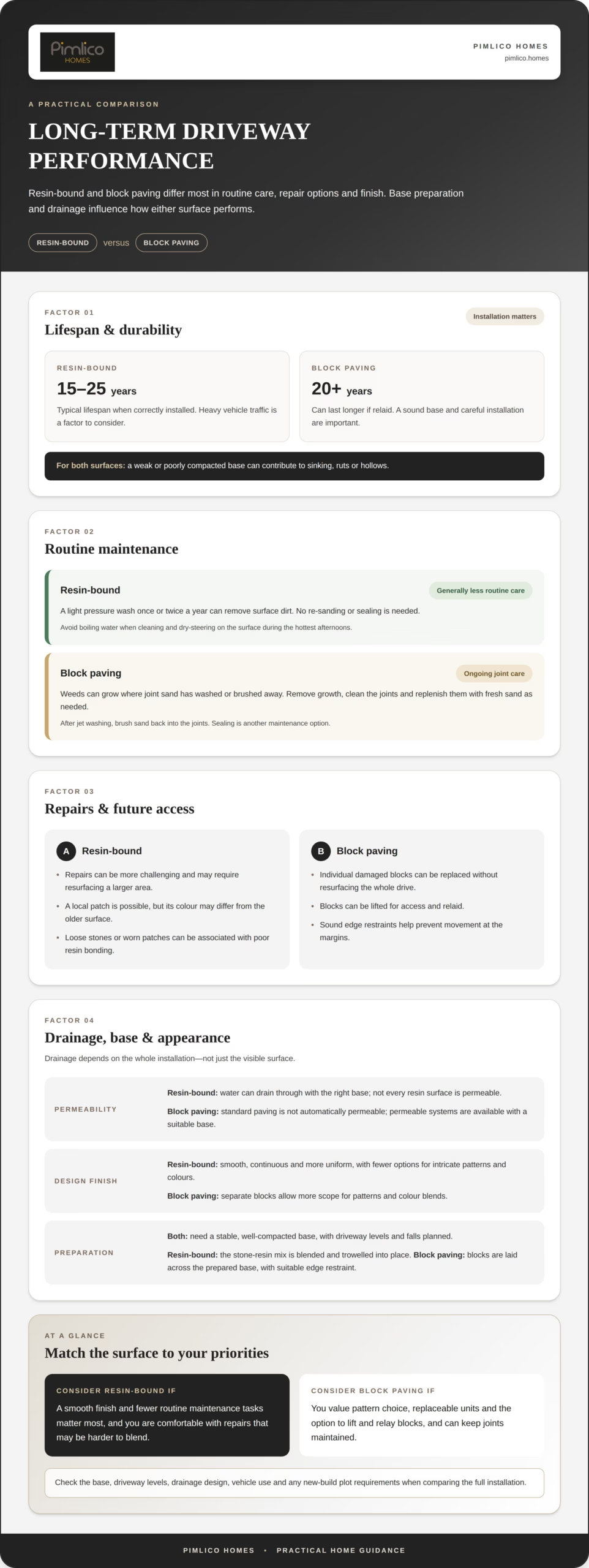
Resin-bound surfacing blends natural stone with clear, UV-stable resin, then is trowelled into a smooth, porous finish. With the right base, water can drain through the surface, making it a choice to consider where drainage and SuDS matter. It offers a more uniform appearance than block paving, with fewer options for intricate patterns and colours.
Block Paving Drainage
Standard block paving is not automatically permeable, but permeable systems are available when installed with a suitable base. A drainage design can help manage pooling, while ordinary blocks may allow water to collect. Separate blocks offer more scope for patterns and colour blends than resin’s continuous finish, but drainage depends on the system beneath the paving.
Planning and SuDS Approvals
There is no single rule that applies to every driveway across England, Scotland, Wales and Northern Ireland. An impermeable driveway may need planning permission, and not every resin surface is permeable. SuDS approval depends on the proposed drainage design and development requirements, not the surface alone. New-build documents may also set conditions for driveway materials or alterations, so check the relevant plot documents before making changes.
Base Preparation and Installation
For either surface, start with a stable, well-compacted base and plan the driveway’s levels and falls. Sub-bases are often built from MOT Type 1 in layers, with each layer thoroughly compacted. Resin-bound installation then blends and trowels the stone-resin mix into place. Block paving requires blocks to be laid across the prepared base, with suitable edge restraint helping prevent movement at the margins.
| Option | Permeability | Design | Key requirement |
|---|---|---|---|
| Resin-bound | Permeable with the right base | Smooth, fewer patterns | Stable, drained base |
| Block paving | Permeable systems available | More patterns and blends | Permeable base for drainage |
Choose resin-bound surfacing for a smooth finish with planned permeability, or a permeable block system for greater pattern choice.
Maintenance requirements
Resin-bound driveways generally need less routine care than block paving. A light pressure wash once or twice a year can remove surface dirt, and resin-bound paving does not need re-sanding or sealing. Avoid boiling water when cleaning and dry-steering on the surface during the hottest afternoons to help preserve the finish.
Block paving needs more attention at the joints. Weeds can take root where sand has washed or brushed away, so remove growth, clean the joints and replenish them with fresh sand as needed. Sealing is another maintenance option. After jet washing, for example, brush sand back into the joints to restore their fill.
Resin-bound paving suits homeowners who want a simpler cleaning routine; block paving offers a familiar surface but needs ongoing joint care. Resin has no sanded joints for weeds to grow into, although debris still needs clearing. With block paving, inspect the joints and surrounding growth as part of regular outdoor maintenance.
Repairs differ too. Individual damaged blocks can be replaced, while resin-bound repairs may be more challenging and require resurfacing a larger area. A local resin patch is possible, but its colour may differ from the older surface. Block paving allows a direct unit replacement; a resin repair may leave a visible change in the stone blend.
Maintenance affects both appearance and the effort involved over time. Choose resin-bound surfacing if fewer routine tasks matter most, while recognising that repairs may be harder to blend. Choose block paving if you value replaceable units and can keep the joints clean, weeded and replenished. Check either surface regularly for loose blocks, worn joints or damage.
Block paving durability and repairability
Block paving is a durable option for driveways carrying regular vehicle traffic. Its interlocking units distribute weight, helping reduce the risk of cracking under load. Individual blocks can still crack after an impact, but a damaged unit can be replaced without resurfacing the entire drive. Sound edge restraints also help prevent paving from creeping at the margins.
Block paving can last 20 years or more, and may last longer if relaid. That lifespan depends on a sound base and careful installation. A poorly prepared base can lead to ruts or hollows; blocks may shift as the ground beneath them settles. Weeds can grow in the joints, although regular joint care belongs to the maintenance picture rather than the surface’s structural lifespan.
Resin-bound surfacing has a typical lifespan of 15 to 25 years when correctly installed. Its seamless finish can suit homeowners who prefer a continuous surface, but repairs are less straightforward than replacing individual blocks. A localised repair is possible, though the new area may differ slightly in colour. Heavy vehicle traffic can be a consideration when comparing resin with block paving.
Durability depends on installation. A weak or poorly compacted base can contribute to sinking with either surface. Weeds are more likely in block joints, while poor resin bonding can cause loose stones or worn patches. Blocks can crack after impact, and a UV-stable resin binder does not mean the colour can never change.
When weighing long-term durability, consider vehicle loads, base quality and how important straightforward repairs are to you. Block paving uses replaceable units and can be relaid, which can make local access or damage easier to address. Resin creates a continuous finish, but repairs may be more visible and heavy use can be a concern. Balance a seamless appearance against the ease of replacing individual units.
Resin-bound and block-paving cost comparison
A careful comparison of resin driveways vs block paving for new homes starts with the full installation scope. The cost ranges overlap, so the surface material alone does not show which option will cost less.
The choice of block can shift the estimate considerably. Resin-bound surfacing combines natural stone with resin, and its cost also depends on the area and installation specification.
| Driveway material | Typical UK cost per square metre | What affects the comparison |
|---|---|---|
| Resin-bound | Area, base and finish | |
| Block paving | Block type, base and edging |
For resin driveways vs block paving for new homes, compare like with like: the same area, preparation, suitable base and edging. Quality block paving and resin can fall within a similar price range when those elements are included. Natural-stone blocks, for example, may cost more than traditional blocks, while additional base work can affect either option.
Use the per-square-metre figures as a starting point, then weigh the chosen finish against maintenance and repair considerations. A lower material cost does not necessarily mean a lower overall installation cost if the base or edging differs. Resin may appeal beside a contemporary property, while block paving offers broader choices of pattern and material. For a considered approach to a new home, explore bespoke home design.
Pimlico Homes
Pimlico Homes creates new homes in which the setting, arrival and architectural character form part of one considered vision. When weighing resin-bound surfacing against block paving, consider how the driveway relates to the home’s layout and exterior materials. A smooth resin finish may complement contemporary lines, while block paving offers patterns and texture at the entrance.
For a bespoke luxury home, the driveway is part of a wider conversation about how the property should look and function. Pimlico Homes creates Luxury Detached Homes, Executive Courtyard Homes, Bespoke Luxury Homes and Luxury Barn Conversions. Each provides a distinct context for considering the approach as part of the home, rather than as an isolated surface.
If you are planning a new home and would like to discuss its wider design, contact Pimlico Homes.
Shape an arrival that belongs to your home
Choosing resin or block paving for a new home is also a design decision: the entrance sets the tone before the front door comes into view. Consider how the driveway’s colour, texture and pattern will sit alongside the architecture, planting and boundaries. A material that looks right on its own may create a different impression as part of the whole property.
Consider the driveway while the wider home design is taking shape, rather than treating it as a finishing detail. This makes it easier to create a considered relationship between the approach, the building and its surroundings. Pimlico Homes focuses on distinctive homes, making the wider design a natural starting point for discussing the arrival.
Contact Pimlico Homes to discuss how your driveway can complement your home, and take the next step towards a more cohesive design.
Frequently Asked Questions
What happens if your driveway needs repaired?
Block paving repairs can often be limited to the affected area: damaged units are lifted and replaced, then the surrounding surface is relaid. Resin-bound paving can also be repaired locally, but matching the existing stone blend and colour may be difficult. Wider damage may require resurfacing a larger section. The right approach depends on the extent and location of the damage.
Which Surface Offers Better Value?
Neither surface offers better value in every situation. Resin-bound paving may suit homeowners who prefer less routine maintenance, while block paving allows individual units to be replaced. Compare the full installation scope, including the base and edging, alongside upkeep and repair needs. A lower initial cost alone does not determine which driveway offers better value over time.
Which is The Best Solution for Your Driveway?
The right surface depends on your site conditions, drainage plans and preferred appearance. Resin-bound paving may suit a modern, uninterrupted design if the base supports drainage. A permeable block system can work well when pattern choice matters. Also consider vehicle use, since block paving’s interlocking units can handle heavy loads.
Which should you choose?
Choose resin-bound paving if a smooth finish and fewer routine maintenance tasks matter most, and you are comfortable with potentially more visible repairs. Choose block paving if you value varied patterns and replaceable units. For a new home built by Pimlico Homes, assess the driveway alongside the exterior design, drainage requirements and expected vehicle use. These priorities offer a more useful guide than appearance alone.
What are the typical UK costs per square metre for resin driveways and block paving?
Resin-bound driveways typically cost between £50 and £90 per square metre in the UK, while block paving costs around £60 to £110 per square metre. These broad ranges overlap. Block material affects the price: traditional blocks, premium concrete, clay and natural stone have different cost ranges. The area, base preparation and edging also influence the total installation cost.
How durable are resin-bound driveways compared with block paving, and what is their expected lifespan?
Correctly installed resin-bound driveways typically last around 15 to 25 years, while block paving can last 20 years or more and may last longer if relaid. These figures describe typical lifespans, not a guarantee for an individual driveway. A stable base and suitable installation are central to durability. Block paving can suit heavier vehicle use; resin may be less robust under heavy traffic.





