A Section 106 obligation is not a standard charge applied to every development. In England’s planning system, it is linked to a particular site and the effects of its proposed development. If you are searching for “understanding a developer’s obligations under Section 106”, start with this distinction: the requirements depend on the land, proposal and agreement.
The legal language can make it difficult to tell what an agreement requires, when an obligation takes effect or whether it applies to a specific home. It is also easy to confuse Section 106 with the Community Infrastructure Levy (CIL), although a development may be subject to both.
This guide explains the purpose and main forms of planning obligations, how they are assessed and agreed, and what delivery or discharge may involve. It also considers what an agreement could mean for a developer, landowner or homebuyer, including how obligations can bind successors in title. The detail depends on the agreement and the development, so some questions call for project-specific planning or legal advice. Clear obligations help connect a development’s design and delivery with the needs it creates.
Key Takeaways
- To understand a developer’s obligations under Section 106, identify the specific commitments recorded for the development and the land.
- Follow how a planning impact can lead to an obligation being drafted, completed and monitored by the relevant parties.
- Distinguish a negotiated Section 106 obligation from the Community Infrastructure Levy, which operates through a separate mechanism.
- Use the agreement to identify when obligations are triggered and what evidence, payments or actions may be needed to discharge them.
- When buying a home, review the relevant planning documents and legal position to understand which obligations affect the land and whether any apply to you.
Understanding a Developer’s Obligations Under Section 106
A Section 106 obligation is a planning obligation secured under section 106 of the Town and Country Planning Act 1990. It links a commitment to particular land and a proposed development, rather than imposing a universal charge on every developer. To build a clear understanding a developer’s obligations under Section 106, read the agreement in the context of the specific site and planning proposal.
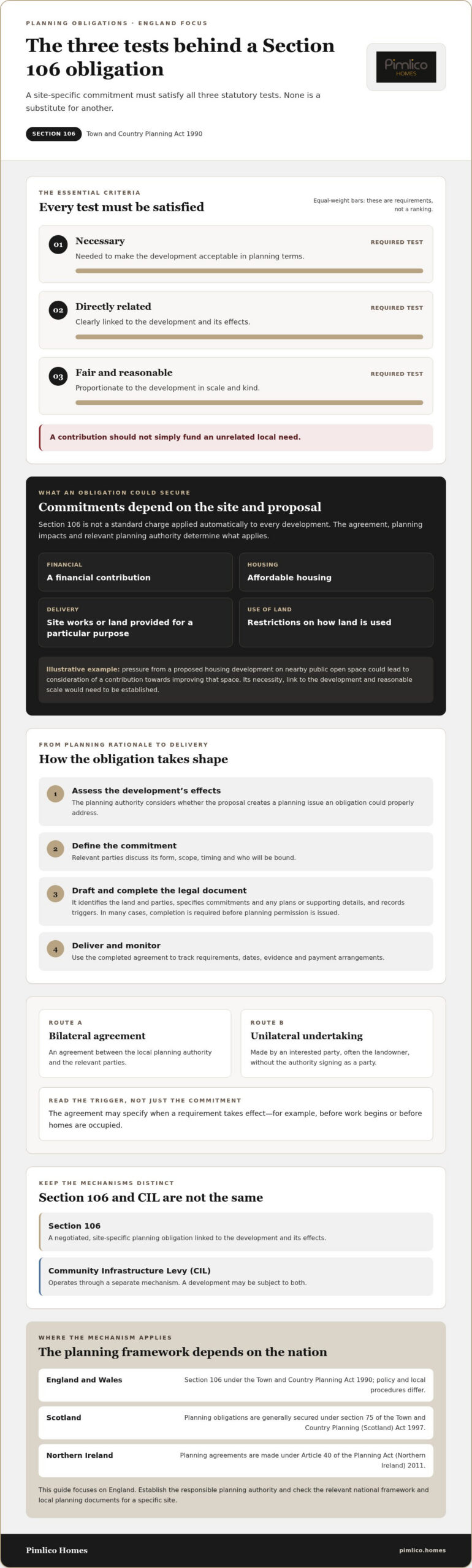
Depending on the development, an obligation might require a financial contribution, affordable housing, site works, land to be provided for a particular purpose, or restrictions on how land is used. These commitments are not automatic. The agreement, the development’s impacts and the relevant planning authority determine what applies. Planning obligations must meet statutory tests: they must be necessary to make the development acceptable in planning terms, directly related to it, and fairly and reasonably related in scale and kind.
What does a Section 106 agreement do?
A planning obligation can address an effect of a proposal that would otherwise make it unacceptable. It sets out what must be done and when. It may be documented as a bilateral agreement between the local planning authority and relevant parties, or as a unilateral undertaking made by an interested party, often the landowner, without the authority signing as a party. Both routes can secure obligations in connection with planning permission.
The wording matters. The document identifies the land and parties, specifies each commitment and sets any triggers, such as a requirement taking effect before work begins or before homes are occupied. The statutory basis and purpose are summarised in Section 106 of the Town and Country Planning Act 1990. A clear, site-specific agreement helps everyone understand the relationship between the development and its obligations.
Which parts of the UK use Section 106?
The Section 106 mechanism under the 1990 Act applies in England and Wales, although planning policy and local procedures differ between the two nations. This guide focuses on the English planning context. Scotland and Northern Ireland have separate planning frameworks and statutory routes: planning obligations are generally secured under section 75 of Scotland’s Town and Country Planning (Scotland) Act 1997, while Northern Ireland has planning agreements under Article 40 of the Planning Act (Northern Ireland) 2011.
Guidance or policy for one nation should not be assumed to apply elsewhere. For a particular site, establish which planning authority is responsible and refer to the relevant national framework and local planning documents. Where the agreement’s effect or wording is uncertain, project-specific planning or legal advice can help clarify the position.
How Section 106 Obligations Are Assessed and Agreed
Assessment begins with the proposed development and its likely effects. The planning authority considers whether those effects create a planning issue that an obligation could properly address. The developer and other relevant parties then discuss the form, scope and timing of any proposed commitment. Understanding a developer’s obligations under Section 106 means following the process from the planning rationale through to the final agreement and its monitoring.
In England, national planning policy sets three tests for planning obligations: they must be necessary to make the development acceptable in planning terms, directly related to the development, and fairly and reasonably related to it in scale and kind. The government guidance on planning obligations explains how these tests inform decisions. Meeting them does not guarantee that a particular obligation will be agreed: the proposal and evidence still need to be considered in context.
What tests should a planning obligation satisfy?
In practical terms, an obligation should address a genuine planning consequence, have a clear link to the development and be proportionate to its effects. It should not simply fund an unrelated local need.
Illustrative example: if a proposed housing development is expected to add pressure to a nearby public open space, a contribution towards improving that space might be considered. The authority would need to establish why the contribution is necessary, how it relates to the development’s impact and whether its scale is reasonable. The same tests apply to non-financial commitments, such as providing affordable housing or carrying out site works. The evidence, policy and proposal determine the detail.
How does a planning obligation reach completion?
Once a potential obligation is identified, the parties clarify what it will require and who will be bound. Drafting should accurately identify the relevant land, parties, commitments and any plans or supporting details. The wording should also make clear when each requirement is triggered, such as at commencement or occupation, where specified.
The obligation is completed through the relevant legal process, which can involve a bilateral agreement or a unilateral undertaking. In many cases, completion is required before planning permission is issued, though the process depends on the application and authority. After completion, the agreement is the reference point for delivering and monitoring commitments. Record dates, evidence requirements and payment arrangements clearly rather than relying on informal assumptions.
These are binding legal terms, so project-specific legal or planning advice may be appropriate before agreeing wording or interpreting its effect. Clear obligations support the considered delivery of residential development. To explore the design and character of Pimlico Homes’ residential developments, view the homes and developments on the company website.
Section 106 or Community Infrastructure Levy: What Is the Difference?
Section 106 and the Community Infrastructure Levy (CIL) are distinct planning mechanisms. In England, Section 106 obligations are negotiated in connection with particular land or a development, while CIL is a levy that a charging authority may introduce through its own charging schedule. Understanding a developer’s obligations under Section 106 means distinguishing site-specific commitments from a separate charge calculated under CIL rules. The Planning Portal’s explanation of Section 106 agreements provides further context on the role of planning obligations.
| Feature | Section 106 | CIL |
|---|---|---|
| Legal mechanism | A planning obligation secured through an agreement or undertaking. | A statutory levy established under CIL legislation and administered under its regulations. |
| How liability is established | Negotiated for the proposal and recorded in the obligation, subject to planning policy and legal tests. | Determined under the applicable charging schedule and CIL rules, including any relevant relief or exemption. |
| Typical application | Site-related commitments, which may include affordable housing, works, restrictions or agreed contributions. | A charge towards infrastructure, generally calculated by reference to development floorspace and the authority’s published rates. |
What does a Section 106 agreement cover that CIL may not?
A Section 106 obligation can set out commitments tailored to a development, such as affordable housing provision, a restriction on how land may be used, specified site works or a contribution connected to an identified impact. These are examples, not standard requirements for every scheme. The planning context and the agreement’s precise terms determine whether a commitment is included and what it requires.
CIL, by contrast, operates through the charging authority’s published schedule and the relevant statutory rules. It is not a substitute for every site-specific obligation. A Section 106 contribution should not be treated as a general payment towards any local project: its purpose and relationship to the development must be established.
Can Section 106 and CIL both apply to a development?
Yes. Both mechanisms may be relevant to the same development, depending on the proposal, local arrangements and applicable rules. Their purposes and legal bases differ, so the presence of one does not automatically remove or duplicate the other. Review the planning decision, the completed Section 106 agreement and the current CIL charging schedule together. These documents help clarify the development’s obligations, how any charge is calculated and when commitments take effect.
Delivering, Monitoring, and Changing a Section 106 Obligation
A completed agreement is not the end of the process. Each obligation must be delivered in line with its wording, which may set a trigger such as commencement of development or occupation of a home. Understanding a developer’s obligations under Section 106 means looking beyond what has been promised to when it falls due, who must act and what evidence will demonstrate completion.
For a residential development, a missed trigger or incomplete record can create uncertainty for the project and the authority monitoring it. Keep the signed agreement alongside the planning permission, plans and any formal variations. Use the agreement as the source for each obligation’s specific requirements.
What should a developer track during delivery?
Turn the agreement into a practical schedule. For each obligation, record:
- Commitment and responsible party: what must be done, paid or restricted, and who is responsible.
- Trigger and deadline: the event or date that activates the obligation, as stated in the agreement.
- Evidence and status: records of works, payments or other steps taken, plus any submission or confirmation required by the agreement.
- Financial details: the stated calculation method, indexation, interest provisions and payment instructions.
- Discharge requirements: any process or evidence needed to demonstrate that the obligation has been satisfied.
Check the exact terms rather than relying on a general project timetable. An obligation may have been fulfilled in practice, but that does not always mean the authority’s records have been updated or that any required confirmation has been obtained. Keep correspondence and evidence together, and establish whether further steps are needed to record discharge.
Can a Section 106 obligation be varied or discharged?
In England, statutory routes may allow an application to modify or discharge an obligation. Under section 106A of the Town and Country Planning Act 1990, an application can generally be made after five years from the date the obligation was entered into. Eligibility and procedure depend on the legislation, the agreement and the circumstances. A request does not guarantee that the authority will agree to the proposed change.
Before seeking a change, establish the agreement date, the provision in question and the effect of the proposed variation. Check the current statutory process and obtain tailored planning or legal advice where the consequences are material. Clear records and obligations support the considered delivery of homes. Explore Pimlico Homes’ residential developments.
What Section 106 Means for Landowners, Developers, and New-Home Buyers
A Section 106 obligation can have implications beyond the planning application. Depending on its terms and the legal position, an obligation may bind the land and affect later owners. That does not mean every new-home buyer automatically takes on every commitment made by a developer. The agreement, the property’s title and the circumstances of the purchase all matter.
For landowners, an agreement may shape how land can be used or developed, and may be relevant to its value or a future sale. Developers need to understand the commitments, triggers and delivery requirements that relate to their proposal. For buyers, clarity about which parts of the agreement affect the home or wider site can make the planning context easier to understand.
What should a homebuyer look for in planning documents?
Start with the planning decision and the Section 106 agreement, then look for provisions that relate to the property or the development as a whole. Check whether the agreement refers to particular land, sets restrictions, requires works or records contributions, and whether information about relevant triggers or discharge is available. A conveyancer can help interpret how the agreement and title documents apply to the purchase.
Reservation, sale and occupation arrangements are specific to the development and its documents. Do not assume that a developer’s commitment transfers to an individual buyer, or that it has no bearing on the property. For broader purchase considerations, a guide to buying a luxury new-build home can sit alongside a careful review of the planning papers.
Why clear obligations matter to a residential development
For a developer, clearly documented and deliverable obligations help connect the planning decision with the practical sequence of building and occupation. For landowners and buyers, accessible information can explain how commitments relate to the site and what remains to be completed. Precision matters: read the agreement on its own terms, rather than treating it as a general charge or a blanket promise about a development.
Understanding a developer’s obligations under Section 106 starts with the documents that apply to the specific land and proposal. Review the planning decision, agreement and relevant title information, and seek tailored legal or planning advice where the effect is uncertain. To explore Pimlico Homes’ residential developments, discover its collection of luxury detached homes, executive courtyard homes and bespoke new builds.
Make Your Next Property Decision with Clarity
Section 106 obligations are specific to the land and development, not a standard charge on every developer. Their terms set out what must be delivered and when, while CIL operates through a separate charging framework. For buyers and landowners, the planning decision and agreement offer essential context, but the effect on a particular property depends on the documents and legal position.
Understanding a developer’s obligations under Section 106 means reading the relevant agreement carefully, tracking its triggers and distinguishing a completed commitment from one formally discharged. Where the implications are uncertain, tailored planning or legal advice can help clarify the position.
Pimlico Homes specialises in bespoke residential development, creating luxury detached and executive courtyard homes. Explore Pimlico Homes’ residential developments to discover its luxury homes and bespoke new builds.
Frequently Asked Questions
What is a developer’s obligation under Section 106?
A developer’s Section 106 obligation is a planning obligation secured under section 106 of the Town and Country Planning Act 1990. Its terms relate to particular land or a development and may require payments, affordable housing, site works or restrictions on use. These are possible forms, not automatic requirements for every scheme. Understanding a developer’s obligations under Section 106 means checking the specific agreement and its planning context.
Is a Section 106 agreement compulsory for every development?
No. Section 106 is not a universal charge or an automatic condition for every development proposal. Whether an obligation is required depends on the proposal’s planning context, its impacts, applicable policy and the relevant legal tests. A planning authority may seek an obligation where it is justified, but the outcome depends on the circumstances. To understand a particular site, review its planning decision and site-specific documents rather than assuming an agreement applies.
Can a developer negotiate the terms of a Section 106 agreement?
Yes. The terms are considered in the planning process between the planning authority and relevant parties, and may be discussed as a proposal is assessed. Any obligation should relate to the development and satisfy the applicable policy tests. The supporting evidence, proposed wording and circumstances all matter. Negotiation does not guarantee that a particular term will be accepted or removed, so the final executed agreement is the key record of what has been agreed.
Does a Section 106 obligation transfer to a new landowner?
Some Section 106 obligations can bind the land and affect people who later acquire an interest in it, but the precise effect depends on the agreement and legal position. This differs from a personal commitment, which may apply only to a named party. For a purchase or transfer, review the executed agreement alongside the title documents. Obtain tailored legal advice if you need to establish which obligations affect a particular property or owner.
Can a Section 106 agreement be changed or discharged?
A Section 106 obligation may be varied or discharged through an applicable legal route, but this is not automatic. Eligibility, timing and circumstances can affect which procedure is available, and an authority is not obliged to agree to a requested change simply because it has been proposed. Before relying on a variation, review the agreement and check the current statutory process for the site’s jurisdiction. Tailored planning or legal advice can clarify the options.
Is Section 106 the same as Community Infrastructure Levy?
No. Section 106 and the Community Infrastructure Levy (CIL) are separate planning mechanisms. Section 106 secures obligations connected to particular land or a development, with terms recorded in an agreement or undertaking. CIL operates through a distinct charging framework, including the relevant charging schedule and regulations. Both may be relevant to one proposal, depending on the applicable rules. Review the planning decision, Section 106 agreement and current CIL schedule together.
When must a developer fulfil a Section 106 obligation?
The agreement sets when each obligation must be fulfilled. A trigger may relate to a defined stage, such as commencement of development or occupation, but there is no single timing rule for every commitment. Read the executed agreement to identify the trigger, any deadline, the responsible party and the evidence required. For financial obligations, check the stated payment terms and calculation provisions. Keeping a clear record helps establish what is due and whether it has been completed.
Does Section 106 apply throughout the United Kingdom?
No single planning framework applies throughout the UK. Section 106 of the Town and Country Planning Act 1990 is used in England and Wales, though planning policy and procedures can differ between them. Scotland and Northern Ireland have separate planning legislation and mechanisms for securing planning obligations. Establish the site’s jurisdiction and refer to the relevant planning authority’s current rules and documents. This guide focuses principally on the English planning context.