What if the strongest security in a luxury home is not the most visible? The most effective security features in luxury new build homes are considered as part of a wider picture, where the property’s design, technology and everyday routines work together.
It is understandable to wonder which measures make a meaningful difference. Cameras, access controls and alarms can offer reassurance, but visible equipment may affect the character of a carefully designed home. Privacy matters too, particularly when family, guests and household staff share access.
This guide explains how to think about layered security, compare physical measures and electronic systems, and manage access responsibly. It also covers questions to raise during the design and purchase journey. The aim is a home that feels protected without losing the ease, warmth and quiet welcome that make it yours.
Key Takeaways
- Assess security against your household’s routines and the home’s layout, rather than choosing measures based on fear or appearance alone.
- Compare security features in luxury new build homes by their purpose, upkeep and effect on the design. One solution will not suit every household.
- Plan doors, windows, lighting and cabling early, before interior finishes are fixed.
- Manage household access through clear permissions and regular reviews. Keep any staff checks relevant, respectful and lawful.
- Use a considered handover and review routine to help security measures remain practical as household needs change.
Why security features deserve early consideration in a luxury new build home
Security is most useful when it starts with how you will live in the home, rather than with a list of devices. A layered approach brings together the property’s design, physical measures, technology and household routines. Each element has a role: the layout can support clear visibility, doors and windows can provide physical protection, technology can assist with detection or access, and consistent habits help everything work day to day. A broad overview of Home security systems illustrates the range of measures that can form part of this picture.
A layered security plan is a considered combination of design, measures and habits, not reliance on one product. That distinction matters in a luxury home, where privacy, ease of use and architectural character are as important as sensible protection. The right balance depends on the household and the property, not on fear or assumptions about crime.
Thinking about security early gives it a place in the design and purchase journey. Entrances, window placement, external lighting and the routes people take through the home can be considered alongside comfort and appearance. This is especially useful in a bespoke new build, where the arrangement of spaces is shaped around the household. Thoughtful planning can help a home feel private and welcoming, without making protection its defining feature.
Begin with the household, the property and its approach
Start with ordinary patterns. Consider when the home is occupied, how deliveries arrive, where visitors are welcomed and how often the household is away. Then look at the approach to the property: the number and position of entrances, sightlines from inside and outside, the boundary layout and areas that become less visible after dark. These details help identify practical questions without relying on dramatic claims about risk.
For example, a delivery point near the main entrance may shape how parcels are received, while a regularly used side entrance may need to be included in everyday access arrangements. These are not universal vulnerabilities, but prompts to understand how the home will function. Match any measures to actual use and the site layout, keeping the response proportionate and manageable.
Build security into the home without losing its character
Including security in early design conversations can help preserve a considered architectural finish. The position and specification of doors and windows, circulation routes and the relationship between internal rooms and external spaces all influence how the home feels and functions. Lighting can support comfortable movement and visibility, while carefully considered sightlines can help residents see their surroundings without sacrificing privacy.
Discretion often comes down to coordination. Rather than letting equipment or later additions dictate the appearance of a façade, consider how practical requirements can sit alongside materials, proportions and landscaping. Security should contribute to confidence and comfort, not create a display of threat. In a thoughtfully designed new home, protection can be built into how spaces work, even when it is not the first thing a visitor notices.
Layered security features in luxury new-build homes
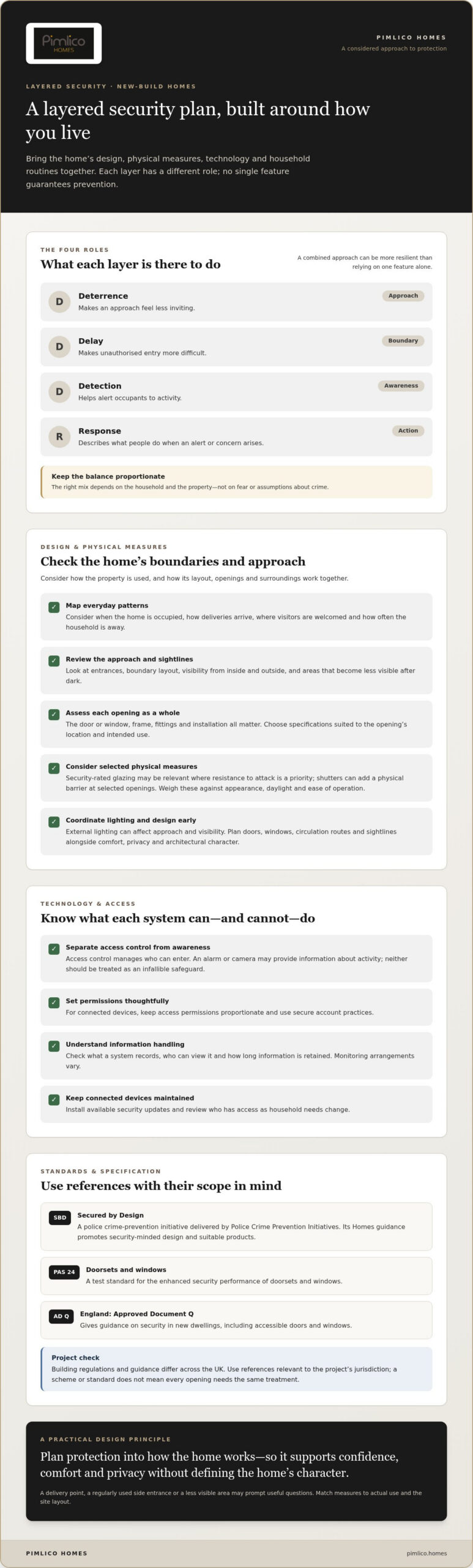
Each layer has a distinct purpose. Deterrence makes an approach feel less inviting; delay makes unauthorised entry more difficult; detection helps alert occupants to activity; and response describes what people do when an alert or concern arises. None guarantees prevention. Together, physical measures, access management, electronic systems and household routines can provide a more resilient approach than relying on one feature alone.
It helps to distinguish physical protection from awareness and control. A robust door or suitable glazing may strengthen a physical boundary. An access control system manages who can enter, while an alarm or camera may provide information about activity. Connected devices bring another consideration: keep access permissions proportionate, use secure account practices and install available security updates. Understand what a system records, who can view it and how long information is retained. Monitoring arrangements vary, and neither an alert nor a camera should be treated as an infallible safeguard.
Standards and schemes can help make specifications clearer, but it is important to understand their scope. Secured by Design is a police crime-prevention initiative delivered by Police Crime Prevention Initiatives; its Homes guidance promotes security-minded design and suitable products. PAS 24 is a test standard for the enhanced security performance of doorsets and windows. In England, Approved Document Q gives guidance on security in new dwellings, including accessible doors and windows. Building regulations and guidance differ across the UK, so use references relevant to the jurisdiction and project. A scheme or standard can inform a specification, but it does not mean every opening needs the same treatment.
Physical features: doors, glazing, boundaries and lighting
Consider the whole opening, not just the lock: the door or window, frame, fittings and installation all matter. Choose specifications appropriate to the location and intended use. Security-rated glazing may be relevant where resistance to attack is a priority, while shutters can provide a further physical barrier at selected openings. Neither suits every window or elevation, so weigh them against appearance, daylight and ease of operation. Boundaries and carefully positioned external lighting can also affect approach and visibility. CISA’s overview of Physical Security Measures offers broader context on physical protection.
Electronic features: access control, alarms and connected systems
Intercoms can help residents manage visitors; access controls can limit entry to authorised people; alarms and cameras may support awareness of activity. Decide who needs permissions and remove or revise access when circumstances change. Connected equipment also depends on sound digital habits, including individual accounts, strong passwords and timely updates. Give privacy equal attention: position cameras thoughtfully, limit access to recordings and consider who may be captured. Plan these choices as part of the home’s design, whether considering bespoke new builds or other luxury new build homes.
Which luxury home security features suit your priorities?
The right choice depends on what you want a measure to do and how well it fits the way your household lives. More visible or complex security is not automatically more suitable. A discreet, well-maintained arrangement may serve a household better than technology that is difficult to use or creates unnecessary interruptions. Use the comparison below to weigh practical value against design, privacy and upkeep.
| Feature type | Purpose and strengths | Limitations | Design impact | Upkeep |
|---|---|---|---|---|
| Physical measures | Strengthen or delay access at doors, windows and other openings. | Do not alert residents to activity on their own; suitability varies by opening. | Can be integrated into the architecture, though visible additions may affect the appearance. | Check operation and condition as part of routine home care. |
| Access controls | Manage who can enter and support convenient access for residents and authorised users. | Permissions need thoughtful management; systems may depend on power or connectivity. | May reduce the need for multiple visible entry arrangements. | Review access permissions and maintain the system. |
| Monitoring | Alarms and cameras may provide alerts or records of activity. | Alerts can require interpretation, and recording raises privacy considerations. | Equipment placement can influence both sightlines and the home’s appearance. | Consider device function, settings, storage and updates. |
| Household procedures | Consistent habits help people use measures as intended and manage everyday access. | They rely on clear communication and regular attention. | Usually unobtrusive, but should be easy for household members to follow. | Review routines when household needs or users change. |
Physical measures address the opening itself. Electronic monitoring can provide information about activity, but it does not replace sound doors, windows or sensible access arrangements. For instance, a camera may help residents understand who has approached an entrance, while a suitable physical specification addresses a different need. False alerts can interrupt daily life, so consider how alerts are configured and who is expected to respond. For connected devices, privacy settings, authorised access and maintenance deserve equal attention.
For a sense of how these priorities relate to the design of a considered new home, explore Pimlico Homes.
Match the measures to your household and design priorities
Frequent visitors may make clear entry permissions especially useful. A household that travels often may place greater value on agreed routines for securing the home and reviewing alerts. Where several residents, guests or authorised staff need access, convenience must sit alongside control. Choose arrangements people can use confidently, with permissions suited to their roles. The most proportionate combination supports privacy and everyday ease while respecting the home’s architecture.
How to vet and manage private staff in a high-security home
Household staff may need access to particular rooms, entrances or systems to carry out their roles. Clear arrangements protect privacy and support smooth day-to-day work, without treating trusted staff as presumed threats. A proportionate process is straightforward: define the role, carry out relevant checks, agree permissions and review access when circumstances change.
Clear access rules protect privacy while helping a household run with trust, confidence and respect. The aim is not to make a home feel guarded. It is to give everyone who works there a shared understanding of what is expected, with a practical way to raise concerns or resolve uncertainty.
Recruit carefully and set expectations from the outset
Begin by identifying what the role involves and what access it genuinely requires. Identity, reference and employment-history checks may be appropriate, but their scope should be relevant to the position, lawful and handled respectfully. Before requesting information, understand the applicable UK requirements, including how personal details should be obtained, used and stored. Keep checks proportionate rather than collecting information simply because it is available.
Set expectations in writing as part of the working arrangements. Cover confidentiality, the handling of household information and personal data, key or credential control, and how to report an incident or concern. A considered induction can explain entry procedures, how visitors and deliveries are managed, which areas are private and whom to contact in an emergency. Clarity from the outset prevents people having to guess.
Manage permissions, keys and changing household needs
Access should reflect each person’s duties. Agree which entrances, rooms and systems are needed, and issue only the keys or credentials required for the work. Keep a simple, secure record of what has been issued and to whom. If several people share responsibility for a task, make sure the arrangement remains clear rather than allowing permissions to expand by default.
Review access when a role, schedule or household arrangement changes. This may mean updating a permission, collecting a key or closing an account that is no longer required. Build the review into ordinary household administration so it does not depend on memory. Staff should also know how to report a lost key, an unexpected access issue or a concern about activity, and who will receive that report.
These routines are an important human layer alongside the security features in luxury new build homes: technology can manage entry, but people still need clear, respectful guidance. A well-judged approach supports household privacy without adding needless friction to daily life. As you consider the design and purchase of a new home, explore Pimlico Homes’ luxury homes as part of that wider vision.
How to plan security into a luxury new build home
Security is easier to coordinate before design decisions become fixed. A considered plan moves from household priorities to design coordination, suitable measures, a clear handover and routines that can be reviewed over time. This sequence helps keep practical needs in view without letting equipment dictate the character of the home.
Coordinate security decisions through design and handover
Begin by identifying how the household will use the property: where residents and visitors enter, how deliveries are received, which areas need privacy and what happens when the home is unoccupied. Raise these considerations with the project team early. Door and window requirements, external lighting and routes for cabling or other infrastructure are easier to coordinate before finishes are fixed. Late changes can constrain placement or disrupt carefully selected materials.
Then select measures in response to the home’s layout and intended use. General principles can guide the conversation, but precise specifications depend on the project, the products selected and applicable regulations. Requirements and guidance differ across UK jurisdictions, so follow current information relevant to the property. For broader context on the purchase journey, Pimlico Homes’ luxury new build buying guide offers a useful companion to considering the long-term qualities of a home.
A useful handover is practical, not merely technical. Organise the information residents will need to use and maintain the arrangements:
- Instructions for operating systems and changing settings.
- A record of keys, credentials and who has been given access.
- Details of relevant device accounts, support information and maintenance guidance.
- Notes on agreed household procedures, including how to report a fault or lost key.
Keep these records secure and accessible to the people responsible for the home. Clear documentation can make future changes easier, whether a device needs attention or household access arrangements evolve.
Create a calm, maintainable security routine
Security should remain manageable once the build is complete. Set a regular time to review permissions, keys, devices and household procedures, and revisit them after a meaningful change, such as a new member of staff or a different pattern of occupancy. Keep the review proportionate: confirm that arrangements still make sense, address outstanding maintenance and remove access that is no longer needed.
Good routines balance reassurance with ease. Residents should understand the checks expected of them, while privacy settings and access to recorded information remain carefully managed. The aim is not constant vigilance, but a home that feels comfortable to live in and straightforward to care for. For readers weighing the wider considerations of a new build, the long-term value of a new build home can also form part of the decision.
Thoughtful planning makes security features in luxury new build homes part of a coherent design and ownership journey. Discover considered homes by Pimlico Homes.
Shape a home that feels confidently yours
Bring your priorities into the conversation as you consider the home you want to live in. Think about how privacy, ease of access and a sense of welcome should feel in everyday life, then use those preferences to guide your design and purchase decisions. Security features in luxury new build homes are most meaningful when they support that experience rather than define it.
Pimlico Homes develops luxury detached and executive courtyard homes, alongside bespoke new builds and premium barn conversions, with a focus on high-quality craftsmanship. These homes are designed for buyers considering how the spaces they choose will support the rhythms of home life. As you explore what matters to you, consider not only the spaces themselves, but how you want them to feel over time.
Explore luxury homes by Pimlico Homes and take the next step towards a home shaped around your aspirations.
Frequently Asked Questions
What security features should a luxury new build home have?
There is no single essential package. Choose layers that fit the household, design and applicable requirements. For example, a family expecting frequent deliveries may prioritise a practical way to manage the entrance, while a home with several regular users may need carefully assigned access. Consider how each measure works alongside the others and whether residents can use it consistently. A useful plan supports everyday confidence without making the home feel difficult to live in.
Are new build homes more secure than older homes?
Not necessarily. Age alone cannot establish how secure a property is. Compare the actual doors, windows, locks, access arrangements and installed systems, as well as their condition and how they are used. A newer property may have contemporary specifications, but that does not tell you whether they suit your needs or have been maintained. For a meaningful comparison, look at each home’s particular features and documentation rather than relying on its age.
Do security shutters make a home safer?
Shutters can add a physical barrier at selected openings, particularly where a household wants an additional layer when a room is unoccupied. Their value depends on the opening, how often the shutter will be used and its effect on light, views and the façade. They are not a substitute for suitable doors, windows or sensible access arrangements. Consider them as one possible element in a proportionate plan, rather than assuming they are necessary for every window.
What is Secured by Design, and does it apply to every new build?
Secured by Design is a police crime-prevention initiative delivered by Police Crime Prevention Initiatives. Its guidance and scheme requirements relate to designing and specifying security measures; it is not a universal requirement for every new home. Applicability depends on the particular development and the scheme’s current scope. If a property refers to Secured by Design, examine what the reference covers, and consult current official guidance alongside the building requirements relevant to its UK jurisdiction.
How should private staff be vetted for a high-security home?
Begin with the responsibilities of the role, then make any identity, reference or employment-history checks relevant and proportionate. Explain what information is needed and handle it respectfully, following applicable UK rules for personal data and recruitment. Agree expectations in writing, including confidentiality and what to do if a key is lost or a concern arises. Clear procedures establish professional boundaries; they should support a respectful working relationship, not imply that staff are inherently untrustworthy.
How can I protect privacy when using cameras or smart security systems?
Set cameras to capture only the areas needed, and avoid recording neighbours or shared spaces unnecessarily. Limit account access to people who need it, use strong, unique passwords and keep device software updated. Think carefully before enabling audio, which may capture private conversations. If cameras record beyond your household’s private space, data-protection responsibilities may apply; consult current Information Commissioner’s Office guidance. Review storage and sharing settings regularly so collected information remains proportionate to its purpose.