
What if the best way to protect a luxury new build is to think about security before the keys are handed over? The right security features in luxury new builds are not simply added on; they are considered alongside the architecture, how entrances are used and the comfort of everyday living. That matters in homes where generous glazing, refined finishes and carefully composed spaces deserve protection without visual compromise.
It is natural to wonder which measures make a practical difference and whether decisions made late in the build will limit your options. A considered approach is layered: it brings together the property’s design, access points and household routines rather than relying on a single solution. Planning early also gives you time to review the documented provisions and note any decisions for after you move in.
This guide explains how to assess security as part of a new-build purchase, what to consider before handover and how to review your arrangements once you move in. From discreet design decisions to the questions worth resolving at each stage, you will have a clearer framework for protecting your home while preserving the character that makes it yours.
Key Takeaways
- Learn why a calm, proportionate approach to home security can support peace of mind without relying on fear.
- See how boundaries, doors and windows, lighting, alarms and monitoring can contribute different layers of protection.
- Compare measures by their purpose, practical limitations and impact on design and everyday use.
- Use a step-by-step review to assess entrances, accessible openings, lighting and sightlines before and after moving in.
- Discover how to consider security features in luxury new builds early, so practical choices can sit comfortably alongside the home’s character.
Why security features matter in luxury new builds
Concern about burglary is understandable when choosing a home, but security planning need not begin with alarm or worst-case thinking. A more useful starting point is to consider how the home is approached, how its entrances and openings are used, and what practical measures would help you feel at ease. In a new build, these questions belong alongside design, comfort and household routines.
Home security is a proportionate combination of prevention, detection and considered routines. Prevention can include physical boundaries and secure openings. Detection can help make activity apparent. Everyday habits, such as locking doors when leaving, support the measures already in place. As the overview of Physical Security explains, protection can involve a range of complementary measures.
Layered security means combining measures with different purposes, rather than relying on one device to protect the whole home. No single measure guarantees protection or removes all risk. The value lies in considering how the parts work together and whether they suit the property and the people living in it.
What does layered home security mean?
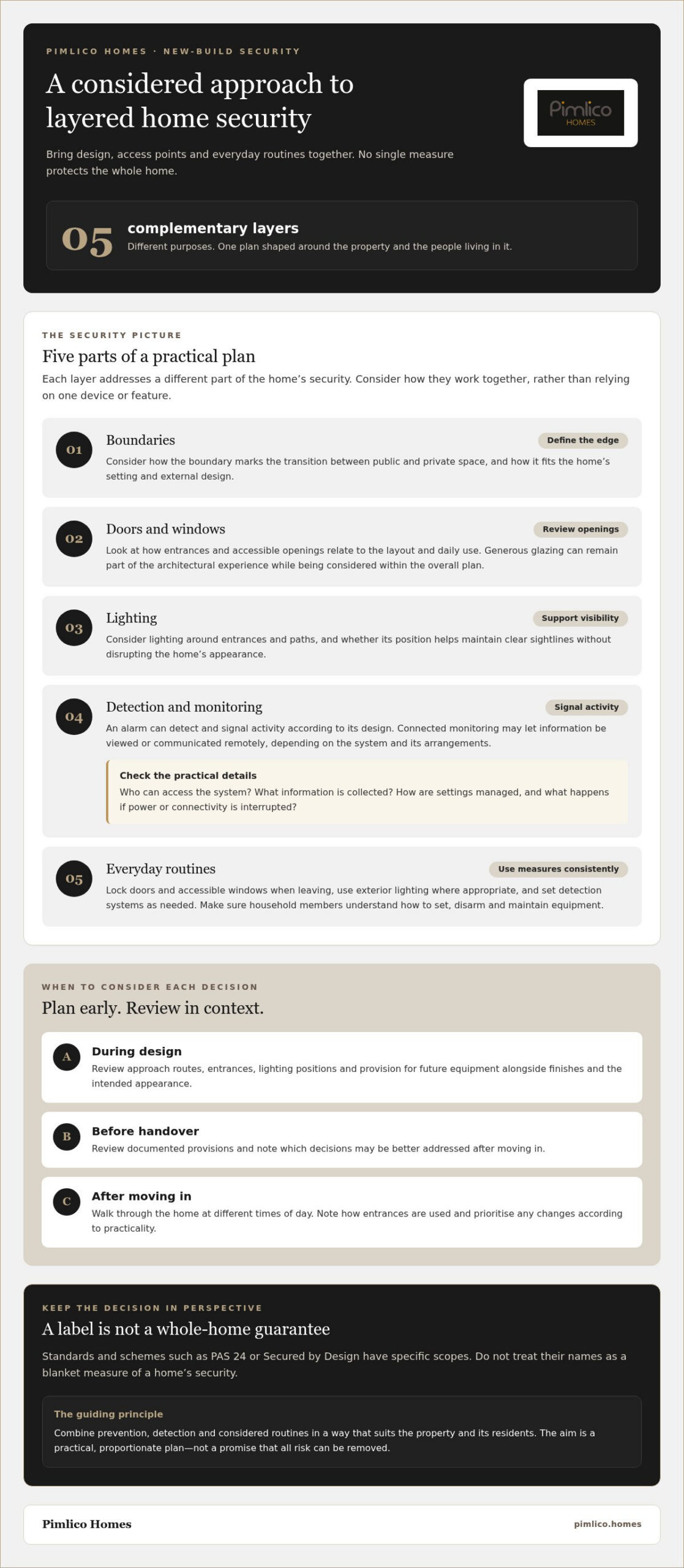
Think of the layers as a sequence. Boundaries help define the edge of a property. Doors and windows form openings in its outer envelope. Lighting can support visibility around entrances, while detection measures can signal activity. Household routines help ensure that everyday security is not overlooked. Each layer addresses a different part of the plan.
For example, when leaving for the day, residents might lock doors and accessible windows, use exterior lighting where appropriate and set a detection system. These actions complement one another, but none should be treated as a complete solution on its own. The right balance depends on the home’s layout and how it is lived in.
Why consider security before moving into a new build?
Considering security early can make decisions easier to coordinate with the design. While reviewing plans, consider how people approach and enter the home, whether lighting can support clear sightlines and where future security equipment might fit without disrupting finishes or the intended appearance. This can be especially useful in homes with generous glazing or carefully composed external spaces.
Some choices are easiest to consider during design, including lighting positions, access routes and provision for future installation. Other details can be reviewed after moving in, when you understand daily routines and how each entrance is used. Walk through the home at different times of day, note any questions and prioritise changes according to practicality. The same method applies to detached homes, executive courtyard homes and other luxury new builds: start with the household and layout, then consider which layers make sense.
How security layers work together in a luxury new build
Each security measure has a particular role. The aim is not to make a home feel fortified, but to create a considered arrangement in which the setting, physical openings, lighting and any electronic measures support one another. This approach is valuable in a design-led property, where practical choices should sit comfortably within the architecture and the way the home is used.
Independent layers are more resilient than relying on a single security measure because each can serve a different purpose if another is overlooked, unavailable or unsuitable. That does not make risk disappear. It gives homeowners a broader, more adaptable plan.
Physical design, doors and windows
Boundaries help define the transition between public and private space, while doors and windows are the points through which residents enter, leave and enjoy natural light. A useful review considers how these elements relate to the home’s layout and daily use, rather than treating any one feature as a complete answer. The arrangement will differ between a detached house and an executive courtyard home.
Protective choices need not dominate the design. Materials, sightlines and the placement of practical features can be considered alongside the home’s proportions and finishes. Large glazed areas, for instance, are part of the architectural experience. Their presence is a reason to consider how openings fit into the overall plan, not to assume that the design must be compromised. Standards and schemes such as PAS 24 or Secured by Design have specific scopes, so do not treat their names as a blanket measure of a home’s security.
Lighting, alarms and connected systems
Lighting supports visibility around entrances and paths, making it easier for residents to move around the property after dark. An intruder alarm has a different role: it detects and signals activity according to its design. Connected monitoring may allow information from security equipment to be viewed or communicated remotely, depending on the system and its arrangements. None should be understood as a guarantee that an intrusion will be prevented or that a response will follow.
Technology works best as a complement to sound physical choices and sensible routines. Before selecting connected devices, consider who can access them, what information they collect, how settings are managed and what happens if power or connectivity is interrupted. Clear user controls matter. Household members should understand how to set, disarm and maintain the system, and how to manage access when routines change.
For buyers considering security features in luxury new builds, compare options by asking what each contributes, where its limits lie and how it will fit into everyday life. The same design-conscious thinking that shapes a home’s layout can help frame these decisions. Explore luxury new-build homes with the whole living experience in mind, including comfort, architecture and long-term suitability.
Comparing security measures: what each can and cannot do
A security feature is most useful when its purpose and limits are clear. A gate may shape access to a shared entrance, for example, but it cannot secure every private doorway. An alarm can signal activity, but it does not physically strengthen a window. For buyers weighing security features in luxury new builds, the question is not simply which measure sounds most comprehensive. Consider how each fits the home, its residents and the other layers around it.
Physical measures resist access, lighting supports visibility, and alarms detect or signal activity. These roles are complementary, not interchangeable.
| Measure | Role | Practical limitation | Design or usability consideration |
|---|---|---|---|
| Boundaries, doors and windows | Define access and form the home’s physical envelope. | They cannot remove all risk or replace careful everyday use. | Consider appearance, ease of use and how residents enter and leave. |
| Lighting | Improves visibility around relevant areas and entrances. | Its usefulness depends on placement, operation and conditions. | Balance clear illumination with the home’s external character and household routines. |
| Alarms and monitoring | Detect or communicate activity, depending on the system. | They do not physically resist entry or guarantee a response. | Consider controls, maintenance, privacy and who will use the system. |
| Shared-development provisions | May help manage access to communal spaces. | They do not replace security within the private home. | Understand which spaces and routines the provision covers. |
Private-home measures versus shared-development security
Some measures are within the homeowner’s control, such as household routines and choices about the home’s openings. Other provisions, where present, relate to shared areas and may be managed collectively. A concierge or gated entrance can form an additional access layer, but neither should be treated as a substitute for considering the individual home. Assess shared arrangements separately from private entrances and openings, and note which areas they cover.
Discreet integration versus visible deterrence
Some homeowners favour measures that sit quietly within the architecture; others prefer visible features that make security arrangements apparent. Each choice can affect appearance, convenience and daily habits. Discreet integration may preserve a clean visual composition, while visible equipment may be easier for residents to identify and operate. Neither approach is universally superior. Suitability depends on the property’s design, the household’s preferences and the practical role each measure is intended to serve.
A thoughtful comparison avoids treating a single prominent feature as a complete answer. Consider what it does, what it cannot do and how it works alongside other measures. That distinction helps keep decisions proportionate, design-conscious and relevant to everyday life.
How to review security in a luxury new build: a practical checklist
A structured review turns security from a broad concern into a manageable set of decisions. Begin before completion, using available plans and written information to understand what is included. Keep a separate note of personal choices you may make later. This distinction helps you assess security features in luxury new builds without assuming that a feature is supplied simply because it could be added.
Follow the sequence below, recording what you know and what you still need to resolve through the usual purchase and handover process.
- Assess the home. Consider the main entrances, other accessible openings, external lighting and sightlines around the property. Think about how residents, visitors and deliveries will approach and use each entrance.
- Review the plans and documentation. Note the stated details for doors, windows, lighting and any security provisions. Separate these from options you may wish to consider after taking possession.
- Record questions. List unclear specifications, access arrangements and design considerations. Keep questions together so they can be addressed as part of the normal purchase and handover process.
- Prioritise the layers. Decide which considerations relate to physical openings, visibility, detection or household routines. Think about how future alarms, sensors or controls could fit without interrupting the design.
- Revisit after moving in. Review the arrangements once you have experienced the home at different times of day and established how each space is used.
Questions to consider before completion
At this stage, focus on what is documented and how it relates to the layout. Review the available information about doors, windows, lighting and stated provisions. Note possible locations for future equipment or controls. Keep unanswered points specific, such as whether a detail is included or how an area is intended to be used, rather than making assumptions about the specification.
A considered first-week security review
After taking possession, review the access arrangements, keys and any instructions supplied with the home. Agree household routines for locking up, using lighting and managing deliveries. As furniture is placed and daily patterns become clearer, consider sightlines and how entrances are used, then update your notes with any further priorities.
Quick review checklist
- Entrances and accessible openings considered
- Documented features distinguished from future choices
- Lighting and sightlines reviewed
- Questions recorded for the purchase and handover process
- Access instructions and household routines reviewed after moving in
A considered purchase brings together the home’s design, comfort and practical details. Explore Pimlico Homes’ luxury new builds as you form a clear view of what will support your household over time.
Designing security into the experience of a luxury new build
A home should feel considered in every detail, from the way daylight enters a room to the sense of privacy and ease its layout provides. Security belongs in that broader picture. Rather than beginning with a particular device, start with the home and the people who will live in it: how they arrive, which spaces they use most and what helps them feel comfortable at different times of day.
Thoughtful planning brings practical considerations into conversation with architectural character. The position of an entrance, views across an approach, external lighting and the relationship between windows and private spaces all shape how a home is experienced. These details do not promise a particular outcome, but they can help buyers weigh security alongside appearance, comfort and long-term suitability.
Security as part of considered residential design
Privacy, access and lighting are connected. A route from the entrance to the main living spaces, for example, may influence how household members welcome visitors or manage deliveries. Glazing can frame a garden and draw in natural light, while sightlines and planting influence how exposed or secluded a space feels. Considering these elements together helps keep security decisions proportionate and relevant to daily life.
There is no single design formula. A detached home and an executive courtyard home may offer different relationships between the front door, shared approaches and private outdoor areas. In either setting, security choices should reflect the household’s priorities without allowing equipment or routines to dictate the character of the home. Buyers weighing wider decisions may find the luxury new-build buying guide useful alongside their review of design, documentation and handover details.
From purchase decisions to everyday peace of mind
A measured process is straightforward: review the information available about the home, note what is specified, identify the household’s priorities, then consider complementary layers that suit the property. Once settled, revisit those choices as rooms are furnished and routines take shape. A home’s needs become clearer through use, and a considered plan can adapt without sacrificing the calm, coherent feel of the design.
Privacy can be an especially important part of that assessment. The layout of courtyard homes and privacy offers one way to think about how private outdoor space relates to the home and its approach. The broader principle applies across property types: consider how you want to use each space, then assess how access, sightlines and lighting support that experience.
Good decisions need not be dramatic. They come from understanding the home, recording the details that matter and choosing measures for a clear purpose. If you are considering a carefully designed new home, you can explore Pimlico Homes’ luxury new-build properties as part of your purchase research.
Make your next home decision with confidence
The most reassuring approach is to treat security as part of how a home will serve you over time. As you consider security features in luxury new builds, look beyond individual fittings and reflect on the relationship between privacy, daily routines and the character you want your home to hold. Your priorities may evolve as you settle in, so a thoughtful plan should leave room to adapt.
Choosing a new home is also an opportunity to consider the quality of its design and the care behind its creation. Pimlico Homes is a specialist developer of luxury detached and executive courtyard homes, with a focus on bespoke new builds and high-quality residential craftsmanship. These qualities reflect a considered approach to a significant purchase, while leaving room for you to make the home your own.
Take the next step at your own pace. Explore Pimlico Homes’ luxury new builds and discover a home that feels right for the way you want to live. Thoughtful choices today can help create a more settled sense of home tomorrow.
Frequently Asked Questions
Are luxury new-build homes more attractive to professional burglars?
Not necessarily. A property’s type alone cannot establish the risk to an individual home, and affluence is not proof that it will be targeted. Context matters, including the home’s design and the household’s routines. Rather than assume a particular burglary pattern, consider what is proportionate for the people living there. A calm, layered plan is more useful than decisions driven by alarmist claims or unverified generalisations.
What security features should I look for in a luxury new build?
Begin with the documented provisions for doors, windows, lighting, alarms and access arrangements. The security features in luxury new builds can vary, so understand each in context rather than treating its presence as a guarantee. Consider how physical measures and detection relate to your household’s routines. For example, think about who regularly uses side or garden entrances and how everyone will manage access when coming and going.
Can security measures be integrated without changing a home’s appearance?
Security can often be considered alongside a home’s architectural character, although not every measure will be invisible or suit every property. Some choices may be easier to plan during design, while others can be considered later. Weigh appearance against practical use and privacy. A discreet feature may better suit one setting, while another household may value equipment that is easy to see and operate.
Do gated entrances or concierge services make a home secure?
No shared access arrangement should be treated as complete protection for a private home. A gate or concierge, where present, may contribute an additional layer in communal areas, but its scope and operation can differ between developments. Consider how it relates to your own doors, windows and household routines. Review the information provided about shared provisions, then assess private access arrangements separately.
Should I plan home security before moving into a new build?
Considering security before moving can help you understand documented provisions and how future choices might fit with the home’s design. It is not a requirement, nor does early planning guarantee a particular outcome. You can also review how you use the property after settling in. For instance, once furniture is in place, you may have a clearer sense of privacy needs and the routes household members use most.
Are smart security systems enough to protect a new-build home?
No. Connected devices can support detection and control, but they are not a complete solution on their own. Their usefulness depends on appropriate installation and configuration, dependable connectivity and whether household members know how to use them. Consider what happens if a device is offline, and keep access settings manageable for the people who need them. Technology is best viewed as one possible complement to physical measures and everyday habits.
What is the first thing to check when reviewing a new-build home’s security?
Start with the home’s documented specifications and access arrangements, so you know what is already provided rather than assuming a particular feature is included. Then consider doors, windows and lighting in relation to how your household will use the property. Note practical details such as who will hold keys and how visitors will be admitted. This gives buyers and new owners a clear, calm starting point for further decisions.





