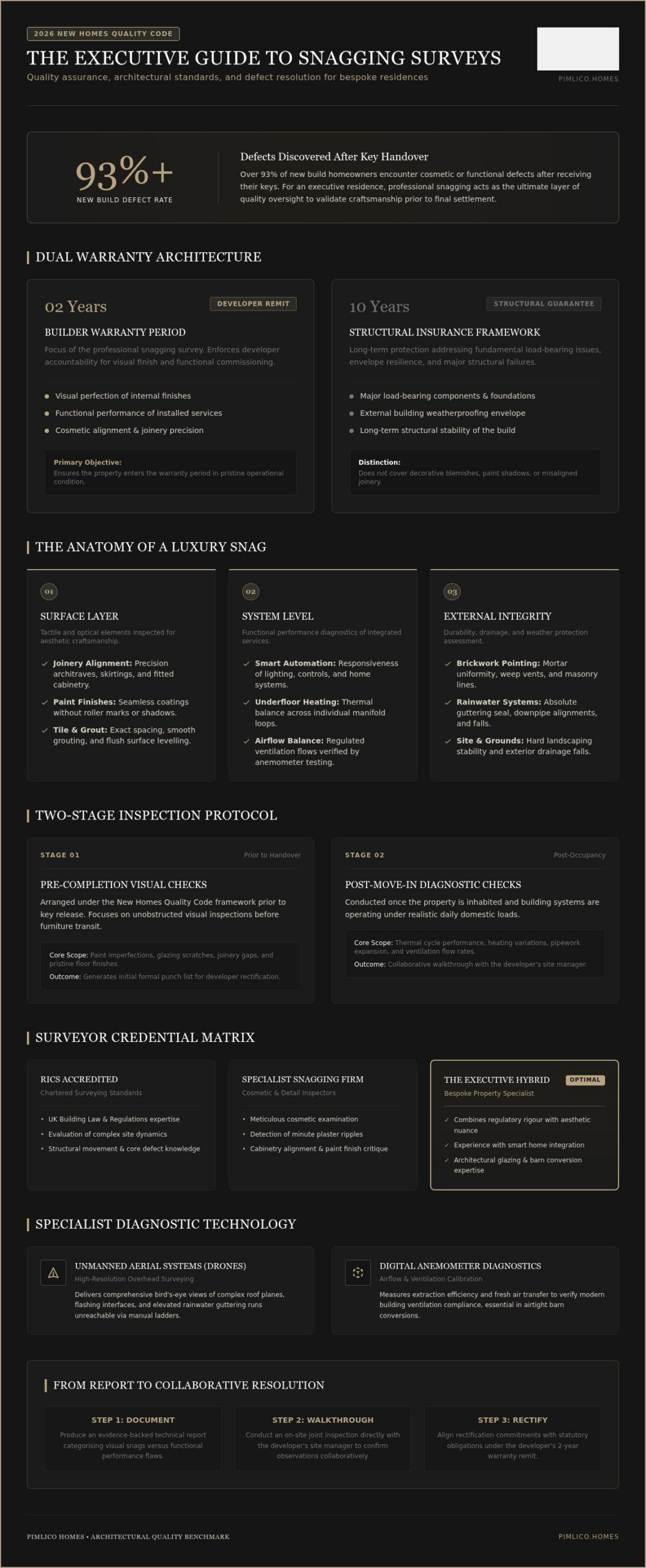
Did you know that over 93% of new build homeowners discover defects after receiving their keys? For the discerning buyer of an executive residence, this isn’t merely a statistic; it’s a call for meticulous oversight. Setting up a snagging survey shouldn’t feel like an act of mistrust, but rather the final, sophisticated layer of quality assurance that your investment deserves. It’s about ensuring that the vision of excellence you purchased is the reality you inhabit. We believe a home is a legacy of craftsmanship that deserves a keen, expert eye to validate its perfection.
We understand that the transition into a bespoke home should be a period of refined pride, not one of anxiety regarding hidden structural flaws or cosmetic inconsistencies. You likely want a flawless finish without the stress of confrontational negotiations with your developer. This guide masters the art of arranging a professional inspection under the latest 2026 New Homes Quality Code. You’ll discover the optimal window for pre-completion checks, the technical standards your surveyor must meet, and how to foster a collaborative path toward a perfect home. We will secure the peace of mind that comes with absolute structural and cosmetic integrity.
Key Takeaways
- Understand the vital distinction between minor cosmetic imperfections and the latent structural defects that could affect your home’s enduring value.
- Identify the essential credentials for your surveyor, prioritising RICS accreditation and specific experience with high-specification executive residences.
- Optimise your timeline by setting up a snagging survey that encompasses both pre-completion visual checks and post-move-in diagnostic inspections.
- Learn how to transform a technical report into a collaborative resolution through professional walkthroughs with your developer’s site manager.
- Secure your investment by aligning your snagging findings with the two-year builder warranty and the ten-year structural guarantee framework.
Defining the Snagging Survey: A Final Guard of Quality
Achieving the pinnacle of residential excellence requires a final, meticulous inspection. Setting up a snagging survey serves as a sophisticated guard of quality, ensuring that every architectural detail aligns with the original vision of your luxury detached home. This process formally documents a punch list or snag list of items that require attention before or shortly after you take possession. In the context of executive residences, a snag isn’t merely a minor inconvenience. It’s a deviation from a standard of finish that hasn’t yet reached the required level of artistry. It’s about validating the craftsmanship you’ve invested in.
Luxury new builds demand a far more nuanced eye than standard housing. Whilst a conventional survey might overlook a slightly misaligned tile or a faint shadow in a paint finish, these details are paramount in a bespoke property. Setting up a snagging survey allows you to transition into your new life with absolute confidence, knowing that the structural and cosmetic integrity of your home has been verified by an expert. It transforms the moving process from a period of uncertainty into a celebration of refined pride.
The Anatomy of a Luxury Snag
In a high-specification home, the definition of a snag extends beyond simple repairs. At the surface level, we look for perfection in joinery alignment, the seamlessness of paint finishes, and the precision of tile grout. These are the tactile elements you interact with daily. Moving deeper, the survey examines system-level performance. This includes the responsiveness of smart home integrations and the consistent warmth of underfloor heating loops. Finally, the external integrity is scrutinized. A professional surveyor will examine the brickwork pointing, the health of the landscaping, and the absolute integrity of the guttering systems. Each element must contribute to the home’s longevity and aesthetic permanence.
Snagging vs. Structural Surveys
It’s vital to distinguish this process from a traditional structural survey. A snagging survey is an exacting quality-assurance check focused on the visual and functional finish of the property. It ensures that the builder’s two-year warranty period begins with a home that is already in peak condition. This work complements the ten-year structural warranty provided by the developer, which covers major load-bearing failures and weatherproofing. For those moving into bespoke barn conversions, this distinction is even more critical. These unique properties require a surveyor who understands how traditional materials and innovative thinking must harmonise. They ensure that the character of the heritage structure is preserved whilst the modern comforts perform flawlessly from day one.
Selecting the Right Professional for Your High-End Property
The choice of surveyor is a decision that defines the final quality of your residence. You aren’t merely hiring a tick-box inspector; you’re commissioning a guardian of your investment. When setting up a snagging survey, the professional you select must bridge the gap between technical building regulations and the aesthetic demands of a high-specification finish. Under the New Homes Quality Code, you’re entitled to appoint a qualified inspector who understands the complexities of luxury builds. This expertise is vital for ensuring your home reflects the prestige it was designed to embody.
RICS Accredited vs. Specialist Snagging Firms
A Royal Institution of Chartered Surveyors (RICS) professional brings an unparalleled understanding of UK building law and structural integrity. This is essential for complex sites. Conversely, specialist snagging firms often focus more intensely on the cosmetic “executive” finish. They identify the slightest ripple in a plaster finish or a minute gap in bespoke joinery. For owners of executive courtyard homes, the ideal partner is often one who combines these disciplines. You need a surveyor who appreciates the artistry of bespoke luxury homes whilst maintaining a rigid focus on compliance. Ask potential surveyors if they have handled properties with smart home integrations or high-value architectural glazing before committing.
Specialist Equipment for the Discerning Eye
Modern technology has replaced guesswork with precision. Drones provide a bird’s-eye view of roof detailing and guttering that ladders simply cannot reach. Digital anemometers verify that ventilation in bespoke barn conversions meets modern standards without compromising the heritage structure. Thermal imaging is a non-invasive tool for detecting insulation voids. This is particularly crucial in expansive detached homes where heat loss can be a significant concern. Moisture meters ensure that the structural timber and masonry have dried correctly before final finishes were applied. These tools allow for a depth of analysis that the naked eye alone cannot achieve.
Vetting your professional involves asking about their familiarity with premium materials. Do they know how to inspect natural stone flooring or high-end kitchen cabinetry? A surveyor who primarily works on volume-built estates may lack the vocabulary of excellence required for your property. By setting up a snagging survey with a specialist who understands the weight of a significant life investment, you ensure that every detail meets a standard of excellence. This methodical approach builds trust through a steady delivery of facts, honouring the craftsmanship of your new home.
The Critical Timing: When to Arrange Your Inspection
Timing isn’t just a logistical detail; it’s a strategic advantage. When setting up a snagging survey for a luxury detached home, you’re balancing the need for immediate perfection with the physical realities of a new structure. A property is a living entity that breathes, settles, and reacts to its environment. Understanding the specific windows for inspection ensures that every element, from the initial paintwork to the long-term performance of mechanical systems, remains flawless. It’s a methodical process that honours the emotional weight of your investment.
Pre-Handover: The Ideal Window
The most opportune moment for a visual assessment is the short interval between the “Notice to Complete” and your legal handover. Under the 2026 New Homes Quality Code, developers must grant access for a qualified inspector within five calendar days of this notice. This empty property phase is invaluable. Without furniture or lifestyle clutter, a surveyor can identify minute imperfections in floor levelling, wall plastering, and light reflections that might otherwise be obscured. This proactive approach is a core part of The Ultimate Guide to Buying a Luxury New Build Home in 2026, as it allows for resolutions before your move-in date. It’s about ensuring the house is truly ready for your arrival.
Post-Completion: The Reality Check
Some defects only reveal themselves once the home is under the stress of daily use. Plumbing leaks, underfloor heating imbalances, and the natural expansion of bespoke joinery often require a “lived-in” environment to become apparent. Setting up a snagging survey shortly after move-in allows for diagnostic technology to be used more freely than during the pre-completion phase. This secondary check captures the subtle shifts that occur during the first few months of occupancy. It provides a comprehensive record for your developer’s site manager to address, ensuring that the high-specification finishes are maintained as the building settles into its site.
The first two years of ownership represent a “Golden Period” where the developer remains contractually responsible for all defects and cosmetic flaws. A 12-month settling-in inspection is a non-negotiable step for luxury barn conversions and executive homes. As the building undergoes its first full cycle of seasons, natural “drying out” can lead to minor settlement cracks or door misalignments. By documenting these issues before the two-year builder warranty expires, you ensure that the integrity of your residence is protected. This steady delivery of information builds a professional, non-confrontational relationship with your developer, focused entirely on achieving excellence.
Preparing for the Survey: A Practical Set-up Guide
Setting up a snagging survey is a process that benefits from early, clear communication. It is not an exercise in finding fault, but rather a methodical confirmation that the high standards promised during the design phase have been realised in the final build. This preparation phase is your opportunity to align the technical expertise of the surveyor with the specific architectural vision of your home. By approaching the setup with quiet confidence, you ensure that the subsequent inspection is both thorough and professional.
The Developer-Surveyor Relationship
Establishing a collaborative tone between your surveyor and the site manager is essential for a smooth resolution process. A professional surveyor acts as a neutral third party to ensure objective quality. When you introduce them to the site team, frame the survey as a standard part of your quality assurance process. This transparency helps in navigating the “Right to Repair,” where the developer is given the first opportunity to rectify identified issues. Under the 2026 New Homes Quality Code, this collaborative approach ensures that most snags are resolved within a 30-day window, maintaining the momentum of your move-in schedule.
Documenting the Bespoke Details
High-specification executive residences often contain complex systems that require specialist attention during an inspection. Gather all essential documents, including floor plans, electrical schematics, and your bespoke upgrade lists. These records are vital for checking the functionality of smart home AV systems or the precision of custom stonework. It’s important to reference the specifics of luxury new build warranties to ensure your surveyor knows exactly which high-value components require the most scrutiny. This ensures that the technical assessment covers every unique element of your investment.
Security and access are the final practical hurdles to clear before the survey begins. If you are setting up a snagging survey prior to legal completion, the site remains under the developer’s insurance and health and safety liability. Confirm that your surveyor holds the necessary professional indemnity insurance and that the site manager has formally cleared a window for the visit. Creating your own “pre-snag” list of specific concerns allows the professional to focus on your priorities whilst they conduct their wider technical assessment. We invite you to explore our current luxury new build homes to see the level of craftsmanship our own rigorous quality control processes achieve.
From Report to Resolution: Ensuring Excellence in Your New Home
Receiving the completed document is not the conclusion of the process; it is the beginning of a refined dialogue between homeowner and creator. Setting up a snagging survey provides the technical foundation, but the resolution phase requires a collaborative spirit to ensure the property reaches its full potential. A professional report is a tool for excellence, offering a clear roadmap for the site team to follow. It transforms subjective observations into a methodical list of actionable tasks, ensuring that the final finish mirrors the prestige of your initial investment.
Prioritising the Punch List
A comprehensive report often contains a high volume of entries, but not all carry the same weight. It is essential to distinguish between functional defects and aesthetic refinements. Functional snags, such as a misaligned window seal or an imbalance in the ventilation system, require immediate attention to protect the home’s integrity. Aesthetic refinements, such as a minor paint scuff or a slightly uneven grout line, are equally important for the executive finish but may be scheduled differently. Managing tradespeople entering your residence requires clear communication; ensure that all remedial works are grouped logically to minimise disruption to your daily life. For significant structural or system-level corrections, a follow-up inspection is a prudent step to verify that the solution meets the required technical standards.
The “Walkthrough” is a pivotal moment in the resolution process. Reviewing the findings in person with your developer’s site manager ensures that every nuance of the report is understood. This joint review fosters a professional, non-confrontational atmosphere where solutions can be agreed upon instantly. Under the 2026 New Homes Quality Code, developers are generally expected to resolve identified issues within 30 calendar days. Setting realistic timescales for complex bespoke elements, such as custom stonework or specialist joinery, is vital. It is better to allow for a methodical repair that preserves the home’s artistry than to rush a fix that may require further attention later.
The Pimlico Homes Approach to Perfection
A premium developer views a snagging report as a valuable asset rather than a criticism. It is a shared commitment to aftercare that defines luxury residential development. At this level of the market, the goal is a home that remains as perfect in ten years as it is on the day of handover. Final sign-off should only occur once you are entirely satisfied that every item has been resolved to an executive standard. This dedication to longevity and meticulous care is why we encourage you to explore our bespoke luxury homes, where quality is woven into every detail from the first brick to the final polish. Setting up a snagging survey is the final step in a journey of visionary creation, securing the peace of mind that your home is a true masterpiece of modern construction.
Securing Your Legacy of Excellence
Your journey to a flawless home is a methodical progression toward perfection. By selecting a surveyor who understands the nuance of high-specification finishes and identifying the precise pre-handover window, you transform a technical requirement into a celebration of craftsmanship. Setting up a snagging survey ensures that the intricate details of your executive residence are validated by an expert eye. It provides the documented assurance that your property meets the exacting standards of modern luxury and architectural integrity.
At Pimlico Homes, we believe that quality is a continuous commitment rather than a final destination. With 25 years of luxury development expertise, we specialise in bespoke designs tailored to executive lifestyles, supported by comprehensive aftercare and warranty frameworks. We invite you to discover the Pimlico Homes commitment to flawless craftsmanship and explore our portfolio of visionary creations. Your bespoke home should be a source of refined pride and a testament to the enduring values of fine construction. Trust in the process, and enjoy the security of a home built to last.
Frequently Asked Questions
Is a snagging survey really necessary for a luxury new build?
Yes, a survey is vital for any executive residence. Statistics from 2026 show that up to 95% of new build buyers report defects shortly after moving in. Whilst luxury homes represent the pinnacle of craftsmanship, even bespoke builds can contain hidden issues. A professional surveyor typically identifies between 50 and 150 snags that the untrained eye might miss. This process ensures that your residence meets the exacting standards expected of a significant life investment.
When is the best time to set up a snagging survey?
The most effective strategy involves setting up a snagging survey in two distinct phases. First, arrange a Pre-Completion Inspection within five days of receiving your Notice to Complete to catch visible flaws. Second, schedule a more intensive diagnostic survey shortly after moving in. This allows for the use of thermal imaging and drone technology to verify the performance of complex systems whilst the building settles into its environment during those first crucial weeks.
Can a developer refuse to allow a snagging surveyor on-site?
Developers cannot legally refuse access for a Pre-Completion Inspection if the buyer appoints a suitably qualified professional. Under the 2026 New Homes Quality Code, you are entitled to hire an independent inspector from a recognised body such as RICS or the RPSA. The developer must be given adequate notice, usually within the formal completion window, to ensure the site remains compliant with health and safety regulations whilst the surveyor conducts their methodical assessment.
How much does a professional snagging survey typically cost in 2026?
In 2026, the cost of a professional survey reflects the scale and technical complexity of the property. Standard executive homes with five or six bedrooms typically range from £500 to £650 for a comprehensive check. For bespoke luxury properties exceeding 5,000 square feet, fees often range between £800 and £1,500. This investment covers the use of advanced diagnostic tools and provides a detailed report that serves as a vital record for your developer warranty.
What happens if the developer refuses to fix items on the snagging list?
If a developer fails to address identified snags, you are protected by the 30-day resolution rule established by the New Homes Quality Board. Most developers are incentivised to complete repairs quickly to maintain their star ratings. If issues remain unresolved after the formal 56-day dispute process, you can escalate the matter to the New Homes Ombudsman Service. This independent body provides a final, legally recognised resolution for any outstanding defects or non-compliance issues.
How long does a professional snagging inspection usually take?
A thorough inspection of a luxury detached home usually takes between four and six hours. This duration allows the surveyor to meticulously examine every room, test mechanical systems, and deploy specialist equipment like thermal cameras or digital levels. For larger executive courtyard homes or complex barn conversions, the process may take longer. The surveyor focuses on a steady and consistent delivery of information, ensuring no detail of the architectural finish is overlooked during the visit.
Should I do my own snagging or hire a professional?
Whilst homeowners often spot superficial cosmetic marks, they rarely identify the technical issues that a professional captures. Data indicates that owners find approximately 20 minor snags, whereas a qualified surveyor logs over 100 items including insulation voids and plumbing tolerances. Professional inspectors use calibrated technology to verify the integrity of your home. Hiring an expert provides the peace of mind that your executive residence meets the highest standards of modern construction and artistry.
Does a snagging survey cover structural issues or just cosmetic ones?
A snagging survey primarily focuses on visual finishes and functional compliance during the initial two-year builder warranty period. It identifies cosmetic flaws, joinery alignment, and service performance. Major structural integrity, such as load-bearing failure or weatherproofing, is covered by the separate ten-year structural insurance period provided by organisations like the NHBC. Setting up a snagging survey ensures that the functional elements are perfect before the long-term structural cover becomes your primary protection later.