
A recent European Commission study revealed that 53% of environmental claims are vague, misleading, or entirely unfounded. For the discerning investor, this is a stark reminder that a “green” label may be little more than a superficial marketing veneer. You’ve likely felt the frustration of navigating conflicting certifications, or the quiet anxiety that a premium price tag is funding gadgets rather than genuine efficiency. Spotting greenwashing in property development is no longer just an ethical choice; it’s a necessary strategy to protect the long-term value and integrity of your home.
We understand that a residence represents a legacy of excellence and meticulous care. In this guide, you’ll learn how to distinguish authentic environmental stewardship from empty rhetoric, ensuring your investment meets high-specification energy standards that endure. We provide a clear framework for evaluating developer claims, from structural integrity to the nuances of new 2026 regulations, giving you the confidence to choose a property that truly respects the planet whilst securing its future resale value.
Key Takeaways
- Learn the art of spotting greenwashing in property development by identifying “adjective traps” and demanding specific, verifiable evidence of material origins.
- Discover why an EPC “A” rating is merely the baseline for modern luxury, whilst certifications like BREEAM “Excellent” offer a more comprehensive measure of genuine sustainability.
- Master the essential due diligence steps, such as requesting a Home User Guide early to scrutinise the depth of a developer’s long-term energy management commitments.
- Understand the importance of a detailed Schedule of Works to ensure that thermal efficiency is woven into the architectural fabric rather than applied as a superficial layer.
- Recognise how authentic sustainability and energy-efficient master planning safeguard your investment against the evolving regulatory landscape of 2026.
The Evolution of Eco-Prestige: Why Greenwashing Matters in 2026
The prestige of a residence is no longer found solely in the height of its ceilings or the provenance of its masonry. It lives in the invisible efficiency of its bones. In the luxury residential sector, greenwashing often manifests as a polished marketing narrative that promises environmental stewardship whilst delivering only the standard regulatory minimum. Understanding the history of greenwashing reveals a shift from simple linguistic tricks to complex, technical-sounding claims that frequently lack substance. For the discerning buyer, spotting greenwashing in property development is about looking past the “green” label to find structural truth.
The year 2026 is a watershed moment for the industry. With the EU’s Empowering Consumers for the Green Transition Directive becoming applicable in September 2026, and the UK’s Competition and Markets Authority already enforcing strict penalties for misleading claims, the era of vague environmentalism is over. You’re likely wary of the “green premium”, that additional cost often attached to homes with superficial eco-features. True value doesn’t come from a label. It comes from architectural integrity that reduces long-term running costs and enhances the daily living experience. Authentic sustainability isn’t a marketing layer; it’s a fundamental design philosophy that provides the quiet confidence of a lasting investment.
The Psychology of the Eco-Conscious Buyer
High-end real estate is moving away from conspicuous consumption toward a more deliberate, conscious form of ownership. Our clients don’t just want a house. They want a legacy asset that reflects their personal ethics and a desire for permanence. There is a refined pride in knowing your home is built for longevity. This emotional weight is significant; it’s the difference between owning a property that follows a fleeting trend and one that sets a standard for excellence and environmental respect.
The Financial Risk of Superficial Sustainability
Superficial sustainability is a quiet threat to your capital. When eco-features are merely “bolt-on” gadgets, they often mask poor construction quality or outdated thermal designs. This leads to “eco-obsolescence”, where the resale value of new build homes can drop as future buyers demand higher energy standards. With UK regulations tightening, a home that barely meets today’s EPC requirements will soon be a liability. Authentic sustainability is the only way to future-proof your investment against the regulatory shifts of the coming decade.
Deciphering the Dialect: Distinguishing Vague Marketing from Verifiable Fact
Language is the first tool of the developer. Too often, it’s used to obscure rather than reveal. The “Adjective Trap” is a common hurdle when spotting greenwashing in property development. Terms like “eco-friendly” or “sustainable” are frequently deployed as aesthetic descriptors rather than technical commitments. A brochure might claim a home is “inspired by nature,” yet this phrase carries no legal weight. Contrast this with a statement like “sourced from FSC-certified British timber estates.” The former is a suggestion; the latter is a verifiable fact. Genuine stewardship is found in the details of the “Fabric First” philosophy. This prioritises the building’s thermal envelope over superficial additions. A developer focusing on smart thermostats whilst ignoring high-specification insulation is often selling a gadget. True luxury demands structural efficiency.
The Red Flags in Property Brochures
Excellence requires proof. It isn’t found in a stock photograph of a distant forest. These images often distract from high-carbon construction methods. Watch for an over-reliance on “offsetting” schemes. Paying to plant trees elsewhere does nothing to improve the energy performance of your own walls. Vague promises of “future-ready” technology are equally suspect without a specific list of hardware and integration standards. These are often placeholders for missing substance.
The Language of Authentic Excellence
Discerning buyers should seek technical metrics. Look for “U-values” and “Air Permeability” rates. These figures provide a measurable reality of heat loss and draught exclusion. Bespoke design plays a vital role here. It allows for the optimisation of solar gain and natural ventilation through careful architectural orientation. The introduction of the Sustainability Disclosure Requirements has begun to standardise how environmental claims are presented. When exploring high specification new build homes, look for a developer who speaks the language of engineering. This precision proves the worth of the investment. We believe in transparency. You are welcome to explore our bespoke builds, where every claim is backed by meticulous architectural care.
Beyond the EPC Rating: Technical Standards and Certifications to Demand
A standard EPC “A” rating is no longer the pinnacle of achievement. It’s the baseline for any modern residence. For a luxury detached home, true prestige lies in exceeding these foundational requirements through technical artistry. Understanding how to spot greenwashing involves looking deeper into certifications like BREEAM “Excellent.” This standard doesn’t just measure simple energy consumption; it considers acoustics, internal air quality, and the holistic health of the occupants. It transforms a house into a sanctuary of quiet comfort. Whilst the “Passivhaus” standard offers world-class thermal performance, some fear it sacrifices the aesthetic of a bespoke build. This is a misconception. A master craftsman integrates these rigorous air-tightness standards into a grand architectural vision without compromise, ensuring energy efficiency feels like a natural extension of the design.
The ultimate proof of performance is the Post-Occupancy Evaluation (POE). Many developers promise efficiency but few return a year later to measure the reality of their output. A POE verifies that the “as-designed” energy model matches the lived experience of your family. It’s a hallmark of a developer who acts as a reliable guardian of quality, ensuring the home remains an asset of enduring value. This methodical approach builds a steady foundation of trust through the consistent delivery of data-backed results. It invites the buyer to linger on the meticulous details that define a high-specification residence.
Embodied Carbon: The Hidden Footprint
Sustainability isn’t just about the energy used to heat a room. It’s about the energy used to build it. This is why the “heritage charm” of barn conversion homes is so compelling. By repurposing existing structures, we dramatically reduce the carbon footprint of the construction process. Meticulous care in selecting materials is essential. We favour British stone over imported synthetics; it offers a sense of permanence and artistry that mass-produced alternatives cannot match. Meticulous, bespoke construction by skilled artisans ensures that waste is minimised and every joint is precise.
The Role of Third-Party Warranties
A promise is only as strong as the guarantee behind it. Comprehensive luxury new build warranties should now extend to energy performance, protecting the emotional and financial weight of your investment. Spotting greenwashing in property development requires checking for independent verification of performance metrics. A visionary developer welcomes external energy audits and independent snagging. It’s a transparent process that speaks to a discerning audience. These as-built performance checks ensure your home meets the high-specification energy standards promised during the initial grand vision.
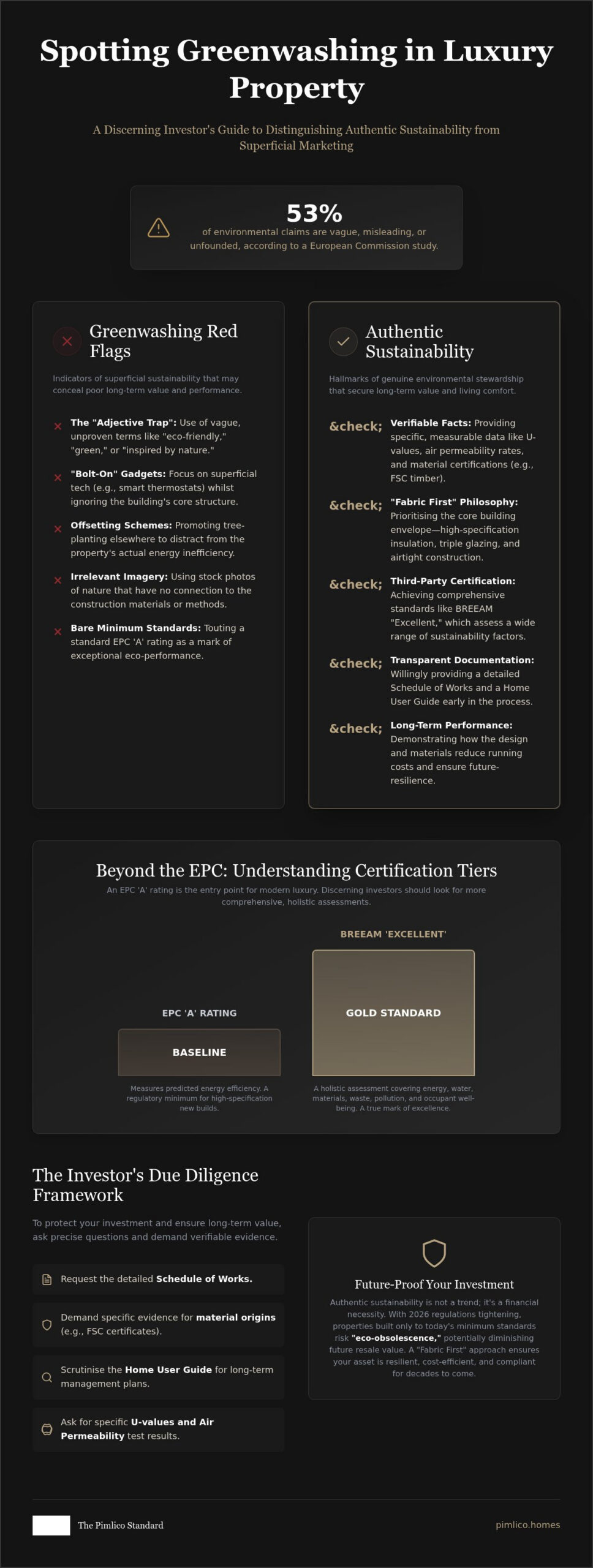
The Eco-Due Diligence Framework: Questions Every Premium Buyer Should Ask
Acquiring a high-specification residence requires more than an appreciation for aesthetics. It demands a methodical inquiry. Spotting greenwashing in property development is a skill honed through specific, targeted questions that pierce the veil of marketing rhetoric. A systematic framework allows you to verify the structural truth of a building before committing to a significant life investment. This process moves from broad visions to the intimate, technical details that define a home of lasting excellence.
- Step 1: Request the Home User Guide. Seek this document early. A genuine developer provides a comprehensive manual detailing how to manage the home’s energy systems effectively. If this guide is thin or generic, the environmental commitment may be equally shallow.
- Step 2: Scrutinise the Schedule of Works. This document reveals the hidden reality of the build. You are looking for specific mentions of thermal bridging and the density of insulation materials. It’s about the precision of the thermal envelope.
- Step 3: Enquire about the supply chain. Ask where the bespoke finishes actually originate. Authentic luxury connects innovative thinking with traditional values; it shouldn’t hide behind an anonymous or carbon-heavy global supply chain.
- Step 4: Assess the landscaping. Determine if the outdoor spaces are merely ornamental. A responsible development uses landscaping to support local biodiversity, creating a sanctuary that respects the natural heritage of the site.
- Step 5: Verify Smart Home credentials. Ensure the technology truly integrates systems like lighting and heating to reduce waste. It shouldn’t just add a layer of complex, unnecessary gadgets.
Investigating the Developer’s Heritage
Longevity is a reliable guardian of quality. Consider whether the firm has a 25-year history of excellence or if “green” is simply a recent marketing pivot. Reviewing previous developments is essential. Observe if those properties have aged with grace and maintained their efficiency over time. The persona of a master craftsman is vital here. It ensures that the focus remains on the human experience of the end user rather than a fleeting trend. We invite you to contact our visionary creators to discuss how our heritage informs our commitment to permanent quality.
Site Visits: What to Look for Behind the Paint
A site visit offers a grand vision of the home’s potential, but you must look closer. Inspect the window installations and door seals. These are the quiet guardians of heat and comfort. Enquire about the heating system; a legacy gas boiler is a red flag in 2026. Look for future-proof air-source heat pumps instead. Finally, observe the flow of the home. A well-designed residence uses natural light to reduce the need for artificial energy, creating a sense of scale and depth that feels both modern and grounded.
The Pimlico Standard: Authentic Sustainability in Bespoke Development
At Pimlico Homes, we believe that true environmental stewardship is woven into the very fabric of the building. We reject the trend of “bolt-on” sustainability. Solar panels and smart sensors have their place, but they cannot compensate for a lack of architectural integrity. Spotting greenwashing in property development becomes much simpler when you encounter a home designed with a “fabric first” mentality from the very first sketch. Our approach ensures that energy efficiency is an inherent characteristic of the structure, providing a level of performance that remains invisible yet profoundly impactful.
There is a unique synergy in our executive courtyard homes where master planning meets modern efficiency. These developments are not merely collections of houses. They are carefully oriented enclaves designed to maximise natural thermal gains whilst maintaining a sense of secluded prestige. This is what we call Sustainable Elegance. It is the sophisticated intersection where high-end design meets low-impact living, ensuring that your home is a responsible life investment that does not ask you to compromise on aesthetic grandeur. We treat every project as a unique creation, acting as a reliable guardian of your long-term satisfaction.
Meticulous Care in Every Detail
Our refined pride is evident in our choice of materials. We select components that stand the test of time, favouring substance over fleeting trends. In our luxury barn conversions, we blend traditional heritage values with innovative thinking. This process preserves the soul of the original structure whilst integrating high-specification thermal systems. Every development is envisioned as a secure enclave. It offers a sense of serenity and quality that only a master craftsman can deliver. Longevity is our primary metric for success, ensuring your home remains a legacy asset for generations.
Your Journey to a Truly Green Luxury Home
Conceptualising a bespoke luxury home is a journey of transparency. We invite our clients to linger on the intimate details, from the precision of our joinery to the technical specifications of our heating systems. There is no need for vague adjectives when the engineering speaks for itself. Spotting greenwashing in property development is often a matter of looking for what is missing; at Pimlico, we ensure every detail is present and accounted for. Our final promise is simple. We build homes that are as responsible as they are remarkable, serving as a reliable guardian of both your capital and the environment.
Securing Your Legacy in a Sustainable Future
Identifying a home that truly respects the environment requires looking beyond the brochure. You’ve learned that authentic sustainability is found in the meticulous details of a fabric-first approach and the rigorous verification of technical standards. Spotting greenwashing in property development is a necessary discipline for the modern investor who seeks to protect both their capital and their personal values. It’s about choosing a residence where efficiency is structural, not merely a marketing veneer.
Our journey at Pimlico Homes is defined by 25 years of meticulous craftsmanship and a specialist focus on bespoke luxury new builds. We take refined pride in our legacy of excellence in executive courtyard developments, where every residence is treated as a unique life investment. We invite you to move beyond the superficial and embrace a future where elegance and responsibility are perfectly aligned. Explore our vision for authentic luxury living and discover a home built for longevity. Your path to a truly sustainable residence begins with a commitment to excellence that never wavers.
Frequently Asked Questions
What is the most common sign of greenwashing in property development?
The most common sign is the use of vague, non-technical adjectives such as “eco-friendly” or “natural” without specific supporting data. Spotting greenwashing in property development often involves identifying a reliance on superficial “bolt-on” features like smart thermostats to mask poor structural insulation. A truly sustainable home prioritises the building’s thermal envelope first. If a developer cannot provide specific U-values or air permeability rates, the environmental claims are likely more aesthetic than architectural.
Does a high EPC rating always mean a home is sustainable?
A high EPC rating is a foundational requirement rather than a mark of unique prestige. Whilst an “A” rating is desirable, it represents the regulatory baseline for modern construction. Discerning buyers should look for more rigorous certifications like BREEAM “Excellent” or the Passivhaus standard. These frameworks consider holistic factors such as internal air quality and lifecycle carbon. They offer a much deeper assurance of energy performance and comfort than a standard certificate alone.
How can I verify a developer’s claims about energy-efficient technology?
Spotting greenwashing in property development requires a request for the Home User Guide and a detailed Schedule of Works early in the process. You should ask for independent verification of “as-built” performance rather than relying on “as-designed” models. A transparent developer will welcome an independent energy audit or a Post-Occupancy Evaluation. These technical documents prove that the innovative heating systems and insulation levels deliver the quiet, efficient environment promised in the initial grand vision.
Are luxury barn conversions more sustainable than new builds?
Luxury barn conversions are often exceptionally sustainable because they significantly reduce embodied carbon by repurposing existing heritage structures. This reuse of materials avoids the high carbon footprint associated with manufacturing new bricks and steel. When blended with modern high-specification insulation and air-source heat pumps, these homes offer a unique synergy of traditional artistry and contemporary efficiency. They represent a sophisticated choice for those who value both history and low-impact living.
What questions should I ask about the materials used in my bespoke home?
You should enquire about the specific provenance and lifecycle of every material used in your bespoke home. Ask if the timber is FSC-certified and whether the masonry is sourced from British stone estates or imported from overseas. Meticulous care in selecting local, high-quality materials reduces transport emissions and ensures longevity. A visionary developer treats material selection as an act of artistry, choosing components that age with grace whilst maintaining their structural integrity.
Is “carbon offsetting” a legitimate way for developers to claim net-zero status?
Carbon offsetting is frequently viewed as a red flag when used as the primary justification for net-zero claims. Authentic sustainability focuses on the direct reduction of carbon during the construction and operational phases of the build. Whilst offsetting has its place in global policy, it doesn’t improve the thermal performance of your specific residence. You should prioritise developers who invest in high-specification fabric and energy-efficient master planning rather than those who simply purchase credits elsewhere.
How does authentic sustainability impact the long-term resale value of a property?
Authentic sustainability acts as a reliable guardian of your property’s long-term resale value by future-proofing it against tightening regulations. As building standards evolve toward 2026 and beyond, homes that barely meet current minimums risk “eco-obsolescence.” A property built to genuinely high-specification energy standards will remain desirable and compliant for decades. This structural truth ensures that your home remains a secure life investment, maintaining its exclusivity and prestige in an increasingly conscious market.
Can a luxury home with high-end finishes still be truly eco-friendly?
A luxury home can absolutely be eco-friendly if sustainability is integrated into the architectural design from day one. High-end finishes and environmental stewardship aren’t mutually exclusive. In fact, bespoke luxury allows for the use of superior, natural materials that are often more sustainable than synthetic alternatives. By blending innovative thinking with traditional craftsmanship, a developer can create a residence that offers both grand aesthetic scale and a remarkably low environmental footprint.





