
A luxury new build doesn’t come with a special stamp duty rate. The stamp duty on luxury new builds uk buyers may pay depends first on where the property is located, then on its purchase price and the buyer’s circumstances. For a high-value home, these details can make a meaningful difference to the bill.
It’s understandable to want a clear figure before committing to a significant purchase. The rules differ across the UK: England and Northern Ireland use Stamp Duty Land Tax (SDLT), Wales uses Land Transaction Tax (LTT), and Scotland uses Land and Buildings Transaction Tax (LBTT). A property’s new-build status does not change which tax regime applies.
This guide explains how the rules may apply in 2026, how price bands and factors such as first-time-buyer status, ownership of another property, residence and lease terms can affect liability, and why developer incentives deserve careful consideration. It also sets out what to review before exchange and completion so you can plan with a clearer view of the costs involved.
Key Takeaways
- For stamp duty on luxury new builds uk, the property’s location determines the tax regime, not its new-build status.
- SDLT, Land Transaction Tax and Land and Buildings Transaction Tax have different rules across the UK. Use the relevant official guidance.
- Check how buyer circumstances, including first-time-buyer eligibility and ownership of another property, may affect the calculation.
- Estimate the bill using the purchase price, applicable rules and the relevant official calculator or guidance.
- Before completion, review the transaction documents and keep a dated estimate to compare against current rules.
Stamp duty on luxury new builds: what buyers need to know first
A carefully designed new home may be distinctive in every detail, but being newly built does not create a separate property tax regime. If you’re researching stamp duty on luxury new builds uk, first identify where the home is situated. Its location determines which tax applies; the purchase price and buyer’s circumstances help determine the amount.
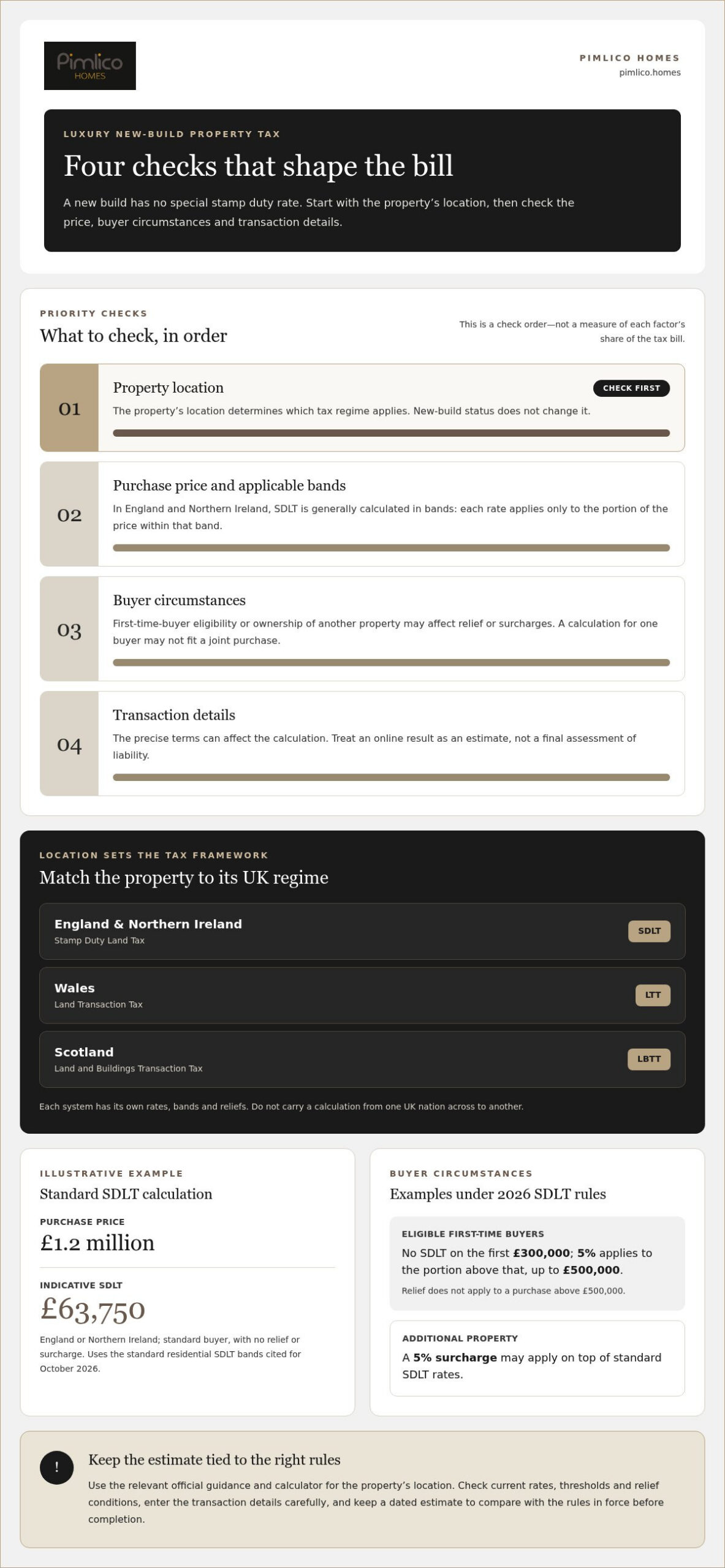
Stamp Duty Land Tax (SDLT) applies to property transactions in England and Northern Ireland. It is generally calculated in price bands, with each rate applying only to the portion of the price within that band. For illustration, using the standard residential SDLT bands in force in October 2026, a £1.2 million purchase in England or Northern Ireland by a standard buyer, with no relief or surcharge, would produce an indicative SDLT figure of £63,750. Different buyer circumstances or transaction details could change the calculation.
Does a luxury new build have a different stamp duty rate?
No. A property being newly built, detached or considered a luxury home does not automatically create a separate SDLT rate. In England and Northern Ireland, the price, applicable tax bands and factors such as relief eligibility or an additional-property surcharge can affect the amount due. Check current official guidance for the relevant tax regime before relying on any rate, threshold or relief.
Care is particularly valuable for a high-value purchase. A change in the price or buyer’s circumstances may affect the calculation, and an online result is only an estimate based on the information entered. It is not a final assessment of liability. The transaction terms and applicable rules must be considered before completion.
Which UK property tax applies to the purchase?
Use the property’s location, not the buyer’s home address, to identify the tax regime:
- England and Northern Ireland: Stamp Duty Land Tax (SDLT).
- Wales: Land Transaction Tax (LTT).
- Scotland: Land and Buildings Transaction Tax (LBTT).
These devolved systems have their own rates, bands and reliefs, so SDLT rules do not apply to a purchase in Wales or Scotland. For broader context, Stamp duty in the United Kingdom outlines the tax’s history and its different forms across the country. For a purchase decision, use the relevant government guidance to check current rules and calculate your position.
How UK stamp duty rules differ for luxury new builds
The tax name and calculation can vary across the UK. Before estimating stamp duty on luxury new builds uk, match the property’s nation to the correct regime. Rates, bands, reliefs and transaction procedures are set separately, so a calculation prepared for one part of the country may not apply elsewhere.
| Tax regime | Applies in | Official guidance |
|---|---|---|
| Stamp Duty Land Tax (SDLT) | England and Northern Ireland | Official SDLT residential property rates |
| Land Transaction Tax (LTT) | Wales | Welsh Government LTT rates and bands |
| Land and Buildings Transaction Tax (LBTT) | Scotland | Revenue Scotland LBTT guidance |
SDLT in England and Northern Ireland
SDLT for residential property is generally calculated in bands, with the relevant rate applied to the portion of the price within each band. The final calculation can depend on more than the home’s price: buyer status, ownership of other property and transaction details may affect relief eligibility or surcharges. Check HMRC’s current guidance before relying on a threshold, rate or relief, and note the date you checked it.
Property transaction taxes in Scotland and Wales
Scotland uses LBTT, while Wales uses LTT. Neither nation uses SDLT for a property purchase within its jurisdiction. Each system has its own bands, reliefs and procedures, which may change independently of SDLT. Check official guidance for the property’s location rather than carrying figures or assumptions across from another nation.
For a high-value purchase, choosing the right framework early helps with planning. A calculator can give a useful indication only if it uses the correct regime and current rules, and the details entered reflect the transaction. Figures copied from an old estimate or a tool built for a different UK tax system may mislead. Verify 2026 thresholds and relief conditions against a dated official source before using them to plan completion.
With the applicable tax framework clear, you can consider the purchase itself. Explore luxury new-build homes as part of that decision.
What can change the tax bill on a luxury new build?
The purchase price is only one part of the calculation. For stamp duty on luxury new builds uk, the tax regime, buyer’s circumstances and precise transaction terms can all matter. A result based on one buyer’s details may not fit a joint purchase or a home bought as an additional property.
First-time buyers and buyers purchasing an additional home
In England and Northern Ireland, first-time buyer relief is separate from whether the home is newly built. Under the 2026 SDLT rules, eligible first-time buyers pay no SDLT on the first £300,000, with 5% applying to the portion above that up to £500,000. Relief doesn’t apply to a purchase above £500,000. Check eligibility conditions and thresholds against current HMRC guidance before relying on them.
Buying another home may bring an additional-property surcharge into the calculation. In England and Northern Ireland, the 2026 surcharge is 5% on top of the standard SDLT rates and applies to additional properties purchased for £40,000 or more. Whether it applies depends on the ownership and transaction circumstances. A 2% non-UK resident surcharge may also apply to residential purchases in England and Northern Ireland, in addition to other SDLT. Confirm the current rules and how they apply to the transaction.
Joint purchases need particular care. The buyers’ ownership positions and individual circumstances may affect relief or surcharge eligibility, so a calculation for one purchaser may not apply unchanged to a purchase in two names. In Wales and Scotland, use the separate LTT or LBTT rules rather than applying SDLT reliefs or surcharges by analogy.
Developer incentives, fixtures, and contract details
A contribution towards buying costs, a price reduction, included fixtures or an upgrade may be described differently in the contract, and the tax treatment can depend on the arrangement. Don’t assume every incentive affects the taxable amount in the same way. Include the full contract and incentive details when confirming how they affect the calculation before exchange or completion.
Keep a record of the price, incentives, fixtures and any agreed changes. RICS guidance on valuing development property provides useful valuation context, but it doesn’t determine the tax treatment of a particular purchase. The transaction documents and applicable tax rules remain central to confirming liability.
How to estimate and check stamp duty before completion
A reliable estimate starts with the transaction details, not just the advertised price. Use this sequence to prepare a considered figure for stamp duty on luxury new builds uk, then check it against the rules in force where the property is located.
- Identify the nation. Establish whether the property is in England, Northern Ireland, Wales or Scotland. This determines whether to use SDLT, LTT or LBTT guidance.
- Confirm the agreed price. Use the purchase price set out in the contract, and note any agreed changes or incentives that may need consideration.
- Establish the buyer circumstances. Record whether the purchase is in one name or jointly, whether any buyer owns or has an interest in another property, and any first-time-buyer or residence details relevant to the current rules.
- Calculate using the appropriate official tool. Use HMRC’s calculator or guidance for SDLT, the Welsh Government’s LTT guidance, or Revenue Scotland’s LBTT calculator and guidance. Enter details that reflect the actual transaction.
- Verify before completion. Compare the result with current official guidance, check any reliefs or surcharges, and confirm the transaction figures and filing arrangements as part of the purchase process.
Information to gather before using a calculator
Have the agreed purchase price and relevant contract details to hand. For each buyer, establish ownership or interests in other property and any status or residence information that may be relevant under the applicable regime. Joint transactions deserve particular attention: a calculator can only reflect what you enter, and missing or inaccurate details can produce an estimate that does not fit the purchase.
Official online tools are useful for planning, but their results are estimates, not a final assessment. They depend on accurate inputs and up-to-date rules. Save the result with the date, the tool or guidance used, and the assumptions entered. If thresholds, reliefs or surcharges have changed since the calculation, revisit it rather than relying on an older figure.
From estimate to confirmed transaction figures
Before completion, review the contract and any agreed incentives alongside the estimate. Confirm how the calculation relates to the transaction documents, which reliefs or surcharges have been applied, and how tax filing and payment will be arranged. This final review helps distinguish a useful planning figure from the amount due for the specific purchase.
With the financial steps mapped out, continue planning the wider purchase through a considered luxury new-build home search, alongside a guide to buying a luxury new build home in 2026.
Plan your luxury new-build purchase with clarity
A clear view of the tax due is one part of a considered home purchase. Before committing, bring together the property’s location, applicable tax rules, buyer circumstances and details recorded in the transaction documents. For stamp duty on luxury new builds uk, careful preparation can help you spot assumptions that need reviewing before completion.
A considered purchase checklist
- Confirm the property’s location. Identify whether SDLT, LTT or LBTT applies, based on where the home is situated.
- Recheck the current rules. Use official guidance for the relevant tax system to verify rates, thresholds, relief conditions and surcharges at the time of purchase.
- Match the calculation to the transaction. Check that the agreed price, buyer names, ownership details and relevant residence information match the inputs used in your estimate.
- Review the documents. Keep the contract and details of agreed incentives with your estimate, so the figures can be considered in the context of the purchase.
- Save a dated record. Note when and how the estimate was prepared, then confirm the completion figures and arrangements as part of the transaction.
Rules and personal circumstances can change, and an earlier estimate may no longer reflect the position at completion. Keep the calculation with its assumptions and source, and review any difference between the estimate and the final figures. This gives you a clear record of how the amount was considered without treating an online result as a final liability assessment.
Explore the next stage of your new-build search
Tax clarity supports a wider decision: whether the home’s design, setting, specification and long-term prospects suit your plans. Resale value is one consideration among many, and no forecast should be treated as a guarantee. Consider these factors alongside the immediate costs and practical details of the purchase.
With the financial picture clearer, you can turn to the home itself. Pimlico Homes develops luxury new-build homes with considered design and high-quality craftsmanship. Explore the homes and consider which could feel right for the next chapter.
Make your next move with confidence
Planning for stamp duty on luxury new builds uk starts with the property’s location: England and Northern Ireland use SDLT, Wales uses LTT, and Scotland uses LBTT. New-build status does not create a separate rate. The price, buyer circumstances and transaction details can all shape the calculation.
Use the relevant official guidance to check current rates, thresholds, reliefs and surcharges, and treat an online calculation as an estimate. Keep a dated record of the figures and assumptions, then review them against the contract and confirm the completion amount as part of the purchase process.
With the financial details considered, you can focus on the qualities that make a home feel right: considered design, craftsmanship and the way each space supports daily life. Pimlico Homes develops luxury residential properties with care and precision. Explore luxury new-build homes from Pimlico Homes and take the next step towards a home that reflects your ambitions.
Frequently Asked Questions
Is stamp duty different on a luxury new build?
No. A home’s luxury or new-build status doesn’t, by itself, create a separate stamp duty rate. The tax system depends on where the property is, while the purchase price and buyer or transaction circumstances can affect the amount due. For stamp duty on luxury new builds uk, use current official guidance for the relevant regime and treat an online result as an estimate until the transaction details have been checked.
How is stamp duty calculated on a new-build home in England?
In England, residential Stamp Duty Land Tax (SDLT) is generally calculated in bands, with each rate applying only to the portion of the price within that band. Reliefs or surcharges may also affect the calculation, depending on the buyer and transaction. For example, under the standard SDLT rules in force in 2026, a £300,000 purchase by a standard buyer results in £5,000 SDLT. Check current HMRC guidance before relying on a figure.
Do Scotland and Wales use the same stamp duty rules as England?
No. Scotland uses Land and Buildings Transaction Tax (LBTT), and Wales uses Land Transaction Tax (LTT). England uses SDLT, as does Northern Ireland. Each system has its own rates, bands, reliefs and procedures, which may change separately. Use official guidance for the nation where the property is located rather than applying English thresholds or reliefs to a Scottish or Welsh purchase.
Can first-time buyers get tax relief when buying a luxury new build?
Potentially, if the purchase is in England or Northern Ireland and the buyer meets the current first-time buyer relief conditions. In 2026, eligible buyers pay no SDLT on the first £300,000, with 5% on the portion above that up to £500,000. Relief doesn’t apply to a purchase above £500,000. A new build isn’t automatically eligible for relief; check the conditions and thresholds against current HMRC guidance.
What happens if I already own another property when buying a new build?
An additional-property surcharge may apply, depending on ownership and transaction circumstances. In England and Northern Ireland, the 2026 SDLT surcharge is 5% on top of standard rates for qualifying additional residential property purchases of £40,000 or more. A 2% non-UK resident surcharge may also apply to residential purchases in those nations. Check the current rules for the relevant tax system, especially for joint purchases or a change of main residence.
Can a developer incentive change the stamp duty calculation?
It depends on the incentive’s form and the contract terms. A price reduction, contribution towards costs, included fixtures or an upgrade may not all be treated identically for tax purposes. Include the contract and full details of any agreed incentives when confirming how they affect the calculation before completion.
When do I need to pay stamp duty on a new-build home?
For SDLT purchases in England and Northern Ireland, the tax must be paid to HMRC within 14 days of completion. The applicable filing and payment arrangements differ under Wales’s LTT and Scotland’s LBTT, so check the relevant official guidance. Confirm the expected amount and timing before completion, and don’t rely on an older online estimate.





