
What if the most important detail in your stamp duty calculation isn’t that your new home is brand new? When considering stamp duty on luxury new build homes, the property’s location, purchase price and ownership circumstances can all shape the bill.
It’s understandable to expect a new build to be taxed differently, or to be unsure how an existing property or company purchase might affect what you owe. In England and Northern Ireland, there are no separate stamp duty rates for new builds. Scotland and Wales have their own property transaction taxes.
This guide explains how the 2026 rules apply, including how price bands work and how first-time buyer status, additional properties, residency and ownership structure may affect your position. It also sets out the information to gather before getting advice tailored to your circumstances. A considered purchase starts with a clear view of the costs and obligations, as well as the home itself.
Key Takeaways
- Identify the UK nation where the home is located first. The property transaction tax differs across England, Northern Ireland, Scotland and Wales.
- For stamp duty on luxury new build homes, “luxury” and “new build” do not create a separate tax category. The calculation depends on the price and buyer circumstances.
- Understand how progressive tax bands apply and which details can affect the calculation, including first-time buyer status and whether you own another property.
- Before exchange, organise the key transaction and ownership details, then confirm the expected completion date with your conveyancer.
- Consider tax planning alongside wider purchase due diligence, including the home’s design, specification and long-term suitability.
Stamp duty on luxury new build homes: what buyers need to know
Stamp Duty Land Tax (SDLT) is a tax on qualifying purchases of land and property in England and Northern Ireland. It is calculated using the chargeable consideration and the rules that apply to the transaction. A home’s prestige or new-build status alone does not determine the amount. The property’s location, price, ownership and other buyer circumstances all matter.
“Stamp duty” is often used as a general term across the UK, but the tax depends on where the property is situated. The distinctions are set out in this overview of Stamp Duty in the United Kingdom. Identifying the right tax system is the first step towards understanding the likely liability.
Which property transaction tax applies in each UK nation?
SDLT applies in England and Northern Ireland. In Scotland, the equivalent tax is Land and Buildings Transaction Tax (LBTT); in Wales, it is Land Transaction Tax (LTT). Each has its own rates, thresholds and rules, so do not use an SDLT calculation for a property in Scotland or Wales. Check current guidance from HMRC, Revenue Scotland or the Welsh Revenue Authority, according to the property’s location.
Does buying a new build change the tax treatment?
No separate SDLT category applies simply because a home is new or described as luxury. The tax framework is the same as for an existing residential property in the same jurisdiction. The outcome can still vary between buyers. The purchase price and transaction terms matter, as do circumstances such as first-time buyer status or ownership of another dwelling. These details can affect which rates or reliefs may apply.
Look beyond the headline price. The contract and any incentives, fixtures, fittings or other items connected with the purchase may need to be considered when working out the chargeable consideration. Their treatment is not automatically the same in every transaction. A conveyancer can assess the contract and explain how the applicable rules affect the calculation.
In practical terms, stamp duty on luxury new build homes is a property transaction tax shaped by location, consideration and buyer circumstances, not architectural distinction. Treating tax planning as one part of choosing a carefully designed long-term home can help bring clarity to the purchase as a whole.
How to estimate stamp duty on a luxury new build
A useful estimate starts with the property’s location, the amount chargeable and the identity and circumstances of the buyer. Rates and reliefs can depend on the transaction’s effective date, so use current official guidance rather than relying on an old calculation.
A practical three-step estimate
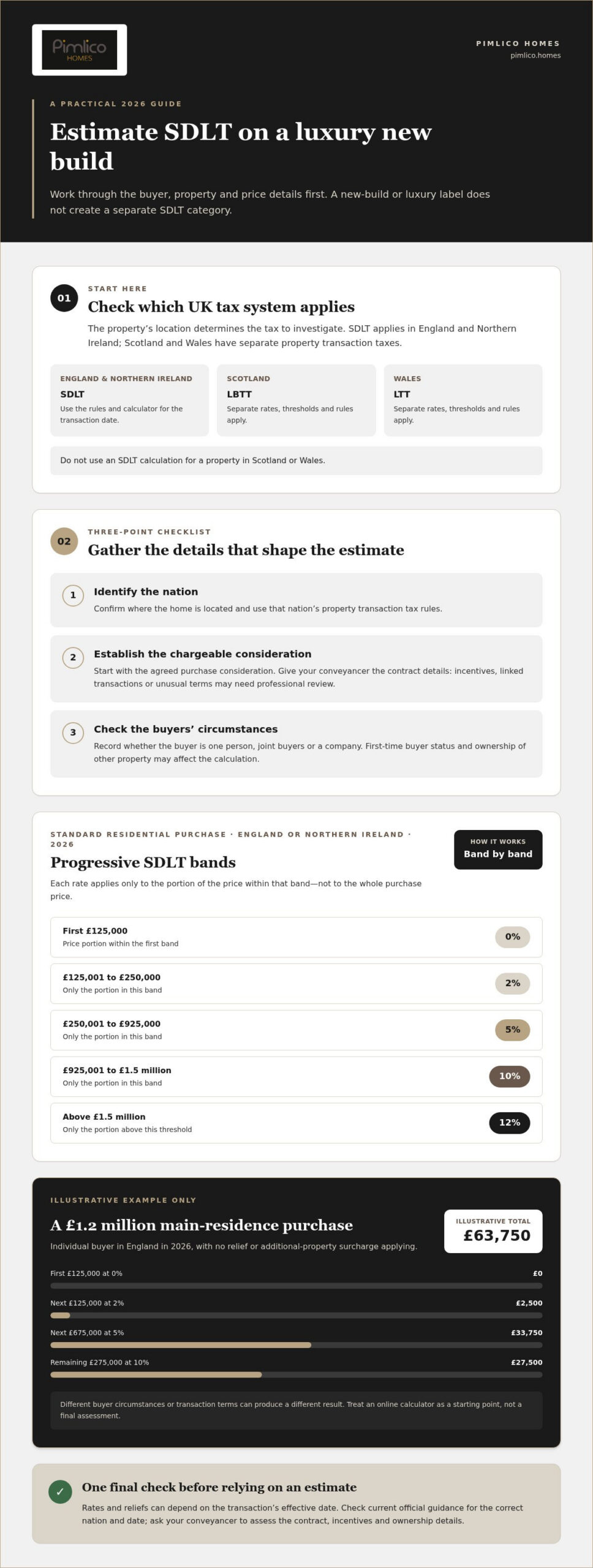
- 1. Identify the nation. SDLT applies in England and Northern Ireland. Scotland and Wales use separate property transaction taxes, with their own rules and calculators.
- 2. Establish the chargeable consideration. Start with the agreed purchase consideration and give your conveyancer the contract details. Incentives, linked transactions or unusual terms may affect the assessment and need professional review.
- 3. Check the buyers’ circumstances. Record whether the purchase is by one person, jointly or through a company. First-time buyer status, ownership of other property and other relevant circumstances may change the calculation.
For England and Northern Ireland, the GOV.UK Stamp Duty Land Tax Overview provides official guidance. Check the rules and calculator that apply to the transaction date. For a property elsewhere in the UK, use the relevant national tax authority.
How progressive bands affect a high-value purchase
SDLT is generally calculated progressively. Each rate applies only to the portion of the consideration within its band, rather than one rate applying to the full price. For a standard residential purchase in England or Northern Ireland, the rates in force in 2026 are 0% on the first £125,000, 2% on the portion from £125,001 to £250,000, 5% from £250,001 to £925,000, 10% from £925,001 to £1.5 million and 12% above £1.5 million.
Illustrative example only: Assume an individual buys a £1.2 million home in England in 2026 as their main residence, with no relief or additional-property surcharge applying. The calculation is £0 on the first £125,000, £2,500 on the next £125,000, £33,750 on the next £675,000 and £27,500 on the remaining £275,000. The illustrative total is £63,750. Different buyer circumstances or transaction terms can produce a different result.
Online calculators can help with an initial estimate, but may not capture every ownership detail, incentive or contract arrangement. Treat the result as a starting point, not a final assessment. For a broader perspective on choosing a carefully considered home, explore Pimlico Homes’ luxury new-build homes.
How owning other properties can change the tax calculation
A purchase as your sole home may be treated differently from buying another dwelling while retaining a property you already own. In England and Northern Ireland, higher SDLT rates can apply to additional residential properties. The 2026 surcharge is 5 percentage points on top of the standard rates, but whether it applies depends on the buyer, the property and the circumstances at completion.
For a typical additional-property purchase, the higher rates may be relevant where the property costs at least £40,000 and the buyer owns another dwelling. The detailed tests matter. Intended use, the value and nature of existing ownership interests, and whether the new home is replacing a main residence can all affect the result. Moving home can raise questions about how the old and new homes overlap in ownership. Do not assume an exception or later refund will apply. Check current HMRC guidance and have the facts assessed before relying on a particular treatment.
Personal, joint and company ownership compared
The ownership route alone cannot determine the bill. Use these questions to prepare for a conversation with your conveyancer or a qualified tax adviser:
| Purchase route | Questions to resolve |
|---|---|
| Sole individual | Will you own another dwelling at completion? Is this purchase replacing your main residence, and what interests do you hold in other properties? |
| Joint individuals | What does each buyer own, including any share in another dwelling? Does either buyer’s history or portfolio affect the transaction’s treatment? |
| Company acquisition | Which company will acquire the property, who is connected with it, and which specific corporate SDLT rules and rates apply? |
Joint buyers should disclose each purchaser’s circumstances rather than assess the transaction using only one person’s portfolio. The rules can treat a joint purchase differently if one buyer owns another dwelling. A company acquisition is also not simply an individual purchase under another name. Distinct provisions may apply, and the company structure should be reviewed on its own facts.
Before exchange, assemble a clear ownership picture: list properties held personally or jointly, the share and nature of each interest, who will buy the new home, and whether an existing main residence will be sold. A solicitor or qualified tax adviser can assess complex portfolio circumstances against the rules in force for the transaction. This is particularly useful where family ownership, company structures or a change of main residence makes an otherwise straightforward purchase more complex.
What to check before exchanging contracts on a new build
Exchange is a significant commitment. Before reaching it, make sure your estimate of stamp duty on luxury new build homes reflects the full transaction, not just the headline purchase figure. A clear record of the terms and your ownership circumstances gives your conveyancer a stronger basis for checking the applicable tax and filing requirements.
Organise the key documents and details
- Draft contract and agreed consideration: Keep the latest contract and a written record of the agreed purchase consideration together.
- Incentives and included items: Share details of incentives, fixtures, fittings or other arrangements connected with the purchase. Their tax treatment can depend on the contract and circumstances.
- Ownership information: Set out who will buy the property, whether the purchase is sole, joint or through a company, and any existing property interests relevant to the buyers.
- Location and timing: Confirm the nation where the home is situated and the expected completion date. The relevant tax regime and rules depend on the transaction, and the date can affect which rules apply.
Ask your conveyancer to confirm the assumptions behind any estimate, including the consideration used, the buyer details considered and whether relief or higher rates have been taken into account. SDLT in England and Northern Ireland is generally payable within 14 days of completion. Your conveyancer can confirm the filing and payment arrangements for your transaction and jurisdiction.
Seek tailored advice early where circumstances are complex
General guidance cannot determine an individual buyer’s liability. A portfolio of properties, joint ownership, a company or trust, or cross-border circumstances may call for specific legal or tax advice. Raise these points before contractual commitments are finalised, while there is still time to understand how the facts affect your estimate and plan for the transaction.
Keep purchase tax separate from the ongoing costs of owning a home. SDLT, LBTT and LTT relate to the property transaction. Recurring charges, such as council tax, have different rules and need their own assessment. A considered budget accounts for both without treating them as the same liability.
Tax checks are one part of wider purchase due diligence. For a broader view of the decisions involved, read our luxury new-build buying guide. You can also explore luxury new-build homes while considering the design and long-term suitability of your next home.
A considered purchase: tax planning alongside choosing a luxury new build
Tax clarity brings confidence to the practical side of buying, but it is only one part of choosing a home. A considered decision also weighs how the design supports daily life, whether the layout suits changing needs, and how the home’s craftsmanship and specification align with your priorities. Consider these factors together, without assuming a particular property will deliver a specific financial outcome.
Balance transaction planning with the home itself
Once you have a clearer view of the applicable transaction tax, give the home the same thoughtful attention. Look at how its spaces connect, how the layout fits your routines and which aspects of the design matter over time. Pimlico Homes’ luxury new-build purchasing guide offers broader decision support alongside the tax and contract checks covered here.
Consider long-term ownership, not predictions
A home is a substantial personal commitment, so consider how it may serve you beyond the day you move in. Future plans, changing household needs and the possibility of resale can all form part of that wider reflection. Our guide to the resale value of new build homes explores longer-term ownership considerations. Use it as context for your due diligence, not as a promise of future value or performance.
Explore a thoughtfully designed new-build home
Pimlico Homes develops luxury new-build homes, including luxury detached and executive courtyard homes, as well as bespoke homes and barn conversions. Consider each home’s design, specification and suitability on its own merits. Tax guidance remains a matter for your conveyancer or qualified tax adviser. This guide helps you understand the questions to raise, rather than providing individual tax advice.
With the tax framework and key purchase checks in view, you can consider the home itself with greater clarity. Explore Pimlico Homes’ luxury new-build homes and consider the design and setting that could suit your next chapter.
Move forward with clarity and confidence
Planning stamp duty on luxury new build homes starts with three essentials: identify the tax regime for the property’s UK nation, understand how progressive bands apply, and consider how your ownership circumstances may affect the calculation. A new build does not automatically have a separate tax category, but joint purchases, existing property interests and company ownership can make the details more complex.
Before committing, gather the purchase and ownership information and ask your conveyancer to assess the transaction against the rules that apply at the relevant time. That clarity supports a considered decision alongside the home’s design, craftsmanship and suitability for your future.
Pimlico Homes develops luxury detached homes, executive courtyard homes, bespoke new builds and high-end barn conversions. For tax guidance, speak with your conveyancer or a qualified tax adviser. To take the next step in choosing a home, explore Pimlico Homes’ luxury new-build homes.
Frequently Asked Questions
Does a luxury new build have a different stamp duty rate?
No. In England and Northern Ireland, neither “luxury” nor “new build” creates a separate SDLT category. The calculation depends on the transaction, chargeable consideration and buyer’s circumstances, including any relevant relief or higher rates. Scotland and Wales use different property transaction taxes, not SDLT. Check current rules with HMRC or your conveyancer. For a property elsewhere in the UK, consult the relevant national tax authority.
Which tax applies when buying a new build in Scotland or Wales?
In Scotland, the relevant tax is Land and Buildings Transaction Tax (LBTT); in Wales, it is Land Transaction Tax (LTT). These are distinct from Stamp Duty Land Tax (SDLT), which applies in England and Northern Ireland. Each nation has its own rates, thresholds and guidance, which can change. For current calculations and eligibility rules, consult Revenue Scotland or the Welsh Revenue Authority, as appropriate.
Can owning another property increase the tax on a new-build home?
Yes, additional-property rules may affect the tax due, but the outcome depends on the buyer’s ownership interests, intended use and other conditions. A joint purchase may need closer assessment if one buyer owns another dwelling. Replacing a main residence can also affect how the rules apply, depending on the details and timing. Check current official guidance and ask your conveyancer to assess your circumstances before relying on an estimate.
How is stamp duty calculated on a high-value property?
For SDLT, the calculation generally uses progressive bands, so each rate applies to the portion of the chargeable consideration within that band, rather than to the whole price. The correct calculation also depends on the property’s UK nation and the buyer’s circumstances. Use the appropriate official calculator with confirmed transaction details, then ask your conveyancer to review the result, particularly if the purchase involves complex ownership or contract terms.
Do new-build incentives affect the stamp duty calculation?
They may need to be considered, but their treatment depends on the incentive, included items, contract terms and facts of the transaction. Do not assume every incentive either changes or leaves the chargeable amount unchanged. Give your conveyancer the full contract and written details of any incentives before relying on an estimate. This allows the calculation to be considered against the rules relevant to your purchase.
Does buying a luxury new build through a company change the tax treatment?
It can. A company acquisition may involve different tax considerations from a personal purchase, and the analysis can depend on ownership connections and how the property will be used. There is no single outcome for every company purchase, and a company structure should not be assumed to reduce tax. Before deciding how to acquire the home, seek tailored advice from a qualified tax professional and conveyancer.
Can an online stamp duty calculator give an exact figure?
An online calculator can provide a useful estimate if its rules and inputs are current, but it may not capture every ownership, contract or relief condition. Select the correct UK tax regime and enter confirmed transaction details, including who is buying and any relevant property interests. Then check current official guidance and ask your conveyancer to review the result before exchange, especially if your circumstances are complex.





