
True luxury in the coming years won’t be measured by the number of touchscreens on your walls; it’ll be defined by their complete disappearance. As we look toward 2026, the future of luxury residential developments is moving away from fickle gadgets and toward a more profound sense of permanence. You likely feel the same hesitation as many discerning investors. There’s a valid fear that today’s “state-of-the-art” home will feel like a dated relic by the end of the decade. You’re seeking a sanctuary that prioritises structural excellence and absolute privacy over high-density convenience.
We promise to show you how the next generation of high-end living in the United Kingdom balances visionary design with traditional values. You’ll discover why the global wellness real estate market is projected to hit $1.8 trillion by 2030, and how this shift influences everything from medical-grade air filtration to acoustic isolation. We’ll explore the transition to “invisible” automation via Matter 1.6 and the enduring value of bespoke executive courtyard homes. By the end, you’ll have the confidence to identify developments that don’t just follow trends, but set a standard for a lifetime of intuitive living.
Key Takeaways
- Understand how the future of luxury residential developments is shifting from material opulence toward architectural meaning and intuitive, behaviour-led design.
- Discover why biophilic principles and medical-grade environmental controls have become the new standard for longevity and wellness in high-end homes.
- Learn to prioritise “invisible” smart systems that offer local network security and seamless integration without the clutter of visible screens or panels.
- Explore the benefits of executive courtyard living, where clever architectural arrangements provide absolute privacy alongside a sense of secure, exclusive community.
- Gain insight into why bespoke craftsmanship and luxury barn conversions offer a robust hedge against depreciation by focusing on permanence and architectural heritage.
Redefining the Essence of Luxury Residential Developments
The concept of high-end living is undergoing a fundamental shift as we look toward 2026. For decades, the industry measured prestige through material excess and sheer volume. Today, the conversation has moved. Affluent buyers are no longer satisfied with a collection of expensive materials; they’re seeking architectural meaning. This evolution marks a significant milestone in the future of luxury residential developments, where the focus has transitioned from what a home says about its owner to how it supports their existence.
We’re seeing the “Experience Economy” firmly take root in the property sector. Buyers are recalibrating their expectations, moving away from static displays of wealth toward environments that facilitate a specific quality of life. It’s a move toward the emotional resonance of a space. Square footage remains a metric, certainly, but it’s now secondary to the “flow” of a floor plan. Modern buyers are looking for:
- Acoustic Privacy: Advanced soundproofing that creates a literal barrier against the outside world.
- Intuitive Transitions: Layouts that naturally guide the user from social hubs to private retreats.
- Atmospheric Precision: The ability to control light and air quality to suit specific moods or health requirements.
From Materiality to Meaningful Design
In this new era, bespoke finishes must serve a greater purpose than mere decoration. Every choice, from the texture of a hand-finished wall to the integration of biophilic design principles, is curated to evoke a sense of calm. The goal isn’t to “show” luxury through glitz, but to “feel” it through an atmosphere of quiet confidence. 2026 luxury is an intuitive extension of the owner’s lifestyle, where every architectural choice anticipates a need before it’s even felt.
The Rise of Architectural Storytelling
True permanence comes from a sense of place. Visionary developers are increasingly using heritage cues to ground new builds in a historical context, ensuring they don’t feel like temporary additions to the landscape. This narrative-driven approach creates “moments of discovery” within a residential layout. Perhaps it’s a framed view of an ancient oak or a courtyard that captures the light at a specific hour. These details foster a deep emotional connection to the property. For those beginning their journey, understanding these nuances is essential, as detailed in our Ultimate Guide to Buying a Luxury New Build Home in 2026. By prioritising storytelling, the future of luxury residential developments ensures that a home isn’t just a structure, but a legacy.
The Wellness Revolution: Intuitive Environments and Biophilic Design
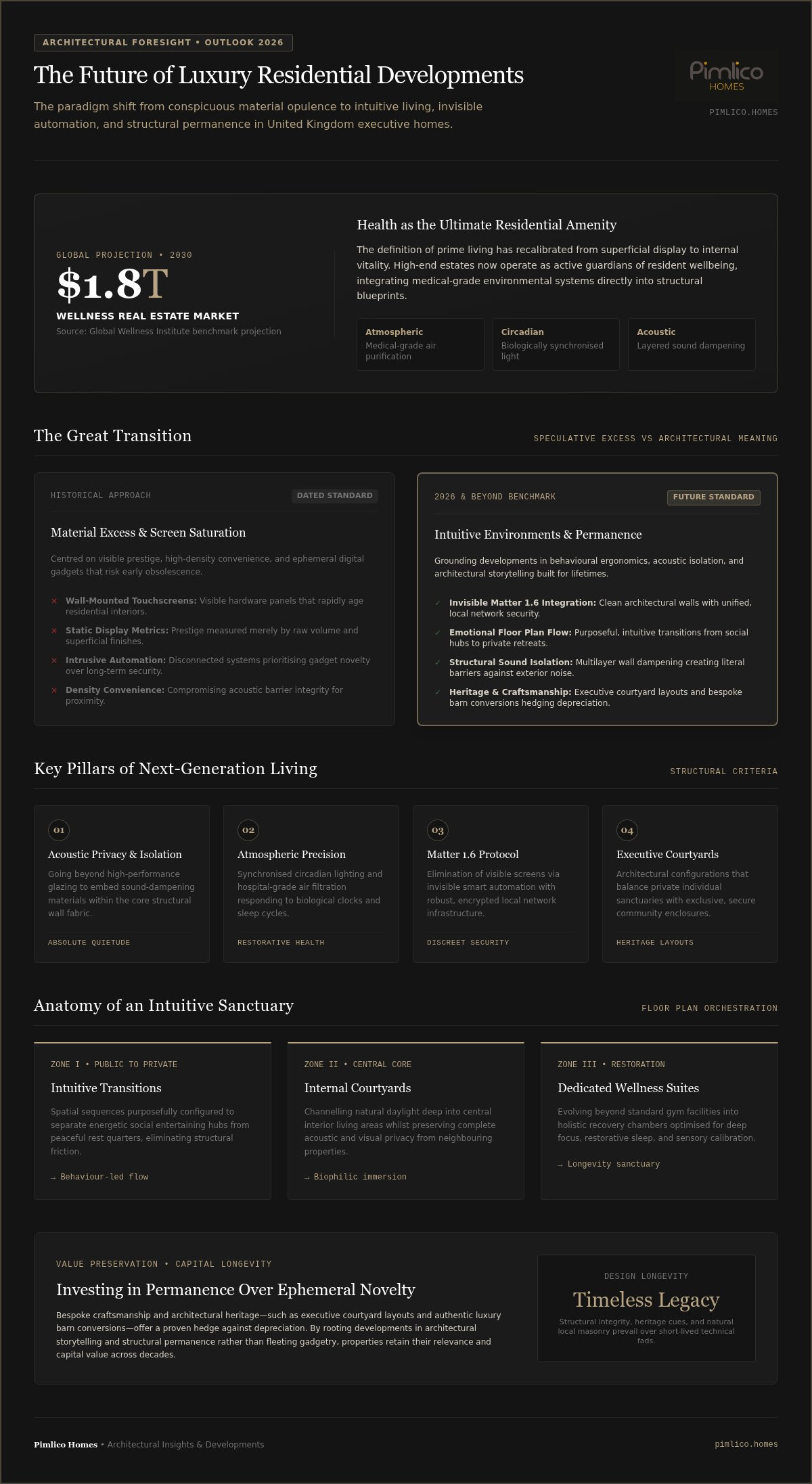
The definition of a premium lifestyle has evolved from outward display to internal vitality. Health and longevity are now the ultimate luxury amenities. This shift is driving the future of luxury residential developments toward a model where the building itself acts as a guardian of the resident’s wellbeing. Data from the Global Wellness Institute suggests the wellness real estate market will reach $1.8 trillion by 2030. This isn’t a passing trend. It’s a fundamental recalibration of how we value our living spaces.
Health as the Ultimate Residential Amenity
Silence is a rare commodity. In a world of constant digital and urban noise, designing for acoustic purity has become a hallmark of executive specifications. It’s about more than high-performance glazing. It involves the careful layering of sound-dampening materials within the very fabric of the walls. Wellness suites have also moved beyond the traditional home gym. They now incorporate medical-grade air purification and circadian lighting systems that synchronise with your biological clock to improve sleep quality. These sanctuary spaces are designed for deep focus and recovery, allowing the home to become a place of genuine restoration.
Integrating Nature into Modern Estates
Bringing the outside in is no longer just about a large window. It’s about architectural integration. Internal courtyards are becoming a signature feature, allowing natural light to penetrate deep into the floor plan whilst maintaining total privacy. Sustainable, breathable materials like natural stone and lime-based plasters promote a healthier indoor climate. Biophilic design increases long-term property desirability by fostering a biological connection between the resident and their environment.
The psychological impact of these choices is profound. High ceilings and clear natural vistas reduce stress levels and enhance cognitive function. As noted in Knight Frank’s Wealth Report, ultra-high-net-worth individuals are increasingly prioritising homes that offer this level of environmental control and health-centric design. If you are looking for a residence that honours these principles, exploring bespoke luxury homes can provide the clarity needed to invest in your long-term wellbeing. By embedding wellness into the core construction, the future of luxury residential developments ensures that your home is as resilient as the legacy you are building.
Technology Without Intrusion: The Era of the Invisible Smart Home
The aesthetic of the high-end home in 2026 is one of serene minimalism. This is achieved not by removing technology, but by making it invisible. In the future of luxury residential developments, the mark of a sophisticated home is the absence of wall-mounted touchpads and blinking hardware. Instead, we see the rise of agentic AI and local network protocols like Matter 1.6, which allow for ambient control without the security risks of cloud-based systems. This shift ensures that technology serves the resident’s comfort rather than demanding their attention through constant notifications or complex interfaces.
Affluent buyers are increasingly wary of “smart” homes that feel like disposable electronics. They understand that a home is a generational store of capital. Therefore, the focus has shifted from current software versions to the underlying infrastructure that supports them. It’s a move toward permanence. By prioritising local network control over cloud-dependent gadgets, developers can guarantee response times under 200ms and total functionality even during external internet blackouts. This provides a level of cyber-resilience that is now a non-negotiable requirement for high-profile residents.
Beyond the Gadget: Intuitive Home Management
True luxury is predictive. We are moving toward environments where heating, acoustic baffling, and lighting systems learn resident behaviour to adjust settings before a room is even entered. Security has similarly evolved. Biometric access and AI-driven perimeter protection provide seamless safety, replacing clunky keypads with silent, reliable recognition. This approach aligns with a broader wellness real estate development framework, where technology is used to reduce cognitive load and enhance the sense of sanctuary. It’s about simplifying life, not complicating it with endless updates.
Future-Proofing Through Infrastructure
Software is fleeting, but the “bones” of a house are permanent. To secure the long-term value of a property, developers must prioritise infrastructure flexibility. This means installing high-capacity cabling and modular tech hubs that can be easily upgraded in 2036 without disturbing the architectural fabric. Infrastructure must also account for the electric vehicle revolution and the need for integrated renewable energy storage. A home’s ability to adapt is its greatest asset. By designing for the future requirements of smart estate integration, as explored in our look at the Future of Executive Living, developers ensure that the future of luxury residential developments remains grounded in practical longevity.
- Local Processing: Moving away from cloud reliance to ensure total privacy and immediate response.
- Modular Hubs: Centralised points for hardware that allow for seamless upgrades as standards evolve.
- Renewable Readiness: Pre-wiring for solar arrays and high-speed EV charging as a standard executive specification.
Community and Privacy: The Evolution of Executive Courtyard Living
The desire for connection often clashes with the necessity for seclusion. In the future of luxury residential developments, this tension is resolved through the evolution of the executive courtyard model. We’re seeing a move away from sprawling, exposed estates toward more considered, secure enclaves. These developments offer the “modern manor” experience. They provide the prestige of a detached home whilst benefiting from shared security perimeters and a cohesive architectural aesthetic. It’s a balance that acknowledges our social nature without compromising the sanctity of the private retreat.
High-density builds frequently fail because they overlook the human need for quietude. The modern enclave solves this by grouping homes around a central, beautifully landscaped core. This isn’t just about aesthetics; it’s about creating a psychological buffer. When you enter the gates of a courtyard development, the outside world feels noticeably more distant. This collective approach to security and maintenance allows residents to enjoy a “lock-and-leave” lifestyle with total peace of mind. It’s about creating a sense of place that feels both exclusive and welcoming.
The Modern Enclave: Security and Serenity
Gated courtyard models are rapidly becoming the preferred choice for discerning executives. These enclaves create a sense of belonging through shared, high-quality landscaping that defines the character of the entire development. It’s about creating a micro-community where residents feel secure and supported. The collective investment in shared spaces enhances the property’s overall value and security. You can explore this concept further in our piece on the Allure of Executive Courtyard Homes, which highlights how these designs master the art of privacy and prestige.
Seclusion by Design
Privacy shouldn’t feel like an afterthought. It must be baked into the blueprints. This is achieved through strategic window placement and building orientation that completely eliminates overlooking from neighbours. The use of private internal gardens allows residents to enjoy outdoor sanctuaries that are entirely their own. These courtyard layouts provide a vital buffer from the outside world, dampening urban noise and shielding the home from public view. It’s an architectural embrace. By prioritising these “quiet” zones, the future of luxury residential developments ensures that your home remains a true sanctuary. If you’re ready to find a space that perfectly balances community and seclusion, you can view our latest executive courtyard homes to see this vision in practice.
Investing in Permanence: Why Heritage and Craftsmanship Prevail
Technology will inevitably evolve, and interior trends will shift with the seasons. However, the physical substance of a home remains the only true constant. In the future of luxury residential developments, bespoke craftsmanship serves as the ultimate hedge against property depreciation. Discerning buyers are increasingly moving away from mass-produced luxury, opting instead for homes that showcase architectural provenance and a meticulous attention to detail. This isn’t merely about aesthetics; it’s about the emotional weight of an investment that is built to last for generations.
Traditional materials such as natural stone, solid oak, and slate are being reimagined for 2026. These elements are no longer reserved for rustic designs. Instead, they’re being used with surgical precision to create contemporary spaces that feel grounded and permanent. Luxury barn conversions, in particular, continue to command a significant premium. They offer a unique marriage of historical volume and modern performance, providing a sense of scale that is difficult to replicate in standard new builds. When a developer prioritises these enduring materials, they’re not just building a house. They’re creating a store of capital that appreciates as the patina of the building matures.
The Resale Value of Quality
A “high specification” must go deeper than the kitchen worktop or the brand of the appliances. In the ultra-prime market, true value lies in the architectural integrity of the build. This includes the precision of the masonry, the quality of the joinery, and the seamless integration of services. Homes with bespoke details and a clear design narrative consistently outperform the broader market during resale. For those looking to understand the financial nuances of such acquisitions, our Luxury Investment Guide offers a deeper look at how quality drives long-term asset value. It’s the difference between a house that feels dated in five years and one that becomes a local landmark.
Pimlico Homes: A Legacy of Excellence
At Pimlico Homes, our 25 years of experience in high-end construction informs every decision we make about the future of luxury residential developments. We act as both visionary creators and reliable guardians of quality. Our commitment to bespoke, detached living and heritage-inspired barn conversions is rooted in the belief that a home should be a masterpiece of artistry and engineering. We invite you to explore our latest collection of executive homes, where traditional values meet innovative thinking to create a living experience of unparalleled security and prestige. Your investment deserves the steady hand of a master craftsman who understands that excellence is never an accident.
- Artisan Millwork: Hand-finished timber elements that provide a tactile sense of luxury.
- Architectural Provenance: Designs that respect the landscape whilst pushing the boundaries of modern living.
- Generational Longevity: A focus on structural quality that ensures the home remains a legacy asset.
Secure Your Legacy in a Changing Landscape
The evolution of the high-end home isn’t about chasing the latest trend; it’s about anticipating the needs of a more discerning generation. We’ve explored how the future of luxury residential developments is being shaped by a transition toward invisible technology and a profound commitment to structural wellness. These aren’t temporary shifts. They represent a permanent recalibration of what it means to live well in the United Kingdom.
Investing in a residence that prioritises bespoke craftsmanship and architectural integrity ensures your home remains a sanctuary for decades to come. At Pimlico Homes, our 25 years of specialist development expertise allows us to redefine the standard for executive courtyard homes. We blend innovative thinking with the permanence of traditional materials to create spaces that feel both visionary and grounded. Every detached residence we build is a testament to our belief that true luxury is found in the meticulous care of the master craftsman.
We invite you to Explore our vision for the future of luxury living and discover a home designed for longevity. Your journey toward a more intuitive, secure lifestyle begins with a developer who understands the emotional and financial weight of your investment.
Frequently Asked Questions
What are the key trends in luxury residential developments for 2026?
The key trends for 2026 involve a transition toward “invisible” technology and structural wellness. We’re seeing a departure from visible gadgets in favour of ambient AI and local network protocols like Matter 1.6. These systems prioritise privacy and cyber-resilience. Additionally, there’s a strong shift toward biophilic design, where natural light and air quality are engineered into the building’s core. This ensures the home supports longevity rather than just providing aesthetic appeal.
How does biophilic design improve the value of a luxury new build?
Biophilic design enhances property value by integrating natural systems that improve resident wellbeing. By prioritising internal courtyards, native landscaping, and advanced air filtration, these homes offer a healthier living environment. Buyers in the premium market increasingly value health as the ultimate amenity. This biological connection to the home fosters a sense of calm and permanence. Properties featuring these elements often command higher resale premiums and demonstrate greater market resilience over time.
Why is the executive courtyard model becoming more popular for high-end homes?
The executive courtyard model is gaining popularity because it perfectly balances private seclusion with a secure sense of community. These enclaves create a “modern manor” atmosphere, where detached homes share a high-quality architectural aesthetic and a secure perimeter. This arrangement provides a physical and psychological buffer from the outside world. It allows for a “lock-and-leave” lifestyle that appeals to busy professionals who require absolute privacy and peace of mind within their primary residence.
How can I ensure my new build home is future-proofed for technology?
True future-proofing focuses on the physical infrastructure rather than current software versions. You should prioritise high-capacity cabling and modular tech hubs that allow for seamless hardware upgrades in the decades to come. Moving toward local network protocols like Matter ensures your home remains functional during internet blackouts. By investing in the “bones” of the house, you ensure the future of luxury residential developments stays flexible enough to adopt the innovative technology of 2036.
What is the difference between a high-specification home and a luxury home?
A high-specification home typically focuses on premium fittings and the latest appliances. In contrast, a luxury home is defined by its architectural narrative, bespoke craftsmanship, and the intuitive flow of its spaces. It’s about the emotional resonance of the environment. While specifications can be upgraded, true luxury is built into the structural integrity and the unique artistry of the design. It represents a generational store of capital that prioritises the human experience over disposable trends.
Do luxury barn conversions hold their value as well as new builds?
Luxury barn conversions often hold their value exceptionally well due to their inherent scarcity and unique architectural character. These properties offer a marriage of historical volume and modern performance that’s difficult to replicate in standard new builds. The enduring appeal of traditional materials like oak and stone, combined with contemporary wellness features, makes them highly desirable. As bespoke projects, they’re viewed as legacy assets, providing a robust hedge against depreciation in the premium residential market.
What role does sustainability play in the future of premium real estate?
Sustainability has evolved from a secondary concern to a core component of operational luxury. In the future of luxury residential developments, premium homes must offer energy resilience through integrated renewable storage and high thermal efficiency. This isn’t just about environmental responsibility. It’s about the security of self-sufficiency and the comfort of breathable, non-toxic living environments. Buyers now expect their homes to be as durable and efficient as they are aesthetically pleasing, ensuring long-term asset viability.
How does architectural narrative impact the resale value of a property?
An architectural narrative transforms a property from a mere commodity into a unique landmark. When a home has a clear design story, it creates a deep emotional connection with potential buyers. This sense of place and permanence is highly valued in the ultra-prime market. Properties that showcase a deliberate vision and heritage cues tend to appreciate more reliably. They stand out in a competitive market, ensuring that the home remains a prestigious and sought-after investment for many years.





