
Could the traditional allure of a heritage estate actually be a quiet drain on your wealth? While the ivy-clad walls of a period property carry a certain romantic weight, the reality of maintaining such structures in 2026 often brings a series of escalating costs and energy inefficiencies that are difficult to ignore. Discerning investors are increasingly looking toward the long-term value of bespoke new build homes to anchor their portfolios. It’s a shift driven by a desire for both aesthetic excellence and the security of an asset that won’t require constant, costly restoration.
Structural future-proofing. We believe that a home is more than a residence; it’s a legacy. This guide explores why high-specification developments represent a superior asset class for sustainable wealth preservation. With the implementation of the Future Homes Standard 2026 requiring a 75-80% reduction in carbon emissions, the gap between older estates and modern builds has never been wider. You’ll discover a clear framework for evaluating ROI through structural excellence, future-proofed technology, and the enduring quality of expert craftsmanship. We will examine how modern engineering creates a value floor that period properties simply cannot match in today’s market.
Key Takeaways
- Understand why luxury residential assets are increasingly preferred over volatile equity markets for wealth preservation in 2026.
- Recognise the financial impact of the “heritage tax” and how high-specification builds eliminate the escalating maintenance costs of period estates.
- Learn how to evaluate the long-term value of bespoke new build homes by scrutinising developer craftsmanship and site-specific geographic resilience.
- Discover how the Future Homes Standard 2026 creates a value floor for new properties that older, carbon-intensive homes cannot match.
- Gain a clear framework for performing due diligence on luxury developments to ensure your investment serves as a lasting family legacy.
Reimagining the Asset Class: Why Luxury New Builds Lead 2026 Portfolios
The investment landscape has fundamentally shifted. In 2026, the allure of intangible equity markets has softened for many high-net-worth individuals. They’re returning to the soil. Tangible, high-specification residential assets now serve as a primary anchor for sophisticated portfolios. This isn’t merely about finding a place to reside; it’s a calculated move toward architectural permanence. Luxury detached homes offer a unique combination of lifestyle enrichment and financial resilience that volatile stocks simply cannot replicate.
Quiet luxury defines the current market. It’s an aesthetic of restraint and deep quality. Investors are moving away from the high-maintenance “heritage tax” associated with older estates. They’re choosing assets that offer a predictable trajectory for appreciation without the constant drain of restoration. By applying fundamental real estate investment principles, it’s clear that a modern executive home acts as a powerful hedge against inflation. It’s a secure vessel for wealth in an unpredictable world.
The Scarcity Factor in Executive Developments
Scarcity is the engine of sustained value. Large-scale, mass-market estates often suffer from price homogenisation. When every property is a mirror of its neighbour, the ceiling for growth is naturally suppressed. Exclusive courtyard developments provide a necessary alternative. By offering a limited run of bespoke homes, developers create a natural supply constraint. This exclusivity drives a premium. Gated serenity and privacy are no longer just lifestyle preferences; they’re essential value drivers that protect your investment from market saturation.
Future-Proofing Through Architectural Integrity
Structural integrity is the cornerstone of the long-term value of bespoke new build homes. We’re currently operating in a high-inflation environment where the cost of premium raw materials continues to climb. Investing in a property constructed with natural stone and high-grade timber isn’t just a design choice. It’s a financial strategy. These materials don’t just age; they patina. They require significantly less intervention than the synthetic alternatives found in standard builds. This commitment to quality ensures the asset remains a “liquid” one, easily transacted because its excellence is visible in every joint and surface. A well-executed architectural vision acts as a direct catalyst for sustained capital growth by ensuring the home remains relevant and desirable for generations.
The Architecture of Appreciation: Defining High-Specification Value
True luxury is often found in what remains unseen. While a polished surface catches the eye, it’s the invisible engineering that secures the long-term value of bespoke new build homes. High specification in 2026 refers to a holistic approach where every component, from the acoustic insulation to the integrated security systems, is designed for permanence. This meticulous attention to detail transforms a building into a high-performing asset. Recent high-end property market analysis suggests that luxury residential segments continue to outperform the wider market, largely because these homes offer a level of structural excellence that cannot be retrofitted easily.
Volume and light have become the new luxury currency. Modern architectural planning prioritises the psychological impact of space, using vaulted ceilings and expansive glazing to create a sense of grandeur. This isn’t just about aesthetics; it’s about marketability. In the secondary market, a home that balances open-plan fluidity with private sanctuaries commands a significant premium. Sophisticated buyers recognise that whilst a kitchen can be replaced, the fundamental flow of a property is its soul. It’s this inherent quality that ensures price resilience during market fluctuations.
Energy Performance as a Core Value Driver
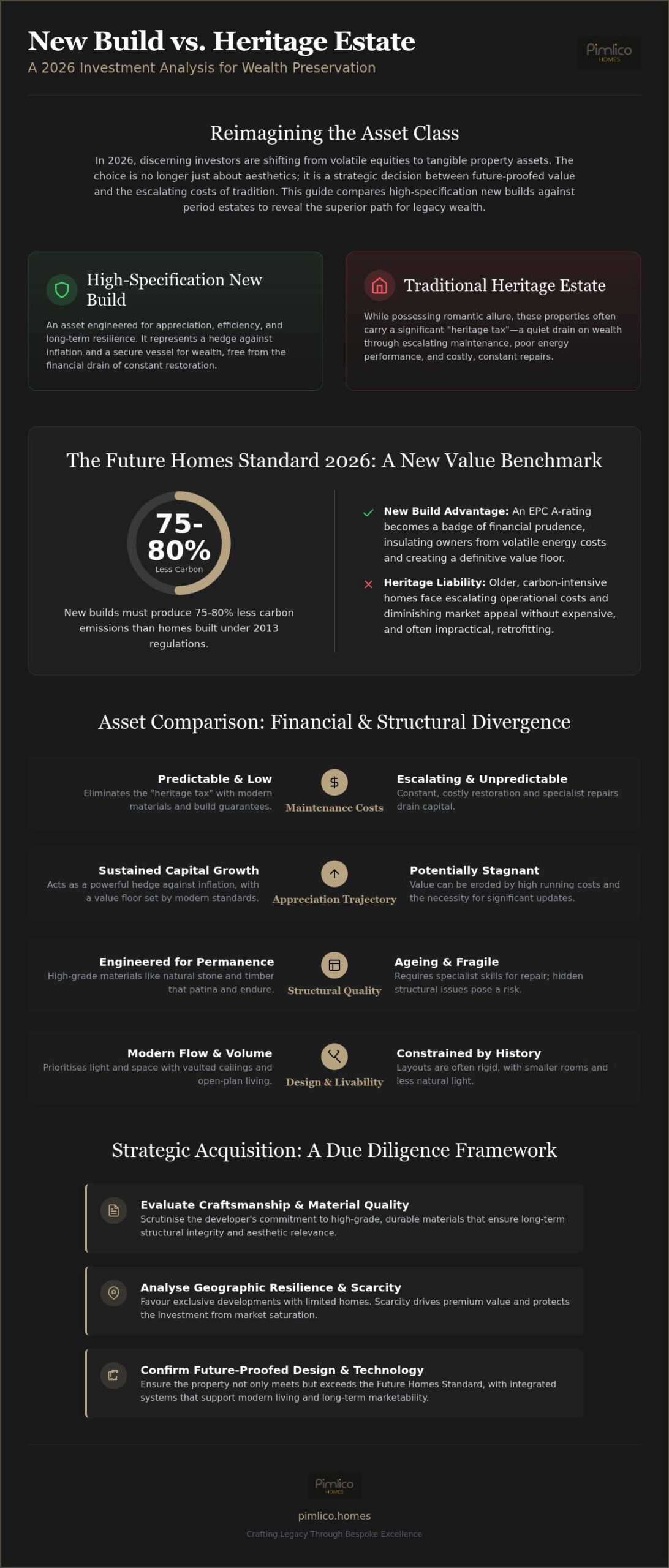
Sustainability is no longer a peripheral concern. It’s a financial imperative. Under the Future Homes Standard 2026, new builds must produce 75-80% less carbon than older counterparts built under 2013 regulations. An EPC A-rating is now a badge of financial prudence. It insulates owners from the volatile operational costs that plague heritage estates. These green technologies, including air-source heat pumps and high-grade thermal envelopes, are essential for future-proofing an investment. A home that is expensive to run is an asset that is inherently more difficult to sell in a climate-conscious economy.
Bespoke Features and the Resale Multiplier
Character and yield are often seen as opposing forces. However, custom barn conversions and bespoke luxury homes prove they can coexist beautifully. By blending traditional materials with modern layouts, these properties capture the emotional appeal of heritage whilst delivering contemporary performance. The inclusion of a hand-crafted kitchen or bespoke cabinetry acts as a resale multiplier. It signals to future buyers that no expense was spared, further cementing the long-term value of bespoke new build homes. You can explore the resale value of premium properties to understand how these design-led decisions translate into tangible capital growth. If you’re considering such an investment, discovering our latest developments might provide the clarity you need to move forward with confidence.
Asset Comparison: The Financial Divergence of New Builds and Period Estates
The romanticism of a Georgian manor often masks a harsh financial reality. We call this the heritage tax. It’s the persistent, escalating cost of maintaining a structure that was never designed for the efficiencies of 2026. For a high-net-worth investor, these costs represent a significant drain on capital that could be better deployed elsewhere. Modern luxury detached homes, by contrast, offer a streamlined balance sheet from day one. They provide a turnkey solution where the focus remains on appreciation rather than restoration.
Liquidity is a crucial differentiator. While a sprawling period estate might sit on the market for months awaiting a specific type of buyer, executive homes in exclusive developments move with far greater velocity. Today’s buyers value their time. They prioritise the psychological ease of a home that’s ready for immediate occupation. This demand creates a more liquid asset, allowing for greater agility in your broader investment strategy. It’s the difference between owning a static monument and a dynamic piece of wealth.
The Hidden Costs of Period Property Ownership
Owning a listed building brings a unique set of challenges. Restrictive regulations often dictate exactly which materials you can use and which craftsmen you must hire. This lack of asset flexibility can be stifling. When you quantify the annual CAPEX required for Victorian or Georgian estates, the numbers are often sobering. From roof repairs to damp proofing, the maintenance cycle is never-ending. Choosing a bespoke new build eliminates these liabilities, replacing them with predictable, low-cost operations and a far cleaner balance sheet.
Yield and Capital Growth Projections
There’s a common myth that new builds suffer from immediate depreciation. In the luxury sector, the opposite is often true. The long-term value of bespoke new build homes is anchored by their scarcity and superior specifications. These homes aren’t mass-produced; they’re crafted. This ensures they hold their value far better than standard residential products. High-specification builds often bypass the “new build dip” because their architectural uniqueness creates a permanent demand floor.
The role of luxury new build warranties is vital here. These protections offer a level of security that a period home simply cannot provide. Whilst period properties are subject to the volatility of structural decay, new builds are protected by comprehensive guarantees for their first decade. Whilst period homes may see growth capped by the prohibitive costs of retrofitting green technology, luxury new builds are projected to maintain a steeper appreciation curve due to their inherent compliance with future environmental mandates.
Strategic Acquisition: How to Evaluate a Premium Residential Development
Identifying the long-term value of bespoke new build homes requires a shift in perspective. It’s about looking past the staging to the bones of the project. A strategic acquisition demands due diligence that extends far beyond the glossy brochure. You must scrutinise the developer’s heritage. A firm with a 25-year history of excellence provides a level of security that a newer outfit simply cannot match. It’s a trust signal. It suggests that the builder understands the nuances of the executive market and possesses the resilience to support the asset long after the keys are handed over.
Site selection remains paramount. Stature and privacy are non-negotiable for the discerning buyer. You should evaluate the geographic resilience of the location. Does the site offer natural protection and exclusivity? Landscaping and exterior grandeur play a vital role here. They establish the first-impression value. A home that feels integrated into its environment, rather than imposed upon it, will always command a higher resale premium amongst an audience that values architectural harmony.
The specification sheet. It’s a roadmap for future appreciation. A genuine high-specification build isn’t defined by surface glitz. It’s defined by the quality of the core infrastructure. Look for premium materials like natural stone and high-grade timber. These aren’t just aesthetic choices; they’re markers of durability. A developer who invests in the best materials is signalling their confidence in the property’s future. When you choose a home built with such meticulous care, you’re investing in an asset that ages with grace.
The Developer’s Pedigree
Creator or manufacturer? This is the fundamental distinction. Whilst a manufacturer focuses on volume and standardisation, a creator treats every project as a unique masterpiece. Look for evidence of high-quality craftsmanship in every detail. Examine the joinery; check the masonry. These intimate details are the true indicators of an asset’s longevity. When a developer is personally invested in the outcome, the quality is palpable. It ensures that the home remains a desirable legacy for decades to come.
Identifying High-Potential Courtyard Developments
Executive courtyard homes offer a unique investment profile. They provide gated serenity and a sense of community without sacrificing individual privacy. When evaluating these, analyse the density-to-prestige ratio. An enclave with fewer, more substantial homes will always outperform a crowded development. Look for enclaves that feel like a private estate. This scarcity is what drives the long-term value of bespoke new build homes in the secondary market. If you are ready to evaluate a property that meets these exacting standards, you can explore our current luxury developments to see how we define excellence.
The Pimlico Standard: Crafting Legacy Through Bespoke Excellence
We don’t simply construct buildings; we curate legacies. At Pimlico Homes, our philosophy is anchored in a 25-year heritage of excellence, where the precision of modern engineering meets the soul of traditional craftsmanship. This deliberate fusion is what defines the long-term value of bespoke new build homes. It’s about ensuring that every joint, every stone, and every integrated system works in perfect harmony to create a residence that is as resilient as it is beautiful. We position ourselves as visionary creators and reliable guardians of quality, focusing on the profound emotional and financial weight of your investment.
Our commitment to the human experience of high-end living is absolute. We understand that a home must perform as well as it inspires. By combining innovative, sustainable thinking with time-honoured values, we ensure each development offers a sense of permanence that mass-market estates cannot replicate. This is a methodical, deliberate process. It mirrors the careful construction of the homes themselves, moving from the grandest architectural visions to the most intimate interior details with unwavering precision.
Bespoke Luxury as an Enduring Investment
Tailoring a vision into a high-specification reality requires a master craftsman’s touch. It’s a journey that transforms a plot of land into a sanctuary of quiet confidence. Our luxury barn conversions represent the pinnacle of this character-driven investment, blending the aesthetic weight of history with the technological superiority required in 2026. These properties don’t just hold their value; they grow in stature. By choosing a dedicated specialist developer, you gain the reassurance that every architectural detail has been scrutinised for longevity. We remain deeply invested in your long-term satisfaction, ensuring that the layout and volume of each room serve the needs of a discerning lifestyle.
Your Invitation to Explore Excellence
We invite you to linger on the details. From the grand vision of an executive courtyard to the intimate precision of hand-finished cabinetry, our work is a testament to meticulous care. The pace of our communication mirrors the careful process of our construction. It’s steady, logical, and transparent. We don’t believe in aggressive tactics. Instead, we offer a sophisticated narrative built on trust and a firm promise of support throughout your investment journey. This is more than a purchase; it’s a connection between innovative thinking and traditional values. We encourage you to explore our vision further and discover how the long-term value of bespoke new build homes can anchor your future wealth. Our role is to be your authoritative expert, guiding you through a complex process with accessibility, pride, and an uncompromising standard of excellence.
Securing Your Architectural Legacy for 2026 and Beyond
As the residential market evolves, the distinction between a mere property and a high-performing asset has never been clearer. We’ve explored how structural future-proofing and the elimination of the “heritage tax” create a value floor that period homes struggle to match. By prioritising energy efficiency and architectural integrity, you’re not just buying a residence; you’re securing a future-proofed vessel for wealth.
The long-term value of bespoke new build homes is ultimately anchored by the pedigree of the creator. With over 25 years of specialist experience in high-end residential development, Pimlico Homes remains a dedicated guardian of quality. Our award-winning focus on bespoke craftsmanship ensures that every executive home we deliver stands as a testament to architectural excellence and financial resilience.
It’s time to move beyond broad visions and focus on the intimate details that define a true legacy. We invite you to explore our current portfolio of luxury developments and discover the security of an investment built to endure. Your journey toward a more sophisticated and sustainable portfolio begins with a single, deliberate step.
Frequently Asked Questions
Do luxury new build homes appreciate in value as well as older properties?
Luxury new builds often demonstrate superior appreciation because they align precisely with modern buyer priorities. Unlike period homes that require constant capital expenditure, high-specification new builds offer structural future-proofing. This ensures the long-term value of bespoke new build homes remains resilient even when the wider market fluctuates. Buyers in 2026 increasingly value turnkey perfection over the maintenance liabilities of older estates, driving sustained demand and price growth for premium developments.
What are the main financial benefits of buying a new build executive home?
The primary financial benefit lies in the predictability of ownership. You avoid the immediate and escalating maintenance costs associated with heritage assets. New build executive homes are also significantly more energy-efficient, complying with the Future Homes Standard 2026. This translates to lower operational overheads and enhanced liquidity. The presence of comprehensive structural warranties provides a decade of financial protection that older properties simply cannot offer to a discerning investor.
How does energy efficiency impact the resale value of a luxury home?
Energy efficiency has transitioned from a preference to a core value driver. Homes meeting the 2026 carbon reduction standards of 75-80% are viewed as lower-risk assets. High EPC ratings insulate owners from rising energy costs and future environmental levies. In the resale market, a luxury home with integrated green technology commands a premium. It represents a future-proofed investment that won’t require expensive retrofitting to remain compliant with evolving UK regulations.
What should I look for in a luxury new build warranty?
A robust warranty should provide ten years of structural coverage from a recognised provider. The true value of a warranty is only as strong as the developer’s heritage. You should look for a builder with a 25-year track record of excellence. This ensures they possess the operational stability to honour their commitments. Ensure the policy covers the building’s envelope and core infrastructure, providing peace of mind for your long-term capital investment.
Is a bespoke luxury home a better investment than a standard new build?
Bespoke luxury homes are significantly better investments due to their inherent scarcity. Standard new builds often suffer from price ceilings caused by the homogenisation of the development. In contrast, the long-term value of bespoke new build homes is driven by unique architectural details and premium materials like natural stone. These properties appeal to a discerning secondary market that is willing to pay a premium for exclusivity and superior craftsmanship that standard estates cannot match.
How do maintenance costs compare between new builds and period properties?
Maintenance costs for a high-specification new build are minimal during the first decade. Most components are under warranty, and modern materials are designed for durability. Period properties often require annual capital expenditure of 1-2% of the property value just to prevent deterioration. From damp proofing to roof restoration, the “heritage tax” is a persistent drain on liquidity. Choosing a new build allows you to deploy that capital into growth rather than repairs.
Why are courtyard developments considered a high-potential investment?
Courtyard developments offer a unique blend of gated serenity and privacy that is highly sought after in the executive market. Their appeal lies in the density-to-prestige ratio; fewer homes on a site create a natural sense of exclusivity. This scarcity drives demand in the secondary market. Investors value the secure, communal feel of a courtyard which, when paired with bespoke architectural integrity, ensures the development maintains its stature and value over time.
Can I customise a luxury new build to increase its future value?
Customisation is a powerful tool for enhancing future ROI if focused on high-end finishes and internal flow. Tailoring a bespoke kitchen or integrating advanced smart home ecosystems adds tangible value that appeals to future executive buyers. It’s important to work with a specialist developer who understands how to balance personal taste with marketability. These bespoke touches signal quality and meticulous care, ensuring the property stands out as a premier asset in any future resale scenario.


