
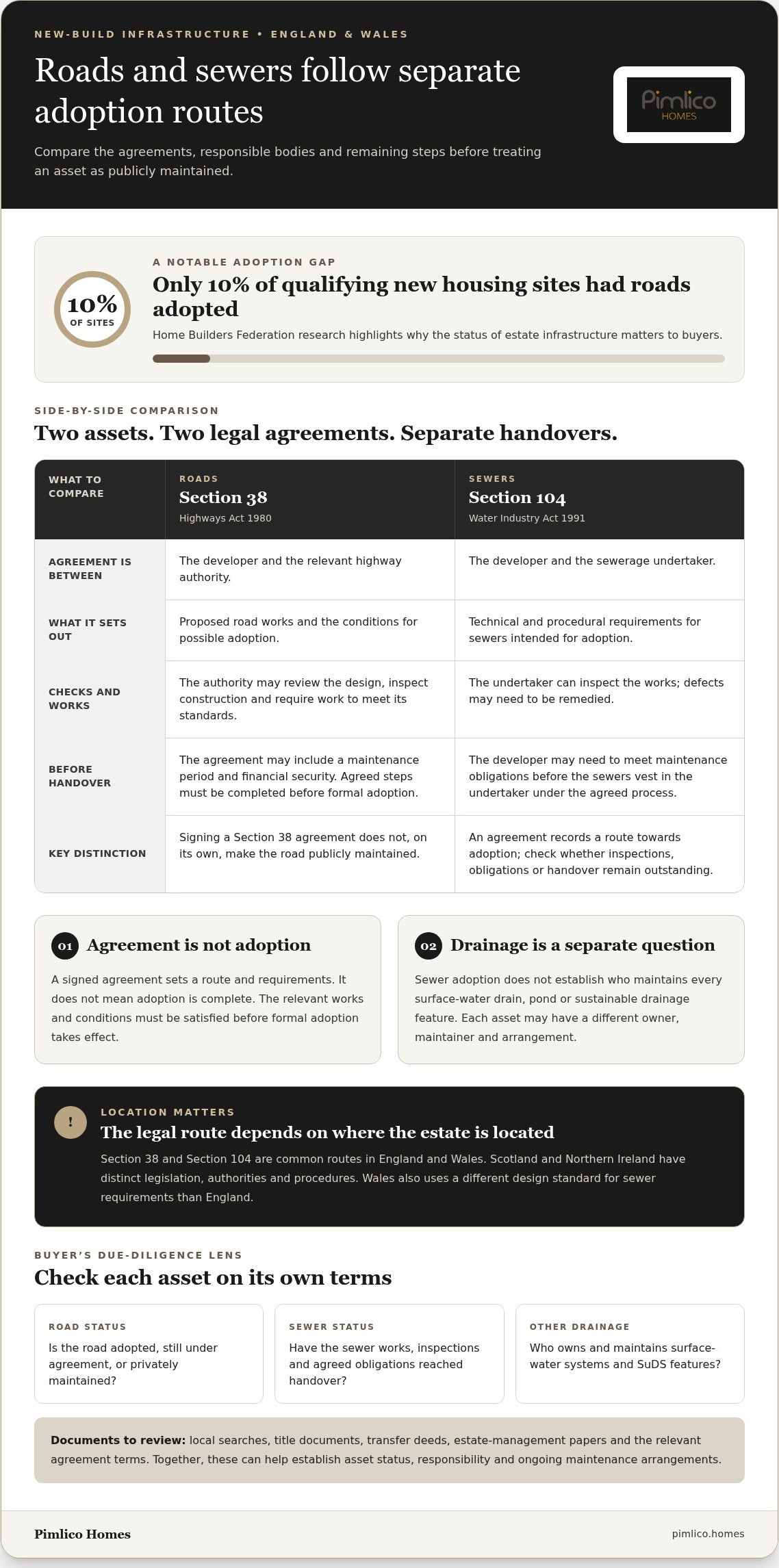
Only 10% of qualifying new housing sites had roads adopted, according to late-2025 research by the Home Builders Federation. That finding highlights why the legal process for adoption of roads and sewers on new estates deserves attention before you buy, not after you move in.
It is natural to assume that a new estate’s roads and drainage will eventually become the responsibility of the council or water company. In practice, road adoption and sewer adoption follow separate legal routes, and drainage features may have their own management arrangements. If infrastructure remains private, homeowners may contribute to its upkeep through an estate management company.
This guide explains the main adoption routes, including Section 38 agreements for roads and Section 104 agreements for sewers in England and Wales, and what private maintenance can mean in practice. It also sets out which agreements, property documents and responsibilities to review with your conveyancer before purchase. Understanding these details helps you assess not only the home, but how the wider estate is intended to be maintained over time.
Key Takeaways
- Road adoption, sewer adoption and private maintenance are separate matters, each with its own responsible body and arrangements.
- The legal process for adoption of roads and sewers on new estates can differ by asset and UK jurisdiction.
- Compare adopted roads with roads still under agreement or privately maintained, and understand what those arrangements may mean for residents.
- Use local searches, title documents, transfer deeds and estate-management papers to establish the status of each asset before buying.
- Review agreement terms and ongoing responsibilities to understand how the estate is intended to be maintained over time.
Road and sewer adoption on new estates: what it means for buyers
“Adoption” is the formal process through which a public body accepts responsibility for maintaining an asset, subject to the relevant legal route and requirements. It is not a blanket handover of everything on an estate. A road, foul sewer, surface-water system and sustainable drainage feature may each have a different owner, maintainer and adoption status.
That distinction matters when assessing a new-build purchase. Public adoption does not always mean that ownership of the land beneath an asset transfers in the same way. Equally, private status alone does not tell you who owns or maintains it. Consider the status of each asset alongside any private maintenance or management-company arrangements.
What changes when an estate road is adopted?
An adopted road forms part of the public highway, with maintenance responsibility generally resting with the relevant highway authority. A private or unadopted road has not been accepted into that public maintenance system. Responsibility may instead sit with a landowner, residents’ management company or another party under the estate documents.
In England and Wales, Section 38 of the Highways Act 1980 is a common route for agreeing that a newly constructed road may be adopted once the required works and conditions are satisfied. The agreement is not the same as completed adoption: the road does not become publicly maintained simply because homes are finished or occupied. Other UK jurisdictions have different legal frameworks, so the applicable route depends on where the development is located.
Private roads are not all arranged alike. One may be owned by a management company and maintained through resident contributions; another may have shared rights and obligations set out in property documents. Check the title and estate arrangements to understand the practical position.
Why sewer and drainage adoption are separate questions
Foul sewers carry wastewater from homes. Surface-water systems manage rainwater, while sustainable drainage systems (SuDS) may include features such as attenuation areas or permeable surfaces. These assets serve different purposes and can have different ownership and maintenance arrangements.
A water and sewerage company may adopt qualifying sewers through a process separate from road adoption. Surface-water infrastructure and SuDS may be managed by a water company, local authority, another public body or a private organisation, depending on the scheme and applicable arrangements. Adoption of a sewer does not establish who maintains every drain, pond or other drainage feature across the estate.
For a clear picture, assess each asset separately. Establish its status, the responsible body and the documents governing maintenance. A defined private arrangement can set out how upkeep is managed, but buyers should understand any associated obligations as part of their due diligence.
How legal adoption works for roads and sewers
Roads and sewers do not pass into public maintenance through one combined process. In England and Wales, road adoption commonly uses an agreement under Section 38 of the Highways Act 1980, while sewer adoption may proceed separately under Section 104 of the Water Industry Act 1991. Scotland and Northern Ireland have distinct legislation, authorities and procedures, so the relevant route depends on the estate’s location.
The detail varies between projects. A typical sequence is for the developer to agree the design and requirements with the relevant authority or sewerage undertaker, construct the infrastructure to the agreed standards, arrange inspections and address any identified defects. Bonds or sureties may provide financial security for specified obligations, but their terms and requirements vary by authority and project.
The road-adoption route under a Section 38 agreement
A Section 38 agreement is made between a developer and the relevant highway authority. It sets out the proposed road works and the conditions for possible adoption. The authority may review the design, inspect construction and require the work to meet its standards. Depending on the agreement, it may include a maintenance period and financial security. Signing the agreement does not, on its own, mean the road has been adopted: the agreed steps must be completed before formal adoption takes effect.
The separate route for sewer adoption
In England and Wales, a developer and sewerage undertaker may enter an agreement under Section 104 of the Water Industry Act 1991 for sewers intended for adoption. The agreement sets out the relevant technical and procedural requirements. The undertaker can inspect the works, and the developer may need to remedy defects and meet maintenance obligations before the sewers vest in the undertaker under the agreed process.
For sewers intended for adoption in England, the Sewerage Sector Guidance and its Design and Construction Guidance set out relevant technical standards. Wales uses a different design standard, so the applicable requirements should be read in the context of the project and agreement. Sewer adoption does not prove that surface-water drainage or SuDS features have also been adopted; those assets may have separate arrangements.
For buyers, the distinction is practical: an agreement records a route towards adoption, while completed adoption marks a later stage. Check the status of roads and sewerage assets separately, including whether inspections, maintenance obligations or formal handover remain outstanding. This is one part of assessing a new-build home. Explore Pimlico Homes’ new-build homes as you consider the wider qualities of a purchase.
Adopted or privately managed: what the difference means
An estate can combine public and private infrastructure. A road may be adopted while a nearby drainage feature remains privately managed; a sewer may have a different status again. Understanding the adoption arrangements helps establish who maintains each asset and how that work is funded.
| Asset and status | Possible responsible party | What to establish |
|---|---|---|
| Adopted road | Relevant highway authority | Whether formal adoption is complete and which roads it covers. |
| Road under an adoption agreement | Developer or another party until the agreed handover; the highway authority may inspect works under the agreement | What conditions, works or maintenance obligations remain before adoption. |
| Privately maintained road | Landowner, residents’ management company or another body, as set out in the documents | Who arranges repairs, makes decisions and allocates costs. |
| Adopted sewer | Relevant sewerage undertaker | Which sewer assets have vested in the undertaker. |
| Private sewer or drainage feature, including SuDS | Developer, management body, landowner or another specified party | Who maintains each feature and whether owners contribute under the estate arrangements. |
Who maintains each type of estate infrastructure?
Responsibility depends on the asset and its legal status. The highway authority may maintain adopted roads, while a sewerage undertaker may be responsible for adopted sewers. A developer, management company or landowner may retain duties for assets that are private or awaiting handover. Shared spaces and surface-water systems can have separate arrangements, so the status of one feature does not establish the status of the rest.
Council Tax does not, by itself, show that every road, shared space or drainage feature is publicly maintained or that no private contribution applies. The title documents and estate-management provisions are central to understanding what owners may be required to pay for.
What can non-adoption mean for residents?
Private management is not, on its own, proof that an estate is defective or unsuitable. It does mean that buyers should understand the arrangements: which body organises maintenance, how decisions are made, what repairs are covered and how costs are allocated. Consider any estate or service charge in light of the governing documents, rather than assuming what it covers from an asset’s unadopted status.
Look for clarity, not simply a public or private label. A defined maintenance structure should explain who acts when work is needed and how owners’ obligations are calculated. The terms and responsibilities, rather than assumptions about service quality or cost, provide a sound basis for comparing properties.
How to check adoption status before buying a new-build home
Check adoption status asset by asset, rather than relying on a general statement that the estate will be maintained. Road and sewer adoption can involve separate agreements and handovers. Establish whether each road, foul sewer, surface-water system and SuDS feature is adopted, covered by an agreement, pending or not intended for adoption.
Which documents can reveal the adoption arrangements?
Begin with the local search and any available records from the relevant highway authority or sewerage undertaker. These can help identify the recorded status of public infrastructure. Then review the property’s title documents, transfer deed and estate-management papers for access rights, maintenance duties, charges and the powers of any management company.
Where adoption is planned, ask your conveyancer to compare the stated position with the relevant Section 38 road agreement or Section 104 sewer agreement, where applicable. Check whether a bond or surety supports the agreement, what it covers and which obligations remain. Handover or inspection records, if available, may help distinguish a signed agreement from completed adoption.
Questions to resolve through conveyancing
Ask your conveyancer to establish who is responsible at completion for each road, sewer, drainage feature and shared space. If future adoption is proposed, clarify which conditions or milestones remain, who must meet them and what happens if the handover does not proceed as expected.
The estate documents should also explain how maintenance decisions are made, how contributions are calculated and allocated, and how disputes are handled. A charge may arise under the property or management arrangements, but its basis and scope should be clear in the governing documents. This article is general information, not legal advice; your conveyancer can advise on the documents and their effect on your purchase.
- Roads: Is adoption complete, covered by an agreement, still pending or not planned?
- Sewers: Which foul or surface-water assets are included in any adoption arrangement?
- Private assets: Who maintains them, and what obligations or charges bind the property?
- Outstanding steps: Are inspections, remedial works or maintenance obligations still required?
Clear answers bring infrastructure into the wider assessment of a home, alongside its design, specification and long-term suitability. For further purchase context, explore the luxury new-build purchase guide.
A clearer new-home purchase starts with infrastructure due diligence
A well-considered purchase looks beyond the home itself to the infrastructure that supports daily life. Roads, sewers, surface-water systems and shared spaces may each have different adoption and maintenance arrangements. Review the current documents for each asset rather than relying on a general assurance about the development.
A practical adoption-status checklist
Before exchange, work with your conveyancer to build a clear picture of the estate’s arrangements. For every relevant asset, record:
- Status: Is it adopted, covered by an agreement, awaiting adoption or intended to remain private?
- Responsibility: Which authority, sewerage undertaker, developer, management company or other party maintains it now?
- Agreement and conditions: What agreement applies, and are inspections, works or other milestones outstanding?
- Ongoing obligations: Which documents set out repair duties, contributions, decision-making powers and any dispute process?
Check that the local search, title documents, transfer deed and estate-management papers tell a consistent story. Where an agreement or handover record is relevant, your conveyancer can review how it relates to the property and whether the stated status matches the available evidence.
An asset remaining private does not, by itself, mean the estate is unsuitable. A clear management structure can set out who arranges maintenance and how owners contribute. The important thing is to understand the terms that apply to your home, including the extent of your responsibilities and how decisions are made.
From legal clarity to confident ownership
Infrastructure due diligence is one part of assessing a new-build property, alongside its design, specification and the wider terms of purchase. It can also help you consider long-term obligations that may matter to future buyers. For further context, explore the resale value of new-build homes and how clear information about a property’s arrangements supports an informed view of ownership.
This guide is general information, not a substitute for conveyancing advice. Adoption routes and documents vary by jurisdiction, and legal conclusions should be based on the current records and professional advice relevant to the property.
With the details understood, buyers can consider a home with greater confidence. Explore Pimlico Homes’ residential developments as part of your search for a thoughtfully crafted new home.
Make infrastructure checks part of your next move
A confident purchase begins with clarity about the whole estate. Road adoption and sewer adoption follow separate routes, and each road, sewer or drainage asset may have its own status and responsible body. Review the relevant agreements, property documents and management arrangements with your conveyancer to understand what is complete, what remains outstanding and which obligations will continue after completion.
The legal process for adoption of roads and sewers on new estates is one part of a wider assessment of your future home. An unadopted asset is not automatically a cause for concern, but its maintenance arrangements and associated responsibilities should be clear before you commit.
Pimlico Homes is a specialist developer of high-end new-build homes and residential developments, with a focus on craftsmanship across detached homes, courtyard developments and bespoke conversions. Explore Pimlico Homes’ new-build homes as you consider a home with carefully considered design and craftsmanship.
Review the estate documents with your conveyancer, then explore Pimlico Homes’ new-build homes as you plan your next move.
Frequently Asked Questions
What does adoption of roads and sewers on a new estate mean?
Adoption is a formal process through which the relevant public body accepts responsibility for maintaining an asset, subject to the applicable legal route and requirements. Roads and sewers are dealt with separately, and adoption of one does not confirm the status of the other. Surface-water drainage and sustainable drainage features may also have distinct arrangements. Check the adoption status asset by asset.
Are all roads on new housing estates adopted by the council?
No. A new estate road does not become publicly maintained automatically when homes are completed or occupied. In England and Wales, a developer may enter an agreement with the highway authority for a road to be adopted once specified requirements are met, but some roads remain private. The local search, relevant agreements and property documents can help establish whether a particular road is adopted, awaiting adoption or privately maintained.
How are new estate roads adopted in England and Wales?
A common route is an agreement under Section 38 of the Highways Act 1980 between the developer and the relevant highway authority. It may set out design requirements, construction standards, inspections, financial security and maintenance obligations. The developer completes the agreed works, and the authority may inspect them before adoption proceeds under the agreement’s terms. Signing a Section 38 agreement alone does not mean the road has already been adopted.
How are sewers adopted on a new estate?
In England and Wales, a developer may enter a Section 104 agreement under the Water Industry Act 1991 with the relevant sewerage undertaker for qualifying sewers. The agreement sets out applicable requirements and the process for inspection, addressing defects, any maintenance obligations and eventual vesting. Sewer adoption is separate from road adoption. It also does not establish who maintains every surface-water drain or sustainable drainage feature, which may have different arrangements.
Who maintains an unadopted road on a new estate?
Responsibility depends on the road’s ownership and the estate’s legal documents. It may rest with the developer, a landowner, a residents’ management company or another party, with costs allocated under the relevant arrangements. There is no single rule for every private road. Before buying, review the title and transfer documents and any estate-management provisions to identify who organises repairs, how decisions are made and whether owners must contribute.
Can a new-build estate remain privately managed if its roads are not adopted?
Yes. An estate can have privately maintained roads and a management structure that sets out how upkeep is arranged and funded. The details depend on the legal documents, which may identify a management company or another responsible party and explain owners’ obligations. Private management alone does not establish the quality or cost of maintenance. Review the relevant documents to understand duties, charges, decision-making powers and how disputes are handled.
Does Council Tax cover maintenance of an unadopted estate road?
Paying Council Tax does not, by itself, mean that a particular estate road is publicly maintained or remove obligations created by the property documents. If a road remains private, its maintenance arrangements may require contributions under the transfer deed or estate-management provisions. Check those documents and the local-search information to establish the road’s status and any applicable obligations. Your conveyancer can explain how the documents relate to the property you plan to buy.





