
Why does the discerning investor often fear that a pristine, never-lived-in property might lose its lustre the moment the keys are turned? It’s a natural hesitation. Many individuals worry about the “new car” depreciation effect or whether modern construction can truly rival the permanence of a period estate. You want the security of an asset that doesn’t just hold its worth but matures into something far greater.
The reality is that the long-term value of a luxury new build home is rooted in its rarity and its readiness for the future. By moving beyond mass-market developments and focusing on bespoke craftsmanship, you’re investing in a property that’s already compliant with the 2026 Future Homes Standards. This guide explores how energy efficiency, architectural scarcity, and minimal maintenance costs converge to create a high-appreciating asset. We’ll examine the strategic advantages of executive new builds and why they remain a resilient choice for a modern property portfolio.
Key Takeaways
- Understand the distinction between mass-market volume and the “Quality Premium” of bespoke craftsmanship to ensure your investment remains a prestigious asset.
- Evaluate the long-term value of a luxury new build home through the lens of A-rated energy performance and the financial protection offered by 2026 sustainability standards.
- Compare the fiscal advantages of modern construction against the escalating maintenance liabilities and retrofitting costs often found in traditional heritage estates.
- Learn how to identify developments with architectural scarcity and exclusive plot positioning to maximise the potential for future capital appreciation.
- Discover how integrating intuitive smart technology and visionary design creates a future-proofed residence that serves as a secure, permanent legacy.
Defining the Long-Term Value of a Luxury New Build Home
Investors often look at the property market through the lens of historical data, where “newness” is sometimes equated with a fleeting premium that evaporates once the first owner moves in. This perspective holds weight in the volume market, where identical units on sprawling estates can suffer from premium deflation as supply exceeds local demand. However, the long-term value of a luxury new build home operates on an entirely different set of economic principles. In the executive sector, value is driven by craftsmanship and exclusivity rather than just the date of completion.
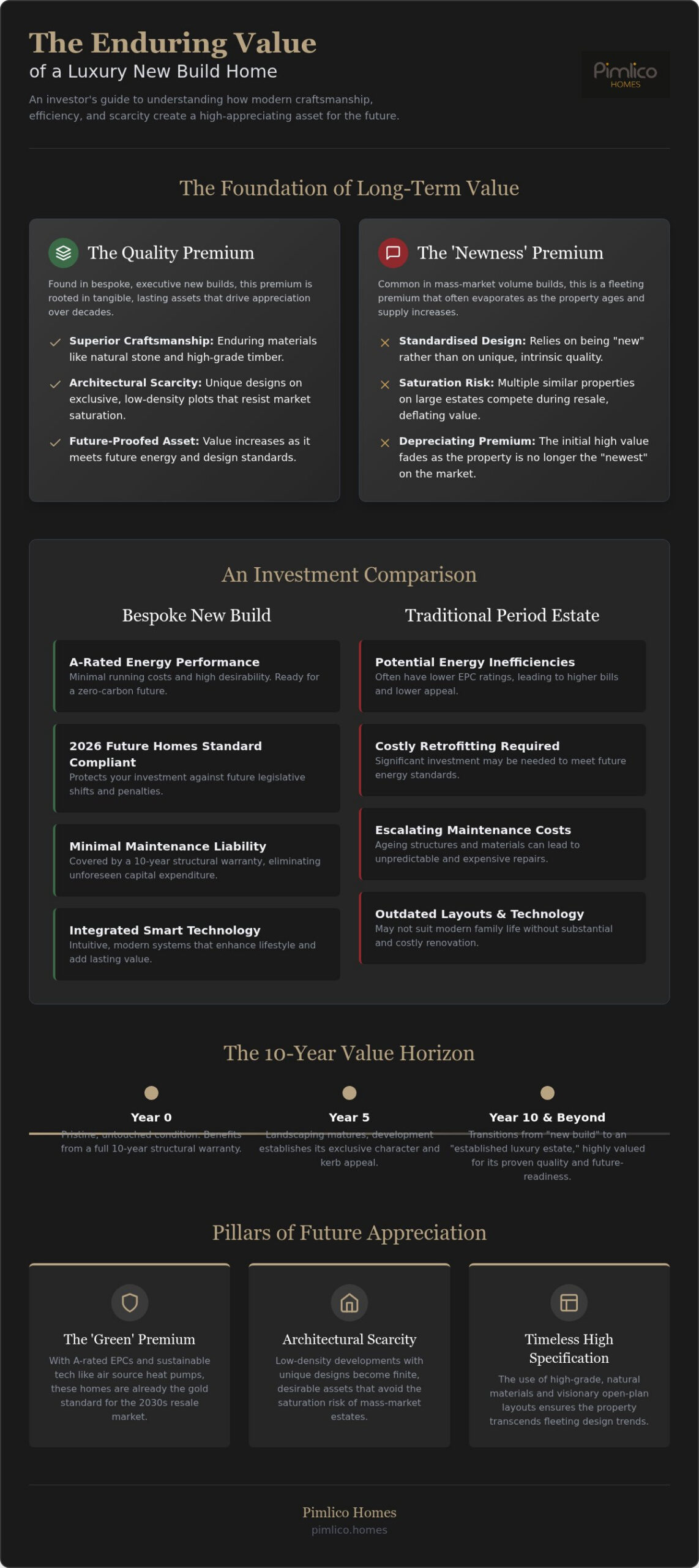
Distinguishing between a mass-market build and a prestige development is essential for capital protection. A volume build relies on a “Newness Premium” that fades. In contrast, a bespoke residence carries a “Quality Premium” rooted in high-end specifications and superior materials. These elements don’t just provide immediate comfort; they ensure the building ages with a grace that mirrors traditional heritage properties. There’s also a profound psychological weight to a residence that has never been lived in. It offers a pristine environment where every finish is untouched, providing a sense of security and a clean slate for an executive legacy.
The Scarcity Factor in Executive Developments
The most resilient assets in any property portfolio are those that cannot be easily replicated. Large-scale estates often face a “saturation risk” where multiple similar properties compete for the same buyer during resale. Executive courtyard developments or small clusters of detached homes avoid this trap by maintaining a low site density. This creates a sense of privacy and “kerb appeal” that remains intact for decades. When a development is limited to a handful of bespoke residences, it retains a level of desirability that mass-produced housing cannot match.
Architectural scarcity is the strategic restriction of housing density combined with unique design elements, transforming a residence into a finite asset that resists market saturation and drives consistent ROI.
The 10-Year Value Horizon
A common concern involves what happens to a property’s worth once the initial structural warranties, such as those from the NHBC, expire. For high-specification homes, this ten-year mark isn’t a cliff edge but a transition. This is the moment a property moves from being a “new build” to an “established luxury estate.” By this stage, the landscaping has matured and the development has gained a reputation for permanence.
Looking toward 2030 and beyond, market behaviour suggests a growing premium for homes that already meet stringent sustainability standards. A detached home built today with visionary energy efficiency will be the gold standard in the resale market of the next decade. These properties won’t require the expensive retrofitting that will plague older homes, ensuring they remain highly liquid and appreciating assets in any climate.
The Architecture of Appreciation: High Specification as an Asset
True value in the executive market isn’t found in superficial finishes. It resides in the deliberate selection of materials and technologies that resist obsolescence. When we consider the long-term value of a luxury new build home, we’re looking at a synthesis of artistry and engineering. High-grade timber, natural stone, and bespoke glazing don’t just provide visual pleasure. They offer a sense of permanence that survives shifting design trends. Open-plan layouts and intuitive internal flow cater to the modern family’s demand for connection, ensuring the property remains highly desirable for future generations.
The “Efficiency Premium” is no longer a niche consideration. With the introduction of the Future Homes and Buildings Standards in 2026, new residences must be zero carbon ready. An A-rated Energy Performance Certificate (EPC) acts as a powerful lever for future resale prices. Buyers in the 2030s will view energy efficiency as a non-negotiable requirement. Integrating smart home technology, such as AI-driven climate control and seamless security, is now a standard expectation for the discerning executive. These systems anticipate needs without complexity, creating a home that feels both intelligent and effortless.
Future-Proofing Through Sustainable Design
Sustainability is the ultimate protector of property ROI. By incorporating air source heat pumps and solar arrays today, you’re shielding your asset against future legislative shifts that will penalise carbon-heavy properties. This “Green Premium” is rapidly rising in the luxury residential sector. Beyond technology, the clever use of floor-to-ceiling glazing ensures natural light remains a permanent value feature. It’s a design choice that enhances well-being whilst reducing the reliance on artificial lighting.
Internal Specifications That Retain Value
Kitchens and bathrooms remain the primary drivers of resale return. According to the Cost vs. Value Report, high-end kitchen remodels and master suite improvements consistently yield strong recoup rates. However, the most significant value often lies in “invisible quality.” Superior insulation, advanced soundproofing, and structural integrity form the bedrock of a home’s worth. To understand the depth of these requirements, you can explore our detailed guide on high specification new build homes. Investing in these foundations ensures your home remains a quiet sanctuary, far removed from the noise of the outside world, whilst securing the long-term value of a luxury new build home. If you’re ready to see how these standards are applied in practice, explore our latest developments.
Luxury New Builds vs. Period Properties: An Investment Comparison
The allure of a Georgian facade or a Victorian manor is undeniable, yet for the executive investor, this romanticism often masks a relentless cycle of capital depletion. Heritage properties carry a heavy burden of “hidden costs” that can erode a portfolio’s performance over time. Retrofitting a Grade II listed building to meet modern expectations is not merely expensive; it is often a structural and bureaucratic labyrinth. In contrast, the long-term value of a luxury new build home is protected by its inherent efficiency and the absence of immediate capital expenditure requirements.
Strategic investors are increasingly favouring executive courtyard homes over traditional manor houses. The reason is simple: modern residences offer a level of privacy and security that older estates, often plagued by public rights of way or outdated boundaries, cannot provide. There is also the matter of fiscal agility. With Capital Gains Tax on residential property held at 24% for higher rate taxpayers in the 2026/27 tax year, the ability to hold a liquid, low-maintenance asset is vital. A snagging list at the start of a new build journey is a minor administrative exercise. A renovation on a period property is a structural risk that can span years.
The Financial Reality of Maintenance
Quantifying the five-year spend on a property reveals a stark contrast. A bespoke new build typically requires only routine aesthetic care, whilst a period home often demands significant outlays for roof repairs, damp proofing, or heating system failures. These savings extend to insurance. Data from 2026 suggests that new build homes can attract 20-40% lower buildings insurance premiums compared to equivalent older properties due to their superior fire safety and modern plumbing standards. Whilst a period conversion often struggles to exceed a “D” or “E” EPC rating without invasive intervention, a 2026 new build achieves near-zero thermal leakage through integrated air source technology and advanced insulation.
The “Character” Debate
The common argument that new builds lack “soul” is being dismantled by visionary developers who embrace “Modern Heritage.” This design philosophy combines traditional aesthetics, such as reclaimed stone and timber beams, with the structural integrity of 21st-century engineering. Bespoke barn conversions are a prime example of this harmony, offering the soaring ceilings of a heritage asset without the draughts or subsidence risks. If you appreciate this blend of history and innovation, exploring modern barn conversion interiors reveals how refined rural luxury is achieved without compromise. This approach ensures the long-term value of a luxury new build home remains high, as it appeals to both the emotional and practical needs of the future buyer.
Strategic Selection: How to Maximise Your Resale Value
Maximising the long-term value of a luxury new build home is an exercise in foresight. It requires an investor to look beyond the immediate aesthetic appeal and consider the factors that will drive desirability in a decade. Capital growth in the executive sector isn’t accidental. It’s the result of selecting a property where architectural scarcity, developer reputation, and site positioning converge to create a resilient asset. When market conditions fluctuate, it’s these high-specification residences that remain liquid and sought after.
Evaluating the Developer’s Pedigree
The reputation of the creator is inextricably linked to the resale potential of the home. Whilst volume housebuilders prioritising speed can lead to a “new car” depreciation effect, a specialist developer with decades of industry experience offers a different trajectory. These visionaries focus on limited-run developments that age gracefully. Researching a developer’s past projects allows you to witness how their previous builds have appreciated over a five to ten-year horizon. A bespoke approach to interior architectural planning ensures that the home doesn’t feel like a carbon copy of its neighbours. This uniqueness is a primary driver of the “Quality Premium” that protects your investment from mass-market deflation.
Plot Selection and External Grandeur
Privacy, light, and outlook represent the three pillars of plot value. Within an exclusive development, the most secluded plots with the most expansive views will always command a higher resale price. Executive courtyard layouts are particularly effective at preserving value. They offer a sense of arrival and a communal “estate feel” that standard cul-de-sacs cannot replicate. This external grandeur is complemented by mature landscaping, which should feel like a natural extension of the architecture rather than an afterthought. For those considering regional variations, understanding the resale value of new build homes north east provides vital context on how location and specification interact to drive ROI.
Future buyers will view certain features as non-negotiable. Large, detached footprints, integrated smart security, and professional-grade kitchen spaces are the foundations of the executive standard. By choosing a home that already exceeds these expectations, you ensure your property remains at the pinnacle of the market. If you’re looking to secure an asset built to these exacting standards, explore our current luxury developments to find your next investment.
Securing Your Legacy with a Bespoke Luxury Home
Legacy. It’s a word that carries the weight of generations. When you invest in a property of this calibre, you aren’t just purchasing a structure; you’re securing a permanent asset that reflects your values and protects your capital. The long-term value of a luxury new build home is found in this intersection of emotional security and financial resilience. By choosing a residence built to exceed 2026 sustainability standards, you’re ensuring your home remains a cornerstone of your portfolio, untouched by the obsolescence that threatens older heritage estates.
Pimlico Homes focuses exclusively on detached and bespoke executive residences. We understand that the mass-market model of high-density estates often leads to premium deflation. When every house on a street is a replica, value is dictated by the lowest common denominator. A tailored approach to construction eliminates this risk. By creating architectural scarcity through executive courtyard developments and bespoke barn conversions, we ensure each property remains a unique and highly liquid asset that resists market saturation.
The Pimlico Homes Standard
Our commitment to architectural integrity is the bedrock of our reputation. With 25 years of specialist experience, we’ve refined the art of high-end construction, moving from grand visions to the most intimate, meticulous details. We don’t just build houses; we create environments where artistry and engineering coexist. Choosing a developer with a quarter-century of heritage provides a level of reassurance that volume housebuilders simply cannot match. It’s the difference between a temporary residence and a permanent legacy. We invite you to explore our current developments and discover the bespoke opportunities that await the discerning investor.
Next Steps for the Discerning Buyer
The journey toward owning a bespoke luxury residence begins with a shared vision. Early engagement in the design and specification process is vital. It allows you to influence the internal flow and high-specification finishes that will define your living experience for years to come. This proactive approach ensures every element of the home aligns with your personal requirements whilst maximising its future resale potential. If you’re ready to explore a future-proofed investment that combines innovative thinking with traditional values, the path forward is clear. View our exclusive luxury developments and take the first step toward securing your architectural legacy.
Investing in an Architectural Legacy
Excellence. It’s a standard that doesn’t fade with time. The strategic decision to acquire a high-specification residence is a commitment to a future-proofed asset. By prioritising architectural scarcity and advanced energy performance, you bypass the common pitfalls of mass-market developments. You’ve explored how bespoke craftsmanship and a readiness for 2026 sustainability standards transform a property into a resilient financial cornerstone. The long-term value of a luxury new build home isn’t just about the initial premium. It’s found in the years of minimal maintenance and the enduring desirability of an exclusive courtyard enclave.
Pimlico Homes brings 25 years of excellence in luxury residential development to every project. Our award-winning attention to architectural detail ensures that each home isn’t just built, but crafted to last generations. We specialise in creating exclusive enclaves that protect your privacy and your investment. Now is the time to move beyond the ordinary and secure a residence that truly reflects your ambitions. Discover the enduring quality of Pimlico Homes and begin your journey toward a legacy of refined luxury.
Frequently Asked Questions
Do luxury new build homes lose value immediately after purchase?
No, not in the executive sector. Unlike mass-market estates where oversupply causes premium deflation, luxury builds in exclusive enclaves retain value due to architectural scarcity. The newness is a secondary factor to the high-specification materials and superior plot positions that protect the long-term value of a luxury new build home from the day the keys are handed over. This ensures your capital remains secure.
How does the resale value of a luxury new build compare to a period property?
Resale value for luxury new builds is increasingly competitive due to the absence of heritage debt. Whilst period properties carry character, they often suffer from escalating maintenance costs and poor energy efficiency. Modern executive homes are built to 2026 standards, making them more liquid assets. Buyers in 2030 will pay a premium for a home that doesn’t require invasive retrofitting or structural repairs. It’s a pragmatic choice for the discerning investor.
What are the most important features for maintaining new build resale value?
Several factors ensure a property remains a high-appreciating asset:
- Low-density site positioning within an executive courtyard.
- A-rated EPC certification and zero-carbon readiness.
- High-grade natural materials like stone and timber.
- Integrated smart security and AI-driven climate systems.
These elements distinguish a permanent residence from a temporary house, ensuring it appeals to the high-net-worth market for decades.
Is a bespoke barn conversion a better investment than a new build detached home?
Both offer unique investment profiles depending on your portfolio goals. A bespoke barn conversion provides immediate architectural character and historical charm without the structural risks of a traditional manor. Conversely, a luxury detached home offers total design freedom and modern internal flow. Both assets benefit from the same high-specification standards, ensuring they remain prestigious and sought-after properties in any market climate. Your choice depends on your aesthetic preference.
How do 2026 energy efficiency standards affect property value?
The 2026 Future Homes Standards create a Green Premium for properties that are zero carbon ready. Homes built to these exacting requirements are shielded from future legislative penalties and rising energy costs. This future-proofing significantly enhances the long-term value of a luxury new build home, as buyers will increasingly prioritise properties that offer thermal efficiency and on-site renewables as standard features. It’s an investment in both sustainability and capital security.
What is the “premium deflation” timeline for high-end executive homes?
Premium deflation is largely a myth in the bespoke luxury sector. Whilst volume builds might see a dip in the first three years, executive homes in limited-run developments often see immediate appreciation. This is due to the rarity of the plot and the quality of the craftsmanship. By the ten-year mark, these properties have transitioned into established estates, often outperforming the wider market through consistent desirability.
Why should I choose a specialist luxury developer over a national housebuilder?
Specialist developers prioritise artistry and longevity over volume and speed. A national builder’s focus on identical units leads to market saturation, which can stifle capital growth. A specialist brings decades of experience to create unique, detached residences with high-end specifications. This bespoke approach ensures your home remains a distinguished asset, far removed from the generic designs found on mass-market estates. It’s the difference between a house and a legacy.
Can smart home technology actually increase the long-term value of a property?
Yes, provided the technology is intuitive and seamlessly integrated. Future buyers expect smart security, lighting, and climate controls as standard in the executive market. Technology that anticipates a resident’s needs without being overly complex adds a layer of sophistication that justifies a higher resale price. It’s an essential component of a modern home that is designed to stay relevant for decades, enhancing both lifestyle and financial return.


