
What if a home’s most telling luxury isn’t what you see from the road, but how you feel as you arrive? Appearance matters, yet the psychology of ‘arrival’ and luxury home ownership begins before the front door opens. The approach, the pause at the threshold and the first moments inside form a sequence that can shape whether a place feels welcoming, private and truly yours.
It’s easy to focus on finishes and visual impact when making a significant buying decision. But the difference between a home that feels welcoming and one that leaves you unmoved can be harder to explain, and just as important to recognise. Ownership is lived day by day, not simply admired during a viewing.
This article explores how transitions, sensory details and personal meaning influence that experience. You’ll find practical ways to assess an arrival, compare a grand entrance with an everyday welcome, and consider whether a home feels right for your routines as well as your taste.
Key Takeaways
- Assess the approach, entrance and first moments inside, not only the home’s appearance.
- Notice how light, sound, materials and privacy affect your experience, while remembering that preferences differ.
- Look beyond a grand entrance and consider whether the arrival works for everyday life.
- During a viewing, start outside and follow the route in. Where practical, revisit at a different time to compare your impressions.
- Use the psychology of ‘arrival’ and luxury home ownership as one perspective on a significant purchase, alongside practical checks.
The psychology of arrival: why coming home matters
An impressive building can command attention from the street. Entering a home is different: it is a place you return to, move through and gradually make your own. A façade may create an immediate visual impression, but coming home is a sequence of experiences, from the approach to the first moments indoors.
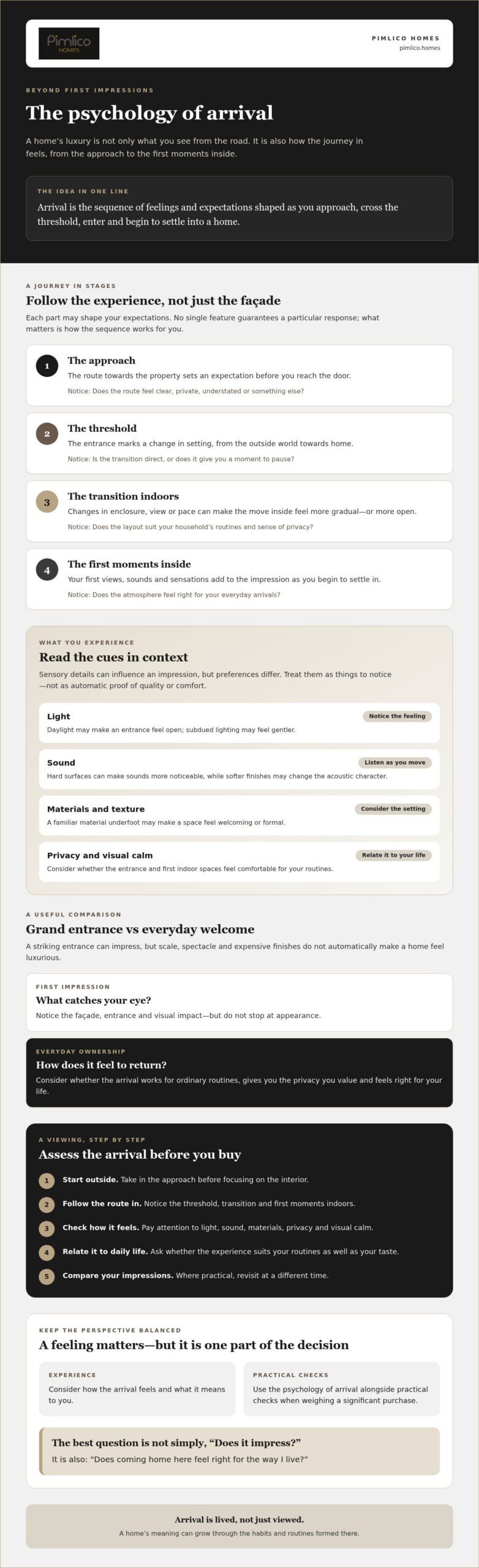
Arrival is the sequence of feelings and expectations shaped as you approach, cross the threshold, enter and begin to settle into a home. It is not simply façade design or interior styling. It describes how you experience those spaces and what they mean to you.
What does arrival mean in luxury home ownership?
Consider the journey in stages: the route to the property, the threshold, the transition indoors and the first moments of settling in. Each stage may influence your expectations, but no particular feature guarantees a specific response. A clear route might feel reassuring to one person; another might value a more private or understated entrance.
Routines, memories and expectations shape what feels familiar or welcoming. A home may bring to mind a place you have cherished, or a new property may become meaningful through the habits you form there. That is why the psychology of ‘arrival’ and luxury home ownership extends beyond a polished first viewing.
Luxury is not automatically created by scale, spectacle or expensive finishes. A grand entrance can impress, but a more useful question is whether the experience feels right for the owner’s life. That response might be as simple as feeling at ease at the threshold or having a moment to leave the day behind.
Why can returning home feel restorative?
Coming home can mark a shift from public demands to private life. Familiar surroundings may help some people feel more comfortable or in control, but this is a possibility, not a universal outcome. The meaning of a room or entrance depends on the person, the moment and the associations they bring with them.
Environmental psychology examines relationships between people and their surroundings. It offers a useful way to think about how a home is experienced, not just how it looks. Applied to arrival, it prompts a practical question: does moving into this property feel like a natural change of pace for you?
Consider that question alongside layout and finish. A home is experienced repeatedly, through ordinary routines as well as special occasions. Its arrival experience can become part of what ownership means, shaped over time by the lives lived there.
From outside world to private sanctuary: how arrival cues work
A home’s arrival experience takes shape in stages. The approach sets an expectation, the entrance marks a change in setting, and the first views, sounds and sensations indoors add to the impression. These cues do not need to be dramatic. What matters is how they work together and whether the sequence feels comfortable to you.
Arrival cues guide your attention from the outside world towards the privacy and atmosphere of home. They are not a checklist of fashionable features. A striking material or statement doorway may catch your eye, but its effect depends on the setting and what you value.
How thresholds create a sense of transition
A threshold can distinguish a route accessible to visitors from the more private space beyond. The transition may be direct or unfold gradually through a change in enclosure, view or pace. Neither approach is inherently better. A home does not need a dramatic entrance to make arrival feel considered.
Hypothetical example: imagine one home where the front door opens straight into a busy shared space, and another where a short entrance area offers a moment to pause. The second arrangement might feel more private to some people, while others may prefer the openness of the first. Ask which layout better suits your household’s routines.
How sensory details shape first impressions
Light, acoustics, texture, temperature and visual calm can all influence an impression, though not in the same way for everyone. Daylight may make an entrance feel open; subdued lighting may feel gentler. Hard surfaces can make sounds more noticeable, while softer finishes may change the acoustic character. A familiar material underfoot may also make a space feel welcoming or formal.
Assess these details in context rather than treating any one of them as proof of quality or comfort. Notice how the entrance feels during your visit, then consider whether its atmosphere would suit your everyday arrivals. A viewing gives you an impression, not a guarantee of how a home will feel in every season or situation.
This is the practical value of the psychology of ‘arrival’ and luxury home ownership: it encourages you to consider lived experience alongside appearance. For comparison, explore Pimlico Homes’ residential developments and consider how each property’s approach and entrance might fit the way you want to come home.
Is luxury arrival just an impressive entrance? The experience beyond first impressions
Not necessarily. A dramatic entrance may make a memorable first impression, but grandeur alone cannot guarantee that a home feels welcoming or that you feel you belong there. Repeated use can reveal what matters most: a feature that impresses a visitor may not be what makes daily arrivals comfortable.
This is not an argument against formal architecture or visual drama. For some owners, a strong sense of occasion is part of what makes a home feel right. The question is whether the arrival also suits ordinary routines, not just whether it photographs well or makes an impact on a first visit.
Grand gestures and everyday welcome are not the same
Consider the difference between spectacle and ease. A visually striking entrance might create anticipation, while a straightforward route from the door to the spaces you use most might feel more practical day to day. One does not have to replace the other. Ask whether the home balances the impression you want to make with the comfort and privacy you value when returning.
A viewing captures a moment, not a prediction of long-term satisfaction. Note what draws your attention, then ask how the same sequence might feel on an ordinary evening or when welcoming guests. These are personal judgements, not a universal ranking of architectural styles.
How to assess whether arrival feels personal
Use the comparisons below as prompts, not a scorecard. Preferring one option does not make a home more or less luxurious; it helps clarify what matters to you.
Spectacle
Does a bold entrance feel meaningful to you, or would you rather the approach be understated?
Privacy
Does the transition offer the degree of separation from visitors or passers-by you prefer?
Familiarity
Does the route feel intuitive, and can you imagine using it comfortably as part of your routine?
Personal fit
Does the arrival suit how you live, including how you receive guests and move through the entrance?
Consider accessibility separately from privacy or presentation. Do the route and entrance work for your needs now, and are they likely to remain suitable if your circumstances change? A home’s welcome is not defined by one design language. For the psychology of ‘arrival’ and luxury home ownership, a more useful measure is how well the experience reflects your habits and priorities, beyond the first impression.
How to read a home’s arrival experience before you buy
A viewing lets you experience more than a property’s rooms and finishes. Begin before you enter. Notice the route, the transition indoors and how you might use the space. A useful reminder: assess the experience, not only the photograph.
A four-step arrival assessment for property viewings
- Begin with the approach. Notice how you reach the entrance. Is the route easy to understand? Is it clear where to go, and does the setting offer the privacy and welcome you want?
- Pause at the threshold. Before moving further inside, notice the light, sound and sense of separation from outside. Record your immediate response, but do not treat it as a verdict on the property.
- Imagine an ordinary return. Picture arriving at the end of a typical day. Would the entrance and route indoors fit your routines? Does anything feel awkward or more exposed than you would like?
- Imagine welcoming a guest. Is it clear where a visitor should go? Consider how you would receive someone while maintaining the level of privacy that feels right to you.
Where practical, arrange another visit at a different time. Daylight, activity nearby and your own circumstances may differ, giving you another perspective. A second viewing can add context, but it cannot show every future condition.
Questions to ask about emotional fit
Separate your first response from questions that need further investigation. A brief note after the viewing can help distinguish a feeling from a fact.
- Routine: Can you picture arriving and moving indoors in the way you normally would?
- Privacy: Does the approach and entrance offer the separation you prefer?
- Guests: Would visitors be received in a way that suits your household?
- Practical checks: What needs confirming about condition, access or other property matters?
Record impressions such as “the entrance felt exposed” separately from practical questions that need evidence. Your reaction is useful personal information, but it is not a substitute for surveys or appropriate professional advice. This distinction matters to the psychology of ‘arrival’ and luxury home ownership: emotion can help you recognise what matters, while due diligence helps you assess the purchase.
To consider homes through this lens, view Pimlico Homes’ residential developments and reflect on how each property’s arrival might fit your routines and priorities.
Pimlico Homes and the idea of arrival as part of ownership
Thinking about how it feels to come home is one useful lens for evaluating a significant residential purchase. It cannot replace practical checks or an assessment of suitability, but it can help you consider how the property may fit into everyday life, not just how it looks during a viewing.
A developer’s role in shaping the experience of home
Development decisions influence how a home is planned and presented, and how its spaces relate to the experience of living there. Assess the details of each property on their own merits. Do not assume a particular entrance, material or layout, or how it will feel to an owner, without verified information.
Look beyond a single visual impression. Consider the approach, the transition into the home and whether the property as a whole seems suited to your routines and priorities. The psychology of ‘arrival’ and luxury home ownership is personal, so weigh your emotional response alongside practical judgement.
Explore homes through the feeling of coming home
Different residential formats may appeal for different reasons. A detached home, an executive courtyard home, a bespoke new build or a barn conversion each offers a different type of property to consider. The right fit depends on the individual home and your preferences. Compare available properties with the way you want to live, and base judgements about specific features on verified information.
If you are considering a new build, a luxury new build purchasing guide can offer a further point of reference as you think about the buying process. Keep your priorities in view, including the arrival experience, rather than letting a striking first impression decide for you.
Pimlico Homes develops and sells luxury detached homes, executive courtyard homes, bespoke new builds and high-end barn conversions to private buyers across the UK. Consider these residential properties alongside your own priorities and how each confirmed home might suit your sense of homecoming.
Choose a home that feels right to return to
The psychology of ‘arrival’ and luxury home ownership offers a useful perspective on a significant purchase. Consider not only what a home looks like, but how its approach and entrance might feel as part of everyday life. Sensory details and personal routines shape that experience, and a grand first impression alone cannot tell you whether a property feels like home.
At a viewing, take time to notice the transition from outside to inside. Imagine arriving on an ordinary day and welcoming guests, then keep those impressions alongside practical questions that need further checks. Your response is personal, but it can help clarify what matters most.
As a specialist developer selling luxury homes to private buyers, Pimlico Homes offers detached homes, executive courtyard homes, bespoke new builds and barn conversions. Consider these residential categories in light of your priorities and the way you want to live.
Explore Pimlico Homes’ residential developments and take the next step towards finding a home you’ll be pleased to return to.
Frequently Asked Questions
What is the psychology of arrival in a home?
It describes how the approach, entrance and first moments inside may shape your expectations and feelings about being home. The psychology of ‘arrival’ and luxury home ownership is personal: privacy, familiar details, sensory cues and daily routines may all influence your impression. It is not a formal measure of a property’s quality, or proof that a particular design will create the same response for every owner.
Why does arriving home feel different from entering other buildings?
Home is often connected with personal routines, privacy and meaning, so returning may feel like a transition from public life to private space. Familiar sights, sounds or habits could contribute to that impression. The experience varies between people and properties. It is best understood as a possible emotional response, not a universal psychological effect or a guarantee that every homecoming will feel restorative.
Can the design of an entrance affect how welcoming a home feels?
Yes, an entrance can contribute to the impression a home makes, alongside its approach, lighting, sound, privacy and your expectations. A route that is easy to understand may feel different from one that seems exposed or confusing, although preferences differ. Consider the sequence from outside to inside rather than judging the entrance by appearance alone. Ask whether it feels comfortable for your routines and the way you receive guests.
Is a grand entrance necessary for a luxury home to feel impressive?
No. A dramatic entrance may suit your taste, but luxury does not have to depend on scale or spectacle. A considered arrival might instead reflect privacy, a calm transition or a good fit with everyday routines. There is no single style that suits every owner. Ask whether the entrance and approach feel appropriate to the people who will live there and how they want to use the home.
How can I assess a home’s arrival experience during a viewing?
Start by noticing the approach before entering, then pause at the threshold to consider light, sound, privacy and ease of movement. Imagine returning with shopping or welcoming a guest. Note your emotional response separately from practical questions about condition, specification and suitability. If practical, revisit at another time for a different impression. A viewing captures one moment, so it should not replace surveys or other appropriate checks.
What should I consider when choosing a home that feels like mine?
Consider whether the approach and entrance suit your routines, privacy preferences and way of welcoming others. Notice which details feel comfortable to you, rather than simply impressive. Balance that personal response with practical questions about the property and your needs. A sense of attachment can help clarify what matters, but it should complement careful assessment, not replace it. Think about how you may experience the home repeatedly, not only on viewing day.
Does the feeling of arrival matter after the first visit?
Yes, it may matter because arriving home is a repeated experience, not a one-off viewing. A striking feature that catches your attention at first may become less central than privacy, comfort or ease in daily routines. Your response may also shift as your circumstances change. Consider both your first impression and the ordinary moments you expect to experience as an owner, while keeping practical property checks firmly in view.





