
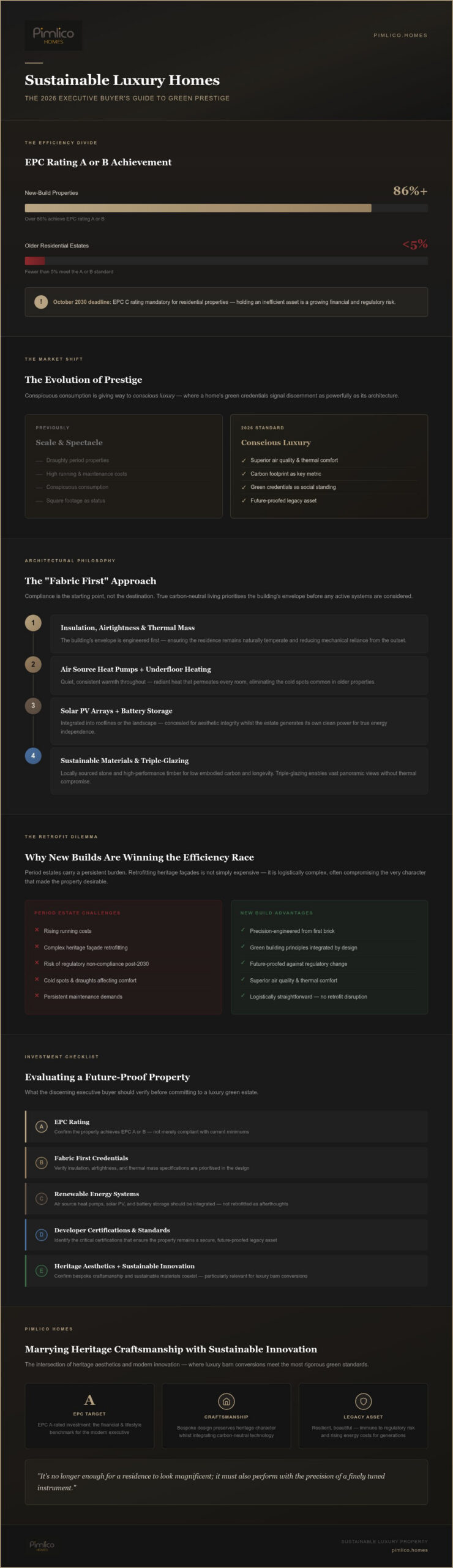
The evolution of prestige. Whilst over 86 per cent of new-build properties now achieve an EPC rating of A or B, fewer than 5 per cent of older residential estates meet this standard. This widening divide has sparked an unprecedented demand for sustainable and green homes amongst executive buyers who refuse to compromise on either aesthetics or efficiency. It’s no longer enough for a residence to look magnificent; it must also perform with the precision of a finely tuned instrument.
The weight of inheritance. You’ve likely felt the burden of maintaining a traditional estate, where rising running costs and the complexity of retrofitting heritage facades create a persistent sense of unease. With the October 2030 deadline for EPC C ratings looming, the risks of holding inefficient assets are becoming impossible to ignore. We’ll show you how the convergence of environmental responsibility and architectural excellence is reshaping the high-end property market for the modern leader. You’ll discover the financial benefits of EPC A-rated investments and see how bespoke craftsmanship can coexist with carbon-neutral innovation. We’re looking at how to secure a legacy asset that remains as resilient as it is beautiful.
Key Takeaways
- Understand why the surging demand for sustainable and green homes is redefining the 2026 property market, shifting the focus from mere scale to sophisticated environmental performance.
- Discover the logistical and financial advantages of choosing a precision-engineered new build over the complex and often prohibitive process of retrofitting a period estate.
- Learn how a “fabric first” architectural approach creates a carbon-neutral residence whilst enhancing the sensory experience of a luxury home.
- Identify the critical certifications and developer standards that ensure your property remains a secure, future-proofed legacy asset in an evolving regulatory landscape.
- Explore the unique intersection of heritage aesthetics and modern innovation that allows luxury barn conversions to meet the most rigorous green standards.
The Evolution of Prestige: Why Conscious Luxury is Driving the Demand for Green Homes
Luxury has shed its louder, more performative layers. In the executive property market, the era of conspicuous consumption is being replaced by a more thoughtful, deliberate standard of living; it’s a shift towards conscious luxury. Today’s high-net-worth individuals view environmental responsibility as a primary differentiator. It’s a quiet signal of discernment that separates the visionary from the merely affluent. This shift is a primary driver behind the surging demand for sustainable and green homes, where the modern estate is defined by its carbon footprint as much as its square footage.
Defining the Conscious Buyer of 2026
The executive profile of 2026 prioritises holistic well-being and global stewardship. High-net-worth buyers are no longer content with the inherited prestige of draughty, high-maintenance period properties that demand constant attention and energy. Instead, there’s a growing appetite for high-specification new builds that integrate the principles of green building from the very first brick. These individuals value their time and health, seeking out spaces that offer superior air quality and thermal comfort without the environmental guilt. In elite circles, a home’s green credentials have become a marker of social standing; it’s a testament to an owner’s forward-thinking nature and their commitment to preserving resources for the next generation.
The Psychology of Sustainable Investment
There’s a profound reassurance found in permanence. Sustainable materials aren’t just eco-friendly; they suggest a longer-lasting legacy that will endure for decades. We’ve reframed “green” as a synonym for superior quality and meticulous engineering. It’s about the invisible details, the airtight seals, and the intelligent ventilation systems that ensure a home remains a sanctuary. The rising demand for sustainable and green homes reflects a desire for assets that are both ethical and indestructible. It’s the confidence that comes from investing in a property that won’t be rendered obsolete by future regulations or rising energy costs. Owning a home that harmonises environmental excellence with architectural beauty fosters a sense of refined pride, knowing that one’s private sanctuary contributes to a greater global good.
The Architectural Pillars of Sustainability: Beyond the EPC Rating
Compliance is the starting point, not the destination. Whilst meeting current Energy Performance Certificate requirements ensures a property is legally sound, the modern demand for sustainable and green homes seeks something far more ambitious. True carbon-neutral living requires a “Fabric First” philosophy. This approach prioritises the building’s envelope; its insulation, airtightness, and thermal mass; before any active systems are even considered. It’s a method that ensures a residence remains naturally temperate, reducing the reliance on mechanical intervention and creating a sanctuary that feels inherently stable.
High-Specification Energy Systems
The transition to a greener estate doesn’t mean a sacrifice in comfort. Quite the opposite. Air Source Heat Pumps (ASHPs) provide a quiet, consistent warmth that traditional boilers simply cannot match. When paired with underfloor heating, they create a gentle, radiant heat that permeates every room, eliminating the cold spots often found in older properties. To achieve true energy independence, large estates are increasingly integrating solar PV arrays and sophisticated battery storage. These systems are often cleverly concealed within the landscape or integrated into rooflines, ensuring the architectural silhouette remains undisturbed whilst the home generates its own clean power.
Sustainable Materials and Craftsmanship
Materials matter. We select locally sourced stone and high-performance timber not just for their low embodied carbon, but for their inherent beauty and longevity. Triple-glazing is no longer just a functional necessity; it’s a design feature. It allows for vast, panoramic views that connect the interior with the natural world without compromising the home’s thermal integrity. A bespoke builder’s role is to ensure these technologies remain invisible. The goal is a home that feels traditional and grounded, yet operates with the efficiency of a spacecraft. This meticulous attention to detail is why many executives now look toward bespoke luxury homes that offer a seamless blend of heritage and innovation.
Managing this performance requires intelligence. Modern smart-home ecosystems act as the brain of the property, constantly monitoring and adjusting energy usage. They learn the habits of the household, ensuring that lighting, heating, and ventilation are only used when necessary. It’s this level of control that satisfies the growing demand for sustainable and green homes, offering a living experience that’s both effortless and ethically sound. It’s the ultimate marriage of high-specification engineering and artisanal care.
The Retrofit Dilemma: Why New Builds are Winning the Efficiency Race
Heritage has a price. Whilst the allure of a period estate is undeniable, the logistical reality of maintaining such a property has shifted dramatically in 2026. The blanket heritage exemption for listed buildings has been revoked, bringing historic homes into the scope of mandatory energy efficiency. With maximum non-compliance fines rising to £30,000 per property, the pressure to upgrade is immense. This regulatory squeeze is a significant factor in the rising demand for sustainable and green homes that are engineered for excellence from the ground up.
Retrofitting a solid-walled manor to meet modern standards often entails massive structural risk. Costs for complex architectural envelopes frequently exceed £100,000, yet even then, achieving an EPC Band A is rarely feasible. Luxury new builds offer a blank canvas. They allow for the seamless integration of low-carbon heating and rooftop solar PV as standard, meeting the Future Homes Standard requirement for a 75 to 80 per cent reduction in carbon emissions. It’s a level of precision that ensures long-term satisfaction without the disruption of deep retrofitting.
The True Cost of Heritage Draughts
Heating a traditional manor requires vastly more energy than a contemporary detached home. According to IEA building efficiency analysis, the decarbonisation of the residential sector relies heavily on the superior thermal envelopes found in new construction. Older properties typically emit 50 per cent more carbon than their modern counterparts. Beyond the environmental impact, the hidden maintenance costs of outdated energy systems create a persistent drain on capital. By 2030, energy-efficient homes are projected to command a significant price premium, whilst inefficient traditional estates may face a punishing “brown discount” in the resale market.
Future-Proofing Your Capital
Investing in a high-specification new build is a strategic move to insulate your wealth. Lenders and private wealth banks now offer preferential borrowing rates, often with margin discounts of 10 to 30 bps, for properties achieving EPC Band A or B. These “Green Mortgages” reflect the lower risk associated with sustainable assets. Choosing a home with a minimal carbon footprint ensures your investment remains attractive to the next generation of eco-conscious buyers. It’s about securing a legacy asset that won’t be hindered by future “green taxes” or refinancing bottlenecks. Modern building standards provide a level of security that a draughty period property simply cannot match.
Evaluating Future-Proof Investments: A Checklist for the Discerning Buyer
The acquisition of an estate is a statement of intent. In 2026, the demand for sustainable and green homes is driven by a desire for assets that offer both ethical alignment and long-term security. Evaluating such an investment requires a move away from superficial aesthetics towards a deeper understanding of architectural performance. One should begin with the site itself. The relationship between plot orientation and passive solar gain is a hallmark of intelligent design; a home that captures the sun’s natural warmth reduces its reliance on active heating systems from the outset. This foresight ensures that the property remains naturally temperate, regardless of the season, whilst protecting the owner from the volatility of energy markets.
The Green Specification Checklist
A comprehensive environmental policy is the blueprint for excellence. Discerning buyers must look for insulation standards with U-values that significantly exceed current building regulations, creating a thermal envelope that feels permanent and protective. Essential certifications, such as Passivhaus standards or high BREEAM ratings, provide the empirical evidence of a home’s sustainable pedigree. Electric Vehicle (EV) charging infrastructure is no longer an optional luxury; it’s a functional necessity for the modern executive. We also look for sophisticated water management systems, such as rainwater harvesting and Sustainable Drainage Systems (SuDS), which manage the property’s environmental impact with quiet efficiency whilst preserving the local ecosystem.
Selecting a Visionary Developer
The difference lies in the execution. A specialist developer brings a level of meticulous care that volume builders simply cannot replicate. They treat green technology as an integral part of the home’s anatomy, ensuring that heat pumps and solar arrays are as beautifully integrated as the hand-carved joinery. Assessing the long-term viability of on-site renewables requires a partner who understands the nuances of local microclimates and energy storage. You’re looking for a visionary creator who views sustainability as a core philosophy rather than a commercial obligation. This commitment to excellence ensures that your home remains a legacy asset for the next generation. It’s about finding a builder who acts as a reliable guardian of quality. To see how these principles are brought to life, you can explore our portfolio of bespoke luxury homes.
Pimlico Homes: Marrying Heritage Craftsmanship with Sustainable Innovation
Excellence is never accidental. It’s the result of a deliberate, methodical process that organises every element of a luxury development around the principles of longevity. At Pimlico Homes, we recognise that the modern demand for sustainable and green homes requires more than just efficient systems; it demands a seamless marriage between traditional artistry and visionary engineering. We specialise in high-end residential projects that respect the natural landscape, ensuring that each property feels like a permanent part of its environment whilst operating at the peak of modern performance.
The unique challenge of delivering sustainable performance in luxury barn conversions is where our expertise truly shines. These structures carry an emotional weight and architectural heritage that many executives find irresistible, yet they often fall short of modern efficiency standards. We bridge this gap through meticulous care. By integrating mechanical ventilation with heat recovery (MVHR) and air-source heat pumps behind traditional stone facades, we create a residence that retains its rustic soul whilst achieving an EPC A rating. It’s a precision-led approach applied to a historic frame, removing the compromise between character and carbon neutrality.
Bespoke Solutions for the Executive Market
A Pimlico bespoke new build represents the pinnacle of sustainable executive living. We don’t believe in one-size-fits-all utility; instead, we tailor energy systems to the specific lifestyle needs of our clients. Whether it’s managing the thermal requirements of an expansive home office or integrating smart-grid technology within our executive courtyard developments, every detail is considered. Our goal is to provide a home that responds to your presence with quiet intelligence. For those navigating the complexities of the current market, The Ultimate Guide to Buying a Luxury New Build Home in 2026 offers deeper insights into selecting the perfect residence.
A Legacy of Excellence
Trust is built over decades. Fusing 25 years of industry experience with the visionary demands of the 2026 property market allows us to act as reliable guardians of quality. We understand the emotional weight of a significant life investment. There is a profound sense of security in knowing your home is built for the future, insulated against changing regulations and fluctuating energy costs. This foresight doesn’t just protect the environment; it protects your capital whilst meeting the long-term demand for sustainable and green homes. To understand the financial implications of these choices, explore our Resale Value of Luxury New Build Homes: An Investment Guide. We remain focused on the human experience, delivering a legacy asset that will be cherished by the next generation.
Securing a Legacy of Excellence
The definition of a luxury estate has undergone a profound transformation. It’s no longer just about the grandeur of the facade or the acreage of the grounds. It’s about the intelligence of the build and the permanence of the investment. We’ve explored how the surging demand for sustainable and green homes is driven by a desire for assets that are as resilient as they are beautiful. By choosing a precision-engineered residence over a draughty period estate, you’re not just avoiding the complexities of future retrofitting; you’re securing a sanctuary that respects both your lifestyle and the planet.
At Pimlico Homes, we bring 25 years of specialist experience to every project we undertake. Our reputation is built on quiet confidence and a meticulous attention to detail that ensures every bespoke home is a masterpiece of modern performance. We’re proud to act as visionary creators and reliable guardians of quality for the discerning buyer. If you’re ready to find a home that balances heritage craftsmanship with carbon-neutral innovation, we invite you to explore our current portfolio of sustainable luxury homes. Your future legacy begins with a single, thoughtful choice.
Frequently Asked Questions
How much does a sustainable luxury home save on energy bills compared to a period property?
A sustainable luxury home typically consumes 30 per cent less energy than its traditional counterparts. For those moving from older period estates, this efficiency often translates into a 20 to 50 per cent reduction in operational heating and lighting costs. Whilst the financial saving is significant, it’s the consistent thermal comfort that truly differentiates the experience. Modern fabric performance ensures your residence remains naturally temperate, regardless of the external weather conditions.
Will installing solar panels or heat pumps affect the aesthetic appeal of a luxury barn conversion?
The integration of renewable technology within a luxury barn conversion is handled with meticulous care. We ensure that air source heat pumps are screened by artisanal landscaping or architectural features to preserve the property’s silhouette. Solar PV arrays can be sensitively integrated into rooflines or concealed within the grounds. Our goal is to ensure that these systems remain invisible yet impactful, protecting the heritage character of your home whilst delivering modern performance.
What is the most important green feature to look for in a new build executive home?
A “Fabric First” approach is the most critical feature to look for in a new build executive home. This philosophy prioritises high-specification insulation and superior airtightness to achieve thermal integrity before any active heating systems are considered. It creates a residence that requires very little mechanical intervention to stay warm. This foundation is essential to meet the growing demand for sustainable and green homes amongst discerning buyers who value longevity and efficiency.
Do sustainable homes have a higher resale value than traditional luxury properties?
Sustainable homes currently command a price premium of 10 to 20 per cent over standard properties. As we approach 2030, this gap is expected to widen as inefficient homes face a punishing “brown discount” and higher liquidity risks. The rising demand for sustainable and green homes ensures that these properties remain highly liquid assets. Securing a residence with high environmental performance ensures that your capital remains protected and attractive to the next generation.
Is it possible to achieve an EPC A-rating in a bespoke luxury barn conversion?
Achieving an EPC A-rating in a bespoke luxury barn conversion is entirely possible through visionary engineering. We achieve this by combining high-performance thermal envelopes with low-carbon heating systems like air source heat pumps. Whilst traditional conversions often struggle with draughts, our methodical process ensures that these historic structures meet the same rigorous standards as a modern new build. It’s the ultimate marriage of architectural heritage and carbon-neutral innovation.
How does Pimlico Homes ensure that green technology doesn’t compromise the “luxury feel” of a property?
We ensure that green technology enhances the luxury feel rather than detracting from it. Systems like underfloor heating provide a gentle, radiant warmth that eliminates the need for unsightly radiators. Mechanical ventilation with heat recovery ensures superior indoor air quality, which is a vital component of holistic well-being. By concealing these advanced features within the home’s fabric, we’ve maintained a sophisticated aesthetic whilst providing a living experience that’s both effortless and ethically sound.
What are the long-term maintenance requirements for sustainable energy systems in large homes?
Sustainable energy systems in large homes generally require less frequent intervention than traditional gas boilers. Air source heat pumps and solar PV arrays are designed for longevity, typically needing only an annual specialist service to ensure peak performance. Battery storage systems and smart-home ecosystems are largely self-managing, though periodic software updates ensure they continue to optimise your energy usage. This methodical approach to maintenance protects your investment and ensures long-term satisfaction.





