
Financial appreciation. Architectural distinction. A bespoke wine cellar can increase a property’s market value by up to 15 per cent, yet its true worth is measured in the security of the vintages it protects. You understand that a curated collection represents years of dedication and capital. It’s natural to feel unease regarding the technical integrity of subterranean storage, particularly when the line between a decorative wine wall and a functional climate-controlled environment is blurred. When searching for homes with wine cellars UK, the priority must be the balance of architectural beauty and engineering precision.
Technical mastery. Heritage craftsmanship. This guide provides the clarity you need to acquire a residence that serves as both a prestigious entertainment space and a secure vault. We’ll outline how to evaluate humidity systems, structural waterproofing, and the maintenance of high-specification cellars. You’ll discover why bespoke luxury homes offer the most reliable path to a world-class storage solution. From the thermal mass of a barn conversion to the innovation of an executive new build, we’ll explore how to ensure your cellar remains a sound financial and lifestyle choice for years to come.
Key Takeaways
- Understand the evolution of wine storage from utilitarian basements to theatre-style rooms that serve as both architectural centrepieces and technical sanctuaries for your collection.
- Learn the critical importance of precision thermoregulation and humidity control, ensuring your vintages are preserved at the ideal temperature without compromising structural integrity.
- Discover how to choose between subterranean vaults and modern wine walls when evaluating homes with wine cellars UK to find a configuration that matches your curation style.
- Recognise the financial benefit of a professionally installed cellar, which can increase the market value of executive homes by up to 15 per cent whilst attracting international interest.
- Gain insight into why integrating a wine cellar during the initial design phase of a luxury new build ensures superior technical performance and aesthetic harmony.
The Renaissance of the Wine Cellar in Modern British Luxury Estates
The modern British estate has undergone a profound architectural shift. What was once a dusty, subterranean afterthought has emerged as a crystalline centrepiece of the home. Today’s homes with wine cellars UK are designed with a theatre-style philosophy, where the collection is displayed behind floor-to-ceiling glass and illuminated by UV-filtered LED lighting. This is no longer merely storage. It’s a dedicated viticulture space that reflects the owner’s journey through the world’s finest vineyards. In executive courtyard homes, these rooms are increasingly positioned adjacent to primary social hubs, bridging the gap between the kitchen and the formal dining hall.
Technical mastery. Heritage craftsmanship. Defining the modern cellar requires a perfect marriage of active cooling technology and bespoke aesthetics. It’s a sanctuary where the air is as precisely managed as the architecture. For the owner of a luxury detached residence, the appeal is deeply emotional. There’s a unique pride in knowing that a rare vintage is maturing in an environment specifically engineered for its protection. It represents a commitment to excellence that extends beyond the visible surfaces of the home.
The Evolution of the Domestic Cellar
Traditional damp vaults served a purpose, but they lacked the precision required for high-value curation. Modern iterations represent a transition from passive, variable conditions to the absolute stability of contemporary climate-perfected rooms. Understanding the fundamentals of wine cellars allows owners to appreciate the necessity of active systems that regulate both vibration and light. These spaces now serve as the heart of high-end social entertaining. Guests are often invited into the cellar for intimate tastings, whilst digital inventory management systems allow the host to locate a specific bottle with a single tap on a screen. The cellar has become a functional gallery.
Why 2026 Buyers Prioritise Custom Storage
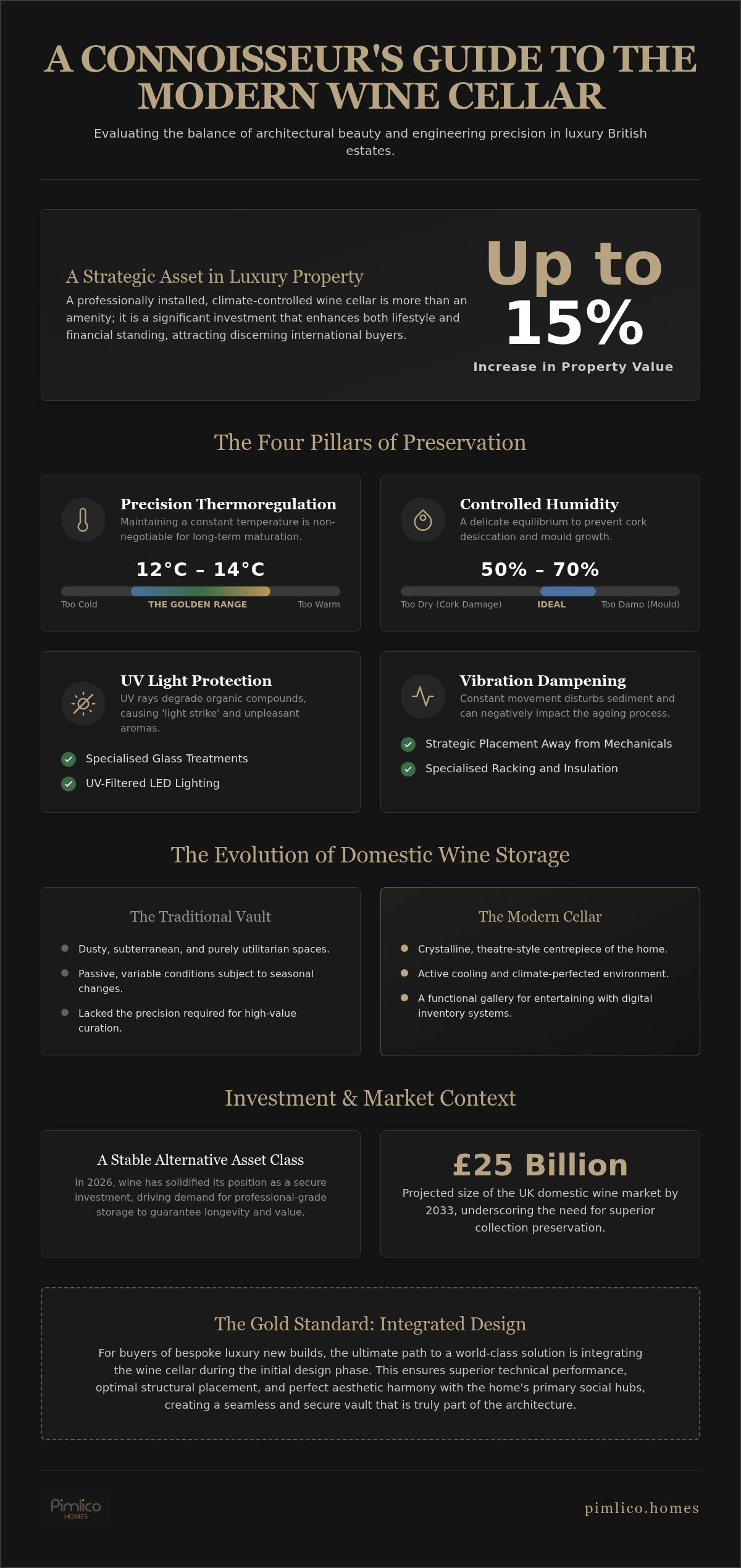
The demand for sophisticated storage is driven by more than just lifestyle. In 2026, wine has solidified its position as a stable alternative asset class in the UK. With the domestic wine market projected to reach approximately £25 billion by 2033, serious collectors require environments that guarantee the longevity of their investment. Buyers of homes with wine cellars UK seek move-in ready excellence. They expect high-specification features that complement other executive amenities like private cinemas and wellness suites. A bespoke cellar provides a sense of permanence. It suggests that the home was built not just for living, but for the careful preservation of a legacy.
Architectural Precision: The Anatomy of a World-Class Home Wine Cellar
Precision is the silent partner of the connoisseur. Whilst a beautiful aesthetic may impress a guest, it’s the invisible engineering that preserves the value of the liquid inside. In the context of homes with wine cellars UK, architectural precision means more than just a sturdy door; it requires a holistic approach to environmental physics. A world-class cellar is a machine for preservation, designed to shield a collection from the four primary enemies of wine: heat, light, vibration, and fluctuating humidity.
Thermoregulation is the primary pillar. Maintaining the ‘golden’ range of 12 to 14 degrees Celsius year-round is non-negotiable for long-term maturation. Fluctuations are the enemy of fine wine, causing the liquid to expand and contract, which can compromise the seal of the cork. Humidity must be equally managed, ideally resting between 50 and 70 per cent. This balance prevents cork desiccation whilst ensuring the environment isn’t so damp that labels begin to perish or mould develops. It’s a delicate equilibrium that requires constant, automated monitoring.
Light and movement pose secondary threats. UV rays can degrade organic compounds in wine, leading to ‘light strike’ and unpleasant aromas. This makes specialised glass treatments and UV-filtered lighting essential. Vibration dampening is also critical, yet the location of the cellar within the home’s structure matters immensely. It should be situated away from plant rooms, laundry facilities, or heavy footfall areas to ensure the delicate sediment in older vintages remains undisturbed. True luxury lies in this level of meticulous foresight.
Active vs Passive Cooling Systems
Traditional passive cooling relies on the natural coolness of the earth. In modern, highly insulated new-build homes, this is rarely sufficient to maintain the necessary stability. Active cooling is the standard for high-specification estates. We recommend split-system cooling for its whisper-quiet operation; the noisy condenser is placed externally, leaving the cellar in serene silence. For the ultimate security, integrated backup power is essential to protect your collection during local grid maintenance or unforeseen outages. This ensures the environment remains constant, regardless of external factors.
Bespoke Materiality and Lighting
The choice of materials serves a dual purpose. Hardwoods like walnut and oak, or natural stone, provide excellent thermal mass, helping to keep the temperature stable. Lighting must be ‘cold’ LED to prevent heat spikes near delicate vintages. Frameless glass walls offer a stunning visual connection to the collection, but they must be double or triple-glazed with thermal breaks to maintain efficiency. For those seeking such technical excellence, bespoke luxury homes provide the perfect foundation for a custom-engineered cellar that balances artistry with scientific rigour.
Comparing Cellar Configurations: From Subterranean Vaults to Wine Walls
Selecting the ideal configuration for wine storage is a decision that balances the scale of curation with the desired lifestyle impact. In the market for homes with wine cellars UK, four distinct formats have emerged as the benchmarks of luxury. Each offers a unique dialogue between volume, visibility, and technical complexity. Whether the goal is a private sanctuary for long-term maturation or a social stage for frequent hosting, the architecture must reflect the intent of the collector.
The Subterranean Advantage
Subterranean vaults remain the gold standard for serious oenophiles. These spaces utilise the natural insulation of the earth to provide a baseline of thermal stability that above-ground rooms struggle to match. Beyond the physics of preservation, there is a distinct prestige in owning a dedicated vault. In new-build detached homes, these lower-ground levels are often designed to include an integrated tasting room. These are intimate environments where the host can decant a rare vintage away from the activity of the main residence, surrounded by the heritage of their collection. Structural considerations are paramount; professional waterproofing and vibration-dampening foundations are essential to protect both the vintages and the property’s integrity.
For contemporary developments where floor space is at a premium, the spiral cellar is an architectural marvel. It uses a recessed concrete cylinder to store hundreds of bottles within a minimal footprint. It’s a striking visual feature, often viewed through a motorised glass trapdoor in the floor of a study or dining room. It represents a visionary approach to high-density storage without sacrificing the cooling benefits of a subterranean environment.
The Above-Ground Wine Gallery
Modern glass technology has revolutionised the placement of the cellar. No longer confined to the basement, the wine room has moved into the primary social zones. These galleries use triple-glazed, UV-protected panels to maintain climate control whilst remaining a stunning visual centrepiece. Integrating such features within luxury barn conversions allows for a refined contrast between traditional timber frames and sleek, modern viticulture technology. Proximity to the kitchen and dining areas ensures that the ritual of selection remains a central part of the evening’s entertainment.
Bespoke wine walls offer a more focused alternative for the frequent entertainer. Whilst smaller in capacity than a full-depth vault, they function as pieces of living art. These installations often feature precision-engineered racking and ‘cold’ LED lighting that highlights the labels without affecting the temperature of the liquid. For many buyers of homes with wine cellars UK, the wine wall is the ultimate expression of modern luxury, providing immediate access to daily vintages within a high-traffic, social environment.
Evaluating Property Value: Why Wine Storage is a Strategic Asset
Strategic assets are defined by their ability to retain value whilst enhancing the owner’s lifestyle. In the competitive landscape of homes with wine cellars UK, these features are no longer considered optional extras. They are essential hallmarks of quality. For the international buyer, a temperature-controlled vault is a global luxury standard, often appearing alongside wellness suites and private galleries. Its presence signals that the property has been constructed with a level of foresight that extends beyond the superficial. It suggests a home built for a collector who values both preservation and prestige.
Financial returns are quantifiable. Verified industry data suggests that a professionally installed cellar can increase a property’s value by 10 to 15 per cent. This is particularly relevant when assessing the resale value of new build homes with premium add-ons. A cellar accelerates the sales process by distinguishing the residence from standard executive developments. It creates a sense of technical permanence that reassures the next generation of investors. Future-proofing is the goal. By ensuring the technology remains relevant for the next decade, owners protect the liquidity of their real estate investment.
The ROI of High Specification Features
Investment requires a long-term view. Whilst the initial cost of a bespoke oak or stone cellar is significant, the return is found in the premium it commands at the asking price. Bespoke installations carry far more weight in the executive market than off-the-shelf cabinets or modular units. There is a psychological impact to consider; the sight of a perfectly integrated, climate-controlled room evokes a feeling of security and exclusivity. It suggests that the developer has prioritised the preservation of the buyer’s assets. This perceived quality often translates into a faster transaction and a higher final sale price.
Evaluating a Developer’s Wine Specification
Discerning buyers must look beneath the surface. When consulting a buying a luxury new build guide, specific attention should be paid to the technical warranty of the cellar. You should ask the builder about the insulation standards and the redundancy of the cooling systems. It’s vital to ensure the cellar is included in the long-term property warranty, protecting your investment for the next decade. Quality is never an accident. If you are seeking a residence that blends this level of technical rigour with architectural elegance, explore our latest luxury detached homes to see how we integrate these essential assets into our vision.
Acquiring Your Vision: Selecting a Developer for a Bespoke Wine-Centric Home
The acquisition of a premier residence is more than a transaction; it’s the realisation of a lifestyle vision. When searching for homes with wine cellars UK, the most discerning collectors recognise that a truly world-class cellar cannot be a mere afterthought. It must be woven into the very DNA of the property. Selecting a developer with the foresight to design these spaces into the foundations ensures a level of structural and technical harmony that retrofitting simply cannot replicate. It’s the difference between a room that holds wine and a sanctuary that preserves a legacy.
Visionary creation. Reliable guardianship. At Pimlico Homes, we approach the integration of high-end amenities with the meticulous care of a master craftsman. We understand that a wine cellar is a complex ecosystem. By considering ventilation, thermal mass, and vibration dampening at the earliest architectural stages, we create environments that offer absolute security for your collection. This methodical process ensures that every executive residence we deliver stands as a testament to excellence and permanence.
The Bespoke Home Builder Advantage
Customisation is the ultimate luxury. Working with a bespoke builder allows you to tailor every facet of the storage environment to match your specific curation habits. Whether your collection requires specialised racking for large-format magnums or specific lighting zones for rare vintages, a bespoke build accommodates these nuances with ease. We collaborate closely with architects to ensure the cellar enhances the home’s natural flow, often positioned as a sophisticated transition between formal living spaces. A specialist developer brings a level of precision to these features that a general contractor often lacks, particularly regarding the high-specification requirements of modern viticulture.
A Commitment to Excellence and Heritage
Our focus on luxury detached homes and bespoke barn conversions is rooted in a 25-year heritage of high-end construction. We don’t just build houses; we curate life investments. Every project we undertake is a marriage of innovative thinking and traditional values, ensuring your home remains a source of pride for decades. We invite you to explore our current luxury new build homes and discover the bespoke opportunities available for your next acquisition. Your journey toward a perfectly engineered, wine-centric home begins with a consultation on a custom layout designed specifically for your lifestyle. We remain committed to supporting you through every stage of this complex, rewarding process.
Securing Your Viticulture Legacy
Mastering the technical variables of light, temperature, and vibration is the only way to ensure a collection’s longevity. Whether you opt for a grand subterranean vault or a contemporary glass-walled gallery, the integration must be seamless and architecturally sound. When evaluating homes with wine cellars UK, remember that the most successful investments are those where engineering and aesthetics are held in equal regard. A cellar shouldn’t just store bottles; it should celebrate them whilst protecting their financial and emotional value.
At Pimlico Homes, we bring 25 years of luxury development expertise to every project. As specialists in bespoke detached and executive homes, our unrivalled focus on high-specification craftsmanship ensures your storage environment is as exceptional as the vintages it protects. We understand the weight of a significant life investment and act as reliable guardians of quality throughout the construction process. Discover the prestige of a bespoke residence with Pimlico Homes. Your journey toward a residence that reflects your passion starts with a commitment to excellence. We look forward to helping you realise that vision.
Frequently Asked Questions
Does a wine cellar add significant value to a UK home?
Yes, a professionally installed wine cellar can increase a property’s market value by approximately 10 to 15 per cent. When considering homes with wine cellars UK, this addition transforms a residence into a highly liquid asset. It appeals to international investors who view climate-controlled storage as a global luxury standard. Beyond the financial return, it signals an architectural foresight that distinguishes the home from standard high-end developments.
What is the ideal temperature for a home wine cellar in the UK?
The ideal temperature for long-term maturation is between 12 and 14 degrees Celsius. Consistency is the most critical factor; fluctuations can cause the wine to expand and contract, potentially damaging the seal of the cork. High-specification systems ensure this ‘golden’ range is maintained year-round, regardless of external British weather conditions. This precision protects the integrity and future value of your most delicate vintages.
Can I include a wine cellar in a new-build barn conversion?
Yes, wine cellars are a frequent and prestigious addition to luxury barn conversions. These properties often provide excellent thermal mass due to their thick original walls, which can be complemented by modern active cooling systems. Integrating a cellar allows for a refined rustic aesthetic, where traditional timber frames meet contemporary viticulture technology. It’s a sophisticated way to ground a rural retreat with modern executive amenities.
How much maintenance does a modern climate-controlled cellar require?
Modern climate-controlled cellars require minimal but methodical maintenance to ensure longevity. You should expect to service the cooling unit annually, which typically involves cleaning filters and checking refrigerant levels. Automated sensors often monitor humidity and temperature in real-time, alerting you to any deviations. This proactive approach ensures the environment remains stable, providing peace of mind for the serious collector who values the security of their life investment.
Is a basement necessary for a high-quality wine cellar?
A subterranean space is not a requirement for high-quality storage in modern homes with wine cellars UK. Advanced glass technology and active cooling allow for stunning above-ground wine rooms or ‘wine walls’ situated in kitchens or dining areas. Whilst basements offer natural thermal stability, contemporary engineering can recreate these conditions anywhere in the home. This flexibility allows the collection to serve as a visual centrepiece for social entertaining.
What are the common mistakes to avoid when buying a home with a wine cellar?
The most frequent error is prioritising aesthetics over technical specification. Inadequate insulation or the use of heat-emitting lighting can lead to temperature spikes that ruin expensive collections. Another mistake is ignoring vibration; placing a cellar near laundry rooms or heavy footfall zones can disturb the sediment in older wines. Ensure the developer has used UV-filtered glass and vibration-dampening foundations to provide a truly secure environment for your curation.
How does active cooling differ from passive storage in a luxury home?
Active cooling uses mechanical systems to maintain precise temperature and humidity levels, which is essential for modern, well-insulated homes. Passive storage relies solely on the natural coolness of the earth and the building’s thermal mass. Whilst passive storage was traditional, it’s rarely stable enough for high-value curation in the UK’s varying climate. Active systems provide the absolute reliability required by the modern home connoisseur.
Can I customise the wine cellar if I buy a bespoke new-build home early?
Yes, early-stage involvement in a bespoke build offers the ultimate opportunity for customisation. You can collaborate with architects to tailor the capacity, lighting, and materiality to your specific collection. This ensures the cellar is integrated into the home’s foundations and social flow from the outset. Choosing bespoke luxury homes allows you to influence the design before construction begins, resulting in a storage sanctuary that perfectly reflects your lifestyle.


