
What if the most memorable luxury exterior is the one that never tries too hard? Timeless exterior design for luxury new builds isn’t about making a grand statement at every turn. It comes from considered proportions, a coherent palette and materials chosen to work comfortably together. When inspiration images point in different directions, it can be difficult to define that restraint. Yet it is often what makes a home feel refined rather than ostentatious.
It’s natural to wonder which choices will still feel right years from now. A striking finish or fashionable detail may catch the eye today, but lasting elegance depends on how the whole exterior works: its scale, balance, texture and relationship to its setting. Look beyond the appeal of an individual feature and consider whether it supports the character of the home.
In this article, we’ll explore how proportion, materials and restraint can help shape an enduring exterior, and how to turn reference images into a clear design brief. Drawing on Pimlico Homes’ work as a developer of luxury new builds, we’ll also consider practical qualities to look for when choosing a home that feels both contemporary and composed.
Key Takeaways
- Assess a façade as a whole. The relationship between its height, width, openings and roofline can matter more than any single feature.
- Compare materials such as brick, stone, timber, render and metal by how they work together, suit the setting and may need maintaining.
- Use coherence and longevity to weigh trend-led details against the wider character of the home. No single choice is universally right or wrong.
- Turn inspiration into a practical brief by separating essential priorities from details you could reconsider, then check that the choices work together.
- Timeless exterior design for luxury new builds is easier to assess when you look beyond first impressions and ask about materials, detailing, specification and maintenance.
What Makes Exterior Design for Luxury New Builds Feel Timeless?
A prestigious home can make a lasting impression without demanding attention. For buyers considering timeless exterior design for luxury new builds, the difference lies less in a fashionable feature and more in the overall composition: does it feel balanced, coherent and suited to its setting?
Timelessness is not a fixed architectural style. It is the relationship between proportion, materials, detailing and context. A contemporary exterior can feel enduring, while a traditional reference can feel unconvincing if it is applied without thought. The useful test is whether each element supports the character of the building instead of competing to be noticed. Design writing often describes proportion, balance, rhythm and unity as foundational design principles. These ideas provide a practical way to assess an exterior beyond personal preference.
Lasting design is shaped by the relationships between elements. Fashion is often defined by the detail that catches the eye first.
How can you recognise a timeless house exterior?
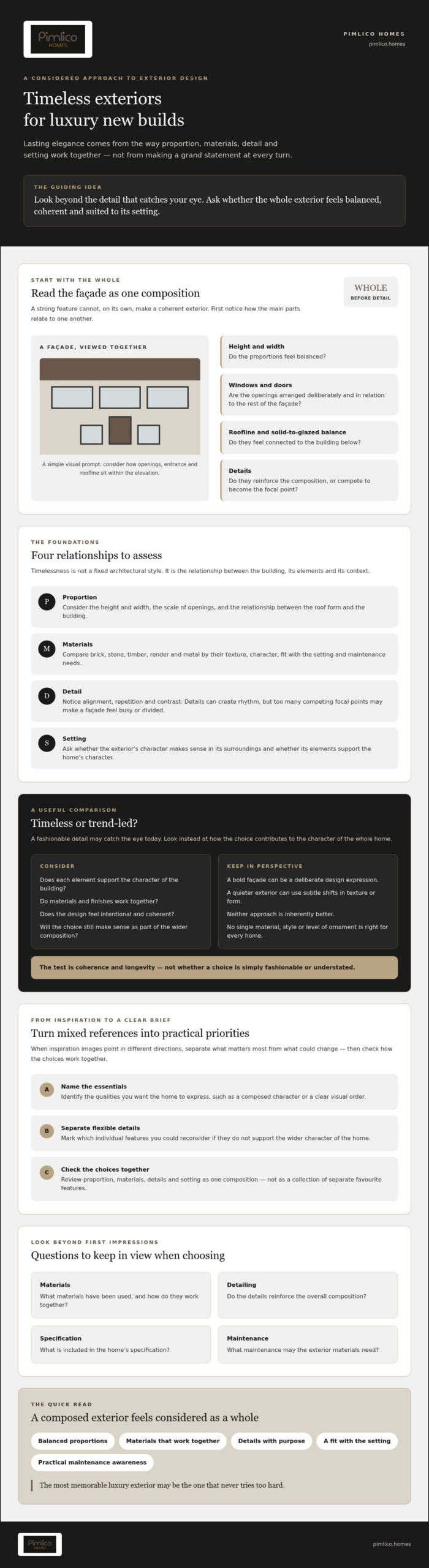
Look at the façade as a whole. Do the height and width feel balanced? Are windows and doors arranged in a deliberate way? Does the roofline sit comfortably with the rest of the building? Check whether details reinforce these relationships or seem added simply to create a focal point.
Timelessness doesn’t mean copying a historic house or rejecting contemporary design. Instead, ask a few observable questions: does the exterior have a clear visual order? Do its materials and finishes work together? Does its character make sense in its setting? The answers help you explain what appeals to you without treating one style as universally correct.
Does luxury have to look conspicuous?
No single level of ornament or contrast defines good taste. A bold façade may be a deliberate expression of its design, while a quieter one may rely on subtle shifts in texture or form. Neither approach is inherently better. What matters is whether the result feels intentional and coherent.
Scale, repetition and contrast all influence that impression. Repeating a strong detail can create rhythm, while using it everywhere may make the façade feel busy. A pronounced contrast can clarify the composition, but several competing contrasts may divide it into unrelated parts. Treat these as prompts for closer observation, not rigid rules.
Labels such as “new money” describe social perceptions, not objective architectural categories. They can distract from qualities you can actually assess: proportion, consistency and how well the details belong to the whole. A more useful question is whether the exterior expresses its character with confidence or relies on visual emphasis alone.
Proportion, Materials and Detail: The Foundations of Lasting New-Build Design
An exterior is read as a composition, not a catalogue of separate features. The building’s height and width, the size and placement of its openings, and the shape of its roofline all affect how the façade feels. For anyone considering timeless exterior design for luxury new builds, proportion is a useful starting point. It helps explain why a home can feel composed before individual finishes come into focus.
Why do proportion and façade composition matter?
Notice the rhythm of the windows. Do they align with one another or with other features of the façade? Does the entrance feel deliberately placed within the elevation? Consider the balance between solid wall and glazed areas, and whether the roof form appears connected to the building below. As ArchDaily explores, scale is a fundamental tool in humanising architecture, shaping how people experience a building.
On a larger home, repeated alignments can provide visual order across a broad façade. Windows might follow a consistent pattern or relate clearly to the entrance and roofline. The aim isn’t to make every elevation symmetrical. It is to see whether the parts feel considered together. Step back from the most striking feature and assess the whole elevation. A strong detail cannot, on its own, create a coherent composition.
Which exterior materials and details are likely to age gracefully?
Brick, stone, timber, render and metal can each contribute a different texture and character. None is automatically timeless. Consider whether a material suits the home’s design and setting, how its colour varies in natural light, and what maintenance it may require. Ask how it meets adjoining finishes, wraps around corners and works at changes in level. These junctions can reveal whether the palette has been planned as a whole.
Material consistency matters more than a fashionable finish. A coordinated palette lets the building’s form remain clear as tastes change. This doesn’t mean limiting a home to one material. A restrained combination can create depth when each finish has a clear role and the contrasts feel intentional.
Details deserve the same discipline. Trim, joints and edges can clarify the architecture, while an accumulation of competing features may make its underlying form harder to read. If you’re reviewing samples, view them outdoors in changing daylight and alongside the other proposed finishes. A colour or texture that looks compelling on its own may feel different in combination. When considering luxury new builds from Pimlico Homes, apply the same close attention to the relationship between a home’s overall form and its visible finishes.
Timeless or Trend-Led? How to Avoid an Ostentatious New-Build Exterior
Luxury doesn’t require oversized gestures or conspicuous ornament. A façade can feel assured through the way its elements work together, rather than through sheer scale or a succession of attention-grabbing details. Restraint alone doesn’t guarantee a timeless result either. Execution, setting and the relationship between design choices all matter.
“Ostentatious” is a subjective impression, not an objective architectural category. Instead of judging a home through assumptions about its owner or status, look at the choices creating that impression. Are several materials, finishes and focal points competing for attention, or is there a clear visual hierarchy? Does the entrance relate to the rest of the façade? Do decorative details support its overall character?
What makes a façade feel considered rather than overworked?
A considered exterior gives the eye a sense of order. The main form reads clearly, windows and entrances have a discernible relationship to it, and distinctive details have room to register. A façade can be bold or ornate and still feel coherent when its features share a design logic. A muted palette can feel unsettled if its elements appear unrelated.
Use this comparison as a prompt, not a set of rules. A trend-led choice can be well judged, and a restrained one can still feel dated or poorly resolved.
| Quality to assess | More considered tendency | More trend-led tendency |
|---|---|---|
| Coherence | Finishes and focal points appear to belong to the same composition. | Several features compete, though a deliberate scheme can bring them together. |
| Longevity | The overall form remains legible beyond one fashionable detail. | The impression depends heavily on a current look or statement feature. |
| Maintenance | Care needs are understood as part of the material choice. | A visually striking finish is chosen without equal attention to upkeep. |
| Relationship to the home | Details reinforce its proportions and character. | A feature draws attention without an obvious connection to the wider design. |
How can you use trends without dating the whole exterior?
Start with the home’s overall composition and material palette. Test each inspiration image against them. Does the idea suit the building’s scale and character, or is its appeal tied to a look that may be less compelling elsewhere? This helps distinguish the quality you admire, such as contrast or texture, from the exact fashionable expression used to achieve it.
Where possible, reserve more changeable preferences for replaceable details rather than making them the organising idea for the whole façade. Consider their likely upkeep as well. Personal taste has a valid place in a new home, but no current trend can guarantee future resale appeal. Aim instead for a design that feels coherent to you and considered as a whole. That is the lasting value of timeless exterior design for luxury new builds.
Build a Practical Design Brief for a Timeless Luxury New Build
A folder of attractive exterior images is a useful beginning, but it isn’t a brief. To make your preferences clear and workable, identify what matters most to your household, then look for the design qualities shared by your references. This turns inspiration into a considered framework for timeless exterior design for luxury new builds.
How do you turn inspiration images into a coherent brief?
- 1. Define your priorities. Separate non-negotiable needs from attractive details you could reconsider. Note how you want the exterior to feel and which practical requirements matter to you.
- 2. Collect references. Save a range of images, but record what appeals to you in each one. It might be the roofline, window proportions, a material or the way colours sit together.
- 3. Identify patterns. Group references by shared features, such as window shape, roof form or palette. If one image suggests strong contrast and another a softer, more unified finish, decide which underlying quality matters most to your household.
- 4. Test choices. Note how proposed materials and colours might work together, and list questions about suitability and maintenance. An image can inspire an idea, but it doesn’t prove that the same finish will suit a different home.
- 5. Review coherence. Read the brief as a whole. Check that the preferred details support the character you want, rather than pulling in conflicting directions.
Keep these notes beside the images. A useful brief might say that you favour a particular roofline, balanced window proportions and coordinated colours, while flagging the upkeep of a proposed finish for discussion. For a broader perspective on the purchase itself, The Ultimate Guide to Buying a Luxury New Build Home in 2026 can sit alongside your design notes as you consider the wider decision.
What should you ask when reviewing exterior choices?
Bring the brief into conversations with the project team. Ask how each major finish relates to the façade, roof and entrance, and request relevant information about the materials and their expected maintenance. Clarify practical requirements instead of assuming a preferred appearance will suit every part of the home.
Keep a short list of unresolved points: how a sample looks in changing daylight, how finishes meet at junctions, and what care they may need. A photograph can communicate mood and composition, but it cannot confirm the material specification or the quality of construction. Record what you still need to verify before drawing conclusions.
As you refine your priorities, explore luxury new builds from Pimlico Homes.
Choosing a Luxury New Build with Confidence: Look Beyond First Impressions
A façade photograph can capture a home at its most flattering angle. It can suggest a mood, reveal the broad composition and help you decide whether a design appeals to you. Choosing a home calls for more than a compelling first impression, however. Use the principles of timeless exterior design for luxury new builds to guide what you observe, then ask questions where you need confirmed information.
What should buyers assess beyond the façade photograph?
If possible, view the home from different angles and both at a distance and close up. Notice how the exterior reads from the entrance and surrounding spaces, and whether visible details feel consistent across the elevations. Look at how finishes meet at edges and around openings. These observations can help you assess the design, but they aren’t proof of what lies beneath the surface.
Ask for confirmed information about exterior materials and specification, particularly where a finish, component or maintenance requirement matters to your decision. Separate what you can see from what needs documentation or professional assessment. A photograph may show a surface colour, but it can’t establish the precise product, how it has been installed or what care it requires.
- Visible impression: Does the home feel coherent from more than one viewpoint?
- Information to confirm: What materials and finishes are specified, and what maintenance should you expect?
- Questions needing evidence: Which details can be supported by documentation, and which may require a qualified professional’s assessment?
How can a developer’s approach support confident decisions?
Clear communication makes it easier to compare what you see with what is specified. Ask how exterior design decisions and build details are explained, what information is available about the finishes, and how open questions can be clarified. If an answer is not yet confirmed, note it rather than filling the gap with an assumption.
This approach is useful whether you’re looking at one façade or comparing luxury new builds more broadly. Pimlico Homes develops luxury new builds and bespoke homes. When considering a home, assess its visible character alongside the information available about its specification. A well-informed decision rests on understanding the design and asking the right questions, not on a promise that an exterior will guarantee future value, durability or resale performance.
Explore Pimlico Homes’ luxury residential developments and consider their design for yourself.
Choose an Exterior with Lasting Confidence
Timeless exterior design for luxury new builds is less about selecting a fashionable look and more about making the whole composition feel resolved. Proportion, materials and detailing should work together, with choices considered in the context of maintenance and setting. A clear design brief helps turn scattered inspiration into priorities you can explain and assess.
When viewing a new build, look beyond the first photograph. Consider the façade from different angles, then ask for confirmed information about materials, specification and care requirements. Visual appeal matters, but it cannot answer every question about how a home has been built or what its finishes involve.
Pimlico Homes develops luxury detached and executive courtyard homes, as well as bespoke new builds and premium barn conversions. Explore Pimlico Homes’ luxury new builds and consider their design, details and specification for yourself. A clear sense of what matters to you, supported by thoughtful questions, can help you approach your next home choice with greater confidence.
Frequently Asked Questions
What makes a house exterior timeless?
A timeless house exterior brings proportion, materials and detailing together in a coherent composition that doesn’t rely on one passing trend. No architectural style is automatically timeless: context, execution and personal preference all influence how a design is experienced. To assess one, look beyond an individual feature and consider the whole façade. Do the roofline, openings, finishes and details feel as though they belong together? This practical test is more useful than relying on style labels alone.
How can a luxury new build look elegant rather than ostentatious?
A luxury new build can feel elegant through balanced proportions, a clear façade and a coordinated material palette, rather than oversized gestures or decorative excess. Restraint is one possible approach, not a universal rule for good design. Review the whole elevation and notice where your attention goes. Does the entrance relate clearly to the main form? Does each prominent feature contribute to a coherent design or compete with the rest of the façade?
Which exterior materials suit a timeless luxury home?
Brick, stone, timber, render and metal can each contribute to a lasting design when they suit the building and work well with its other finishes. There is no universally best material. Consider texture, colour variation, suitability and expected maintenance. Ask the project team for relevant material and specification details. If samples are available, compare them outside and alongside one another, as a finish can look different in changing daylight or against another surface.
Can a contemporary new-build exterior still feel timeless?
Yes. A contemporary exterior can feel enduring when its proportions, materials and details work together, rather than depending on a short-lived visual effect. Timelessness doesn’t require copying historic architecture or avoiding modern design. Instead, assess how clearly the overall composition reads and whether its features appear connected. Terms such as “modern” and “traditional” describe broad approaches, but neither label alone tells you whether a particular design is coherent or well resolved.
How do I avoid making my house exterior look dated?
Begin with a coherent overall composition before choosing decorative details. Consider how finishes relate to the home’s proportions, and take care not to introduce too many competing colours, textures or focal points. No checklist can guarantee that an exterior will never feel dated, since tastes and context change. Separate the main architectural decisions from more personal or trend-led details, then consider which preferences could be reviewed independently if your tastes evolve.
Does timeless exterior design improve a new build’s resale value?
Timeless exterior design can’t guarantee a particular resale value. A coherent façade may support a positive first impression, but a home’s future value depends on many factors and can change over time. Treat design as one consideration, not a financial promise. For a broader view of the purchase, consult The Ultimate Guide to Buying a Luxury New Build Home in 2026 alongside your own assessment of the property and its documented specification.
How do I create a design brief for a luxury new-build exterior?
Start by defining your household’s priorities, then collect reference images and note what appeals to you in each. Look for recurring qualities, such as rooflines, window proportions or colour relationships, rather than copying one photograph. Consider materials and maintenance, and review how each choice works with the whole exterior. Record questions for the developer or design team, including details that need confirmation. The goal is a coherent brief, not a commitment to a named style.





