
Could your passport matter less than where you’ve spent the past year? For the stamp duty surcharge for non-resident property buyers UK, the answer depends on more than nationality: the property’s location, your UK presence and whether you already own a home can all shape the bill.
It’s easy to mistake the non-resident surcharge for the higher rates charged on additional properties. They’re separate rules, and in England and Northern Ireland they may both apply. The residence test also differs from the one used for income tax: broadly, an individual must have spent at least 183 days in the UK during the 12 months before purchase to meet the SDLT residence test.
This 2026 guide explains which tax applies in England, Northern Ireland, Scotland or Wales, and how residence, joint ownership and existing properties may affect your purchase. It also covers what to establish before completion, including whether a refund could be relevant. A considered home purchase starts with a clear view of the obligations as well as the possibilities.
Key Takeaways
- The stamp duty surcharge for non-resident property buyers UK applies to qualifying residential purchases in England and Northern Ireland, where the applicable tax is SDLT.
- For a property in Wales or Scotland, identify the separate tax system first: LTT in Wales and LBTT in Scotland.
- Before assessing a surcharge, establish who is buying, the purchase date, UK days and ownership structure.
- Keep the non-resident rules distinct from additional-property rates. The final calculation can also depend on the property price and any available reliefs.
- Consider tax planning alongside the property’s suitability and your longer-term plans.
What is the stamp duty surcharge for non-resident property buyers?
In England and Northern Ireland, the stamp duty surcharge for non-resident property buyers UK is an additional 2% SDLT charge on qualifying residential property purchases by buyers who meet the tax’s non-resident test. It is added to the standard SDLT rates rather than replacing them. Whether it applies depends on the property’s location and the buyer’s circumstances, not simply on their passport.
“Stamp duty” commonly refers to Stamp Duty Land Tax (SDLT), the property transaction tax in England and Northern Ireland. The Stamp Duty Land Tax (SDLT) overview provides background on the tax and its place in the UK system. Scotland uses Land and Buildings Transaction Tax (LBTT), while Wales uses Land Transaction Tax (LTT). Neither has a separate non-resident surcharge, although each has its own rules for additional properties.
The property’s location identifies the tax regime. If you’re considering homes in different UK nations, assess each purchase under the rules that apply there. The surcharge discussed here concerns SDLT in England and Northern Ireland.
Which property purchases can bring the surcharge into scope?
The surcharge is relevant to qualifying residential purchases, but an overseas connection alone does not make it payable. The purchaser, transaction structure and residence rules all matter. Buying personally is not the same as buying through a company or another entity: entity purchases can be subject to separate SDLT provisions, so the purchaser’s circumstances and structure need to be assessed together.
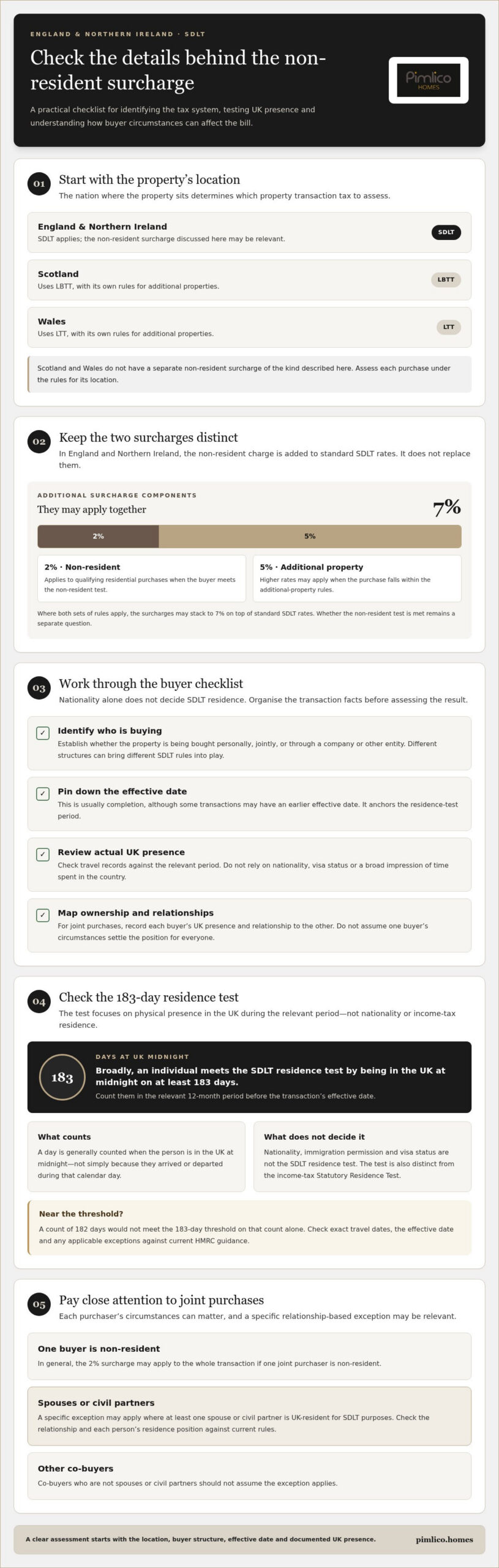
Keep the non-resident surcharge distinct from higher rates for additional dwellings. In England and Northern Ireland, the additional-property surcharge is 5%. If a non-resident buyer also falls within those rules, the surcharges may stack, bringing the combined surcharge to 7% on top of the standard rates. Whether the buyer meets the non-resident test is a separate question.
Is non-resident status about nationality or tax residence?
No. Nationality does not determine the SDLT residence test, and immigration permission or visa status is not the same as residence for this purpose. An individual’s physical presence in the UK is central: broadly, they need to have spent at least 183 days in the UK during the relevant 12-month period to meet the SDLT residence test.
This test is distinct from the Statutory Residence Test used for income tax, so a person’s status for one tax does not automatically determine their status for the other. Establish the precise period and day count against current HMRC guidance, particularly if travel dates or the purchase date are close to the threshold. Joint purchases and company acquisitions also require careful attention to who is treated as the purchaser; the next section explains how to organise those details.
How the non-resident SDLT test works for individuals and joint buyers
For an individual buying a home in England or Northern Ireland, the SDLT residence test is based on physical presence in the UK, not nationality or a general label of tax residence. Start by identifying who is buying, then establish the transaction’s effective date, count qualifying UK days in the relevant period and confirm how the purchase is structured. Each detail can affect the result.
Use this checklist to organise the information:
- Identify the purchaser. Establish whether the property is being acquired by you personally, jointly with another person, or through a company or other entity. Different purchaser structures can bring different SDLT rules into play.
- Pin down the effective date. This is usually completion, although particular transactions may have an earlier effective date. The date anchors the residence-test period.
- Review UK presence. Check travel records against the relevant 12-month period instead of relying on a broad impression of how often you were in the country.
- Map the ownership. For a joint purchase, record each buyer’s relationship to the other and their individual UK presence. Don’t assume one buyer’s circumstances automatically settle the position for everyone.
What does the day-count test measure?
Broadly, an individual meets the SDLT residence test by being present in the UK at midnight on at least 183 days in the relevant 12-month period before the transaction’s effective date. A day is generally counted when the person is in the UK at midnight, rather than simply because they arrived or departed during that calendar day. Confirm the exact period and any applicable exceptions against current HMRC guidance.
For illustration, someone who was in the UK at midnight on 182 days in the relevant period would not meet the 183-day threshold on that count alone. Travel dates and the transaction’s effective date can change the calculation, so this example does not determine an individual buyer’s liability.
How can joint buyers and later residence affect the result?
For joint purchasers, each buyer’s residence status can matter. In general, if one purchaser is non-resident, the 2% surcharge may apply to the whole transaction. A specific exception may apply to spouses or civil partners where at least one is UK-resident for SDLT purposes. Check the relationship and each person’s residence position against current rules. Co-buyers who are not spouses or civil partners should not assume the exception applies.
A later change in circumstances may offer a route to reclaim the non-resident surcharge. Broadly, a buyer may qualify by spending at least 183 days in the UK during the 12 months after purchase, with a claim made within two years of the purchase date. Verify eligibility and the claim period against HMRC guidance.
These examples explain the framework, not personal tax advice. Establishing the facts early brings greater clarity to a home purchase. Alongside that planning, explore the luxury new-build buying guide as you consider the wider decision.
UK property tax comparison: SDLT, LTT and LBTT
The property’s location determines which transaction tax system applies. This is the first distinction to establish: “stamp duty” usually means Stamp Duty Land Tax (SDLT) in England and Northern Ireland, while Wales and Scotland have separate property tax regimes. The SDLT non-resident surcharge does not automatically apply in those nations.
| Property location | Transaction tax | Non-resident and additional-property position |
|---|---|---|
| England and Northern Ireland | Stamp Duty Land Tax (SDLT) | A 2% non-resident surcharge may apply. Higher rates for additional properties are separate and may also apply. |
| Wales | Land Transaction Tax (LTT) | No separate non-resident surcharge. Higher rates may apply to additional dwellings. |
| Scotland | Land and Buildings Transaction Tax (LBTT) | No separate non-resident surcharge. The Additional Dwelling Supplement may apply to additional properties. |
This comparison is a starting point, not a full calculation. The relevant tax authority’s rules, rates and reliefs can depend on the transaction date and the buyer’s circumstances. If you’re comparing homes in more than one nation, calculate each prospective purchase under its own regime rather than carrying an estimate from one property to another.
When does the England and Northern Ireland SDLT framework apply?
SDLT applies to property transactions in England and Northern Ireland. The 2% non-resident surcharge applies to qualifying residential purchases under this framework and has applied since 1 April 2021. A buyer’s total SDLT may also be affected by standard rates, reliefs or higher rates for additional dwellings. The additional-property surcharge is 5% and can apply alongside the non-resident surcharge when the relevant conditions are met.
That distinction is central to understanding the stamp duty surcharge for non-resident property buyers UK: it is an SDLT rule for England and Northern Ireland, not a universal UK property tax charge.
What changes in Wales and Scotland?
Wales charges Land Transaction Tax, while Scotland charges Land and Buildings Transaction Tax. Each has its own rates, reliefs and additional-property rules. Scotland’s Additional Dwelling Supplement is 8% of the purchase price of an additional dwelling. Wales also has higher rates for additional dwellings, but those are not an SDLT non-resident surcharge.
Use the correct terminology as well as the correct calculation. SDLT bands and reliefs should not be used to estimate LTT or LBTT, and devolved additional-property charges should not be described as the SDLT surcharge. The tax framework follows the property, not the buyer’s nationality.
Before committing, establish the property’s nation, the transaction’s effective date and the relevant tax authority’s rules. Then assess the buyer and ownership details within that system. This brings tax planning into the wider home purchase, alongside the property’s suitability and your longer-term plans.
Assessing the surcharge before committing to a purchase
A reliable estimate starts with the facts, not an assumption based on where you live or the passport you hold. Before committing, work through the property’s tax jurisdiction, who will legally buy it, each purchaser’s ownership interests and the expected transaction date. The stamp duty surcharge for non-resident property buyers UK is only one part of the calculation: total tax may also depend on the purchase price, existing property ownership and any reliefs that apply.
Use this checklist to build a clear picture, separating details you can establish from questions that need closer interpretation.
- Property and jurisdiction: record the property’s full location and identify whether SDLT, LTT or LBTT applies.
- Price and timing: note the agreed or expected purchase price and anticipated effective date. Applicable rules can depend on the transaction date.
- Purchasers and shares: list every intended buyer, their planned ownership shares and whether the purchase is personal, joint or through an entity.
- Existing interests: document each buyer’s existing property interests, including details that could affect higher-rate treatment or relief.
- Residence evidence: gather relevant UK travel dates and records for each individual purchaser. A broad estimate of days spent in the UK may not settle a close case.
- Complex structures: flag any company, trust or unusual ownership arrangement for specialist review before relying on a personal-buyer calculation.
Facts to establish: the property’s nation, proposed buyers, stated ownership shares, price and expected transaction date. Points for professional review: how the day-count rules apply, how joint or entity ownership is treated, whether existing interests alter the rates, and whether relief or a refund route is available.
What information should buyers gather?
Bring together documents that support the details in your checklist, including travel records, ownership information and the proposed transaction timetable. If buying jointly, organise the information for each purchaser rather than treating the household as one buyer. Include interests that may not be obvious from the new purchase, and describe any company or trust structure accurately. An organised file makes it easier to identify unanswered questions before exchange or completion.
When should a buyer seek tailored tax guidance?
Seek tailored advice if your day count is close to the threshold, buyers’ circumstances differ, ownership is complex, or you may claim a refund after moving to the UK. For SDLT, use current HMRC guidance; for LTT or LBTT, refer to the relevant devolved authority’s rules. Conveyancing and tax advice are distinct considerations: progressing the legal purchase does not, by itself, resolve a buyer’s tax position.
Once the purchase details are organised, tax planning can sit alongside the wider decision about the home itself. You can explore luxury new-build homes as part of considering a purchase that suits your priorities and longer-term plans.
Plan the tax question alongside your wider UK home purchase
Good purchase planning brings tax into view early without allowing it to eclipse the home itself. Start by identifying the property’s tax jurisdiction, establishing who is buying and their relevant circumstances, and verifying the calculation against current rules. The stamp duty surcharge for non-resident property buyers UK is one consideration in that process, not a measure of whether a property is right for you.
Place any estimate within your wider purchasing plan. Consider transaction tax alongside your available funds and other purchase costs, while keeping it distinct from the home’s specification, design and practicalities of ownership. Assess the layout, finish and suitability for your needs in their own right. Neither a tax estimate nor a particular property choice can promise a financial outcome.
How does purchase tax fit into a wider buying decision?
Build a provisional tax figure into your budget, then treat it as an estimate until the relevant rules and your personal details have been checked. A change in the transaction date, an existing property interest or the way buyers share ownership could affect the final calculation. Keep tax assumptions visible and separate from decisions about design, space and longer-term plans.
Practical and personal priorities matter alongside the numbers: consider how the home will serve you, whether its specification suits your preferences and how ownership fits your plans. Tax research supports the decision, but does not replace it.
What should buyers do next?
Before making an offer or exchanging contracts, assemble the essential details and resolve any uncertainties:
- Confirm whether the property is in England, Northern Ireland, Wales or Scotland, and identify the applicable transaction tax.
- Record every intended purchaser, the ownership structure and any existing property interests.
- Note the expected purchase price, transaction date and relevant UK travel history for each individual buyer.
- Check current guidance from HMRC or the relevant devolved tax authority, and seek appropriately qualified independent advice if the residence test, joint ownership, reliefs or a possible refund is unclear.
Conveyancing progresses the legal transaction; it is separate from tailored tax advice. Understanding both helps you make decisions with a fuller picture before the purchase moves forward.
For a wider view of the home-buying journey, explore The Ultimate Guide to Buying a Luxury New Build Home in 2026. If you are considering your next home, explore Pimlico Homes’ luxury new-build homes as part of your wider search.
Make your next move with confidence
A considered purchase is about more than the transaction itself. It is an opportunity to choose a home that reflects how you want to live, with the financial details understood before decisions become commitments. Treat the stamp duty surcharge for non-resident property buyers UK as one part of that preparation, and give the home’s design, craftsmanship and suitability equal weight in your deliberations.
As a specialist developer of luxury new-build homes, Pimlico Homes focuses on craftsmanship and high-end residential development. Explore the possibilities at your own pace, with a clear view of what matters most to you and your longer-term plans.
Explore Pimlico Homes’ luxury new-build homes and take the next step towards a home that feels distinctly your own.
Frequently Asked Questions
Is there a stamp duty surcharge for non-resident property buyers in the UK?
Yes, a 2% non-resident surcharge may apply to qualifying residential purchases in England and Northern Ireland, where the tax is SDLT. It is added to the standard SDLT rates, and eligibility depends on the transaction and purchaser rather than simply overseas nationality. Scotland and Wales have different property transaction taxes and no equivalent separate non-resident surcharge. Confirm the rules that apply to the property’s location and transaction date before relying on an estimate.
How is non-resident status determined for the SDLT surcharge?
For an individual, the test generally looks at UK presence in the 12 months before the property purchase: broadly, at least 183 days in the UK means the buyer meets the SDLT residence test. HMRC’s day-count rules and the relevant transaction date matter, so keep travel records rather than estimating from memory. This SDLT test is separate from the Statutory Residence Test used for income tax, and nationality or immigration status does not decide it.
Do non-resident buyers pay the surcharge when purchasing jointly?
Generally, if any joint buyer is non-resident under the SDLT test, the 2% surcharge can apply to the whole transaction, not just that person’s share. There is an exception for married couples and civil partners where at least one buyer is UK-resident for SDLT purposes. Unmarried co-buyers should not assume that one buyer’s UK presence removes the charge. Confirm each purchaser’s status and relationship under current HMRC guidance.
Does the non-resident surcharge apply to property in Scotland or Wales?
No separate non-resident surcharge applies under Scotland’s LBTT or Wales’s LTT. That does not mean an additional home is free of higher-rate tax: Scotland has an 8% Additional Dwelling Supplement on the full purchase price of an additional dwelling, while Wales has higher rates for additional dwellings. These are separate rules, not the SDLT non-resident charge. Check the relevant national tax authority’s current guidance for the property and purchase date.
Can I reclaim the non-resident SDLT surcharge if I move to the UK?
Possibly, but moving to the UK alone does not guarantee a refund. A buyer may be eligible if they spend at least 183 days in the UK during the 12 months after the purchase. A formal claim must be made within two years of the purchase date. Keep evidence of your UK presence and verify the eligibility conditions and claim process with HMRC before assuming any surcharge will be returned.
Is the non-resident surcharge the same as the higher rate for an additional property?
No. The non-resident surcharge relates to the buyer’s SDLT residence status; higher rates apply when the purchase falls within the rules for an additional residential property, such as a second home. In England and Northern Ireland, both may apply to one transaction. For a qualifying non-resident purchase of an additional property, the surcharges can combine to 7% on top of standard SDLT rates. Check each rule separately.
Does buying through a company avoid the non-resident surcharge?
No, using a company does not automatically avoid additional SDLT. Company purchases can fall under different rules: residential property bought by a company for more than £500,000 is subject to a 17% rate, with a further 2% surcharge for a non-UK-resident company. Corporate ownership can involve complex conditions, so obtain tailored advice on the proposed structure before proceeding.





