
A freehold home can still come with bills that are not optional. Understanding ‘fleecehold’ and its financial risks starts with looking beyond the title: some freehold properties carry contractual charges for maintaining shared roads, green spaces, drainage or other communal areas. The term can sound alarming, but the label alone does not show whether a particular arrangement is fair, manageable or likely to change.
It is sensible to seek clarity before making one of life’s largest investments. Estate charges may recur, change over time or be calculated under terms that are not immediately obvious. The obligations attached to a home may also affect conversations with future buyers or mortgage lenders, depending on the documents and circumstances.
This guide explains how freehold, leasehold and fleecehold differ, where financial risks may arise, and what to look for in title deeds, transfer documents and management arrangements. By understanding the charges, how they can change and what they cover, you can assess whether the tenure fits your plans for ownership, resale and long-term peace of mind.
Key Takeaways
- “Fleecehold” is an informal label, not a separate legal tenure. Freehold ownership can still involve obligations to contribute towards shared areas.
- Understanding ‘fleecehold’ and its financial risks means examining how charges are set, reviewed and linked to the services they fund.
- Compare freehold, leasehold and fleecehold by looking beyond ownership labels to recurring obligations, control and relevant documents.
- Use a structured review of title documents, budgets, accounts and dispute provisions to understand the commitments attached to a home.
- Assess whether the obligations are clear and predictable for your plans. The word “fleecehold” alone cannot determine whether a property is right for you.
What does fleecehold mean, and is it a form of tenure?
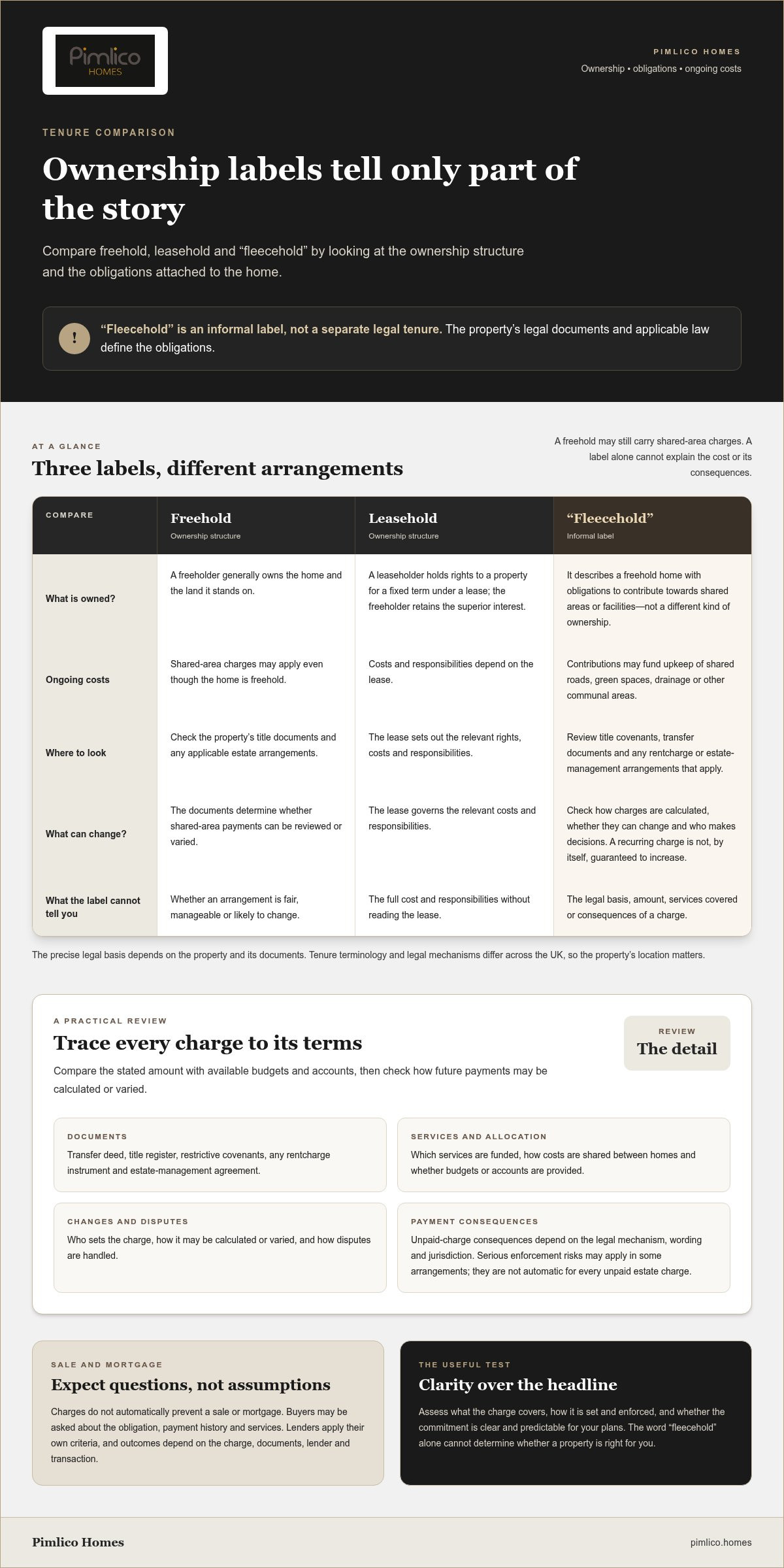
Fleecehold is a critical, informal label for a freehold home that carries obligations to contribute towards the upkeep of shared areas or facilities. It is not a distinct legal tenure, and the word itself does not create or define an obligation. The property’s legal documents and applicable law do that.
A freeholder generally owns the home and the land it stands on. A leaseholder holds rights to a property for a fixed term under a lease, with the freeholder retaining the superior interest. These labels describe different ownership structures, but neither gives a complete picture of a home’s financial obligations. A freehold property may still have shared-area charges, while leasehold costs and responsibilities depend on the lease.
How can a freehold home have ongoing estate charges?
Private roads, landscaped areas, communal lighting and shared facilities all need maintenance. Where a local authority does not maintain these features, an estate arrangement may require homeowners to contribute to their upkeep. In England and Wales, obligations may be set out in title covenants or linked to an estate rentcharge; other arrangements may also apply. The precise basis depends on the property and its documents.
The documents should explain which services are covered and how contributions are calculated or changed. They also affect how an obligation may be enforced. You cannot reliably judge a charge’s basis, amount or consequences from the “fleecehold” label alone. Tenure terminology and legal mechanisms differ across the UK, so the property’s location matters.
Why is fleecehold a contested term?
The word is used in public and campaign criticism of freehold estates where homeowners face charges but may have limited influence over the management of shared areas. Concerns often centre on transparency, control and whether costs are proportionate to the services provided. These are issues worth investigating, but they do not prove that every charge is unfair or every estate is poorly run.
For a general introduction to how the term is used, see What does fleecehold mean. Treat the label as a prompt to examine the details, not as a legal conclusion. Understanding ‘fleecehold’ and its financial risks means assessing the actual obligations, how they operate and what evidence supports concerns about a particular home.
Where can fleecehold create financial risk for a homeowner?
Financial exposure depends less on the name attached to an estate than on the terms that govern payment. An annual maintenance contribution may be predictable, or it may be subject to review, variation or additional charges. A recurring charge does not, by itself, mean that it is guaranteed to increase. The documents should explain whether it can change, how any change is calculated and who decides.
Understanding ‘fleecehold’ and its financial risks means tracing each payment to its basis and purpose. Possible liabilities include estate-management charges, service charges, estate rentcharges and contributions towards specific maintenance. These terms are not interchangeable: the legal basis and consequences depend on the arrangement and the property’s jurisdiction.
Which charges and documents deserve close attention?
Review the transfer deed, title register and any restrictive covenants, rentcharge instrument or estate-management agreement that applies. Look for the services funded, who sets the charge, how costs are allocated between homes, whether budgets or accounts are provided, and how disputes are handled. Compare the stated amount with available budgets and accounts, then check the contractual method for calculating or varying future payments. If records are unclear, it may be harder to forecast household commitments or judge whether a charge reflects the services provided.
Unpaid charges also need careful consideration. In England and Wales, the consequences can depend on the legal mechanism and wording involved; other parts of the UK have distinct legal systems. Some arrangements may carry serious enforcement risks. The UK Government has discussed financial risks for a homeowner, including the potential for homeowners to lose their homes in certain circumstances. This is not an automatic outcome for every unpaid estate charge, so the relevant documents and jurisdiction matter.
Can charges affect resale or mortgageability?
Charges can prompt questions, but they do not automatically prevent a sale or mortgage. During a sale, conveyancing enquiries may seek details of the obligation, its payment history and the services provided. A lender may also consider the terms and their effect on the property, applying its own criteria. Outcomes depend on the specific charge, documentation, lender and transaction.
For a future buyer, the headline tenure is only part of the picture. Predictability, transparency and enforceability can affect how comfortable they feel taking on the commitment. Clear records may help explain the arrangement, while uncertainty can invite further scrutiny. Reviewing tenure and ongoing obligations is one part of choosing a home for long-term ownership. See Pimlico Homes’ new homes as you consider the wider qualities that matter in a home purchase.
Fleecehold, leasehold, or freehold: what should buyers compare?
A tenure label is a starting point, not a complete account of ownership. Compare the registered estate with any covenants, payment obligations and arrangements for shared land. Two homes described as freehold can carry very different responsibilities if one has no shared facilities and the other is subject to an estate-management agreement.
| Ownership model | Structure and possible obligations | Control and documents to inspect |
|---|---|---|
| Freehold | The owner holds the property and land indefinitely. Shared-area contributions may still apply through covenants or other arrangements. | Check the title register, transfer deed, covenants and any estate-management documents. |
| Leasehold | The right to occupy the property is held for a defined term under a lease. The lease may provide for payments such as service charges or ground rent. | Review the lease, including its term, payment provisions, repair responsibilities and rules for alterations or use. |
| Commonhold | A distinct model for owning individual units alongside shared responsibility for common parts, governed through a commonhold structure. | Examine the commonhold documents and rules for the unit and shared areas. Its relevance depends on the property and jurisdiction. |
What does the tenure label tell you, and what does it leave out?
Imagine two freehold houses. One sits on a plot with no shared areas; the other is on an estate with privately maintained roads and landscaping. Their tenure label may match, but the second home could carry additional obligations. The title and related documents show the detail, including who is responsible for maintenance and how contributions are set. UK Parliament research on fleecehold explains how estate charges can affect freeholders. Understanding ‘fleecehold’ and its financial risks therefore means comparing the documents, not relying on the label alone.
How do UK jurisdiction differences affect the assessment?
Property law and terminology are not uniform across the UK. England and Wales share some legal frameworks, but Scotland and Northern Ireland have their own systems, documents and mechanisms for property ownership and shared responsibilities. Base your comparison on the law that applies where the home is located. Do not assume that a term or remedy used in one jurisdiction transfers unchanged to another.
How can you assess fleecehold risks before committing to a home?
A structured review can turn an unfamiliar tenure description into a clearer picture of ownership. Understanding ‘fleecehold’ and its financial risks means following the obligation from the documents through to the services, costs and processes that may affect you over time.
A step-by-step document review
- 1. Confirm the stated tenure. Compare the sales particulars with the legal documents. Treat marketing descriptions as a starting point, not a substitute for the registered title and contractual terms.
- 2. Identify the obligation. Review the title register, transfer deed and any relevant covenants, rentcharge instrument or estate-management agreement. Establish which owner is liable and who receives payment.
- 3. Understand how charges work. Find out how each amount is calculated, when it is reviewed and what contractual method allows it to change. Compare stated costs with available budgets and accounts, noting where figures are estimates or actual expenditure.
- 4. Match payments to services. Record which shared spaces and facilities are covered, such as roads, landscaping or lighting, and who is responsible for their maintenance. Check how costs are allocated and whether the documents explain the management company’s role and control.
- 5. Read the provisions for disputes and arrears. Note the process for raising concerns, how accounts or decisions can be questioned, and what the documents say about unpaid sums. Whether an obligation binds future owners or can be enforced depends on its legal basis and the applicable law.
Questions the paperwork should answer
Look for clear answers on who pays, who receives the money, what services are funded and how charges are set or reviewed. Check whether the documents explain what happens if services change, costs differ from the budget or a dispute arises. The exact legal interpretation can depend on the wording, property and UK jurisdiction, so address uncertainty in writing during the purchase process.
A gap in the paperwork is a reason to seek clarification, not proof of wrongdoing or evidence that charges must rise. Keep a record of explanations and compare them with the contractual documents. For broader purchase-stage considerations, read our luxury new-build buying guide.
Clear information supports a more considered decision about long-term ownership. Pimlico Homes develops luxury new-build homes, giving buyers another option to explore as they set priorities for a future home.
What should a buyer do next if a home may be fleecehold?
Take a measured view. Establish what the obligation requires, how predictable the charges are and whether the arrangement suits your plans for owning the home. The word “fleecehold” alone cannot show that a property is financially unsuitable. The documents, services and practical effect of the commitment are what matter.
When might the obligations merit closer consideration?
Give the arrangement closer attention if the charge calculation is unclear, management powers appear broad, accounts are limited or the process for resolving disputes is difficult to understand. These are questions to investigate, not proof of wrongdoing or evidence that an arrangement is unlawful. Consider what the payments cover, how much influence homeowners have over management, and whether the likely responsibilities fit your long-term budget and ownership intentions.
Make sure the conveyancing review addresses the relevant title and transfer documents, the basis for each charge, and the provisions for setting or changing payments. It should also consider how obligations may affect future owners and what the documents say about arrears or disputes. The applicable legal interpretation depends on the property’s location and circumstances, so do not assume that terminology or remedies are identical across the UK.
How does tenure fit into a wider home-buying decision?
Tenure is one part of a considered purchase. Weigh it alongside construction quality, specification, maintenance responsibilities and the home’s suitability for your plans over time. A shared-area obligation may be easier to understand when the services, costs and management arrangements are clearly set out. Uncertainty deserves clarification before you commit.
For a wider purchase-stage checklist, explore our guide to buying a luxury new-build home. It places tenure questions within the broader assessment of a new home, rather than allowing one label to define the decision.
Ultimately, understanding ‘fleecehold’ and its financial risks is about knowing what you are agreeing to and deciding whether those obligations suit the ownership experience you want. Explore Pimlico Homes’ residential developments as you consider the qualities that matter in your next home.
Make your next move with clarity
Understanding ‘fleecehold’ and its financial risks begins with looking beyond the label. A freehold home may carry shared-area obligations, but the precise commitment depends on its legal documents and arrangements. Review how charges are calculated, what services they fund and how they may change. Then consider whether the obligations are predictable and suit your ownership plans.
Tenure is one part of a considered purchase, alongside the home’s design, craftsmanship, construction quality and long-term suitability. Pimlico Homes develops luxury detached homes, executive courtyard homes, bespoke new builds and premium barn conversions. Informed decisions help you assess each part of a home’s lasting value with confidence.
Explore Pimlico Homes’ residential developments and take the next step towards finding a home that suits your plans.
Frequently Asked Questions
What does fleecehold mean when buying a house?
Fleecehold is an informal, critical term for a freehold home that may come with contractual contributions towards maintaining shared areas or facilities. It is not a separate legal tenure. A charge might relate to private roads, landscaping or communal lighting, for example. The actual obligation depends on the property’s title and related documents, so the label alone cannot tell you what you must pay or how the arrangement works.
Is fleecehold the same as leasehold?
No. Leasehold and freehold describe different legal ownership structures, while “fleecehold” is an informal label sometimes applied to freehold homes with estate-management obligations. A leaseholder holds a right to occupy a property for a defined term under a lease. A freeholder owns the property and land, but may still have to contribute to shared-area maintenance under the relevant documents. Compare the legal structure and obligations rather than relying on the label.
Can a freehold house have estate management charges?
Yes. A freehold owner may be required to contribute to the upkeep of shared roads, landscaped spaces, lighting or other facilities. The obligation may arise through covenants, an estate rentcharge or another arrangement, depending on the property and jurisdiction. Check the title and transfer documents to identify who is liable, what services are covered, how the amount is calculated and what provisions apply if the charge is disputed or unpaid.
Can fleecehold charges increase over time?
They can change if the relevant documents allow charges to be reviewed, varied or adjusted to reflect costs. However, a recurring charge does not automatically mean a guaranteed increase. Examine the method for setting and changing it, the services included, and any available budgets or accounts. This helps distinguish a documented review process from uncertainty about future payments and gives you a clearer basis for assessing affordability over the longer term.
What happens if a homeowner does not pay an estate charge?
The consequences depend on the legal basis of the charge, the documents and the jurisdiction. Some arrangements may provide enforcement mechanisms, and the potential consequences can be serious; they are not identical for every estate charge. Do not assume that non-payment has no effect or that a particular outcome is automatic. Review the terms covering arrears and dispute procedures, and ensure the property’s conveyancing review considers their legal meaning.
Can fleecehold affect selling a home or getting a mortgage?
It may prompt additional questions during a sale or lender assessment, particularly if the charge, management arrangements or supporting records are unclear. It does not automatically prevent a sale or mortgage. Buyers may want to understand payment history, services and how future charges are set; lenders apply their own criteria to the property and circumstances. Clear documentation can help explain the obligation, while uncertainty may lead to further scrutiny.
Does fleecehold mean a property is a bad investment?
No. The term alone cannot establish whether a property is financially unsuitable or a poor investment. Understanding ‘fleecehold’ and its financial risks means assessing the actual obligations: what charges fund, how predictable they are, how management works and what the documents say about changes or disputes. Consider these factors alongside the home’s condition, quality and suitability for your plans. A clear, manageable arrangement may differ substantially from one that is difficult to assess.
Do fleecehold rules differ across England, Wales, Scotland, and Northern Ireland?
Yes. Property law, terminology and the mechanisms used for ownership and shared-area obligations can vary across the UK. England and Wales share some legal frameworks, but rules should not be assumed to apply identically in every context. Scotland and Northern Ireland have distinct legal systems and may use different documents or mechanisms. Assess the home under the law that applies where it is located, rather than relying on guidance written for another jurisdiction.





