
Could a certificate that appears to confirm a home’s construction leave you without the protection you expected? For buyers of new-build homes, understanding professional consultant certificates means looking beyond the title. A Professional Consultant’s Certificate (PCC) can evidence that a qualified professional monitored the work, but it is not the same as a structural warranty or a guarantee against every defect.
It is natural to want clear assurance before making a significant purchase. The detail matters: what the professional was responsible for, which work the certificate covers, how long liability lasts and whether your mortgage lender will accept its format and issuer. A standard PCC has a six-year liability period, but lender requirements can differ, so do not assume it will be accepted.
This guide explains the purpose of a PCC in plain English, where its protection begins and ends, and which details deserve careful attention. It also places the document alongside warranty information, legal advice and the wider due diligence involved in buying a new-build home. Clear expectations matter throughout the process, from reservation through to handover.
Key Takeaways
- Understanding professional consultant certificates means reading the document’s stated scope, not assuming it covers every aspect of a property.
- Check that the certificate identifies the correct home and work, and note the signatory and issue date.
- Compare a PCC with any structural warranty provided. They serve different purposes and should not be treated as interchangeable.
- Check the certificate’s format and professional details against your lender’s requirements before relying on it as mortgage evidence.
- Consider the PCC alongside conveyancing and wider new-build due diligence for a clearer view of the purchase.
What is a Professional Consultant’s Certificate, and what does it confirm?
A Professional Consultant’s Certificate (PCC) is a document in which a suitably qualified construction professional makes statements about their role in the design or monitoring of a property’s construction. For a buyer, it can provide evidence of professional oversight. For a lender or conveyancer, it offers information to consider as part of the purchase. It does not, by itself, oblige a lender to approve a mortgage.
The certificate’s significance lies in its wording. It may describe site visits, the work the professional observed and whether that work appeared consistent with approved drawings or building-contract instructions. The applicable form sets out the commitments made. Read those terms rather than relying on the title or a verbal description: a certificate relating to monitored work is not a promise that defects will never arise.
This distinction is central to understanding professional consultant certificates. The general idea of professional certification is that a professional’s credentials or statements provide evidence within a defined framework. A PCC is more specific. Its value depends on the signatory’s identity and role, the work covered and the terms set out in the document.
What information does a PCC give a lender?
A PCC can describe the consultant’s stated involvement during construction, including the nature of visits or monitoring undertaken. It may address whether the work observed followed approved drawings and relevant building-contract instructions. These statements help a lender and conveyancer understand what professional oversight is being represented. They are not an independent guarantee of the property’s condition.
Look for the precise scope. A statement about work seen during site visits should not be read as confirmation that every element was inspected at every stage. The certificate also does not settle the mortgage decision: lenders assess documents against their own current requirements, which can vary. Treat it as evidence for consideration, not a substitute for lender assessment or conveyancing.
Is a PCC the same as an architect’s certificate?
“Architect’s certificate” is familiar historical terminology for what is now commonly called a Professional Consultant’s Certificate. The older name may still appear in conversation or paperwork, but the current document’s wording and form are what matter. The label alone does not establish what has been certified, who accepts responsibility or whether a particular lender will accept it.
Do not assume that every architect can issue every certificate. The relevant form and lender criteria set conditions for the professional and the certificate. Check the named signatory, their stated professional capacity and the commitments made in the document. This turns a broad assurance into evidence you can consider in context before relying on it in a significant new-build purchase.
What does a Professional Consultant’s Certificate cover, and where are its limits?
A PCC is only as informative as the scope it records. To understand what it offers, separate the consultant’s stated responsibilities from assumptions you might attach to the document. The certificate may describe monitoring during construction and whether work observed appeared consistent with identified drawings or instructions. It does not establish that every part of the property was inspected or that future defects are impossible.
Read the form as a record of defined professional involvement, not as a broad promise about the finished home. For example, a consultant’s recorded visit at a particular stage does not, by itself, show that every concealed component was examined individually. The document’s wording should clarify what the professional undertook to do and the limits of that undertaking.
What construction monitoring does the certificate describe?
Construction monitoring generally involves visits at relevant stages rather than continuous supervision of every task. The certificate may refer to observations made during those visits and to the approved drawings or building-contract instructions used to assess the work. Read its statements in that context: a site visit can provide evidence of oversight without representing a complete inspection of all work, including elements later concealed.
- Identify the reference documents. Note which drawings, specifications or contract instructions are named.
- Read the monitoring language closely. Distinguish work the consultant says they observed from work outside the stated scope.
- Consider the timing. Check whether the described visits relate to the stages relevant to the work covered.
This is where understanding professional consultant certificates becomes practical. A statement that observed work was consistent with specified drawings is narrower than confirmation that every detail of the completed property meets every possible standard.
What is outside the certificate’s assurance?
A PCC does not mean defects cannot arise, nor does it automatically provide a comprehensive repair or insurance promise. Its professional liability is tied to the duties and terms set out in the certificate. If a problem appears, the document does not itself establish that the consultant is liable. The wording and circumstances matter.
Professional indemnity insurance is also relevant, since the applicable certificate requirements may address the professional’s cover. That insurance should not be interpreted as a direct compensation guarantee to the buyer. Its presence, scope and duration are governed by the policy and certificate terms, not by an assurance that every defect will be remedied.
Liability wording and time periods can depend on the form used. Do not rely on a duration quoted elsewhere without comparing it with the current certificate and applicable requirements. If a phrase is unclear, ask your conveyancer to explain its legal effect before relying on it.
Careful paperwork review belongs alongside careful consideration of the home itself. Pimlico Homes’ focus on craftsmanship and timeless design informs its luxury new-build homes, while the terms of any certificate should be understood from the document itself.
PCC versus structural warranty: understand the difference before relying on either
A Professional Consultant’s Certificate and a structural warranty can both be relevant to a lender’s assessment of a new-build property, but they are not interchangeable forms of protection. A PCC records a consultant’s professional involvement and the responsibilities set out in its wording. A structural warranty is a separate arrangement, with cover determined by its own terms. Treating a PCC as simply a shorter or lower-cost warranty risks misunderstanding the purpose of each document.
Compare the documents themselves, including their stated scope, exclusions, duration and the parties responsible. The labels alone do not tell you what you can rely on as a homebuyer.
| Point of comparison | Professional Consultant’s Certificate | Structural warranty |
|---|---|---|
| Purpose | Records professional statements about design or construction monitoring, as set out in the certificate. | Provides cover under a separate warranty arrangement, subject to its policy terms. |
| Professional involvement | Centres on a consultant’s stated role and responsibilities in relation to the work. | May involve inspections or requirements specified by the warranty provider, but these are not the same as the consultant’s PCC obligations. |
| Stated scope | Liability is connected to the certificate’s wording and the professional’s responsibilities. | Cover, exclusions and claims processes depend on the particular warranty documents. |
| Lender consideration | May be considered as evidence, subject to the lender’s requirements. | May also be considered, subject to the lender’s requirements and the scheme’s terms. |
How does a PCC differ from a structural warranty?
The distinction is one of responsibility and remedy. A PCC concerns the professional’s certification and monitoring role. A claim relating to it may require consideration of whether the professional’s stated obligations were met. A structural warranty is a separate cover arrangement and may address specified defects under its terms. Do not assume either document covers every defect or that their protections match. Read each document’s scope and exclusions side by side.
Understanding professional consultant certificates means recognising that a PCC is not simply a warranty with a different name or duration. The certificate’s liability provisions and the warranty’s cover operate under their respective terms. Judge neither by a headline description alone.
Will every mortgage lender accept a PCC?
Do not assume there is a single acceptance rule. Lenders set their own requirements, which may concern the certificate form, the professional who issued it and the property. A document that appears suitable in general may not meet a particular lender’s criteria.
Your conveyancer can assess the relevant lender handbook and the certificate in the context of the transaction. This is especially important before relying on the document as mortgage evidence. Consider the certificate alongside the property and the lender’s requirements, with legal advice where needed. This comparison supports a more informed new-build decision without mistaking lender evidence for a guarantee of protection.
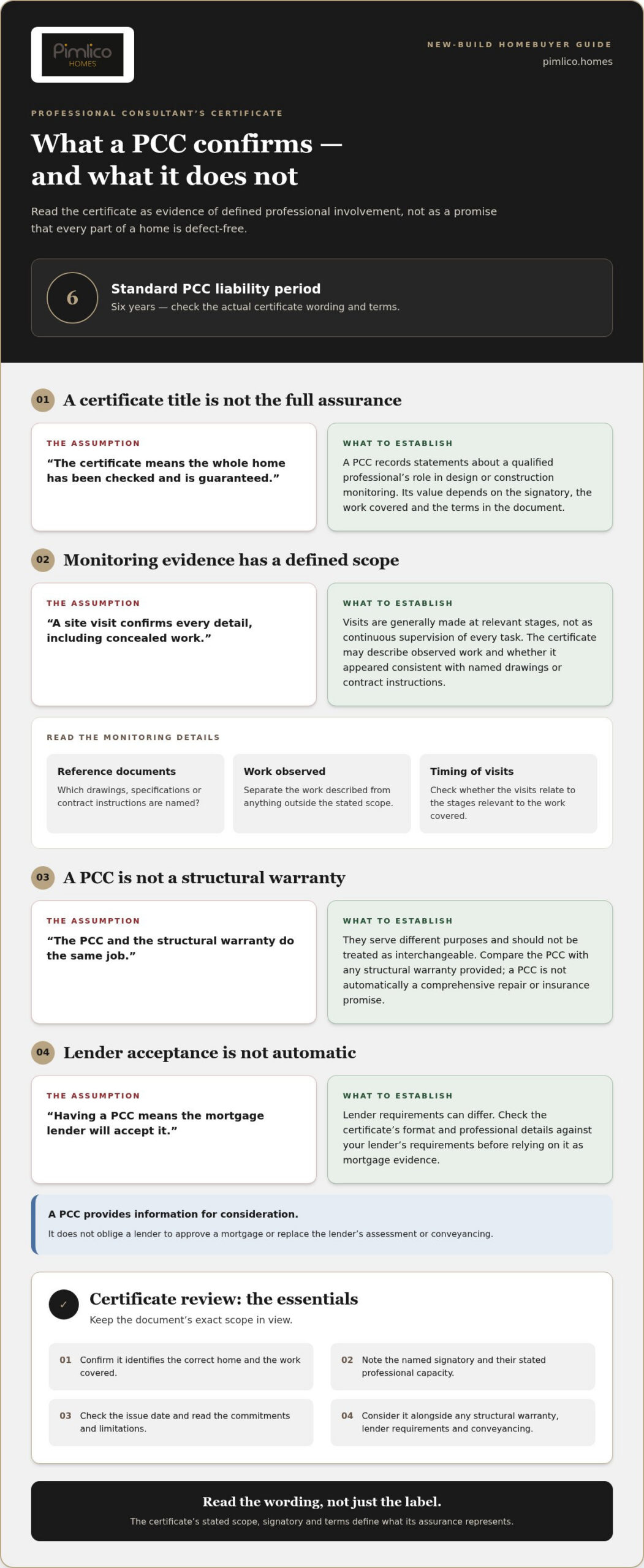
How to review a PCC: a practical checklist for homebuyers
A certificate deserves an ordered review. First establish exactly what document you have, then check that its statements relate to the home and work included in your purchase. This sequence can help you spot gaps early and give your conveyancer clear points to assess. It supports understanding professional consultant certificates without requiring you to interpret the document as a legal expert.
- Identify the document and form. Check that it is a Professional Consultant’s Certificate and note the form or template used. If it has been amended or refers to another document, make a note for your conveyancer.
- Match the property details. Compare the address and property description with the home you are buying. For a conversion or a property with more than one element, check whether the certificate identifies the relevant building and work.
- Check the signatory and role. Record who signed, their stated professional capacity and the responsibilities they accept in the certificate. The professional’s qualifications and status should meet the criteria of the applicable form and the lender’s requirements.
- Read the scope and statements. Identify the work covered, the monitoring described and any statements about conformity with drawings or instructions. Note conditions, exclusions and anything the certificate expressly leaves outside its scope.
- Check the date and supporting material. Confirm the certificate is dated and signed. Look for referenced schedules, drawings or appendices, and flag missing pages or documents rather than assuming they are unnecessary.
- Ask your conveyancer to compare requirements. Consider the certificate against your lender’s current requirements, including the relevant UK Finance Mortgage Lenders’ Handbook guidance. Do not assume that a document accepted for another transaction will satisfy yours.
Which details should buyers examine first?
Start with the essentials: property identification, certificate date, signature and the consultant’s stated role. Then read the monitoring and conformity statements alongside any conditions or exclusions. A reference to a schedule or drawing matters. If it is absent, incomplete or difficult to identify, ask your conveyancer to review the gap before relying on the certificate.
Why do form, jurisdiction and timing matter?
UK Finance guidance and certificate material can vary by jurisdiction. Check the applicable current form and handbook rather than relying on older articles, especially for wording and liability periods. Do not assume that dates are calculated from completion or issue without checking the document and relevant guidance. Your conveyancer can assess the certificate in the context of the transaction.
Clear paperwork is one part of a considered new-build purchase. To explore homes shaped around craftsmanship and thoughtful design, view luxury new-build homes.
Professional Consultant’s Certificates in a considered new-build purchase
A PCC is one document in a wider purchase, not a substitute for conveyancing or for examining the home and its accompanying paperwork. It can clarify what a consultant says they did and provide evidence for a lender to assess. Its meaning depends on the certificate’s actual scope, the property and the lender’s requirements. Bring these details together rather than asking one document to carry more weight than it can bear.
How does certificate review fit into buying a new-build home?
Discuss the certificate with your conveyancer as part of the legal process, and keep its purpose distinct from other enquiries. Reviewing a PCC does not replace understanding the property specification, considering snagging arrangements or examining warranty information. Each addresses a different aspect of the purchase. For a broader view of the process, see The Ultimate Guide to Buying a Luxury New Build Home in 2026.
Clear documentation helps you understand what professional oversight is recorded, which work is included and whether the paperwork meets the lender’s current criteria. It can also help your conveyancer identify questions to resolve before you rely on the certificate. The document should sit alongside, not in place of, the other checks relevant to your transaction.
What should buyers take away from the document?
Keep three questions in view as you review it: what role does the consultant say they performed, what property and work does the certificate cover, and how does it relate to your lender’s requirements? Read the wording itself, including its conditions and referenced documents. A familiar title or general description cannot establish the certificate’s precise scope or acceptance for your particular purchase.
This is the practical value of understanding professional consultant certificates. They provide evidence to interpret, not an automatic decision about lending or a blanket promise about the home. Your conveyancer can place the document in the context of the transaction and explain any points that need further attention.
Buying a new-build home is also a personal decision about design, quality and the experience of moving into a carefully considered space. Pimlico Homes’ customer pledge describes service from reservation through handover of keys, with craftsmanship, innovation and timeless design at its heart. Consider Pimlico Homes’ approach to new-build living as you decide what matters in a home.
Make your next move with confidence
A home purchase is more than a collection of documents. It is the beginning of a new chapter, and clarity around the details can help you approach that decision with greater confidence. Understanding professional consultant certificates is one part of choosing thoughtfully, alongside the qualities that make a home feel enduring, considered and distinctly yours.
Pimlico Homes’ customer pledge extends from reservation through handover of keys, reflecting a commitment to craftsmanship, innovation and timeless design. These principles shape an approach to new-build living in which the experience matters as much as the finished home.
Take the next step at your own pace. Explore considered new-build living with Pimlico Homes and discover homes created with care for the way you want to live. A well-considered decision can be the start of something lasting.
Frequently Asked Questions
How long does a Professional Consultant’s Certificate last?
There is no single period to assume for every PCC. UK Finance material links the liability period to the certificate date, whilst some online explanations refer to completion. Before relying on a stated end date, compare the signed certificate with the current form and the requirements applying to the transaction. Ask your conveyancer to identify the relevant start date, end date and wording rather than applying a general summary.
Can a Professional Consultant’s Certificate be issued retrospectively?
It may be difficult to obtain a retrospective certificate if the consultant did not oversee the relevant design or construction work. A later visit cannot necessarily establish what was observed at earlier stages, particularly where elements have since been concealed. Whether a certificate can be issued depends on the circumstances, the professional’s role and the applicable form. If one is presented, have your conveyancer examine how it was prepared and whether the lender will consider it.
Does a Professional Consultant’s Certificate cover defects in a new-build home?
A PCC is not a blanket promise that a new-build home is defect-free or that every repair will be covered. Its effect depends on the consultant’s responsibilities and the certificate’s terms. A defect appearing after handover does not, by itself, show that the certificate provides a remedy. Review any structural warranty separately, including its own cover and exclusions, so you understand which document may be relevant to a particular issue.
Who is eligible to sign a Professional Consultant’s Certificate?
The signatory must meet the requirements of the applicable certificate form. UK Finance guidance refers to relevant professional-body membership, experience in residential design or construction monitoring, and appropriate professional indemnity insurance. These details should not be inferred from a job title alone. Compare the named consultant’s credentials and stated role with the current form and the lender’s applicable guidance. Criteria can vary by jurisdiction and document version.
Is a Professional Consultant’s Certificate the same as an architect’s certificate?
The PCC was formerly commonly called an architect’s certificate, so both terms remain in property discussions. The current document’s title does not establish that an architect signed it or define the professional’s responsibilities. For instance, older correspondence may use the historic phrase while the certificate provided is a different form. Focus on the document itself, the signatory’s eligibility and the commitments expressed in its wording.
Can a buyer rely on a PCC without checking with the mortgage lender?
No. A PCC’s presence does not establish that it meets the criteria for your mortgage transaction. Lenders may differ in their requirements, and the property, signatory and document wording can all be relevant. Understanding professional consultant certificates includes recognising that general statements about acceptance cannot settle an individual case. Have your conveyancer compare the document with the lender’s current guidance and raise any mismatch before treating it as acceptable evidence.
What happens if the consultant’s professional indemnity insurance changes?
An insurance change does not, by itself, establish whether a buyer’s rights continue or end. The answer depends on the certificate’s wording, applicable requirements and the circumstances of the change. For example, a change after issue may raise questions about the cover maintained during the relevant period. Ask your conveyancer to interpret the certificate and any available insurance information for the transaction. Do not assume a policy change automatically cancels or preserves a claim.





