
The true value of a luxury estate isn’t found solely within its architectural merit, but in the meticulous preservation of the environment that surrounds it. For many discerning homeowners, the transition from a grand vision to daily life involves a complex layer of management that can feel unnecessarily opaque. You’ve likely felt a sense of unease when faced with escalating costs or unclear fee structures that seem to cloud the joy of your investment. We recognise that understanding service charges on new developments is often the final hurdle in securing total peace of mind for your future.
This executive guide provides the clarity you require to ensure your estate remains a pristine sanctuary of excellence. We’ll demystify the breakdown of estate management fees and explain how the Leasehold and Freehold Reform Act 2024 protects your interests. You’ll discover how a curated approach to communal maintenance preserves long term prestige, transforming a standard obligation into a strategic asset. By the end, you’ll have the confidence to ensure your home remains a source of refined pride for decades to come.
Key Takeaways
- Master the complexities of understanding service charges on new developments to ensure your investment maintains its visual prestige and long-term value.
- Discover how these contributions fund the meticulous upkeep of communal aesthetics and sophisticated drainage systems that protect your property’s longevity.
- Learn how the Leasehold and Freehold Reform Act 2024 empowers you to challenge costs and demand transparency within estate management structures.
- Identify the critical questions to ask before exchange; such as requesting a full breakdown of the Management Pack to check for annual inflation caps.
- Explore why a developer’s selection of management partners is as essential as the craftsmanship of the home itself in preserving an executive environment.
The Architecture of Estate Management: Defining Service Charges
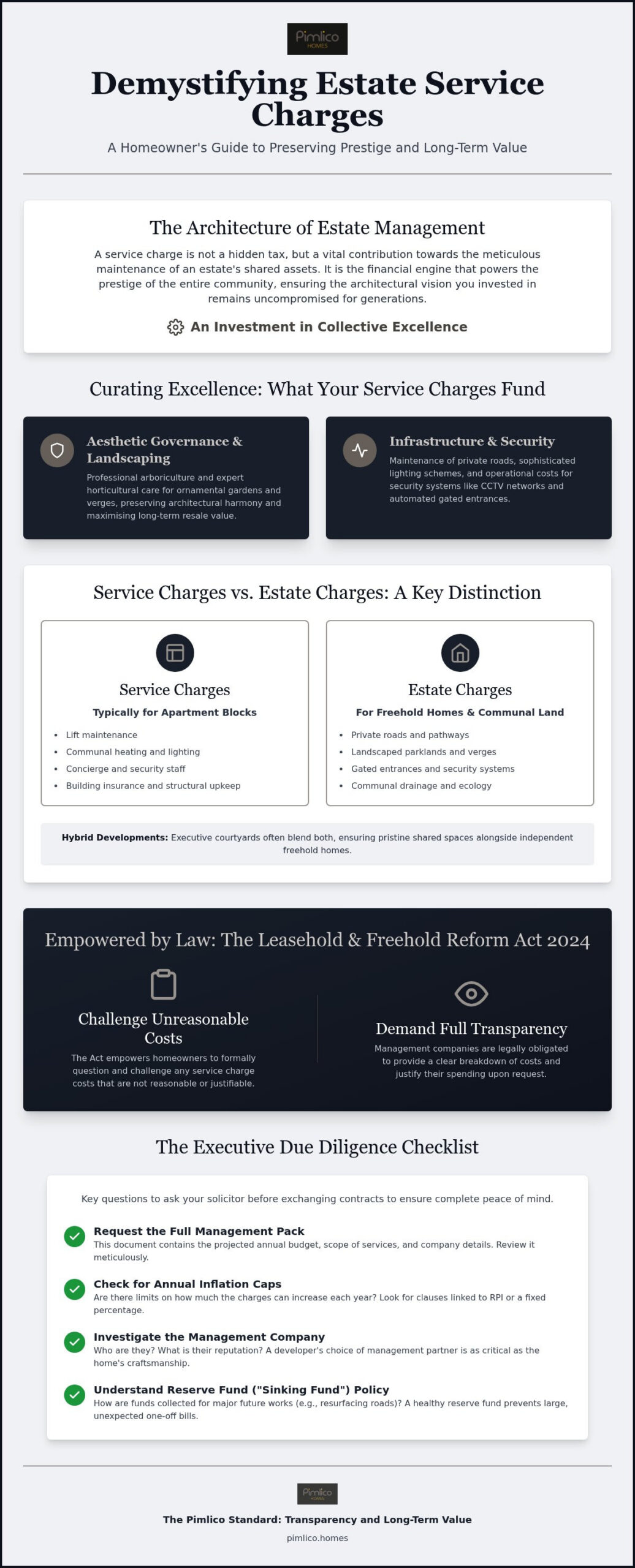
A luxury home is a statement of intent. It’s a commitment to a specific standard of living that extends far beyond the front door. Central to this standard is the communal infrastructure that frames your residence. A service charge isn’t a hidden tax; it’s a vital contribution towards the meticulous maintenance of the estate’s shared assets. In the context of understanding service charges on new developments, we must view these fees as the financial engine that powers the prestige of the entire enclave.
For a high-end development, shared spaces must mirror the artistry of the homes themselves. This includes everything from manicured entrance gates and private access roads to sophisticated lighting schemes and landscaped parklands. Without these contributions, the collective value of the estate would inevitably erode. It’s the difference between a standard housing estate and a curated private community where every detail is guarded with care.
The Evolution of Private Estate Maintenance
Historically, local councils adopted roads and green spaces. Today, the shift towards private management ensures a significantly higher aesthetic standard than a local authority could ever provide. This transition is often driven by Section 106 agreements, which designate these areas as privately managed luxury enclaves to maintain exclusivity. An Estate Rentcharge is the legal mechanism used to secure these maintenance contributions on freehold properties. By understanding rentcharges, buyers can see how legal frameworks are utilised to preserve the long term integrity of their environment. It’s a structure that ensures every homeowner contributes to the sanctuary they inhabit.
Service Charges vs. Estate Charges: A Subtle Distinction
Precision in terminology is essential for the discerning buyer. Service charges usually apply to the shared structural elements of apartment blocks, covering items like lift maintenance, communal heating, or concierge services. In contrast, estate charges focus on the “curtilage”, which refers to the land, private roads, and ecological infrastructure surrounding detached residences.
Executive courtyard developments often require a hybrid approach. They blend the intimacy of shared courtyard spaces with the independence of detached living, creating a unique management profile. This structure ensures that whilst you own your freehold, the shared courtyard remains a pristine extension of your private driveway. Understanding service charges on new developments means appreciating how these funds protect both your individual property and the broader estate’s visual character. It provides the security that the architectural vision you invested in will remain uncompromised for generations.
Curating Excellence: What Your Service Charges Actually Fund
Stewardship and preservation. A luxury development is a living tapestry that requires constant, invisible effort to maintain the vibrancy of its original design. When understanding service charges on new developments, it’s helpful to view these funds as the professional guardianship of your property’s exterior soul. These contributions don’t just “cut the grass”; they finance a level of aesthetic governance that ensures your environment remains as striking in twenty years as it is today.
Landscaping and Aesthetic Governance
Artistry in the environment. The visual harmony of an executive courtyard or a bespoke detached estate depends on professional arboriculture and expert horticultural care. Service charges fund the curation of ornamental communal gardens and the precise maintenance of verges that frame your residence. This isn’t mere gardening. It’s the preservation of architectural harmony, ensuring that every shared space reflects the same artisanal quality as the luxury new build homes we create. By investing in elite landscaping, the estate maintains a consistent “first impression” that directly supports long-term resale value.
Infrastructure and Security Systems
Security and resilience. Beyond the greenery lies a complex network of infrastructure that demands technical expertise and regular investment. Your contributions fund the operational costs of sophisticated security measures, such as CCTV networks and automated gated entrance mechanisms. These systems provide the quiet security that defines an exclusive community. Additionally, funds are allocated to the maintenance of premium block-paved thoroughfares and unadopted private roads, which are often built to higher specifications than standard public highways.
- Sustainable Drainage Systems (SuDS): These are sophisticated ecological systems that manage rainwater naturally, protecting the land and ensuring property longevity.
- Communal Utilities: This covers the power for designer external lighting schemes and the operation of shared pumping stations.
- Security Maintenance: Regular servicing of electronic gates and private security patrols ensures the boundary of your sanctuary remains uncompromised.
Foresight and permanence. Perhaps the most critical element of the charge is the Reserve Fund, often called a Sinking Fund. This is a strategic savings account for major long-term renewals, such as resurfacing a private road or replacing shared infrastructure. By accumulating these funds over time, the management company avoids sudden, significant levies on homeowners. It’s a methodical approach to financial planning that mirrors the careful process of high-end construction, ensuring the estate’s prestige remains unchallenged by the passage of time.
Freehold vs. Leasehold: Navigating Your Rights and Responsibilities
Ownership of a luxury detached residence is often considered the pinnacle of the property market. It’s typically a freehold tenure, granting the owner absolute rights over the land and the structure itself. However, the modern luxury landscape requires a nuanced approach to understanding service charges on new developments. Even when you own the bricks and mortar entirely, you remain part of a wider ecosystem. This communal connection ensures that your home doesn’t exist in isolation, but as part of a protected, high-end enclave.
The legal landscape is currently undergoing its most significant transformation in decades. The Leasehold and Freehold Reform Act 2024 has fundamentally shifted the power dynamic in favour of the homeowner. By 2026, many provisions will be fully implemented, granting freeholders on managed estates significantly more transparency and power. Historically, leaseholders in luxury apartments had clearer paths to challenge unreasonable costs. The law now provides legal parity, ensuring that every homeowner has the right to demand a clear accounting of how their funds are utilised.
The Rise of the “Right to Manage” for Freeholders
The 2026 legislative landscape empowers freeholders to exercise a “Right to Manage” in a way that was previously reserved for leaseholders. This means that if a management company fails to meet the exacting standards required for a premium estate, the residents can collectively take control. It’s a vital safeguard. It allows a community to replace an underperforming agent whilst maintaining the estate’s artisanal standards. This shift ensures that management remains a dedicated service to the residents, not an opaque burden upon them.
The “Fleecehold” Myth vs. Premium Management Reality
You may have encountered the term “fleecehold” in broader property discussions or online forums. Whilst this narrative highlights genuine issues in the mass market, it rarely reflects the reality of bespoke luxury. In a premium enclave, professional management is a deliberate, strategic choice. It’s a safeguard for your property’s resale value. Predatory fees are distinct from value-aligned maintenance costs. Discerning buyers recognise that a transparent annual contribution is a modest price to pay for the permanent protection of their investment’s prestige. Understanding service charges on new developments involves distinguishing between a lack of transparency and the necessary investment required to sustain an elite standard of living.
The Executive Due Diligence: Questions to Ask Before Exchange
Forensic precision. The transition from admirer to owner of a luxury residence requires more than just an appreciation for fine masonry. It demands a rigorous interrogation of the Management Pack during the conveyancing process. This document serves as the financial blueprint for the estate’s future. It’s the primary tool for understanding service charges on new developments. You shouldn’t simply glance at the estimated annual cost; you must dissect the components to ensure the estate’s long-term viability matches its visual allure.
Reputation is everything. Investigating the track record of the appointed management firm is a non-negotiable step. A developer focused on longevity selects management partners with the same meticulous care used in the initial construction. You should confirm the specifics of the handover process. Understanding when and how control passes from the developer to a residents’ management company provides a clear timeline for your future involvement. Crucially, check the increase structure. Look for caps on annual inflation to ensure that the cost of maintaining excellence remains predictable and fair.
Financial Transparency and the Sinking Fund
Financial resilience is built on foresight. For an executive courtyard or a gated enclave, the reserve fund must be scaled appropriately to the complexity of the infrastructure. You should ask if the fund is already being built from day one. It’s also vital to distinguish between the “Management Fee”, which is the agent’s overhead, and the actual cost of physical services. Watch for “hidden” permission fees. Some management structures require homeowners to pay for the right to make future alterations, even for minor architectural changes. Identifying these early protects your freedom to evolve your home as you see fit.
Governance and Resident Control
Direct involvement is the ultimate safeguard of quality. You should ascertain whether the management structure allows residents to hold seats on the board. This ensures that those with the deepest emotional and financial investment in the estate have a say in its governance. A clear Service Level Agreement (SLA) should be in place, defining the exact standards for everything from security response times to the precision of communal landscaping. To ensure your purchase is as secure as it is sophisticated, consult our buying a luxury new build guide for further due diligence. Transparency is the bedrock of our philosophy; explore our luxury new build homes to see how we prioritise clarity at every stage of the journey.
The Pimlico Standard: Transparency and Long-Term Value
A residence of distinction requires a guardian of equal calibre. At Pimlico Homes, we’ve spent 25 years refining our approach to high-end construction; however, we recognise that our responsibility doesn’t end when the keys are handed over. We view the estate as a living extension of the home itself. Our philosophy is rooted in the belief that a luxury property is only as good as the estate that surrounds it. This is why understanding service charges on new developments is central to our transparent purchasing process. We provide comprehensive, upfront documentation to ensure you move forward with absolute confidence in your investment’s future.
Selecting the right management partner is a task we approach with the same meticulous care as choosing our masonry or timber. We look for organisations that understand the nuance of executive living. They must appreciate the subtle difference between standard maintenance and the curation of an elite environment. This artisanal approach ensures that the bespoke character of our luxury barn conversions and detached estates is never diluted by generic service standards. Whether it’s one of our executive courtyard homes or a collection of luxury detached residences, the management must be proactive. This ensures the architectural vision remains unblemished by time.
A Legacy of Excellence
Our visionary approach includes a sustainable management plan designed for longevity. Meticulously maintained communal areas aren’t just for show; they’re a primary driver of property appreciation. By prioritising clarity in understanding service charges on new developments, we protect the emotional and financial weight of your investment. We understand that you aren’t just buying a house. You’re securing a legacy. We remain a reliable guardian of quality long after the final brick is laid, ensuring the sanctuary you’ve purchased today remains an exclusive retreat for decades.
Discovering Your Next Investment
We invite you to explore our current portfolio of bespoke luxury homes and barn conversions. Each residential layout is designed to prioritise privacy and prestige, creating a sense of scale and depth that’s truly unique. Our developments are more than just houses; they’re curated communities built on a foundation of innovative thinking and traditional values. We’re here to guide you through every intimate detail of the process, ensuring your journey is as refined as the home you choose. Explore the vision of Pimlico Homes and discover how we’re redefining the standard of luxury living.
Securing Your Legacy of Excellence
True luxury is found in the enduring quality of your surroundings. By mastering the nuances of understanding service charges on new developments, you’ve taken a vital step in protecting the long-term stature of your investment. You now recognise that these contributions aren’t a burden, but a sophisticated mechanism for preserving the artisanal standards and security of your private enclave. With the legislative protections of the 2024 Reform Act, you possess the clarity and control needed to ensure your estate remains a pristine sanctuary.
At Pimlico Homes, we bring over 25 years of luxury development expertise to every project. As specialists in bespoke detached and courtyard homes, our unwavering focus on high-specification craftsmanship extends to the management partners we select. We’re dedicated to ensuring that the vision you buy into today thrives for generations. It’s time to move beyond the technicalities and begin the journey toward your next residence. We invite you to view our exclusive portfolio of luxury new build homes and experience the Pimlico standard for yourself. Your vision of a perfect, protected home is within reach.
Frequently Asked Questions
Are service charges on new build homes legally capped?
No statutory limit exists for the total amount; however, all costs must be “reasonably incurred” to be legally enforceable. The Leasehold and Freehold Reform Act 2024 strengthens your ability to challenge unreasonable fees at a First-tier Tribunal. Professional developers often include inflation caps within the original management agreement. This provides a layer of financial predictability. It’s a vital part of understanding service charges on new developments before you commit to a purchase.
Can I refuse to pay a service charge if I am unhappy with the maintenance?
You shouldn’t simply stop payments, as this often constitutes a breach of your property’s deed or transfer document. Such actions can lead to legal proceedings or difficulties when you eventually choose to sell. The recommended approach is to pay “under protest” whilst simultaneously raising a formal dispute. You can then seek mediation or a tribunal ruling to address specific failures in maintenance standards or transparency.
What happens to the service charge when the council adopts the roads?
If a local authority adopts the roads, the portion of your estate charge dedicated to their maintenance will cease. In high-end developments, however, roads are frequently left “unadopted” by design. This choice allows the management company to maintain a superior aesthetic standard, such as premium block paving or bespoke lighting, which councils typically won’t support. It ensures the estate’s exclusive character remains entirely uncompromised by public budget constraints.
How much do service charges typically increase each year on luxury estates?
Increases are typically aligned with the Consumer Price Index (CPI) or a specific percentage cap defined in your initial contract. Whilst costs fluctuate based on energy prices or labour rates for landscaping, a well-managed estate should avoid sudden spikes. Transparency is key here. Your management agent should provide an annual budget forecast. This allows you to plan with the same methodical precision used in your other significant financial investments.
Is a sinking fund different from a standard service charge?
Yes, they serve distinct financial purposes. The standard service charge covers recurring annual costs like gardening, insurance, and minor repairs. In contrast, a sinking fund is a long-term savings account for major infrastructure renewals, such as resurfacing private thoroughfares. This separation is a hallmark of understanding service charges on new developments. It ensures that the estate’s prestige is protected without requiring sudden, large levies from homeowners.
Do I need to pay service charges on a freehold luxury detached home?
Yes, most modern luxury detached homes carry a requirement for communal contributions. These are usually secured through a legal mechanism known as an Estate Rentcharge or a positive covenant. These funds ensure that the shared entrance gates, private roads, and ecological systems that define your community are kept in peak condition. It’s a collective investment in the sanctuary that surrounds your individual freehold title, preserving the enclave’s overall allure.
Can residents choose their own management company on a new development?
Residents can indeed take control through the Right to Manage process. Legislation implemented in 2026 has made it significantly easier for freeholders on managed estates to replace underperforming agents. By forming a Resident Management Company, you and your neighbours can select a partner that mirrors your own standards for excellence. This ensures the guardianship of the estate remains in the hands of those most invested in its long-term beauty.
How do service charges affect the resale value of my luxury property?
A professionally managed estate significantly enhances resale value by ensuring a flawless “first impression” for future buyers. Well-maintained communal gardens and secure, gated entrances signal a level of care and exclusivity that commands a premium. Conversely, opaque or poorly managed fees can deter discerning purchasers. High-specification management is an asset. It acts as a permanent guarantee that the architectural vision of the development will never be allowed to fade.


