
A developer’s draft contract is rarely an equitable celebration of your new home; it is a commercial instrument drafted to insulate the builder. When acquiring an executive residence off-plan, understanding the draft contract from a developer is your single most critical safeguard before committing capital. It’s entirely natural to feel uneasy when dense legal jargon obscures builder obligations, particularly when fluid completion schedules risk mortgage expiry and vague architectural specifications leave luxury finishes vulnerable to unilateral substitution.
You deserve absolute certainty over the craftsmanship, standards, and timelines of your future residence. This guide demystifies the entire contract pack, deciphering critical covenants, from long-stop rescission dates to statutory deposit protections, so you can challenge unbalanced terms and protect your investment before formal exchange. Ahead, you’ll discover the essential clauses every discerning purchaser must scrutinise, ensuring a smooth transition from initial legal review to completion.
Key Takeaways
- Scrutinise every legal boundary, warranty covenant, and architectural plan inside the legal pack to ensure total clarity before committing funds.
- Differentiate target delivery dates from formal completion notices to maintain absolute control over mortgage deadlines and avoid sudden completion default.
- Gain the leverage needed to negotiate standard developer-favoured terms, ensuring buyer capital remains safeguarded under equitable stakeholder holding terms.
- Master the art of understanding the draft contract from a developer to protect bespoke architectural finishes against unilateral builder substitutions.
- Establish rigorous pre-completion inspection protocols and defect rectification periods so your executive residence meets the highest standards of craftsmanship.
What Is in the Developer’s Draft Contract Pack?
A developer’s draft contract pack represents the formal legal proposal for property ownership transfer. While traditional conveyancing involves static properties with documented histories, an off-plan transaction concerns a residence yet to reach practical completion. The legal documents establish the architectural vision, boundary extents, and structural warranties that govern your home. True precision is vital here. In high-value property acquisitions, understanding the draft contract from a developer requires examining not only statutory clauses, but also the live construction schedules, planning obligations, and master environmental reports shaping the development.
Specialist conveyancers scrutinise these bundles to ensure builder covenants align with equitable property standards. Because the documents are prepared by the seller’s legal team, they inherently favour commercial development timelines. Discerning purchasers must understand the core legal instruments, architectural specifications, and warranty provisions before committing capital within the traditional property conveyancing process.
Core Documents in the Developer Contract Bundle
The contract pack contains several interdependent legal instruments designed to establish plot boundaries, governance structures, and regulatory approvals:
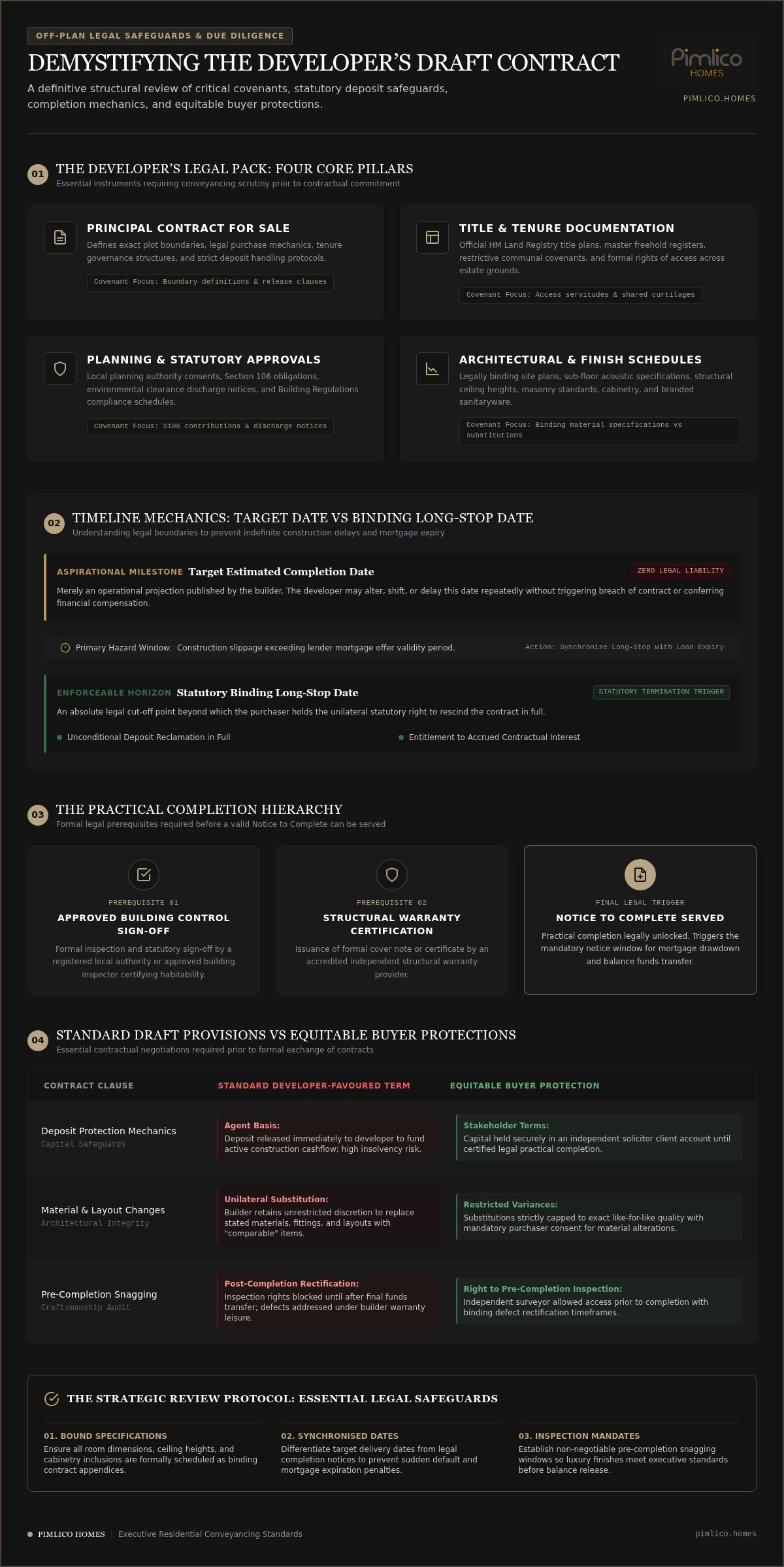
- Principal Contract for Sale: Defines specific plot boundaries, agreed purchase mechanics, tenure structures, and deposit protocols.
- Title and Tenure Documentation: Includes official Land Registry title plans, master freehold registers, and restrictive covenants affecting communal land or ongoing rights of access.
- Planning and Statutory Approvals: Contains formal local authority planning consents, Section 106 agreements, environmental discharge notices, and Building Regulations compliance schedules.
Architectural Drawings and Specification Schedules
Precision defines luxury homebuilding. A comprehensive contract pack must bind the physical design to the legal agreement, ensuring your bespoke residence reflects the promised craftsmanship. Architectural layout drawings show exact room dimensions, ceiling heights, service risers, and primary structural points. Site plans outline private garden curtilages, communal verges, and private driveway access rights.
Crucially, the pack contains the formal schedule of finishes. This document itemises external masonry, sub-floor acoustics, hand-finished cabinetry, integrated appliances, and sanitaryware. When reviewing these schedules alongside your solicitor, consult our guide to buying a luxury new build to benchmark high-calibre architectural inclusions against standard developer allowances. Mastering and understanding the draft contract from a developer ensures that every promised material specification is contractually enforceable before exchange.
Decoding Critical Developer Clauses: Deadlines, Delays, and Variations
Developer draft contracts are rarely neutral instruments. They are crafted by commercial legal teams seeking maximum operational leeway. When purchasing off-plan, understanding the draft contract from a developer means reading between the lines of completion targets and material schedules. Without clear contractual boundaries, a buyer shoulders the financial hazards of delayed delivery and altered architectural integrity.
Target Completion Dates versus the Binding Long-Stop Date
An “estimated completion date” provides no legal commitment. It is merely an aspirational milestone that builders can revise without financial consequence. To protect your capital, the contract must establish a long-stop date. A long-stop date is an absolute, non-negotiable legal cut-off point beyond which the buyer has the unilateral statutory right to terminate the contract and reclaim their deposit in full with accrued interest. Aligning this long-stop date with your lender’s mortgage offer validity window is essential. If construction overruns and your loan offer lapses, securing re-approval under altered financial terms can prove costly.
Notice to Complete and Practical Completion Triggers
Legal completion should never occur on a developer’s say-so. The build must first achieve practical completion, evidenced by formal regulatory sign-off from an approved building inspector alongside an independent structural warranty certificate. Once this certification is served, the developer issues a formal Notice to Complete.
- Notice Window: Standard contracts stipulate a window of ten working days from the service of notice to complete the financial transfer.
- Late Settlement Penalties: Missing this deadline triggers aggressive default interest rates, often 4% or 5% above the Bank of England base rate.
- Snagging Protection: Conveyancers must remove clauses compelling immediate financial settlement ahead of pre-completion aesthetic and defect reviews.
Specification Variation and Material Substitution Clauses
Luxury acquisitions turn on bespoke craftsmanship. Yet standard contracts routinely allow builders to alter layouts by 3% to 5% of gross internal floor area without triggering price reductions. Worse, generic substitution clauses permit developers to replace specified materials with “equivalent alternatives” when procurement pressures arise. In prime homes, substituting bookmatched marble or bespoke timber joinery with commercial substitutes damages the home’s intrinsic value.
Your legal team should challenge broad substitution rights against the statutory unfair contract terms guidance, securing buyer veto rights over key finishes. When commissioning bespoke luxury homes, partnering with principled builders who commit to immutable schedules of finishes eliminates the need for contentious contractual renegotiation. Truly understanding the draft contract from a developer guarantees your completed residence mirrors the architectural vision you originally purchased. If you value architectural permanence and uncompromised build integrity, explore Pimlico Homes to experience executive homebuilding defined by transparent covenants.
Developer-Favoured Terms versus Equitable Buyer Protections
Standard new-build agreements are written to protect the builder’s commercial cash flow, frequently leaving private purchasers with substantial legal exposure. Understanding the draft contract from a developer requires identifying these imbalances before contracts become legally binding. Principled housebuilders recognise that delivering executive homes demands mutual trust. They welcome balanced, equitable amendments that honour real-world construction needs whilst preserving the buyer’s capital and peace of mind.
Rigorous conveyancing redrafts standard volume-builder covenants into fair consumer commitments, aligning the agreement with the statutory expectations of the New Homes Quality Code. The contrast between customary developer clauses and balanced protections illustrates where legal representation must focus.
Comparative Analysis of Purchase Contract Terms
Evaluating standard developer terms alongside equitable alternatives highlights where key negotiations take place:
- Deposit Holding: Standard drafts release buyer deposits directly to the builder as “agent for the seller” upon exchange, exposing funds to commercial insolvency risks. Equitable terms demand funds be held by the developer’s conveyancer as an independent “stakeholder” in a protected client account until legal completion.
- Defect Liability: Volume contracts often treat cosmetic snags at builder discretion with open-ended resolution timescales. A balanced contract incorporates a mandatory thirty-day defect resolution guarantee backed by a formal pre-completion snagging protocol.
- Construction Delays: Developer-favoured clauses grant unilateral construction extensions for broad supply chain delays without redress. Fair amendments provide reciprocal arrangements, including daily delay allowances or explicit long-stop rescission rights with deposit refunds.
Estate Rentcharges and Management Company Covenants
When acquiring executive courtyard homes or private detached developments, communal amenity management requires careful legal oversight. Volume-builder contracts frequently contain aggressive estate rentcharge mechanisms under Section 121 of the Law of Property Act 1925. These statutory remedies grant rentcharge owners the draconian right to grant a lease over your home if a minor maintenance payment is delayed, rendering the freehold unmortgageable.
Your solicitor must insist on striking out Section 121 statutory remedies or ensuring the developer includes explicit lender-approved exclusion clauses. Management company covenants must also guarantee transparent, audited accounting schedules with predefined expenditure caps. If roads, balancing ponds, surface-water drainage, and estate lighting are designated for local authority adoption under Section 38 or Section 104 agreements, the contract must include developer indemnities. These commitments protect buyers from legacy maintenance liabilities should adoption processes experience prolonged delays. Mastering and understanding the draft contract from a developer ensures that every shared management structure protects your property rights well into the future.
Navigating the Legal Review: Enquiries, Warranties, and Snagging Rights
The legal review stage transforms passive scrutiny into proactive protection. When acquiring an executive property, understanding the draft contract from a developer requires raising targeted enquiries that reach far beyond standard title searches. A specialist solicitor experienced in prime new builds knows that generic enquiries often miss subtle site-specific liabilities. From unadopted drainage basins to shared courtyard access covenants, every legal boundary must be defined before contracts become binding.
Formulating Development-Specific Legal Enquiries
Precision conveyancing uncovers site liabilities that standard property forms overlook:
- Planning and Section 106 Agreements: Verify that all local authority planning conditions and financial contributions are fully discharged. Outstanding developer obligations can transfer unexpected liabilities onto incoming plot owners.
- Statutory Utility Bonds: Confirm that foul drainage, surface water systems, and access roads are protected by formal Section 38 and Section 104 adoption bonds with relevant water and highway authorities.
- Rights of Way and Access Easements: Clarify shared private driveways, courtyard rights of access, and underground service run easements across adjacent parcels.
Integrating Independent Snagging and Warranty Schedules
A flawless handover requires contractual teeth. Standard draft contracts routinely attempt to restrict pre-completion visits, arguing that aesthetic imperfections should be addressed through post-completion customer service channels. Discerning purchasers must never accept these terms without amendment.
Insist on an explicit contractual clause granting access for an independent, accredited snagging surveyor before legal handover. Under modern codes of practice, this Pre-Completion Inspection must allow your surveyor reasonable site access once the Notice to Complete is served. Crucially, the contract should bind the developer to a formal rectification schedule, guaranteeing that all documented snags are resolved within an agreed thirty-day window. These protections operate in tandem with your comprehensive ten-year structural warranty, which provides two years of builder defect cover followed by eight years of structural insurance backed by latent defect policies.
True architectural excellence begins with transparent covenants. At Pimlico Homes, over two decades of craftsmanship delivering high-specification executive residences means our legal packs reflect the same precision as our masonry. Every courtyard development and conversion we build incorporates comprehensive structural warranty protection alongside dedicated pre-completion snagging protocols. Understanding the draft contract from a developer should be an exercise in clarity, not confrontation. If you seek uncompromised standards and equitable contracts, speak with our team today to view our bespoke developments.
From Draft Review to Exchange: Securing Your Dream Home
Finalising the draft contract signifies a pivotal transition, shifting your focus from defensive legal scrutiny to definitive homeownership. Every amendment, deletion, and negotiated covenant must be formally agreed in writing between respective conveyancers before either party commits. Understanding the draft contract from a developer ensures that the final documentation reflects your bespoke arrangements, leaving no room for verbal promises or ambiguous intentions. Once both solicitors confirm agreed wording, duplicate contract counterparts are signed, moving your acquisition into the binding exchange phase.
Capital protection remains paramount during this closing sequence. Your legal team must ensure exchange deposits are transmitted directly into regulated solicitor client accounts under agreed stakeholder terms, preventing premature drawdown. With contractual safeguards locked down, you can anticipate completion with total peace of mind.
Final Checks Prior to Contractual Exchange
Before authorising your conveyancer to commit funds, verify these critical operational alignment points:
- Mortgage Offer Continuity: Reconfirm your lender’s formal valuation expiry date comfortably extends beyond the contractual long-stop date to avoid unexpected reapplication hurdles.
- Supplemental Specification Schedules: Verify that all bespoke architectural variations, custom cabinetry alterations, or upgraded appliance packages are bound into executed supplemental agreements.
- Contractual Authority: Authorise the formal release of your exchange deposit only after receiving written confirmation that all developer undertakings have been formally incorporated.
The Value of Principled Craftsmanship and Transparent Contracting
An exceptional home requires an exceptional foundation, both in its physical structure and its contractual framework. Principled developers understand that creating executive courtyard homes and bespoke residences is an enduring partnership built on transparency. Clear contracts do not merely protect legal boundaries; they set the tone for attentive aftercare and celebrate architectural artistry.
Mastering and understanding the draft contract from a developer gives you complete confidence in the integrity of your purchase. When homebuilders match uncompromised construction standards with balanced, fair contractual terms, the path to acquiring an executive home becomes effortless. Discover how our heritage of excellence shapes every detail by exploring our bespoke new build homes, executive courtyard homes, and luxury barn conversions. Connect with Pimlico Homes to explore bespoke luxury residences built on enduring trust.
Safeguarding Your Vision: The Path to Certainty
Acquiring an exceptional new home should inspire excitement, not legal anxiety. By mastering and understanding the draft contract from a developer, you hold the power to dismantle one-sided covenants, enforce immovable specification schedules, and safeguard your deposit under equitable stakeholder terms. True confidence comes from knowing your contractual completion mechanics and defect rectification rights are locked down before signing.
Principled developers build mutual trust from the initial draft pack through to final handover. Backed by over two decades of craftsmanship delivering high-specification executive residences, Pimlico Homes champions transparent contracting standards prioritising buyer peace of mind. Every property we create features ten-year comprehensive structural warranty protections and dedicated pre-completion snagging protocols, ensuring the legal foundation of your purchase matches the structural integrity of the build. Step into a collaborative acquisition process where architectural excellence and legal clarity align seamlessly. Discover bespoke luxury living with Pimlico Homes and secure a residence crafted for generations to come.
Frequently Asked Questions
What is the difference between a draft contract and an exchanged contract?
A draft contract is an unexecuted, negotiable proposal issued by the developer’s solicitor, outlining suggested terms, boundaries, and specifications. It carries no legal commitment. In contrast, an exchanged contract is a legally binding covenant created when signed counterparts are swapped and the formal deposit is paid. Until exchange occurs, neither buyer nor seller is legally obligated to proceed, meaning terms can still be challenged and amended.
Can I negotiate the terms in a developer’s draft contract?
Yes, purchasers can and should negotiate terms before formal exchange. While volume builders often present agreements as standard paperwork, bespoke property purchases regularly involve substantive legal adjustments. Essential amendments include converting deposit terms from agent to stakeholder holding, limiting finish substitutions, and enforcing clear defect rectifications. Mastering and understanding the draft contract from a developer ensures your conveyancer focuses on negotiating terms that truly safeguard your capital.
What is a long-stop date and why is it crucial in new-build contracts?
A long-stop date is a definitive, contractually binding backstop deadline by which the developer must achieve practical completion. While estimated build milestones are purely aspirational, passing the long-stop date grants you the unilateral legal right to terminate the agreement and reclaim your deposit in full. Without a long-stop clause, a buyer could remain bound indefinitely during severe construction overruns, risking lapsed mortgage offers and trapped funds.
What happens if the developer changes the specification without my consent?
If the contract lacks protective clauses, developers often rely on variation terms to substitute materials or alter layouts without buyer approval. However, if your conveyancer amends the draft to mandate explicit written consent for major alterations, any unauthorised material downgrade constitutes a breach of contract. This entitles you to demand correct reinstatement, negotiate financial compensation, or rescind the purchase agreement entirely before completion.
Are estate management charges legally enforceable under a freehold draft contract?
Yes, estate management charges are legally enforceable covenants embedded in the freehold transfer deed to fund shared infrastructure, private lighting, and communal grounds. However, draft contracts must be scrutinised to exclude aggressive statutory remedies under Section 121 of the Law of Property Act 1925. Solicitors must also secure commitments for annual audited accounts, transparent expenditure breakdowns, and reasonable caps on annual maintenance increases.
Should an independent snagging survey be included in the contract terms?
An independent snagging survey must always be incorporated into the contract schedule. While industry consumer codes grant pre-completion inspection entitlements, embedding this right directly into the contract ensures your accredited surveyor receives timely site access once the Notice to Complete is served. Crucially, the agreement should contractually obligate the builder to rectify all identified decorative and minor structural snags within an agreed thirty-day window.
How long do I have to review the developer’s draft contract before exchanging?
Developers typically specify a reservation validity period of 28 calendar days from issuing the legal pack to complete exchange. However, this deadline is not an absolute statutory barrier. Comprehensive legal due diligence takes precedence over arbitrary sales targets. A thorough approach to understanding the draft contract from a developer requires taking the necessary time to resolve development enquiries, inspect warranties, and confirm equitable terms before transferring exchange capital.





