
A marked bay does not, by itself, mean a visitor may use it. Visitor parking allocation rules in luxury private developments depend on how spaces are designated and on the property documents and estate regulations. Allocated bays are generally assigned to a particular home, while unallocated bays are shared under the development’s stated conditions. A visitor’s right to park depends on those terms, not simply on whether a space is empty.
It is easy to assume that a well-appointed development will have straightforward parking for guests, but the details matter. This guide explains how allocated and unallocated spaces work, which parking rights to review before buying, and what visitor notices or permits may require. With these distinctions clear, you can assess whether the arrangements suit your household and the way you expect to welcome guests.
Key Takeaways
- Distinguish a bay assigned to a home from shared parking, and look for the rules that govern who may use each space.
- Before buying, review the property documents and estate regulations for parking rights, restrictions and how breaches are handled.
- Check what a visitor note or permit must display, where guests may park and whether the arrangement covers tradespeople.
- Understand how planning rules shape parking provision, including the electric vehicle charging requirement for certain new homes in England.
Allocated and unallocated parking
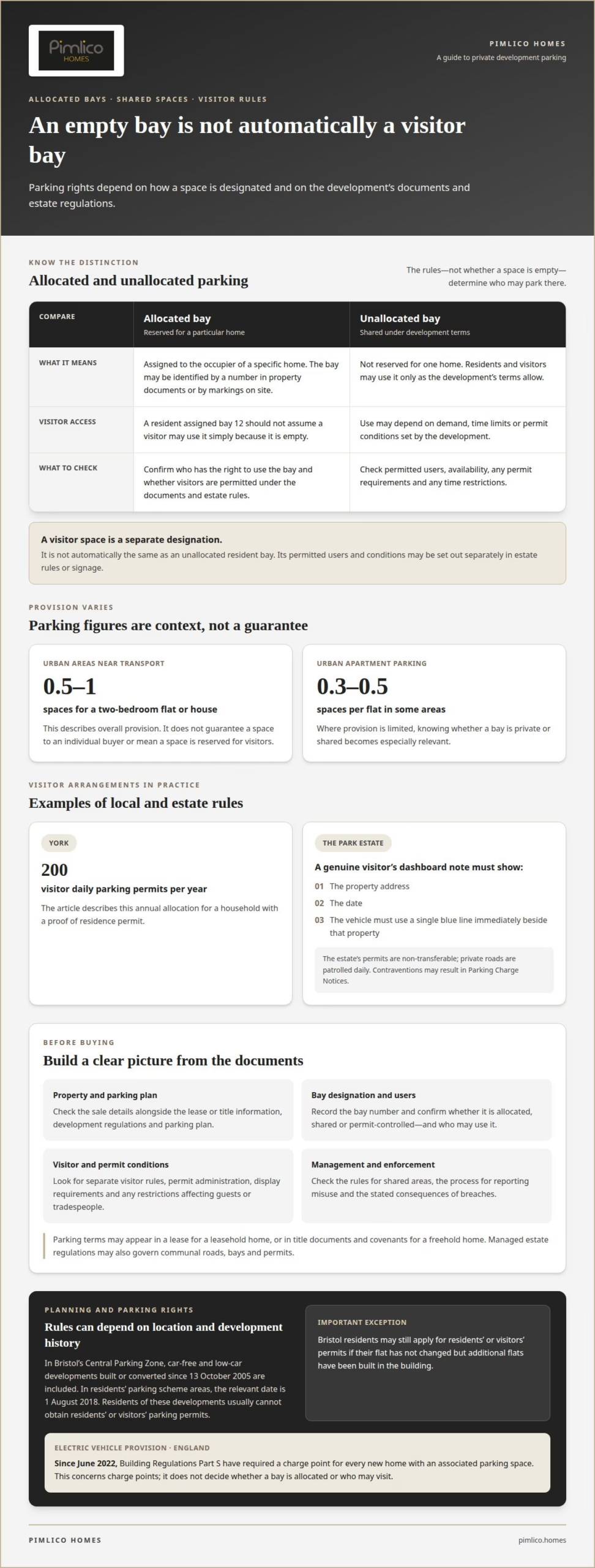
An allocated parking space is a bay reserved for the occupier of a particular home. The allocation may be identified by a bay number in the property documents or by markings on site. For example, a resident assigned bay 12 should not assume a visitor can use it simply because it is empty. The development’s rules determine who may park there and under what conditions.
An unallocated parking space is shared rather than reserved for one home. Residents and visitors may use these bays according to the development’s terms, so availability can depend on demand and any time or permit restrictions. A visitor space is not automatically an unallocated resident bay: its permitted users and conditions may be set out separately in estate rules or signage.
Provision varies by location and property type. In urban areas near transport, a typical range is 0.5-1 spaces for a two-bedroom flat or house. That figure describes overall provision, not the number guaranteed to an individual buyer or reserved for visitors. A development might have allocated resident bays alongside a limited shared area, so the distinction between types matters.
Bristol illustrates how planning status can affect parking arrangements. In its Central Parking Zone, car-free and low-car developments include residential developments built or converted since 13 October 2005. In residents’ parking scheme areas, the relevant date is 1 August 2018. Residents of these developments usually cannot obtain residents’ or visitors’ parking permits.
Electric vehicle provision is another part of the picture. Since June 2022, Building Regulations in England (Part S) have required a charge point for every new home with an associated parking space, according to UK Government. This requirement concerns charge points, not whether a bay is allocated. For a clear view of the arrangement, identify each space’s designation, permitted users, and any permit or charging conditions in the development documents.
Parking rights and checks before buying
Parking rules depend on the property’s legal documents and any estate regulations, not simply on whether it is leasehold or freehold. Before buying, establish which spaces are associated with the home, who may use them and how permits are administered.
Parking Rights Before Buying
Parking rights define a buyer’s use of a bay and any shared parking areas. Review the sale details alongside the lease or title information, development regulations and parking plan. Check whether the space is allocated, shared or permit-controlled, and whether visitor parking has separate conditions.
Check practical restrictions as well as the right to park. For example, Bristol residents in a car-free or low-car development can still apply for residents’ or visitors’ permits if their flat has not changed but additional flats have been built in the building. This exception shows why a property’s history and circumstances can matter.
Rules Across Ownership Types
Ownership type describes the legal basis on which a home is held, while management rules set out how shared areas operate. For a leasehold home, parking terms may appear in the lease; for a freehold home, title documents and covenants may be relevant. A managed development can also have estate regulations covering shared roads, bays and permits.
The Park Estate illustrates how detailed managed rules can be: its permits are non-transferable, and private roads are patrolled daily. Parking contraventions may result in Parking Charge Notices. These arrangements are separate from a home’s tenure, so consider both the ownership documents and the rules for communal areas.
Before committing, note the bay number, permitted users, permit conditions and process for reporting misuse. In urban areas, apartment parking provision may be as low as 0.3-0.5 spaces per flat, making the distinction between a private bay and shared provision especially relevant. Record any visitor restrictions that affect your household’s plans.
For buyers considering a new build, parking deserves attention alongside the home’s design and setting. Explore new build homes as part of that decision.
Visitor parking notes
A visitor parking note is a written notice recording a guest’s authority to park. Its wording, display position and permitted bay depend on the development’s rules.
Laws and Planning Rules
Planning rules shape parking provision, while development documents set out how visitor spaces are used. In England, Planning Policy Guidance Note 13 introduced maximum parking standards for new developments in 2001. The National Planning Policy Framework replaced PPG13 in 2012.
There is no single visitor allocation that applies across every UK council area. Location, planning policy and the development’s approved arrangements influence the spaces and permits available. In Bristol, Blue Badge holders can park without a permit in residents’ parking areas, permit holders only bays, shared-use bays and pay-and-display bays.
Rule-Setting and Allocation Factors
Planning conditions and private estate arrangements determine parking access. Councils shape provision through planning policy; the relevant development or estate management rules govern permits, notices, bays and enforcement.
Where visitor spaces are limited, alternatives can include a visitor permit, an authorised shared bay or a time-limited arrangement. In York, a household with a proof of residence permit receives an annual allocation of 200 visitor daily parking permits. On The Park Estate, a genuine visitor’s dashboard note must show the address and date, and the vehicle must use a single blue line immediately beside that property.
Accessible, electric vehicle and loading bays each have their own designations and conditions of use. In Bristol, the Blue Badge parking provisions above apply in residents’ parking areas. England’s Part S requires a charge point for every new home with an associated parking space, but does not itself define visitor access to charging.
Enforcement depends on the development’s stated process. The applicable terms should explain how a breach is reported, assessed and challenged; private estate rules may provide for parking notices. A development can also set visitor charges in its parking terms. Any fee and appeal route should be clearly stated in the notice or permit conditions.
What UK laws and planning rules govern visitor parking in private residential developments?
Planning policy guides how parking provision is assessed for a development. Visitor arrangements also depend on the approved scheme and the rules for shared areas, so a national figure cannot describe every private development.
In England, planning policies can allow local authorities to consider a site’s circumstances. Leeds uses expected parking standards rather than maximum levels, allowing site-specific discussions. Provision can therefore be considered in relation to a proposed development’s location and design, rather than treated as a fixed ceiling.
Leeds’s parking supplementary planning document encourages new short- and medium-stay car parks in the city centre. Its planning conditions are intended to ensure that city-centre car-park pricing, stay limits and opening times do not add to congestion at peak travel times. These details concern public car parks, but illustrate how planning controls can address parking’s effects on surrounding streets.
Planning decisions and private estate arrangements serve different purposes. Planning policy informs the approved design and provision; development rules set practical terms for residents and guests, such as where visitors may park and whether they need a notice or permit. The terms for an individual home and its shared areas determine how these arrangements apply day to day.
For buyers, a useful step is to read the approved parking plan alongside the property documents and estate rules. Note whether visitor bays are shown, whether access is restricted, and how any permit or visitor notice must be displayed. A plan showing spaces does not, by itself, explain who may use them or the conditions attached.
England’s planning framework also addresses electric vehicle provision. Since June 2022, Part S of the Building Regulations has required a charge point for every new home with an associated parking space, according to UK Government. This requirement concerns charge-point provision, not a visitor’s right to occupy a bay or use its charger.
For a home where design and practical details are considered together, explore a carefully planned home.
Pimlico Homes
Pimlico Homes offers luxury detached homes, executive courtyard homes and bespoke luxury homes. As you consider a property, visitor parking allocation rules in luxury private developments are one practical part of assessing how well it suits your household. Consider your guests’ needs alongside the home’s design, setting and shared arrangements. A clear understanding of visitor parking allocation rules in luxury private developments can help you frame questions about a prospective home and decide which details matter most to your daily life.
Make parking part of your next property decision
A home should support your everyday life, including how you welcome family, friends and other visitors. Give parking the same considered attention as layout and setting. Visitor parking allocation rules in luxury private developments can help frame that decision, but your own priorities matter too: how often guests visit, whether they need accessible parking, and how much flexibility you value.
Before taking the next step, consider which arrangements would feel practical over time. A clear sense of your household’s needs can make conversations about a future home more focused, helping you weigh the details that contribute to a comfortable, confident choice.
If you are considering a move and would like to discuss what matters in your search, contact Pimlico Homes about your property priorities. A thoughtful next step can bring your ideal home into clearer view.
Frequently Asked Questions
How many visitor parking spaces are required per dwelling in UK luxury developments?
There is no single visitor-space allocation for every UK development. Provision depends on location, local planning policy and the approved scheme. A development may provide shared visitor bays, rely on permits for nearby parking, or offer limited visitor provision. Before purchase, distinguish spaces intended for visitors from those assigned to individual homes: the total number alone does not show who can use each bay.
How do residents book or allocate visitor parking spaces?
Residents follow the process set by their development’s parking arrangements, which may use permits, visitor notices or shared bays. Do not assume there is a booking system: some schemes allocate permits to households, while others require a notice to be displayed in the visitor’s vehicle. For example, a resident may need to put the visit date and property address on a dashboard notice. The scheme’s instructions determine the steps.
What are typical visitor parking time limits and permit requirements?
There is no standard time limit or permit format for all private developments. Each scheme’s rules determine how long a guest may stay, whether a permit or notice is needed, and where it must be displayed. Check the permitted arrival period, expiry conditions, authorised bays and any registration details required. A valid permit for one area may not authorise parking elsewhere.
What rules apply to accessible, electric vehicle and loading bays for visitors?
Each bay’s designation and the estate rules determine who may use it and under what conditions. In Bristol, Blue Badge holders may park without a permit in residents’ parking areas, including permit-holder-only, shared-use and pay-and-display bays. Part S requires charge points in specified new homes, but does not itself define visitor access to charging.
What penalties, appeals and enforcement procedures apply to visitor parking violations?
Enforcement follows the development’s stated rules, which should explain how breaches are reported, assessed and challenged. The Park Estate’s private roads are patrolled daily, and contraventions may result in Parking Charge Notices; residents can report a breach to the Estate Office.
Can visitors be charged for parking in a private UK development, and what are typical fees?
Yes. A development may set visitor parking charges in its parking terms, and any fee and appeal route should be clearly stated in the notice or permit conditions.





