
Two documents called “warranties” can offer very different forms of protection. If you’re buying a new build, understanding the distinction between a collateral warranty and a structural warranty for new build homes UK can help you establish what each document actually provides and who can rely on it.
The terms are easy to confuse. Both relate to a property’s construction, but a collateral warranty generally gives a defined third party, such as a purchaser, funder or tenant, contractual rights against a construction professional or contractor. A structural warranty is separate insurance-backed cover that may apply to specified defects, subject to the policy terms. Neither document’s title tells you the full extent of your protection.
This guide explains who may rely on a collateral warranty and what those rights are for, then compares them with structural cover and defects arrangements. You’ll learn what to check in your new-build paperwork, including the beneficiary, property, scope of cover, exclusions and claim process. Reading the documents carefully helps you understand the protection they describe before you rely on it.
Key Takeaways
- A collateral warranty may give a third party contractual rights, but who can rely on it depends on the document and project arrangements.
- Identify the parties named in the warranty and how it relates to the construction contract or professional appointment.
- A structural warranty for new build homes UK is distinct from a collateral warranty. Review the policy terms to understand its cover.
- Check each document for the beneficiary, property, responsible party and work or risks covered.
- Keep warranty documents with your purchase paperwork so you can find the relevant protections and responsibilities when needed.
What is a Collateral Warranty and Who is it For?
A collateral warranty may give a third party contractual rights connected with construction work, even if that party wasn’t part of the original building contract or professional appointment. It can provide a direct route to a contractor or consultant, but not everyone with an interest in the property automatically becomes a beneficiary.
The wording identifies the parties, the duties being extended and, in some cases, whether rights can be transferred. The project’s contractual arrangements also affect how the document operates. A collateral warranty does not, simply by its name, promise that a home is defect-free or that every construction issue will be repaired. The What is a Collateral Warranty? overview offers additional background on the concept.
What does a collateral warranty do?
A contractor or consultant usually owes duties to the party that appointed them under a building contract or professional appointment. A collateral warranty can extend specified duties to an identified third party, creating a contractual relationship between that beneficiary and the warrantor. It is a separate document, not a replacement for the original contract, and its precise effect depends on its terms.
For example, a developer might appoint an architect for a new-home scheme. A funder or purchaser could be named as a beneficiary in a collateral warranty from that architect, with the document setting out the relevant duties owed directly to them. This is an illustration, not an arrangement used on every development.
Who may receive a collateral warranty?
Potential beneficiaries include a purchaser, tenant, funder or owner with an interest in the building. The warranty should identify who receives the rights and which contractor, consultant or other party is responsible for the relevant duties. Anyone not named or otherwise covered by the wording should not assume they can rely on it.
Some documents explain whether a beneficiary can transfer its rights to a future owner or another party. The terms may set conditions or limits, so don’t presume a transfer is permitted. For a buyer, distinguish the named beneficiary from anyone who might acquire the home later, and check what the document says about a change of ownership.
This distinction matters alongside a structural warranty for new build homes UK buyers may encounter in their purchase documents. A collateral warranty concerns specified contractual rights against a named duty-holder. It is not automatically an insurance policy or a general guarantee of construction quality. Treat it as a specific part of the home’s legal paperwork, rather than a broad assurance based on its title.
How a Collateral Warranty Connects the Construction Team to Third Parties
A development involves organisations with different roles and contracts. The developer may appoint a main contractor to carry out the building work, while architects, engineers or other consultants work under separate professional appointments. A collateral warranty can connect one of those project participants directly to an identified third party, but only for the duties and rights set out in the document.
A simplified chain might look like this:
- The developer enters a building contract with the main contractor.
- The developer appoints consultants to provide defined professional services.
- A contractor or consultant gives a collateral warranty to a named beneficiary, such as a funder, purchaser or owner.
These links are not automatic, and a project may use different contractual arrangements. A collateral warranty is usually related to an underlying building contract or professional appointment. Read it alongside that underlying document to see which work it refers to and how the obligations fit together.
What responsibilities might a collateral warranty refer to?
The warranty may refer to duties set out in a contract or appointment, rather than create a single, universal standard of responsibility. A consultant’s obligations may concern professional services, such as design work, while a contractor’s may relate to carrying out construction work. Read the document’s scope, exclusions and any limits on their own terms. Its title alone doesn’t show which work is covered.
Look for a clearly identified beneficiary, duty-holder and scope of work. For example, a warranty concerning a consultant’s design services does not necessarily cover every aspect of a contractor’s on-site work. Nor should a buyer assume that rights granted to one party automatically extend to others connected with the property.
Why do funders, purchasers and owners ask about them?
A third party may seek a direct contractual route to a project participant, rather than relying only on a contract to which it is not a party. This can matter during funding, a sale or a change of ownership, when warranty documents may form part of the wider property paperwork. A collateral warranty does not promise a successful claim or a particular remedy. The beneficiary’s position depends on the wording, circumstances and applicable law.
Pay particular attention to transfer provisions. A document may explain whether rights can pass to a future owner and set out conditions for doing so. Don’t assume you can rely on a warranty addressed to a previous owner, or that rights can be transferred without following the stated process. Clear references to the property, beneficiary and work make the contractual chain easier to follow.
Keep this contractual route separate from a structural warranty for new build homes UK buyers may encounter. Structural cover is a separate form of cover, governed by its own policy terms. For general information about new-home warranty and insurance arrangements, see NHBC New Home Warranty.
For buyers considering a new-build purchase, understanding who is responsible for each part of a development can make the paperwork easier to follow. Pimlico Homes develops luxury new-build homes, with an approach centred on considered residential development. Explore Pimlico Homes’ approach to new-build homes.
Collateral Warranty vs Structural Warranty: Understand the Difference
Although their names sound similar, these documents serve different purposes. A collateral warranty may give a named third party specified contractual rights against a construction professional or contractor. A structural warranty is separate insurance-backed cover for a home, with protection defined by the policy. The documents may sit alongside one another in a purchase file, but neither should be assumed to replace the other.
Compare them by asking what each does, who it involves and which terms govern it:
- Purpose: A collateral warranty sets out contractual rights for an identified beneficiary. A structural warranty provides cover for specified issues under an insurance policy.
- Parties: A collateral warranty generally names a beneficiary and a construction party, such as a contractor or consultant. A structural warranty involves the policyholder, insured parties and insurer, as defined by the policy.
- Legal basis: A collateral warranty is a contract connected to an underlying building contract or professional appointment. Structural cover is governed by the policy wording and insurance terms.
- Typical paperwork: Look for a signed collateral warranty alongside the relevant underlying contract or appointment. Structural cover is documented separately, commonly through policy documents and associated schedules or certificates.
This comparison is a guide, not a substitute for reading the actual documents. Parties, terminology and paperwork can differ between projects. The wording determines which rights or cover apply.
Is a collateral warranty the same as structural warranty insurance?
No. A collateral warranty provides a specified beneficiary with a contractual route to rely on defined obligations. Structural warranty insurance is an arrangement that may respond to certain defects or losses under its policy. The two can relate to the same home but involve different parties and responsibilities. Neither automatically covers every defect, loss or cost. For a structural warranty for new build homes UK buyers should read the specific policy’s insured risks, exclusions, claim requirements and other limits.
How do building warranties and defects obligations fit in?
A contractor’s defects obligations may be set out in the building contract, including what must be put right and on what terms. Those obligations differ from a collateral warranty, which may extend specified contractual rights to a third party, and from insurance cover, which responds according to the policy. The relevant period and available remedy depend on the document, not simply on the word “warranty”.
For a considered purchase, keep the documents separate and compare their functions rather than treating them as one broad promise. Legal rights and insurance arrangements can depend on the facts and the UK jurisdiction involved. England, Wales, Scotland and Northern Ireland may have different legal frameworks, so don’t assume terminology or a general explanation applies identically across all four nations. If a clause is unclear, seek advice suited to the property and jurisdiction.
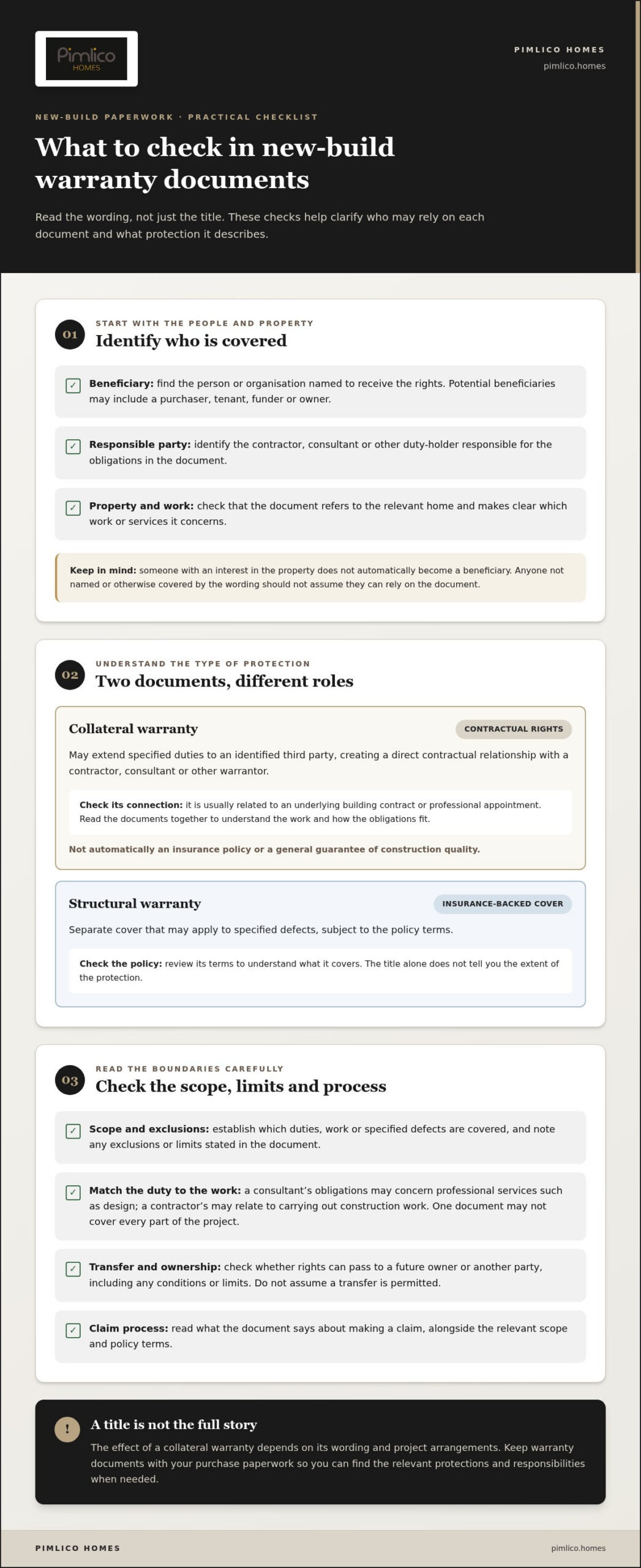
What to Check in New-Build Warranty Documents
Start by identifying what each document is intended to do. Keep the collateral warranty, any structural warranty policy, the building contract or appointment, and defects information distinct. Similar wording on a cover page does not make their protections interchangeable. Use this sequence to organise your review before relying on any term.
Which details should a buyer identify first?
Work through each document in order. Record the details that connect its stated rights or cover to the home and the people involved:
- Document type and parties: Identify whether you’re reading a collateral warranty, an insurance policy, a building contract extract or defects information. Note who issued or signed it and who is named.
- Beneficiary and duty-holder: Identify the person or organisation meant to receive the rights, then the contractor, consultant or other party responsible for the stated duties.
- Property or project: Check that the description matches the relevant development and, where stated, the specific home or plot. Look for details that distinguish it from other properties on the scheme.
- Underlying agreement: Note any building contract or professional appointment the document refers to. If that agreement is not included, record the reference so you can understand which terms may be relevant.
- Work and responsibilities: Look for the services or construction activities covered. Design responsibilities and building work are not necessarily the same, so note which work is described and who undertook it.
- Conditions and exclusions: Mark limitations, exclusions, notice procedures and claim requirements for closer review. A stated process or deadline may affect how a beneficiary must act.
- Transfer wording: Check whether the document explains how rights can be assigned or transferred to a future owner. Don’t assume rights pass automatically with a sale.
What can affect a warranty’s usefulness?
A document’s usefulness to a buyer depends on how its wording links the right person to the right duty-holder, property and scope of work. For a structural warranty for new build homes UK buyers should examine the policy terms, including the stated cover, exclusions and claim process. A collateral warranty, by contrast, should be read for the contractual rights it gives its named beneficiary. Neither heading proves that protection is comprehensive.
Transfer and assignment provisions can raise legal questions, and their effect may depend on the document, circumstances and applicable law. Requirements can differ across England, Wales, Scotland and Northern Ireland. Use this checklist to organise your review, not to interpret an individual contract. Seek appropriate legal advice if a clause or the consequences of a transfer are unclear.
Keeping the documents with your purchase paperwork makes it easier to compare their roles and find the relevant terms later. As you consider a carefully documented new-build purchase, explore Pimlico Homes’ new-build homes.
A More Confident New-Build Purchase Starts with Clear Warranty Documents
A home purchase brings together documents with different purposes. Warranty paperwork is easier to understand when you distinguish contractual rights in a collateral warranty from the cover described in a structural warranty policy. One may give a named beneficiary specified rights against a construction party; the other provides separate cover according to its policy wording. Neither should be treated as a universal promise that every defect or loss will be covered.
Keep each document with your purchase paperwork. Store the policy, collateral warranty, any referenced contract or appointment, and related notices together, and note which property and parties each concerns. This makes it easier to find the relevant terms later, particularly if you need to understand a stated process or explain the document to someone involved in the purchase.
How does warranty clarity support the purchase journey?
Clear documents help buyers understand what they are receiving before relying on them. Identify who is meant to benefit, which party has the stated responsibilities, what work or risks the wording concerns, and whether exclusions or conditions affect the protection. That understanding supports a more informed decision, but cannot guarantee that a future issue will qualify for a remedy or claim.
Reviewing the paperwork is one part of a wider purchase journey, alongside considering the home’s design, specification and suitability for your needs. Pimlico Homes’ luxury new-build purchasing guide covers other practical questions to consider when assessing a new home. Read each warranty document on its own terms, rather than relying on its heading or a general description to establish the extent of your rights.
Explore a considered approach to new-build homes
In a considered new-home purchase, quality, design and clear information all matter. A carefully designed property is a significant investment, and understanding its documents forms part of assessing the home. For buyers looking at a structural warranty for new build homes UK, consider the policy separately from any collateral warranty, paying attention to its scope, conditions and claims process.
Keep your documents in an orderly file, in print or digitally, and retain any correspondence that explains which paperwork relates to the property. If wording is unclear or a transfer of rights may be relevant, get advice appropriate to the document and jurisdiction. This can help you understand the protections available, without guaranteeing a particular outcome.
Pimlico Homes develops luxury new-build and bespoke residential properties with attention to design and the experience of living in the finished home. To explore its approach to new-build homes, visit Pimlico Homes.
Choose Your Next Home with Confidence
A considered purchase is about more than the assurances a document appears to offer. Take time to understand the paperwork, then weigh it alongside the home’s design, quality and suitability for the life you want to build there. Understanding a structural warranty for new build homes UK can form part of that decision, but it is not the only measure of a home’s long-term appeal.
Pimlico Homes is a specialist developer of luxury new-build residential properties, including detached homes, executive courtyard homes and bespoke homes. Each offers a distinct approach to contemporary living, shaped by considered design.
Explore the possibilities and consider which home suits your next chapter. Explore Pimlico Homes’ considered approach to new-build living.
Frequently Asked Questions
Can a collateral warranty be transferred to a later buyer?
Sometimes, but transfer depends on the warranty’s wording and the relevant legal framework. It may set conditions for assigning rights or restrict whether and how they can pass to someone else. A later buyer should not assume the benefit transfers automatically with the property. Ask your conveyancer to review the executed document and any transfer steps it specifies, particularly if the original beneficiary differs from you.
Does a collateral warranty cover defects in a new-build home?
It may provide rights if a defect relates to a duty covered by the warranty, but it is not automatically a policy that pays for repairs. For instance, a design issue might relate to a consultant’s stated obligations, while a cosmetic snag may fall outside the document’s scope. A structural warranty for new build homes UK buyers encounter is separate insurance-backed cover, governed by its own terms and exclusions.
Do all new-build homes come with a collateral warranty?
No, a collateral warranty is not automatically provided with every new-build home. Whether one exists can depend on the project’s contracts, the parties involved and the transaction arrangements. A buyer might receive other documents, such as a structural warranty policy or information about a defects process, which serve different purposes. Review the purchase pack’s document list and ask your conveyancer to identify what each document provides.
What is the difference between a collateral warranty and a third-party rights clause?
Both can give a third party rights connected with construction duties, but they do so through different documents. A collateral warranty is typically a separate agreement between the construction party and beneficiary. A third-party rights clause may grant rights within an existing contract. The effect depends on the wording and applicable law, which can differ across UK jurisdictions. A solicitor can explain which mechanism the project documents use.
Can a lender require a collateral warranty for a construction project?
A lender may require collateral warranties as part of its project funding arrangements, but this is not a universal requirement for every development or home purchase. Finance documents may specify which project parties must provide rights and to whom. A buyer should distinguish such funding conditions from any lender requirements relating to a home’s structural warranty. The relevant transaction documents determine what is required in a particular case.
What happens if a collateral warranty contains an error?
Don’t assume an error is harmless, even if it appears to be a simple misspelling. An incorrect beneficiary name, property reference or description of the work could create uncertainty about who or what the document covers. Raise the discrepancy with your conveyancer before relying on it, and keep the version received. Any correction should be handled formally by the relevant parties. Its legal effect depends on the document and circumstances.





