
Does the true essence of a luxury home lie in the weathered grain of a centuries-old beam, or in the silent, airtight precision of a contemporary masterpiece? This choice often defines the legacy of a high-end property investment. When weighing the barn conversion vs modern new build pros and cons, you may find yourself torn between the romantic allure of a historic structure and the desire for uncompromising efficiency. You shouldn’t have to accept the anxiety of hidden structural costs or a lack of architectural soul; instead, your home should be a seamless reflection of your status and your standards.
Architectural heritage. Contemporary precision. This guide serves as a definitive comparison to bring clarity to your decision-making process. We’ll examine the delicate balance between preserving a story from the past and authoring a new one through bespoke construction. Whether you’re drawn to the irreplaceable charm of vaulted timber or the effortless luxury of a modern executive home, you’ll gain the insights necessary to secure a residence that offers both permanence and prestige. We’ll look at everything from long-term resale value to the meticulous details of high-specification craftsmanship.
Key Takeaways
- Evaluate the emotional and architectural weight of choosing a residence that reflects your personal identity and status.
- Explore the unique allure of luxury barn conversions, where original stone masonry and vaulted ceilings establish an immediate sense of grandeur.
- Weigh the barn conversion vs modern new build pros and cons to decide between the irreplaceable story of a historic structure and the silent precision of contemporary design.
- Discover how VAT ratings and maintenance cycles influence your investment, including the 0% rating on new builds and the reduced 5% rate for certain conversions.
- Align your specific lifestyle vision with a property that delivers either character-driven heritage or the effortless efficiency of a bespoke executive home.
The Architectural Dilemma: Character Heritage versus Contemporary Precision
Luxury residential development in 2026 has evolved beyond mere opulence. It’s now an exploration of identity. For the discerning investor, the choice between a historic restoration and a ground-up creation is a philosophical one. It represents a decision between becoming the guardian of a narrative or the architect of a new future. This choice carries immense emotional weight; your home is the most visible expression of your values and your status. As we look at the barn conversion vs modern new build pros and cons, it becomes clear that the debate is no longer just about aesthetics. It’s about how we balance the grand volume of the past with the exacting precision of the future.
The relevance of this discussion has peaked as buyers seek more than just square footage. They want a connection to the land and a structure that feels permanent. Whether it’s the rhythmic pattern of original stone masonry or the sharp, clean lines of a bespoke luxury home, the goal remains the same: a residence that feels entirely singular. This analysis sets the stage for a deeper look at how light, volume, and longevity play out in these two distinct architectural paths.
The Allure of the Unique
Generic, volume-built housing is no longer acceptable for those who have reached the pinnacle of their careers. There’s a profound shift towards properties that offer a sense of artistry and meticulous care. Bespoke homes serve as a definitive statement of executive status; they prove that the owner values quality over convenience. Whilst a barn conversion provides an immediate connection to local history, a bespoke new build offers the chance to create a new legacy. Both paths reject the mundane in favour of something that feels solid and enduring. This desire for uniqueness is what drives the high-end market, as collectors of fine things apply the same discerning eye to their primary residence as they do to their private galleries.
Performance as a Luxury Standard
In the modern era, luxury is defined by what you don’t have to notice. High thermal performance and “invisible” technology are now the benchmarks of a truly premium home. Discerning buyers expect exceptional energy efficiency without sacrificing architectural style. This is where the barn conversion vs modern new build pros and cons often lean towards the latter. Modern new builds allow for the seamless integration of air-source heat pumps and smart climate control from the very first brick. However, innovative engineering now allows us to bridge this gap, bringing high-specification craftsmanship to heritage structures. The expectation is simple: a home should be a sanctuary of comfort, operating with a silent precision that matches its visual grandeur.
The Soul of the Structure: The Unique Allure of Luxury Barn Conversions
A barn conversion is an act of preservation. It’s a commitment to a structure that has already stood the test of time; it offers a sense of permanence that is difficult to manufacture from scratch. When you walk into a completed project, the first thing that strikes you is the unrivalled volume. Vaulted ceilings and massive structural openings create a sense of grandeur that modern residential standards rarely allow. This is the primary emotional draw. However, carefully weighing the barn conversion vs modern new build pros and cons reveals that this character comes with specific responsibilities. You’re not just a homeowner; you’re a custodian of heritage stone and timber.
Original features like exposed timber beams and rugged stone masonry provide a tactile connection to the past. These elements create a “refined rustic” atmosphere that is impossible to replicate with new materials. Yet, this path isn’t without its challenges. Planning restrictions often dictate what can be done to the exterior, sometimes limiting your ability to add windows or modern extensions. Inside, the challenge lies in compartmentalising vast open-plan spaces. Creating intimate, private zones within a cavernous structure requires a master craftsman’s touch to ensure the home remains functional for executive living. It’s a process that demands patience and a deep respect for the original blueprint.
Preserving Heritage Charm
The true artistry lies in the execution of modern barn conversion interiors. It’s about finding the precise point where raw textures meet sophisticated finishes. We use sympathetic materials, such as reclaimed oak or local stone, to ensure new additions feel like they’ve always belonged. This approach maintains the building’s integrity whilst introducing the high-specification craftsmanship expected in a luxury residence. It’s a delicate balance; you want the comfort of the present without silencing the echoes of the past. Success is found in the details, from the way a modern staircase interacts with a centuries-old wall to the subtle integration of underfloor heating beneath flagstone floors.
The Volume Advantage
Space in a barn conversion is perceived differently. Because of the double-height entrance halls and the unique light play from original agricultural apertures, these homes often feel far more expansive than their actual square footage. The scale is cinematic. It allows for statement lighting and mezzanine levels that look down upon the heart of the home. Whilst the barn conversion vs modern new build pros and cons list might highlight the efficiency of the latter, it cannot replicate the sheer vertical drama found in a well-executed conversion. For those who value a home with a distinct personality, our luxury barn conversions offer a rare opportunity to own a piece of architectural history that has been thoughtfully adapted for contemporary life.
The Power of Performance: Why Modern New Builds Define Executive Living
Whilst the barn conversion relies on the bones of the past, the modern new build offers the exhilarating freedom of the blank page. It’s about precision. When evaluating the barn conversion vs modern new build pros and cons, the most significant advantage of a new structure is the total absence of compromise. You aren’t forced to adapt your lifestyle to fit within a pre-existing stone shell. Instead, every millimetre of the home is engineered to serve your specific needs. This path represents the pinnacle of contemporary luxury, where architectural vision is limited only by the imagination rather than the placement of a centuries-old load-bearing wall.
You gain complete sovereignty over the floor plan and the interior flow. Every vista from every window is intentional, designed to capture the light at specific times of day. However, this freedom carries a unique responsibility. There’s a risk that a new build can feel generic if it lacks the guiding hand of a bespoke developer. Without high-specification craftsmanship and a focus on architectural artistry, a new home can struggle to find its “soul” in the same way a heritage project does. There is also the matter of the maturation period. Unlike a conversion nestled in an established landscape, a new build requires time for gardens and surroundings to settle into their full, lush potential.
Bespoke by Design
The unrivalled benefits of buying a luxury new build become clear when you consider the integration of modern living requirements. Ground-up construction allows for seamless smart home integration that is part of the building’s DNA, not an afterthought hidden behind plasterboard. You can design the home around your specific furniture collections or lifestyle needs, ensuring that a gallery wall has the perfect lighting or a grand piano has the ideal acoustic alcove. It’s an intimate process that results in a residence that fits you like a well-tailored suit.
Efficiency without Compromise
In 2026, performance is a non-negotiable standard for executive living. Modern new builds achieve exceptional thermal efficiency through the use of air-source heat pumps and advanced insulation layers that far exceed what is possible in most conversions. This precision extends to acoustic performance. By using modern floor systems and sound-dampening stud work, we ensure a level of quietness between rooms that heritage structures often struggle to match. This technical excellence is backed by the quiet confidence of a comprehensive 10-year structural warranty, providing a sense of security that is deeply reassuring for any significant property investment.
Beyond the Aesthetic: Navigating Practicalities, VAT, and Long-Term Value
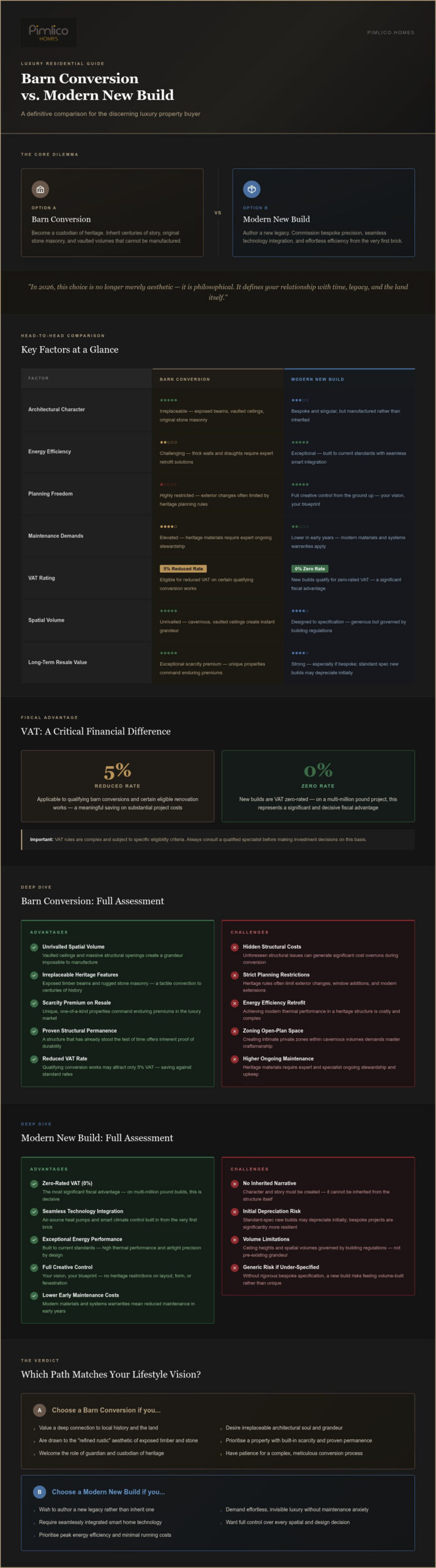
A property investment of this magnitude requires a clear-eyed view of the fiscal and logistical foundations. Whilst the visual drama of a vaulted ceiling or a sleek glass facade captures the imagination, the underlying practicalities often determine long-term satisfaction. When assessing the barn conversion vs modern new build pros and cons, the financial implications start at the very beginning of the construction phase. One of the most significant distinctions lies in the tax treatment of the project. New builds generally benefit from a 0% VAT rating on labour and materials; by contrast, conversions typically attract a reduced rate of 5%. This difference can represent a substantial sum, often allowing for higher-specification finishes or advanced landscaping elsewhere in the budget.
Planning permission presents another distinct set of challenges. For those pursuing a rural retreat, the “Class Q” permitted development rights offer a pathway for agricultural buildings, yet these come with strict limitations on the building’s footprint and external appearance. New builds, whilst subject to rigorous local planning policies, often provide more certainty once the initial design is approved. These logistical hurdles are the silent partners in your development journey. They require a steady, expert hand to navigate successfully, ensuring that the dream of a luxury residence doesn’t become mired in administrative delay.
The Investment Perspective
The question of longevity often centres on which property type holds its value better during economic shifts. There is an enduring appetite for heritage charm, yet the resale value of new build homes in premium enclaves remains exceptionally robust due to their turn-key nature and energy credentials. Many investors now look towards executive courtyard homes as a secure investment; they offer the perfect blend of privacy and modern efficiency. Whilst a “character premium” might inflate the initial purchase price of a barn, the lack of future maintenance liabilities in a new build often provides a more predictable return on investment over a ten-year horizon.
The Maintenance Reality
It’s a common misconception that heritage properties are perpetually high-maintenance. If a conversion is executed with high-specification craftsmanship and modern damp-proofing, it can be as resilient as any new structure. However, new builds undeniably offer a “honeymoon period” of low costs. With everything from the roof tiles to the boiler being brand new, immediate capital expenditure after purchase is virtually non-existent. For heritage projects, a rigorous structural survey is an absolute necessity before work begins. It identifies the hidden story of the stone and timber, allowing for a realistic assessment of the work required to bring the building up to 2026 standards. If you are ready to explore the potential of a specific site, you can enquire about our bespoke luxury developments to begin your journey with confidence.
Crafting the Final Verdict: Selecting the Property for Your Lifestyle Vision
The decision ultimately rests on the legacy you wish to create. When you weigh the barn conversion vs modern new build pros and cons, you’re deciding between the role of a guardian and that of a pioneer. For the character lover, the choice is often visceral. You’re drawn to the irreplaceable story of a building that has weathered the centuries; you value the grand verticality of a vaulted barn and the tactile warmth of ancient timber. For you, a luxury conversion is a piece of living history. It’s a home that commands attention through its sheer uniqueness and architectural soul, offering a sense of artistry that modern materials struggle to replicate.
Conversely, the performance seeker prioritises a life of silent, effortless precision. If your vision of luxury involves underfloor heating that responds instantly to your preferences, airtight thermal efficiency, and a floor plan designed specifically for your furniture, a bespoke new build is the superior choice. You aren’t interested in the structural compromises of the past. You want a home that operates with the reliability of a fine timepiece. Interestingly, a middle ground exists. Many of our clients choose future executive living by commissioning new builds that incorporate reclaimed stone or traditional masonry, achieving heritage aesthetics without sacrificing modern performance.
Before you commit to your next significant property investment, ask yourself these five essential questions:
- Do I value the historical story of a building more than the freedom to design its layout from scratch?
- Is high thermal performance and energy efficiency a non-negotiable requirement for my daily comfort?
- Am I prepared for the specific planning nuances and VAT implications of a heritage project?
- Does my lifestyle require the “honeymoon period” of low maintenance offered by a new structure?
- Which property type better reflects the status and identity I wish to project amongst my peers?
The Pimlico Homes Approach
At Pimlico Homes, we don’t believe in a binary choice between old and new. We believe in excellence. With over 25 years of experience, we bring the same level of high-specification craftsmanship to our luxury barn conversions as we do to our bespoke new builds. We understand that the barn conversion vs modern new build pros and cons list is personal to every client. Our role is to act as a reliable guardian of quality, ensuring that whichever path you choose, the result is a residence of permanence and artistry. We invite you to explore our current portfolio of exclusive properties to see how we blend traditional values with innovative thinking.
Your Next Steps
The journey towards your ideal home begins with a conversation. We recommend an early-stage consultation to discuss your specific requirements, whether you’re looking for a luxury detached home in Durham or an executive courtyard development in the North East. We can arrange a private viewing of our current projects, allowing you to experience the scale and finish of our work first-hand. A home is not just a structure; it’s the backdrop to your life and a testament to your achievements. Let us help you author that story. You can contact our team today to begin exploring your vision further.
Securing Your Architectural Legacy
Your choice of residence is a definitive statement of your values and your vision for the future. Whether you’re captivated by the rhythmic stone masonry of a heritage restoration or the silent, airtight precision of a bespoke new build, the decision hinges on how you wish to experience luxury. We’ve explored how the barn conversion vs modern new build pros and cons extend beyond mere aesthetics, touching on vital financial nuances such as VAT ratings and the “honeymoon period” of contemporary maintenance. Each path offers a unique opportunity to create a sanctuary that reflects your status and provides a sense of permanence.
With 25 years of specialist expertise, Pimlico Homes is dedicated to delivering award-winning attention to detail in every project. We specialise in bespoke designs tailored to executive lifestyles, ensuring your home is as functional as it is beautiful. We invite you to explore our exclusive collection of luxury new builds and barn conversions to find the property that resonates with your personal narrative. Your next chapter deserves a backdrop of uncompromising quality and artistry. We look forward to helping you bring your vision to life with the quiet confidence your investment deserves.
Frequently Asked Questions
Is a barn conversion more expensive to maintain than a modern new build?
Heritage buildings generally require more frequent maintenance than new structures. A luxury new build offers a distinct period where structural elements and systems are under comprehensive warranties. Conversions, whilst updated with high-specification craftsmanship, involve older stone and timber that may need specialist care over time. Choosing an expert developer ensures these long-term maintenance risks are minimised from the very first day of occupancy.
Do new build homes have the same resale value as period barn conversions?
Both property types hold significant value, but their appeal differs amongst discerning buyers. Period barn conversions often command a character premium due to their architectural soul and limited availability. However, luxury new builds in premium enclaves maintain robust resale value because of their turn-key nature and superior energy credentials. The final value often depends on the level of artistry and the exclusivity of the location.
What are the VAT benefits of buying a luxury new build over a conversion?
New build homes benefit from a 0% VAT rating on labour and materials, providing a substantial financial advantage for the investor. Conversions typically attract a reduced 5% VAT rate, provided the building has met specific criteria regarding its previous use. This distinction is a key factor when weighing the barn conversion vs modern new build pros and cons for your next significant property investment.
Can I achieve the same energy efficiency in a barn conversion as a new build?
It is possible to reach high standards of efficiency in a conversion, though it requires more complex engineering. Modern new builds are designed from the foundations up for airtightness and thermal performance. Whilst we can integrate air-source heat pumps and advanced insulation into heritage structures, the inherent precision of a new structure usually results in superior running costs and silent, effortless performance.
Are barn conversions colder than modern executive homes?
Modern conversions are not colder if they have been developed with contemporary high-specification craftsmanship. Older projects often struggled with heat loss, but today’s projects use advanced insulation and underfloor heating to ensure a constant, comfortable temperature. Modern executive homes are built to current regulations, making them naturally warm; however, a well-executed barn conversion can match this thermal comfort through expert retrofitting and sympathetic design.
Which property type offers better privacy for high-profile residents?
Executive courtyard homes and bespoke new builds often provide superior privacy through intentional architectural design. Whilst barns are frequently located in secluded rural settings, their large original apertures can sometimes overlook communal areas. New builds allow for the strategic placement of windows and landscaping to ensure total seclusion. Both options offer exclusivity, but the ground-up approach allows for more control over specific sightlines.
How long does a typical barn conversion take compared to a new build project?
Conversions often take longer due to the unpredictable nature of working with centuries-old structures. A bespoke new build follows a methodical and deliberate timeline from the foundation upwards. Heritage projects may reveal structural surprises that require specialist attention or rare materials, which can extend the schedule. Typically, a new build project offers a more predictable delivery date for those planning a significant life transition.
Are there more planning restrictions for conversions than for new builds?
Conversions are often subject to stricter limitations to preserve the building’s historical character. Planning authorities frequently dictate the type of materials used and the placement of new windows to maintain the original facade. New builds face their own rigorous local policies, but they don’t have to navigate the preservation of a pre-existing shell. This remains a critical consideration when assessing the barn conversion vs modern new build pros and cons.


