
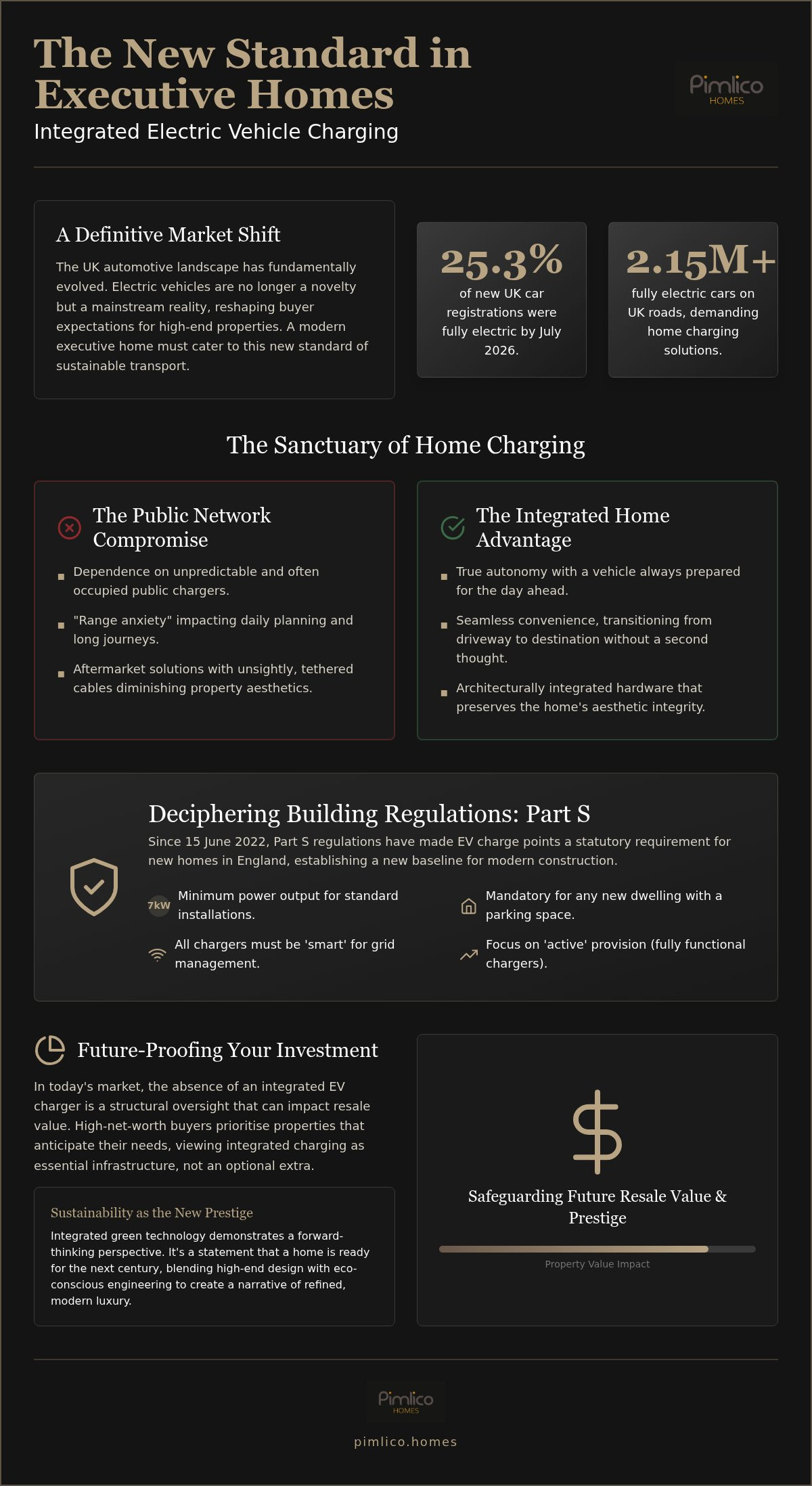
By July 2026, fully electric vehicles accounted for 25.3 per cent of the UK’s new car market, marking a definitive end to the era of the petrol-only driveway. For the discerning homeowner, this transition isn’t merely about transport; it’s about the seamless integration of technology into the fabric of the home. You likely recognise that a residence should be a sanctuary of convenience, yet the prospect of retrofitting chargers or dealing with unsightly, tethered cables often brings a sense of hesitation. It’s a valid concern, particularly when navigating the intricate requirements of Part S building regulations.
This article demonstrates how new build homes with electric car charging points have become the new benchmark for luxury living. We’ll show you how built-in, smart-ready infrastructure protects your property’s value whilst maintaining the architectural integrity of your estate. By examining the shift toward 7kW universal sockets and the long-term benefits of future-proofed wiring, we provide the clarity needed to ensure your next investment is as visionary as it is beautiful.
Key Takeaways
- Understand how Part S of the Building Regulations has established a mandatory standard for integrated charging infrastructure in all contemporary residential developments.
- Discover why new build homes with electric car charging points are essential for safeguarding the future resale value and prestige of your property investment.
- Learn about the architectural strategies that allow for the seamless and aesthetically sensitive placement of hardware within bespoke luxury barn conversions and detached estates.
- Gain insight into the technical requirements of smart-enabled charging systems and their role within a sophisticated, fully integrated smart home ecosystem.
- Explore how executive-level specifications bridge the gap between traditional craftsmanship and the innovative demands of modern, sustainable transport.
The Evolution of the Executive Home: Why EV Charging is Essential
The executive home has undergone a quiet but profound transformation. What once felt like a futuristic novelty has matured into a fundamental pillar of residential design. For those investing in bespoke luxury homes, the presence of integrated electric vehicle charging infrastructure is no longer a secondary consideration; it’s a primary requirement. This shift mirrors the rapid evolution of the UK automotive market, where over 2.15 million fully electric cars now occupy the roads.
The psychological comfort of home-based refuelling cannot be overstated. It represents a return to true autonomy. There’s a particular sense of security in knowing that your vehicle is prepared for the day ahead, shielded from the unpredictability of public networks. In the context of new build homes with electric car charging points, this utility is woven into the very identity of the property, ensuring that modern technology serves the inhabitant without disrupting the sanctuary of the home.
The Shift in Buyer Expectations for 2026
In the current market, the absence of a dedicated charger is increasingly viewed as a structural oversight. By July 2026, fully electric cars represented 25.3 per cent of all new car registrations in the UK. High-net-worth buyers now prioritise properties that anticipate their logistical needs. They seek a lifestyle defined by fluidity. A home that lacks the capacity to power a modern fleet is essentially a home that’s out of step with the future.
The convenience factor is the ultimate luxury. By removing the range anxiety that often accompanies public charging, these homes offer a level of peace that aftermarket solutions simply cannot match. It’s about the seamless transition from the motorway to the driveway. Everything is ready, waiting, and perfectly integrated.
Sustainability as a Mark of Prestige
Prestige has found a new language in the form of environmental responsibility. For the visionary homeowner, sustainability isn’t a compromise on quality but an enhancement of it. It reflects a commitment to longevity and meticulous care. Integrating green technology into the fabric of new build homes with electric car charging points demonstrates a forward-thinking perspective that respects both heritage and innovation.
Luxury living is increasingly defined by energy independence. When a property is equipped with high-specification infrastructure, it becomes more than just a residence; it becomes a self-sustaining estate. This crossover between high-end design and eco-conscious engineering creates a narrative of refined pride. It’s a statement that the home is ready for the next century whilst remaining grounded in timeless architectural values.
Deciphering Building Regulations: Understanding Part S and Your New Home
The legal landscape for residential development shifted fundamentally on 15 June 2022. It wasn’t merely a change in preference. It was a statutory requirement. The introduction of Building Regulations Part S ensured that every new dwelling in England with a parking space must now include an electric vehicle charge point. This mandate represents a significant step toward the government’s 2035 ban on new petrol and diesel cars. For new build homes with electric car charging points, the technical requirements are precise. A standard installation must provide a minimum power output of 7kW. It’s a baseline. Whilst some developers might view this as a box-ticking exercise, it’s actually the foundation of a modern home’s utility.
The Legal Framework for New Residential Developments
The regulations distinguish between active and passive provision. An active point is a fully functional, smart-enabled charger ready for immediate use. Passive provision involves the installation of cable routes to allow for future upgrades. In executive developments, the focus is almost exclusively on active solutions. All chargers must be smart devices. They connect to the internet to manage grid demand and allow you to schedule charging for off-peak hours. To protect against excessive infrastructure costs, there’s a £3,600 cost cap per charge point for grid connection. If the cost exceeds this, the developer may install cable routes instead. However, in a luxury setting, such compromises are rare. The goal is always a complete, ready-to-use system.
Beyond Compliance: The High-Specification Standard
Meeting the law is the starting point. It’s not the destination. In a luxury context, the electrical load of the property must be carefully managed to support multi-vehicle charging without compromise. It’s about capacity. A bespoke estate might require sophisticated load-balancing technology to ensure that charging your car doesn’t interfere with other high-demand smart home systems. It’s a delicate balance that requires expert planning from the outset of the build.
We believe that technical excellence should be invisible. It should work perfectly every time you plug in. This level of attention ensures that your home remains a high-specification asset for decades to come. When considering the intricate details of bespoke luxury homes, the integration of these systems is handled with the same artistry as the masonry or the joinery. It’s about creating a home that’s as intelligent as it is beautiful.
The Aesthetic of Innovation: Integrating Technology into Bespoke Design
The visual dialogue between heritage architecture and modern utility is often a delicate one. For those investing in luxury barn conversions or detached estates, the sudden appearance of a utilitarian plastic box on a hand-laid stone facade is unacceptable. It disrupts the narrative of the home. This is where architectural sensitivity becomes paramount. In the context of new build homes with electric car charging points, the goal is total integration. The hardware should feel like a natural extension of the property’s design language, not an afterthought. While Approved Document S mandates the technical presence of these units, it offers no guidance on their visual impact. That responsibility falls to the visionary creator.
Discreet Placement and Architectural Harmony
True luxury is often defined by what you don’t see. We prioritise the use of recessed units and bespoke housing to hide bulky cables from view. It’s about maintaining the purity of the structure. For many detached properties, internal garage charging is the preferred solution. It keeps the technology shielded and the exterior lines clean. However, where external points are necessary, we look to executive courtyard planning. By creating designated, discreet charging zones, we ensure the hardware does not disrupt the primary kerb appeal of the home. It’s a methodical approach to site layout that respects the traditional silhouette of the building whilst embracing the future of transport.
Materiality and Finish
The choice of hardware must reflect the quality of the home itself. Standard plastic finishes are replaced with premium alternatives like brushed metal or matte stone that complement the property’s colour palette. Meticulous care is taken with cable management systems to ensure the exterior remains tidy at all times. A messy cable is a design failure. We also consider how lighting design can influence the space. Subtle, low-level LEDs can highlight charging areas at night, providing safety and convenience without creating a harsh, industrial atmosphere. It’s these intimate details that separate a standard development from a bespoke residence. The result is a property that feels complete. It’s a marriage of heritage and high technology that safeguards the emotional and financial value of your investment.
- Bespoke housing to match masonry or timber cladding.
- Concealed cable routing within structural voids.
- Load-balanced systems that prioritise architectural integrity.
Every element is chosen for its longevity and artistry. By treating a charger as an architectural feature rather than a mere appliance, we maintain the sense of exclusivity that defines a Pimlico home. This commitment to design ensures that new build homes with electric car charging points remain beautiful, functional, and deeply reassuring for decades to come.
Technical Excellence: Assessing Charging Speeds and Smart Capabilities
Precision in engineering is the hallmark of a high-specification residence. While the regulatory baseline for new build homes with electric car charging points is set at a 7kW output, the requirements of an executive lifestyle often necessitate a more sophisticated approach. At this level of development, we move beyond simple utility into the realm of technical excellence. It’s about ensuring that the home’s infrastructure doesn’t just meet current demands but anticipates the rapid evolution of automotive technology. A charger is no longer an isolated appliance; it’s a critical node within a complex, interconnected domestic ecosystem.
The Three-Phase Power Advantage
For families managing a fleet of multiple electric vehicles, the standard single-phase 7kW charger can occasionally fall short of expectations. This is why many of our bespoke projects incorporate three-phase power, allowing for 22kW charging speeds. This significant upgrade reduces charging times by approximately two-thirds, provided the vehicle’s onboard inverter supports it. Implementing such a system requires meticulous planning of the property’s internal wiring and early engagement with the local grid operator to ensure sufficient capacity. It’s a visionary investment that provides the ultimate convenience: the ability to rapidly replenish a vehicle’s range between social engagements or business commitments.
This robust electrical framework also serves as the foundation for future innovations. We are already seeing the emergence of Vehicle-to-Home (V2H) technology, which allows your car to act as a high-capacity battery for the residence during peak times. By preparing the property now, we ensure that the home remains at the forefront of energy efficiency for decades to come.
Smart Energy Management and Apps
Intelligence is woven into every aspect of modern charging hardware. Through dedicated smartphone applications, residents can programme their charging cycles to align with off-peak electricity tariffs, ensuring the most cost-effective operation. These systems provide real-time data on energy consumption, allowing for the precise management of the household’s carbon footprint. Connectivity is paramount; we ensure that every unit is linked via hardwired ethernet or high-gain Wi-Fi to maintain a stable, secure connection for over-the-air software updates.
Integration with renewable energy sources represents the pinnacle of sustainable luxury. By linking the charging infrastructure to solar PV arrays, it’s possible to power your transport using energy harvested directly from your own roof. This level of energy independence is a defining characteristic of our luxury new build homes, where every detail is designed to support a seamless and responsible lifestyle. It’s about more than just transport; it’s about the artistry of living well in a changing world.
- 22kW three-phase charging for rapid energy replenishment.
- Smartphone integration for off-peak tariff optimisation.
- Solar PV linking for truly carbon-neutral motoring.
- Hardwired data connectivity for enhanced security and reliability.
The result of this methodical approach is a home that feels effortlessly capable. By focusing on technical depth and architectural sensitivity, we create environments that protect both your time and your investment. If you’re ready to explore a residence that prioritises this level of foresight, we invite you to view our latest luxury detached homes and see how we’re redefining the modern standard.
Future-Proofing Your Investment with Pimlico Homes
At Pimlico Homes, we view a property as a living legacy. It’s a structure that must age with grace whilst adapting to the shifting demands of a modern, technological world. Our approach to new build homes with electric car charging points is rooted in this philosophy. We don’t see technology as an intrusion upon tradition. Instead, we see it as a necessary evolution of the high-specification home. By integrating these systems during the initial design phase, we ensure they’re as permanent and reliable as the foundations themselves. This commitment to technical depth allows us to marry heritage aesthetics with the visionary requirements of the future.
A Visionary Approach to Construction
For us, EV infrastructure is a core architectural element, not a plastic box added at the eleventh hour. In our executive courtyard homes, the placement of charging points is part of a broader masterplan. It’s about privacy, prestige, and the quiet efficiency of a well-ordered estate. This meticulous care extends to every luxury detached home we create. We provide the ultimate foundation for an executive lifestyle where every need is anticipated and every convenience is refined. It’s a methodical process that prioritises the human experience of the end user, ensuring that your home feels effortlessly capable from the moment you move in.
The Longevity of Luxury
Investing in a bespoke property is a significant life decision. It requires a partner who understands the emotional and financial weight of that commitment. Our focus on quality ensures that the resale value of new build homes remains protected against the obsolescence of lesser developments. A home without integrated, smart-ready charging will soon feel like a home without central heating. By choosing a Pimlico development, you’re securing a property that remains relevant, desirable, and prestigious for decades to come.
We invite you to experience a different standard of construction. Our 25 years of industry expertise allow us to offer a level of reassurance that’s rare in the modern market. From the first consultation to the final handover, our process is deliberate and supportive. If you’re considering buying a luxury new build, you deserve a residence that reflects your own visionary outlook. It’s about the artistry of the build and the security of a future-proofed investment. This is the modern luxury standard: a home that’s ready for the future of transport without compromising on the timeless values of excellence and craftsmanship.
- Architecturally integrated new build homes with electric car charging points as standard.
- High-specification finishes that safeguard long-term property value.
- A 25-year heritage of specialist luxury construction.
- Bespoke planning that respects both traditional design and innovative utility.
Securing Your Vision for the Future
The transition to electric transport is no longer a prospect for the future; it’s a present reality that defines the luxury residential market. Excellence in construction. Harmony in design. We’ve explored how building regulations establish the minimum standard, yet true prestige lies in the architectural sensitivity of the installation. Integrated solutions ensure that technology serves the home without diminishing its aesthetic soul, even whilst meeting the most rigorous technical demands.
Investing in new build homes with electric car charging points is a strategic move to safeguard property value and ensure long-term lifestyle fluidity. With 25 years of industry expertise, Pimlico Homes remains a reliable guardian of quality. We deliver bespoke designs tailored for the discerning executive with meticulous attention to high-specification detail. Discover the visionary standard of Pimlico Homes. Your journey toward a home that bridges the gap between heritage and innovation begins with a single, inspired choice.
Frequently Asked Questions
Do all new build homes in the UK come with an EV charger by law?
Yes, since 15 June 2022, Part S of the Building Regulations mandates that all new residential buildings in England with associated parking must include an electric vehicle charge point. This legislation aims to future-proof the nation’s housing stock as we move toward the 2035 ban on new petrol and diesel cars. In a luxury context, this means that new build homes with electric car charging points are now the baseline for any high-specification development.
Can I upgrade the charging point in my new build home to a faster speed?
Upgrading is possible, though it requires a methodical assessment of your property’s electrical capacity. While a 7kW unit is standard, moving to a 22kW charger usually necessitates a three-phase power supply. For executive residences, we often plan for this higher capacity during the initial construction phase. It ensures that your home can support the rapid energy demands of multiple vehicles without putting undue strain on the internal wiring or the local grid.
Will an EV charger work with a luxury barn conversion property?
Integrated charging is perfectly suited to luxury barn conversions when handled with architectural sensitivity. The challenge lies in the marriage of heritage materials and modern utility. We prioritise discreet placement, often utilising recessed units or bespoke housing that complements the original stonework or timber cladding. It’s about ensuring the technology remains invisible until it’s needed, preserving the unique character and emotional weight of a significant historic investment.
How much value does an electric car charging point add to a new build home?
An integrated charging point is a vital component in safeguarding the long-term resale value of your property. By July 2026, electric vehicles represented 25.3 per cent of the new car market, making home charging a non-negotiable requirement for many high-net-worth buyers. A property without this infrastructure is increasingly viewed as incomplete. It’s a visionary addition that signals a home is ready for the future, providing both financial security and a sense of exclusivity.
Is a 7kW charger sufficient for an executive household with two cars?
A 7kW charger is typically sufficient for overnight replenishment of two vehicles, provided they are charged sequentially or have modest daily mileage. However, for an executive household with higher demands, we recommend the technical excellence of a three-phase system. This allows for significantly faster charging speeds and greater flexibility. It’s about providing the ultimate foundation for a modern lifestyle where your transport is always ready for the next social or business engagement.
What happens if my new build home parking is in a communal courtyard?
Communal courtyard parking is subject to the same Part S regulations as individual driveways. Developers must ensure that charging points are accessible to residents, often through shared charging hubs or dedicated spaces with smart-metered access. In our executive courtyard homes, we take meticulous care to integrate these points into the landscape design. This ensures that the infrastructure remains functional without disrupting the sense of privacy and prestige that defines a communal residential space.
Are home EV chargers safe to use in all weather conditions?
Modern charging units are engineered to be exceptionally resilient and are safe to use in all weather conditions. They carry high Ingress Protection ratings, typically IP65 or higher, which means they are fully protected against dust and heavy jets of water. Whether it’s a persistent British downpour or a winter frost, the hardware is designed for longevity and permanence. It’s a deeply reassuring feature that allows you to charge your vehicle with complete peace of mind.
Can I integrate my EV charger with my existing smart home system?
Smart integration is a hallmark of the modern high-specification home. Most contemporary chargers are designed to connect seamlessly with existing smart home ecosystems via Wi-Fi or hardwired ethernet. This allows you to monitor energy consumption, schedule charging for off-peak hours, and even link the system to solar PV arrays through a single smartphone application. It’s a sophisticated way to manage your household’s carbon footprint whilst maintaining the effortless convenience of a fully automated residence.


