
Why does one quiet corner of the countryside become a landmark of architectural excellence whilst the field adjacent remains merely a pasture? It’s a question of vision. You’ve likely felt the weight of technical data when trying to understand how property developers choose locations, fearing a hidden planning risk or an environmental oversight. It’s often difficult to distinguish between a pleasant area and a truly prime development location that will hold its value for generations.
Identifying a site for luxury detached homes requires a blend of cold, analytical data and an intuitive sense for future prestige. We’ve spent decades refining this process; we act as guardians of quality for those who seek more than just a house. In this article, you’ll discover the sophisticated criteria and visionary strategies used to identify the most prestigious residential settings. We’ll provide a professional framework for site selection, helping you recognise high-potential areas before they become mainstream. From risk mitigation to the subtle cues of future stature, you’ll gain the confidence to see the long-term value in every placement.
Key Takeaways
- Learn the professional framework of how property developers choose locations by balancing regional economic indicators with the subtle “ripple effect” of neighbouring high-value sites.
- Understand how the physical characteristics of the land, from mature trees to natural topography, dictate the potential for bespoke architectural design and long-term privacy.
- Discover why proximity to “aesthetic anchors” and top-tier amenities, such as independent schools and fine dining, is a non-negotiable factor in securing residential prestige.
- Gain insight into the visionary “masterplan” approach that prioritises the resident’s lifestyle and emotional connection to the landscape before the first stone is laid.
- Learn to distinguish between a standard development area and a truly prestigious site to ensure your investment carries the weight of a lasting architectural legacy.
The Foundation of Prestige: Why Location Selection Dictates Development Success
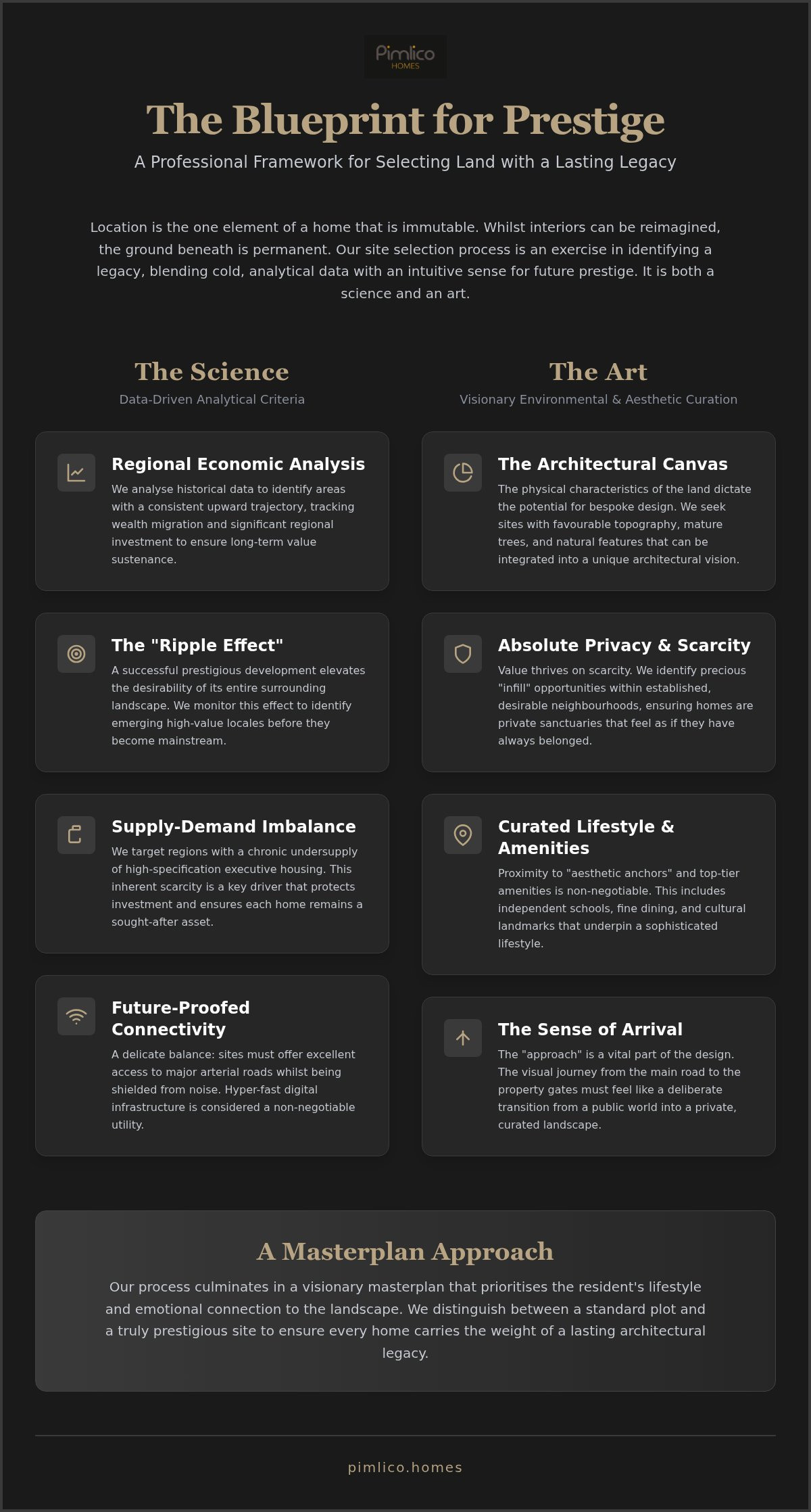
Location is the only element of a home that remains immutable. You can reimagine interiors, extend footprints, or refine facades, but the ground beneath the foundation is permanent. For a discerning developer, the site selection process is an exercise in identifying a legacy. A “Prime” location isn’t merely a point on a map; it represents a convergence of history, natural beauty, and social stature. It’s why how property developers choose locations is often described as both an art and a science. The psychological weight of an address is profound. It provides an immediate sense of security and belonging. Whilst emerging luxury areas offer the thrill of growth, established prestigious postcodes provide the reassurance of timelessness.
The Concept of Scarcity in Land Acquisition
Value thrives on scarcity. In the most desirable regions, land is a finite resource, and this limitation creates an inherent long-term protection for your investment. We look for “Infill” opportunities, which are small, precious pockets of land within established neighbourhoods. These sites allow for new construction without diluting the area’s existing character. Identifying these hidden gems requires a visionary eye. We seek out plots that offer absolute privacy, often tucked away behind mature treelines or amongst heritage residences, ensuring the home feels like it has always belonged there. This scarcity ensures that your home remains a unique asset in a crowded market.
Defining the ‘Executive’ Standard of Placement
Prestige is often measured by what isn’t there. High-density developments focus on convenience and volume, but an executive placement prioritises space, air, and silence. A luxury detached home requires a backdrop that reflects its architectural stature. It needs a stage. We consider the “approach” as a vital part of the design. The visual journey from the main road to the property gates should feel like a transition into a private sanctuary. It’s a methodical transition from the public world into a curated landscape. This deliberate pace of arrival establishes the tone for the entire living experience. It’s the difference between a house and a true estate.
Decoding the Market: The Analytical Criteria for Site Acquisition
Success in luxury development isn’t accidental. It’s the result of rigorous data analysis and a deep understanding of regional shifts. We look at where wealth is migrating and where significant regional investment is being concentrated. Understanding how property developers choose locations involves looking past the current market snapshot. We use historical data to identify areas with a consistent upward trajectory. We aren’t just looking for a site for today. We’re looking for a location that will sustain its value and prestige for decades to come.
The “Ripple Effect” is a powerful indicator that we monitor closely. When a prestigious development succeeds in a specific area, it often elevates the desirability of the entire surrounding landscape. We assess the supply-demand imbalance, particularly for luxury detached homes. In many regions, there is a chronic undersupply of high-specification executive housing. This scarcity is a key driver in our selection process. It ensures that every home we build remains a rare and sought-after asset.
Infrastructure and Connectivity for the Modern Professional
Connectivity is a delicate balance. A site must be accessible to major arterial roads for the modern professional, yet it must remain shielded from the noise of progress. Acoustic privacy is a hallmark of a premium address. Digital infrastructure is now equally critical. A luxury home in 2026 requires hyper-fast connectivity as a standard utility. We also look at future projects. A new bypass might enhance peace, whilst a planned commercial hub could diminish the exclusivity we guard so fiercely. We seek locations that are future-proofed against urban sprawl.
Planning and Regulatory Feasibility
Navigating the National Planning Policy Framework (NPPF) is a critical step in how property developers choose locations that offer both viability and prestige. We look for sites where the vision can be realised without compromise. Recent trends in zoning reform for housing, particularly those aimed at increasing supply near transit hubs, influence our long-term strategy. Green Belt and Conservation Area status add layers of complexity, but they also protect the long-term beauty of a neighbourhood. We prefer sites with “Pre-app” clarity. This early dialogue with planners ensures that our commitment to high-specification construction aligns with local authority expectations from the outset. It removes the uncertainty that can plague lesser developments.
The Architectural Canvas: Topography and Environmental Selection
The land itself dictates the limits of architectural imagination. When considering how property developers choose locations, the physical contours of a site are as vital as the postcode. A flat, featureless field offers ease of construction, but a site with natural variation offers character and soul. We look for land that allows for bespoke architectural design, where the home doesn’t simply sit on the ground but feels as though it emerges from it. Mature oaks, ancient hedgerows, and natural water features are viewed as “natural assets” rather than obstacles. These elements provide an instant sense of maturity and permanence that no amount of new landscaping can replicate.
Complex terrain is often avoided by volume builders due to its technical demands. For a luxury developer, a slope is an invitation to create tiered gardens and unique subterranean levels. This verticality adds a sense of drama and exclusivity to the property. Beyond the visible aesthetics, the technical integrity of the ground is a priority. Meticulous assessments of soil quality and drainage are essential. These invisible factors ensure the longevity of a high-specification build, protecting the structural legacy against the shifting British climate for generations to come.
Orientation and the Mastery of Natural Light
South-facing orientation remains a non-negotiable standard for the most prestigious developments. It’s an essential requirement for the mastery of natural light. Light is a luxury in itself. Expansive glazing is a hallmark of our executive homes, yet it must be balanced with absolute internal privacy. A well-selected site allows for floor-to-ceiling glass that captures the sun’s path throughout the day whilst remaining shielded from the public gaze. This careful orientation also enhances energy efficiency, allowing sustainable technologies to perform at their peak within a naturally warmed environment.
Heritage and Conservation Constraints
The quest for a unique placement often leads to sites with existing heritage assets. When identifying locations for luxury barn conversions, we seek out structures that offer a sense of grounded history. These sites allow us to work with the natural character of the British countryside rather than imposing something alien upon it. Existing stone walls or ancient timber frames provide a texture and weight that modern materials struggle to match. It’s a methodical process of preservation and innovation. We ensure the development respects the heritage of the land whilst providing the uncompromising comforts of a modern executive lifestyle.
Curating Lifestyle: Social and Aesthetic Considerations
A premium home is more than a physical structure; it is an invitation into a specific way of life. Understanding how property developers choose locations requires looking through the lens of the resident’s daily experience. We seek out “Proximity to Excellence.” This means identifying sites within a short radius of top-tier independent schools and established fine-dining hubs. For the executive buyer, time is the ultimate luxury. A location that offers seamless access to these pillars of lifestyle without sacrificing peace is a rare find. We look for the “Aesthetic Anchor.” A view of rolling countryside or the silhouette of a historic landmark adds an unquantifiable value that matures over time. These vistas provide a sense of permanence and connection to the British landscape.
Social fabric is equally vital. We evaluate the character of an area to ensure it aligns with the expectations of those who value discretion and quality. The ideal site offers “Quietude.” It must be far enough from the hum of industry to ensure absolute silence at night, yet close enough to cultural centres to remain vibrant. This balance is difficult to strike. It requires a methodical search for pockets of land that have remained untouched by urban sprawl whilst retaining their connection to the wider world.
Privacy and the Art of the Enclave
The shape of a site often dictates its potential for security. When we design our Executive Courtyard Homes, we look for specific plot geometries that allow for a communal sense of safety whilst protecting individual privacy. We utilise natural boundaries to create a gated feel without the need for aggressive physical gates. Mature woodlands, ancient stone walls, or subtle changes in elevation act as guardians of the enclave. This creates a sanctuary feel. It ensures that the resident’s private life remains entirely shielded from the public gaze, fostering a sense of exclusive belonging within a protected perimeter.
The Balance of Community and Seclusion
True luxury offers the choice between engagement and retreat. We select locations that provide a sense of belonging to an elite community of like-minded individuals. Walkability is a key factor. We look for sites where one can walk to local artisan amenities, such as a boutique bakery or a specialist grocer, whilst still returning to the absolute seclusion of a private estate. It is a delicate equilibrium. Every development we undertake is designed to add to the local architectural vernacular rather than disrupt it. We ensure that our presence enhances the area’s heritage, securing the long-term stature of the neighbourhood for all who live there.
Discover our latest vision for luxury new build homes and see how we translate these lifestyle considerations into reality.
The Pimlico Perspective: How We Identify Exceptional Potential
At Pimlico Homes, our 25-year heritage has taught us that a site’s potential isn’t just about what’s on the surface. It’s about the legacy it can support. Our specific approach to how property developers choose locations is defined by a commitment to the “Masterplan.” Before the first stone is laid, we envision the resident’s lifestyle in its entirety. We consider the quietude of a morning coffee on a south-facing terrace and the sense of security felt when passing through a private entrance. We prioritise sites that offer the footprint for detached living and expansive outdoor spaces. This isn’t just construction. It’s the creation of a sanctuary.
Our rigorous selection process ensures that every Pimlico home is an investment in quality. We don’t just build houses. We curate environments where families can thrive and where architectural beauty meets functional excellence. This methodical vetting of land allows us to maintain our position as a leader in the luxury market. We act as guardians of your investment, selecting only the locations that promise longevity and prestige.
Selecting for Bespoke Potential
A site must be more than just buildable. It must be inspiring. We assess a location’s ability to host high-specification interior architectural planning, looking at how the natural light interacts with the internal volumes we intend to create. There is a vital synergy between the land and the level of finish we provide. For those looking to understand the finer details of our builds, Deciphering New Build Home Specifications offers a deeper look at the standards we uphold. We only select sites that allow our bespoke vision to flourish without compromise, ensuring every room has a purpose and a view.
The Vision for Executive Courtyards
Our choice of location is driven by a desire for stature. We seek out settings that naturally foster a sense of curated privacy and shared prestige. This is particularly evident in our approach to The Allure of Executive Courtyard Homes, where communal security meets individual seclusion. Every development location must reflect our history of excellence. We ensure the orientation of the land supports the privacy our clients demand. Whilst many seek the path of least resistance, we embrace the technical complexities that lead to architectural distinction. This ensures that a Pimlico address remains a hallmark of success and a testament to refined taste.
Securing Your Architectural Legacy
Understanding the intricate process of how property developers choose locations reveals that a prime address is never a matter of chance. It’s the result of balancing technical analytical data with a visionary eye for natural beauty and social stature. By prioritising scarcity, topography, and a proximity to excellence, a developer creates more than just a residence; they establish a permanent sanctuary. Legacy is built on ground that inspires. Every site must offer the potential for a home that feels both modern and timeless.
At Pimlico Homes, we bring over 25 years of specialist luxury development experience to every site we select. Our award-winning commitment to high-specification craftsmanship ensures that each home in our portfolio of exclusive developments is a masterpiece of design. These homes are situated in the country’s most sought-after enclaves, where privacy and prestige are guaranteed. We invite you to explore our current portfolio of expertly situated luxury developments and discover how our meticulous site selection creates the perfect foundation for your lifestyle. Your journey towards a home that reflects your true stature begins with a single, perfectly placed step.
Frequently Asked Questions
What is the most important factor property developers consider when choosing a location?
Scarcity remains the most vital factor in the site selection process. A location must offer a unique quality that cannot be easily replicated elsewhere, such as a protected view or an established social stature. When assessing how property developers choose locations, we look for land that supports a legacy. It isn’t just about the current market price. It’s about the inherent value of a site that will remain exclusive for generations.
How do developers find ‘off-market’ land for luxury developments?
Finding off-market land requires a combination of deep regional roots and a reputation for excellence. We often secure sites through direct dialogue with landowners who value discretion and quality. These opportunities never reach the public market. By maintaining these long-standing relationships, we identify hidden gems, such as secluded paddocks or heritage farmsteads, that provide the perfect canvas for a luxury detached home or a bespoke courtyard development.
Does a location’s history affect its development potential?
A location’s history is a significant asset that adds a sense of permanence and soul to a new development. We look for sites with grounded history, such as those featuring ancient stone walls or proximity to historic landmarks. This heritage provides an emotional connection that modern landscaping alone cannot achieve. It ensures the development feels like a natural extension of the landscape rather than a temporary addition to a suburb.
What is the difference between a brownfield and a greenfield site for luxury builds?
Brownfield sites are previously developed plots, whilst greenfield sites represent land that has never been built upon. For luxury builds, we often seek out high-potential brownfield sites, such as redundant agricultural buildings, for luxury barn conversions. These sites offer unique character and established boundaries. Greenfield sites are prized for their untouched natural beauty and the freedom they provide for expansive architectural planning and south-facing garden orientations.
How does the National Planning Policy Framework influence site selection?
The National Planning Policy Framework (NPPF) provides the essential rules for sustainable development in the UK. It’s a core part of how property developers choose locations that are both viable and prestigious. We use the framework to ensure our vision aligns with national standards for quality and conservation. This methodical approach ensures that our developments are legally robust and environmentally responsible from the very beginning of the project.
Why is proximity to independent schools so important for executive developments?
Proximity to top-tier independent schools is a primary lifestyle anchor for executive buyers. Families often choose their residence based on the educational opportunities available nearby. By selecting sites within a short radius of elite institutions, we ensure the property remains a highly sought-after asset. This proximity saves valuable time for busy professionals, allowing them to balance a demanding career with a rewarding family life in a prestigious, quiet setting.
How do developers balance privacy with connectivity when choosing a site?
Balancing these two pillars requires a visionary approach to site orientation and natural screening. We seek locations that offer seamless access to major arterial roads whilst using mature woodlands or stone walls to block acoustic intrusion. It’s a question of creating a private sanctuary that doesn’t feel isolated. The ideal site allows you to reach a cultural centre in minutes, yet offers absolute silence once you pass through your property gates.
What role does topography play in the cost and feasibility of a luxury project?
Topography is the silent architect of a luxury project. Whilst complex terrain increases engineering costs and foundation requirements, it also creates the opportunity for tiered landscaping and subterranean features. A sloping site allows for unique views and a sense of vertical drama that flat plots lack. We view these physical challenges as assets that enhance the bespoke character of the final build, ensuring the home truly belongs to its landscape.


