
A luxury label is frequently little more than a sophisticated coat of paint applied to a standard floor plan. It’s an all too common frustration for the discerning buyer. You’ve likely encountered properties where the executive tag feels like a transient marketing tactic rather than a permanent mark of quality. Understanding what makes a home ‘executive’ in 2026 requires looking far beneath the surface finishes to the very soul of the architectural intent. True prestige isn’t found in a list of expensive materials. It’s found in the intersection of high-status stature and a layout meticulously engineered for the modern professional’s complex life.
We’ll help you navigate the ambiguity of estate agent terminology to ensure you never overpay for a standard house with a luxury label. This article provides a definitive checklist of the architectural, interior, and lifestyle hallmarks that distinguish a true executive residence from its peers. You’ll gain a deep understanding of the investment value inherent in bespoke developments and curated enclaves. From the evolution of the high-level home office to the nuances of sophisticated hosting spaces, we’ll provide the confidence to identify a build that truly reflects your achievements and supports your future.
Key Takeaways
- Understand the precise criteria for what makes a home ‘executive’ in 2026, moving beyond vague marketing labels to identify true architectural stature.
- Identify why a detached profile and the use of enduring materials like natural stone are essential for establishing a property’s presence and long-term value.
- Discover the evolution of high-specification interiors, where dedicated, acoustically treated professional suites have become a non-negotiable requirement for high-level productivity.
- Explore the strategic importance of curated enclaves and executive courtyards in providing the ultimate balance of privacy, security, and communal prestige.
- Recognise the investment value of bespoke craftsmanship and how a quarter-century of heritage in luxury development ensures a home meets the highest standards of modern excellence.
The Definition of an Executive Home: Beyond the Real Estate Label
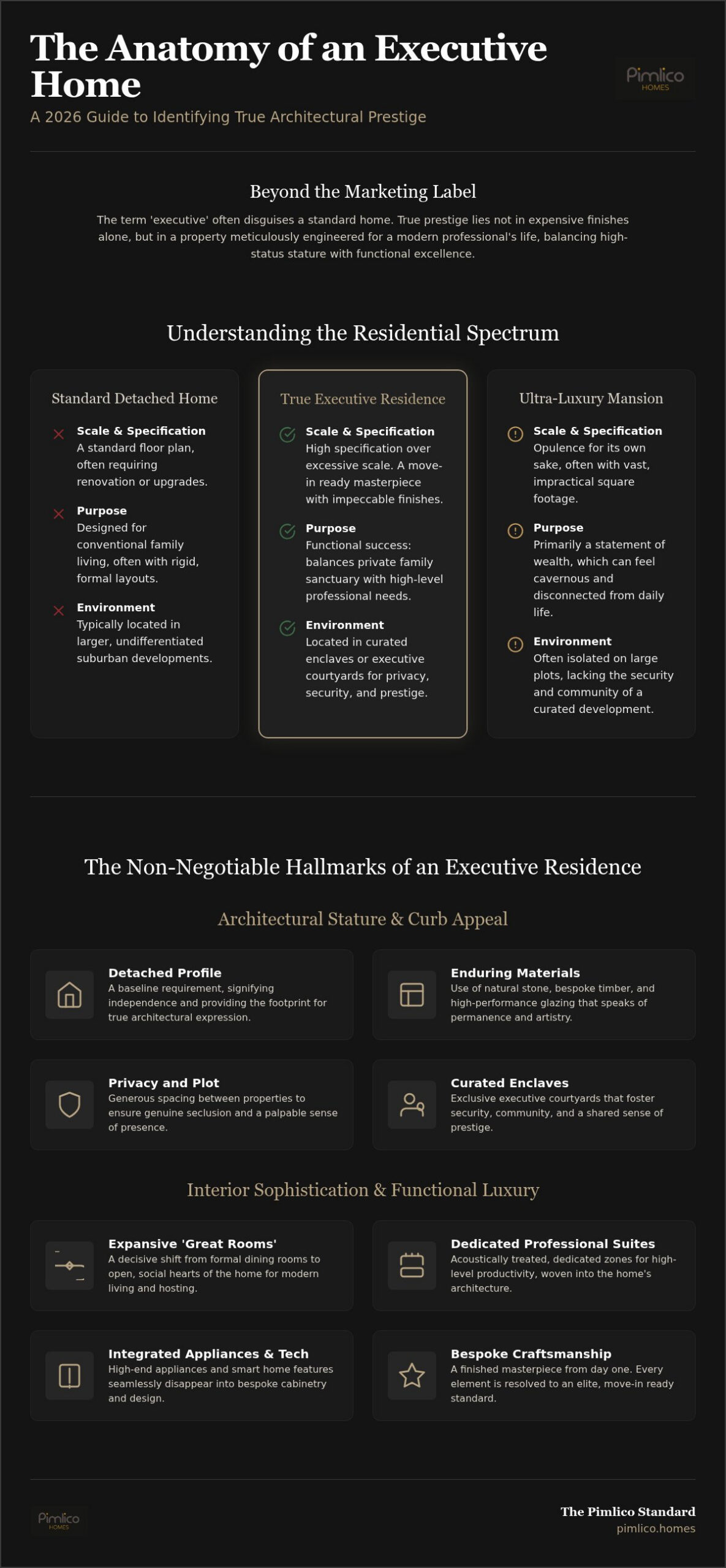
The term ‘executive’ is frequently brandished as a generic synonym for ‘expensive’. This is a misconception that does a disservice to the architectural precision required to earn the title. In 2026, discerning what makes a home ‘executive’ involves identifying it as a distinct tier of residential excellence. It sits purposefully between the standard detached family home and the sprawling, often impractical, ultra-luxury mansion. It’s a residence defined by functional success; a space that serves as a tangible reward for professional achievement whilst remaining a highly efficient tool for modern living.
Expectations have shifted. An executive property is no longer a project for the future. It’s a finished masterpiece from the moment the keys are handed over. This ‘move-in ready’ ethos is central to the definition. The professional buyer isn’t looking for a canvas to renovate; they’re seeking a high-specification environment where every detail, from the smart home integration to the kitchen cabinetry, has already been curated to an elite standard. Every element must be resolved. Every finish must be impeccable.
The Professional’s Retreat: Function Meets Form
The floor plan of an executive home must perform a delicate balancing act. It needs to provide a sanctuary for private family life whilst effortlessly facilitating high-level professional requirements. We’ve seen a decisive shift away from the rigid, formal dining rooms of the past. Instead, the focus has moved towards expansive ‘great rooms’ that act as the social heart of the home. These spaces are complemented by integrated, high-end appliances that disappear into bespoke cabinetry, ensuring the aesthetic remains undisturbed by the mechanics of daily life. Productivity is woven into the architecture through dedicated zones that allow for focus without isolation.
Executive vs. Luxury Estates: Understanding the Spectrum
Luxury is often associated with opulence for its own sake, frequently resulting in vast manor houses that feel cavernous and isolated. In contrast, the executive standard prioritises high specification over excessive scale. It’s about the quality of the experience rather than the quantity of the square footage. These homes are designed to be manageable and intimate, often located within curated enclaves or executive courtyard developments. This positioning ensures a sense of community and security that isolated grandeur simply cannot provide. It’s a more refined approach to prestige, focusing on meticulous craftsmanship and the emotional weight of a significant life investment. The result is a home that feels like a visionary creator’s output, grounded in traditional values yet forward-thinking in its execution.
Architectural Stature and Curb Appeal: The Exterior Hallmarks
Curb appeal in the premium sector is about more than a tidy driveway or a manicured lawn. It’s about a palpable sense of presence. When discerning what makes a home ‘executive’, the first indicator is how the building commands its plot. A detached profile isn’t just a preference; it’s a baseline requirement for this tier of housing. It signifies independence and provides the physical footprint necessary for architectural expression. The materials used must speak of permanence and artistry. In 2026, we see a decisive move away from standard brickwork towards the use of natural stone, bespoke timber cladding, and expansive high-performance glazing. These elements don’t just look superior. They offer a tactile quality and a commitment to longevity that mass-market builds simply cannot replicate.
The executive courtyard has emerged as a definitive British hallmark of prestige. This concept moves beyond the traditional cul-de-sac to create a curated environment where the shared space is as meticulously designed as the private residences. It offers a sense of arrival that establishes immediate authority. It’s a secure, exclusive enclave that fosters a quiet confidence amongst its residents. Professional landscaping plays a vital role here, using structural planting and high-quality hardscaping to define boundaries without the need for harsh, industrial fencing.
The Importance of Plot and Privacy
Space remains the ultimate luxury. Executive homes require generous spacing between neighbours to ensure true seclusion. We prioritise the use of ‘natural boundaries’ such as mature hedgerows and hand-built stone walls. These features provide a sense of security whilst softening the property’s transition into the surrounding landscape. The orientation of the home is equally vital. Each property is methodically positioned to capture maximum natural light throughout the day whilst ensuring that primary living spaces aren’t overlooked. It’s a deliberate approach to site planning that values the internal experience as much as the external view.
Architectural Integrity: Bespoke vs. Mass Market
A true executive residence avoids the ‘cookie-cutter’ feel of large-scale developments. It features unique elevations that reflect a visionary approach to design. This often involves a sophisticated fusion of architectural forms. We see this most clearly when integrating traditional structures with ultra-modern elements. For example, the transition from heritage stonework to modern barn conversion interiors represents a masterclass in refined rural luxury. This blend of old and new creates a home that feels grounded in history yet perfectly suited for contemporary life. If you’re seeking a property that transcends the ordinary, explore our collection of luxury detached homes to see this philosophy in practice.
Interior Sophistication: High Specification and Functional Luxury
If the exterior establishes a property’s stature, the interior defines its soul. In 2026, understanding what makes a home ‘executive’ requires a shift in focus from the visible to the structural. High specification is no longer just about the brand of the oven or the choice of tiles. It is about the hidden layers: the acoustic insulation between floors, the precision of the underfloor heating, and the seamless integration of services that remain entirely out of sight. True functional luxury is felt rather than seen. It is the silence of a well-built room and the effortless flow of a space that anticipates the needs of its inhabitants.
The most significant interior evolution is the rise of the ‘Professional Suite’. This is not merely a desk tucked into a spare bedroom. It is a dedicated, acoustically treated environment designed for high-level productivity. With the permanent shift towards hybrid work for senior leaders, a silent, professionally lit space for global video conferencing is a non-negotiable hallmark of the executive standard. It requires high-bandwidth connectivity and a layout that allows for professional focus without total isolation from the rest of the home.
The social heart of the property has also been reimagined. Kitchens now feature oversized quartz islands that act as both a culinary theatre and a casual gathering point. However, the mechanics of hosting are increasingly tucked away. Hidden ‘butler’s pantries’ allow the primary kitchen to remain a pristine social space whilst the preparation and cleaning occur out of sight. This philosophy extends to the master suites, which now function as three-zone private sanctuaries. They comprise a restful sleeping area, a walk-in dressing room, and a four-piece en-suite that prioritises tranquillity and craftsmanship.
The Evolution of the Executive Floor Plan
The rigid boundaries of ‘open-plan’ living have matured into ‘broken-plan’ layouts. This approach uses internal glazed partitions or subtle level changes to retain natural light whilst providing the acoustic privacy required for a multi-generational household. Volume is also a key differentiator. Increased ceiling heights and widened internal doors contribute to a sense of stature that standard homes cannot match. The grand entrance hall sets this tone immediately, acting as a transition space that commands respect through sheer scale and light.
Smart Technology and Energy Efficiency
Prestige is now inextricably linked with intelligence and sustainability. An executive home in 2026 is an automated ecosystem where lighting, climate, and security are managed through a single, intuitive interface. This technical sophistication extends to the building’s fabric. A-rated energy efficiency is more than a cost-saving measure; it is a mark of a high-performance asset that holds its value. For a deeper look at these technical requirements, consult our buying a luxury new build guide.
Selecting the Right Development: Location, Privacy, and Enclaves
The setting is the silent partner of architectural excellence. You cannot define what makes a home ‘executive’ by looking at the four walls in isolation. The calibre of the surrounding development is just as vital as the specification of the kitchen or the height of the ceilings. A true executive residence requires a context of equal quality. This is why limited-number developments are so highly prized. They avoid the over-developed, congested feel of standard housing estates, replacing density with space and generic landscaping with a curated streetscape that commands respect from the moment you arrive.
The rise of the ‘Executive Courtyard’ represents a masterclass in modern British prestige. It is perhaps the most visible indicator of what makes a home ‘executive’ in a competitive market. Unlike the sprawling cul-de-sacs of the past, these are intimate, high-security environments designed for a specific demographic. They offer a sense of communal prestige whilst maintaining absolute individual privacy. It is this balance that creates the ‘enclave’ feel; a sanctuary where every property shares the same commitment to high-end maintenance and architectural integrity.
The Appeal of Exclusive Enclaves
Gated access and private roads are the physical manifestations of this exclusivity. When you enter a curated enclave, the transition from the public world to a private domain is immediate. This uniform excellence ensures that the ‘curb appeal’ of your property is never compromised by a neighbour’s lack of care. A well-managed streetscape acts as a frame for the architecture, enhancing the emotional and financial value of the investment. For those seeking the pinnacle of this format, we explore these themes in our guide to executive courtyard homes.
Long-Term Asset Security
Investment logic dictates that scarcity drives value. There are only so many bespoke plots available in prime locations, making homes in these developments remarkably resilient assets. They are often considered ‘recession-proof’ because the demand for high-specification, private living consistently outstrips supply. Understanding the resale value of new build homes in this category reveals a pattern of strong capital growth. If you are ready to secure your place in a curated community, explore our latest executive courtyard homes to find your next investment.
The Pimlico Standard: Why Our Executive Homes Define the Modern Era
Pimlico Homes has spent a quarter of a century refining the definition of the premium residence. We don’t merely construct buildings; we architect a lifestyle that reflects the stature of those who inhabit it. Our focus remains steadfast on luxury detached homes and executive courtyard developments. These models represent the pinnacle of modern living. They offer a sanctuary that is increasingly rare in a world of high-density housing. It’s a commitment to quality that has been honed over 25 years of industry experience.
When we evaluate what makes a home ‘executive’, we look for a standard that exceeds industry norms. It’s found in the quiet confidence of a stone-built elevation. It’s present in the seamless operation of a high-specification smart home system. We believe that prestige is a permanent quality, built into the very fabric of the property. This ‘Pimlico Difference’ is a focus on privacy and stature that ensures every residence we create stands as a bold leader in its field.
A Commitment to Craftsmanship
Our portfolio is a testament to diverse architectural excellence. Whether we are delivering bespoke luxury homes or intricate luxury barn conversions, the commitment to artistry remains unchanged. Every project is a masterclass in meticulous care. We focus on the hidden details that define longevity. This includes everything from the precision of the external masonry to the hand-finished quality of the internal cabinetry. We understand the emotional weight of a significant life investment. Our role is to act as a reliable guardian of that quality, ensuring that your home remains a source of refined pride for decades to come.
Your Journey to Executive Living
The transition into a Pimlico home is a methodical and deliberate process. It begins with a vision and ends with a masterpiece. We invite you to explore our current developments to see how we translate what makes a home ‘executive’ into physical reality. From the first inquiry to the final handover, the narrative is one of sophistication and support. We don’t just sell houses; we provide a visionary environment where you can thrive. This is the promise of the Pimlico standard: a home that embodies the permanence and artistry of a life well-lived.
Securing Your Future in an Executive Masterpiece
The evolution of the premium property market has redefined the boundaries of residential excellence. We’ve moved beyond simple luxury to a standard where every architectural decision serves a purpose. Identifying what makes a home ‘executive’ in 2026 requires looking for that perfect intersection of privacy, high-specification functional design, and the security of a curated enclave. It’s about a residence that supports your professional productivity whilst providing an uncompromising sanctuary for your family life. It’s a tangible reward for your success.
Pimlico Homes brings 25 years of luxury development expertise to every project. We specialise in exclusive courtyard enclaves and bespoke detached builds where award-winning attention to architectural detail is the baseline. We invite you to move beyond the ambiguity of standard real estate labels and experience a home that truly reflects your achievements. Discover the Unrivalled Stature of Pimlico Homes and take the first step towards a residence built with permanence and artistry. Your vision of the perfect executive lifestyle is waiting.
Frequently Asked Questions
What is the difference between a luxury home and an executive home?
A luxury home often prioritises opulence and sheer scale, whilst an executive home is defined by functional prestige. When considering what makes a home ‘executive’, look for a layout engineered for the modern professional. These properties balance high-status architectural stature with practical features like acoustically treated offices. They are designed to be managed easily without sacrificing the high-specification finishes that signify a significant life investment.
How many bedrooms does an executive home usually have?
Most executive homes feature four or five bedrooms, but the focus is on the quality of these spaces rather than the count. A primary hallmark is the master suite, which usually includes a dressing room and a four-piece en-suite. Additionally, one bedroom is frequently repurposed or specifically designed as a professional suite. This ensures the home facilitates both high-level hosting and the productivity required by senior leaders in 2026.
Is an executive home a good long-term investment?
Executive residences are traditionally considered resilient assets due to their inherent scarcity and high build quality. Properties situated within curated enclaves or executive courtyard developments tend to retain their value more effectively than standalone houses. The combination of bespoke architectural design and a prime location creates a high-performance asset. Buyers often view these homes as secure investments that offer both lifestyle benefits and long-term capital security.
What are the essential smart home features in a 2026 executive residence?
In 2026, an executive residence must function as an intelligent ecosystem. Essential features include integrated climate control, automated smart lighting, and advanced security systems managed through a single interface. High-bandwidth connectivity is also vital to support a professional home office. These technologies are woven into the fabric of the building, providing a seamless experience that enhances the hidden quality of the home whilst improving overall energy efficiency.
Why are executive courtyard developments becoming more popular?
The appeal of executive courtyard homes lies in the perfect balance of privacy and communal prestige. These developments create an exclusive enclave feel that standard housing estates cannot match. Residents benefit from a secure, limited-number environment where the shared streetscape is as meticulously maintained as the individual properties. This format fosters a sense of security and quiet confidence, making it a highly desirable choice for the discerning professional.
Does an executive home have to be a new build?
An executive home doesn’t strictly have to be a new build, though the move-in ready expectation makes high-specification new builds very attractive. Luxury barn conversions are a prime example of how traditional structures can be reimagined to meet the executive standard. The key is that the property must feature modern architectural integrity and high-end finishes from day one, regardless of whether it is a heritage restoration or a contemporary construction.
What kind of plot size should I expect with an executive detached home?
You should expect a plot that provides generous spacing between neighbours to ensure absolute seclusion. Whilst smaller than a vast manor estate, the grounds of an executive detached home are designed to accommodate natural boundaries like stone walls or mature hedgerows. The orientation is carefully planned to maximise natural light and prevent overlooking. This ensures the property has a palpable sense of presence without the overwhelming maintenance requirements of a larger country estate.
How does the ‘executive’ label affect the resale value of a property?
The executive label indicates a property that meets a specific tier of residential excellence, which helps attract a high-intent, discerning demographic. Understanding what makes a home ‘executive’ allows buyers to recognise the hidden value in high-performance materials and bespoke designs. Because these homes are often located in limited-number developments with high-specification finishes, they typically command a premium on the resale market and offer strong capital growth potential.


