
True luxury isn’t found in the height of a fence but in the depth of a landscape. Mastering garden design for privacy in a new estate requires more than just perimeter planting; it demands a vision that reconciles personal intimacy with architectural elegance. You likely understand the frustration of a new build plot, where the lack of mature greenery makes your private world feel like a public stage. It’s a common challenge for the discerning homeowner who values seclusion as much as style.
This masterclass will show you how to transform a sterile blank canvas into a prestigious sanctuary through sophisticated layering and strategic structure. We shall explore how pleached trees, climate-smart screening, and executive courtyard designs create a retreat that enhances both your lifestyle and your property’s value. You’ll discover that a garden can be much more than a boundary; it can be a curated experience of quiet confidence and enduring beauty. By the end of this guide, you will have the blueprint to turn an overlooked space into a masterpiece of seclusion.
Key Takeaways
- Master the concept of architectural layering by using bespoke pergolas and gazebos to disrupt sightlines and establish immediate intimacy within your plot.
- Implement effective garden design for privacy in a new estate through the strategic use of mature, evergreen planting for year-round stature and screening.
- Learn to zone your outdoor space into distinct “rooms” and utilise level changes to create sunken areas that feel naturally secluded from the surrounding environment.
- Appreciate how true seclusion begins with the architectural vision of the developer, ensuring sightlines are managed from the very first blueprint.
- Elevate your property’s prestige by moving beyond simple fencing towards a curated landscape that harmonises with the sophisticated design of a luxury home.
The Challenge of Privacy in Modern Executive Estates
Privacy by Design. This is the philosophy that treats the garden as a seamless extension of the interior living space. In the context of garden design for privacy in a new estate, the objective is to create a sanctuary that feels both expansive and entirely protected. New developments often suffer from a “goldfish bowl” effect. This occurs because young planting and open-plan layouts provide little resistance to prying eyes. Whilst the internal architecture may be flawless, the lack of external enclosure can leave residents feeling exposed. The challenge lies in maintaining the grand, far-reaching views that characterise executive living whilst securing the intimate personal space your family deserves. It’s about finding that delicate equilibrium between an open, airy feel and the security of a private domain.
Identifying Sightline Vulnerabilities in New Plots
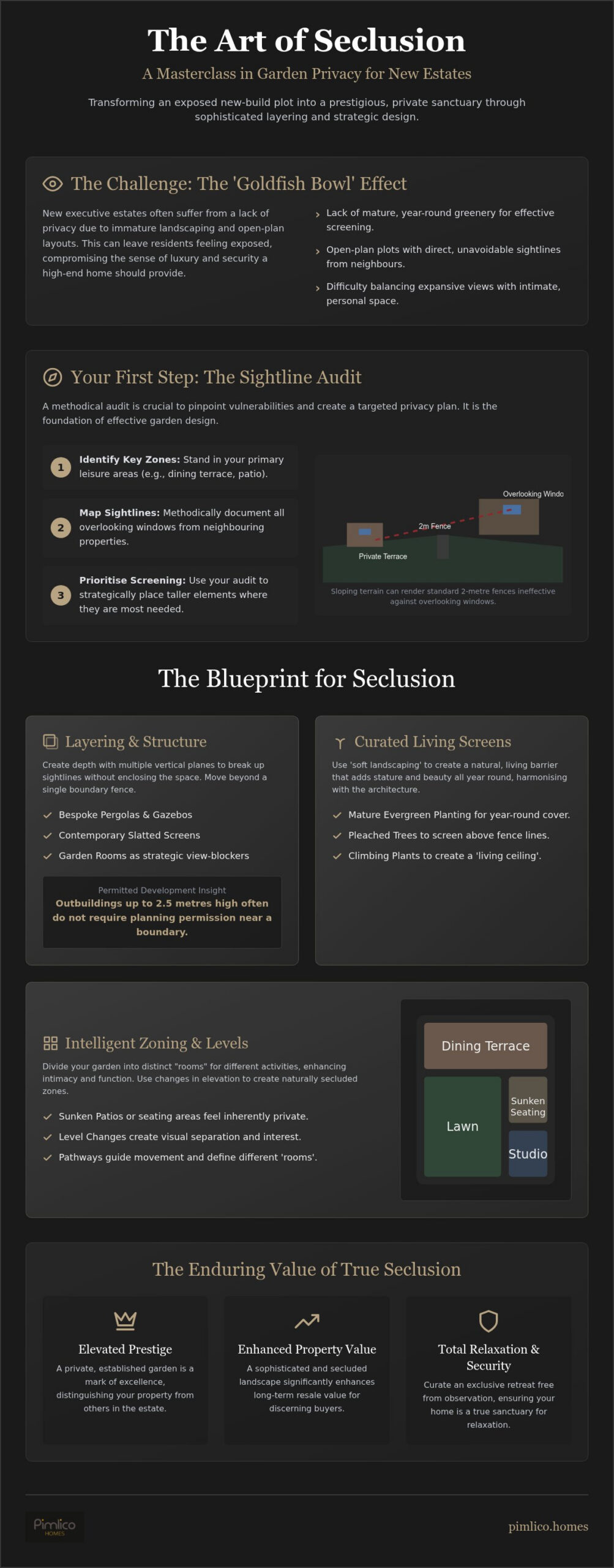
A sightline audit is the first step in reclaiming your seclusion. You must map overlooking windows from neighbouring properties whilst standing in your key leisure zones. It’s a methodical process. Start at your primary dining terrace and look upwards. The impact of sloping terrain can be particularly deceptive; a property situated just a few feet higher than yours can render a standard boundary fence entirely ineffective. In the UK, garden fences can generally be built up to 2 metres high without needing planning permission, but this height is often insufficient on tiered estates. By pinpointing these specific vulnerabilities, you can prioritise where to install taller, more sophisticated screening elements that work within permitted development rights.
The Psychological Value of a Secluded Sanctuary
Privacy is an essential element of prestige. It provides a sense of security that is vital for high-end living. Rather than simply hiding from the world, you are curating an exclusive retreat that reflects your personal standards. This architectural enclosure also serves a practical purpose. It significantly enhances the long-term resale value of luxury detached homes. Potential buyers view a private, established garden as a mark of excellence. Whether you utilise a traditional hedge or a modern slatted screen, the investment is one of both emotional and financial weight. It’s a mental shift from basic boundary marking to the creation of a private estate. Achieving high-quality garden design for privacy in a new estate ensures your home remains a place of total relaxation, free from the noise and observation of the outside world.
Architectural Layering: Seclusion Beyond the Boundary Fence
Depth is the secret to true seclusion. When considering garden design for privacy in a new estate, a solitary fence is rarely enough to counter the elevated sightlines of neighbouring properties. Architectural layering solves this by introducing multiple vertical planes between your terrace and the boundary. This technique creates a visual baffle, breaking up the view without making the garden feel claustrophobic. Contemporary slatted screening panels, often crafted from durable cedar or powder-coated aluminium, provide a refined solution. They offer a sophisticated, modern aesthetic that filters light beautifully whilst ensuring your private moments remain exactly that.
Using Pergolas and Living Structures
Bespoke pergolas and oak-framed gazebos act as structural anchors within a landscape. These are not merely decorative; they are strategic tools for privacy. When designing a sustainable landscape, the focus should be on how these structures can be positioned to frame preferred views whilst masking less desirable ones. Integrated louvred roofs allow for a bespoke level of enclosure, giving you the power to adjust your environment at the touch of a button. Training climbing plants like Wisteria or fragrant Jasmine over these frames adds a layer of organic density. It creates a living ceiling that provides both fragrance and a natural shield from overlooking windows.
Strategic Placement of Garden Rooms and Studios
Garden rooms and studios represent the ultimate marriage of utility and privacy. Positioning a home office or personal gym at a specific angle can effectively truncate the view from a neighbour’s balcony. These buildings should always mirror the high-quality materials of the main residence to ensure aesthetic harmony. In 2026, navigating permitted development rights remains a critical part of the process. Most outbuildings can be constructed up to 2.5 metres high without planning permission if they are close to the boundary. This height is often perfect for creating a permanent, sound-dampening barrier.
The benefits of using a garden studio as a privacy barrier include:
- Immediate physical obstruction of intrusive sightlines.
- Substantial reduction in ambient noise from nearby properties.
- Enhanced property value through the addition of versatile living space.
Our luxury new build homes are designed with these spatial relationships in mind, ensuring your plot is ready for such prestigious additions. By treating the garden as a series of layered experiences, you move away from the goldfish bowl feeling and towards a home that feels like a true private estate.
Curating Your Living Screen: Soft Landscaping for Stature
Stature is not merely grown; it is curated. For the discerning homeowner, waiting a decade for saplings to mature is an unacceptable compromise. Effective garden design for privacy in a new estate requires an “instant impact” approach, utilising semi-mature specimens that provide immediate enclosure. This method transforms a sterile plot into a settled, prestigious sanctuary from the day you move in. When reviewing Landscape Design: Ten Important Things to Consider, one quickly learns that the functional role of plants is as vital as their beauty. By selecting trees and shrubs with significant height and density, you establish a living barrier that feels like a natural part of the landscape rather than a desperate attempt at concealment.
Pleached Trees: The Hedge on Stilts Solution
Pleached trees are the gold standard for executive privacy. Often described as a “hedge on stilts,” varieties such as Hornbeam or Portuguese Laurel are trained onto flat frames to create a high-level screen. This architectural technique allows you to maintain the height of seclusion without violating standard 2 metre fence regulations. It creates a “floating” green wall that masks the windows of neighbouring properties whilst preserving precious ground-level planting space. This layering of vertical interest ensures your garden feels expansive yet entirely protected from external sightlines. It’s a sophisticated solution that offers year-round structural integrity and a refined, estate-like aesthetic.
Evergreen Textures for Year-Round Seclusion
Diversity amongst your borders prevents a monolithic, clinical appearance. Whilst a traditional Yew hedge offers a sense of permanence and heritage, mixing it with the glossy, larger leaves of Portuguese Laurel adds light and movement to the garden. For a more contemporary, minimalist aesthetic, mature bamboo in bespoke planters can provide a rapid, rustling screen that filters both noise and light. It’s essential that your soft landscaping reflects the quality and longevity detailed in our buying a luxury new build guide. High-quality planting is an investment in your lifestyle, ensuring that your outdoor retreat remains a private, evergreen masterpiece through every season. Balancing this density with the need for light and air circulation is key to maintaining a healthy, vibrant ecosystem within your private grounds.
Consider these species for optimal screening:
- Photinia ‘Red Robin’: Offers vibrant seasonal colour and dense evergreen coverage.
- Western Red Cedar: A fast-growing conifer that provides excellent sound-dampening qualities.
- Holm Oak: A classic, stately choice for creating a dense, impenetrable canopy.
Zoning Your Outdoor Space for Intimate Living
Intimacy is often a product of scale. In a sprawling garden, the sense of being overlooked is magnified by the sheer openness of the terrain. Effective garden design for privacy in a new estate involves dividing the plot into distinct “outdoor rooms.” This architectural approach breaks up the line of sight and creates a series of curated experiences. By using internal walls, pergolas, or tall planting to define these zones, you move away from the traditional open-plan layout that often feels exposed. Each zone serves a specific purpose, from a sun-drenched breakfast terrace to a secluded evening retreat, ensuring that your family can enjoy the outdoors without feeling observed. The flow from your internal living space to these private outdoor zones should feel like a natural progression of the home’s prestige.
Creating Sunken Seating and Private Courtyards
Level changes are a masterstroke in high-end landscaping. Excavating a seating area by as little as 50cm can dramatically alter your perspective. This slight descent physically lowers your eye level below the top of standard boundary fences, instantly increasing your sense of enclosure. The fire-pit “den” is a prime example of this technique. It provides a sheltered, atmospheric space for evening entertaining that feels naturally removed from the surrounding estate. For those seeking the ultimate in seclusion, our executive courtyard homes North East offer a blueprint for how structural architecture can create a private world within the home’s footprint. These designs use the building itself to shield the outdoor space, providing a level of prestige that traditional detached plots often struggle to match.
The Role of Water Features in Acoustic Privacy
Privacy is as much about what you hear as what you see. In executive developments, the proximity of neighbouring properties can lead to intrusive noise pollution. Water features provide a sophisticated solution by introducing “white noise” into the environment. A sleek blade waterfall or a series of minimalist rills can effectively mask the sound of nearby chatter or passing traffic. Strategic placement is essential. Positioning a bubbling basalt stone or a gentle water curtain near your primary dining area creates a private acoustic bubble. This ensures your conversations remain confidential whilst adding a calming, rhythmic element to the garden’s atmosphere. It transforms a functional outdoor area into a true sensory sanctuary, free from the distractions of the outside world.
If you are looking to secure a property where privacy is considered from the first brick, explore our latest luxury new build homes. Our developments prioritise the relationship between internal flow and external seclusion, ensuring your home remains a private estate in every sense.
Integrating Privacy into Your Luxury New Build Vision
True seclusion is woven into the very fabric of a property’s design. It’s not merely a feature you add later; it’s a quality you select at the point of purchase. When considering garden design for privacy in a new estate, the choice of developer is the most significant decision you’ll make. We don’t view the garden as a leftover plot of land. It’s a deliberate extension of the bespoke living experience. During our initial architectural planning phase, we meticulously evaluate sightlines between properties. We ensure that windows and balconies are positioned to respect the intimacy of your outdoor sanctuary. Luxury detached homes offer the ultimate advantage here. Without shared boundaries, you have the autonomy to shape your entire perimeter, allowing for the sophisticated layering and screening techniques that define a prestigious residence.
Selecting a Plot with Inherent Privacy
The search for a sanctuary begins with the site map. Corner plots are often highly coveted because they frequently provide larger, more versatile gardens with fewer immediate neighbours. Cul-de-sac positions offer a different kind of prestige; they provide a quieter atmosphere with significantly less passing traffic. Bespoke builders prioritise plot orientation to maximise both natural light and seclusion. We look for permanent natural screening in the surrounding landscape, such as established woodland or historic stone walls, to anchor your private world. Evaluating these factors before the first brick is laid ensures your garden has the structural foundation required for total intimacy.
The Pimlico Standard: Executive Developments with Built-in Prestige
Our commitment to excellence extends from the foundation to the final architectural detail. We believe that a home’s stature is reflected in the harmony between its interior and exterior worlds. Our luxury new build homes set a new benchmark for executive living by integrating these privacy principles into the core design. We invite you to explore our portfolio of bespoke residences, where every plot is a curated masterpiece of security and style. To ensure your garden matches the standard of your new home, consider this final checklist:
- Conduct a thorough sightline audit from all primary leisure zones.
- Verify permitted development rights for any substantial garden structures.
- Invest in semi-mature planting to achieve an instant, settled impact.
- Integrate water features to establish a private acoustic soundscape.
- Ensure all hard landscaping materials complement the home’s architectural palette.
By following these principles, your outdoor space becomes more than a garden. It becomes a secluded retreat that protects your lifestyle for years to come. Your home should be your sanctuary, and that begins with a vision that values your peace as much as your prestige.
Securing Your Private Sanctuary
Achieving the perfect garden design for privacy in a new estate is an art form that balances structural precision with natural beauty. You now understand how architectural layering and the strategic use of semi-mature planting can dismantle the goldfish bowl effect. It’s about moving beyond the standard perimeter fence to create a series of intimate rooms that reflect your personal stature. True seclusion isn’t an afterthought; it’s a fundamental requirement of high-end living. Each layer of your landscape should serve as a testament to your standard of excellence.
At Pimlico Homes, we bring 25 years of architectural excellence to every development we undertake. As award-winning bespoke home builders and specialists in executive courtyard developments, we recognise that your home is your most significant life investment. We don’t just build houses; we curate environments where your privacy is guaranteed by design from the very first blueprint. Your retreat awaits. We invite you to explore our portfolio of bespoke luxury homes and discover a higher standard of living. Embrace the peace of a home designed specifically for your seclusion.
Frequently Asked Questions
Do I need planning permission for high privacy fences in a new estate?
UK regulations generally allow garden fences to be built up to 2 metres high without planning permission. If your boundary is adjacent to a highway or public footpath, this limit typically reduces to 1 metre. You should always check your property’s deeds for restrictive covenants, as these are common in executive developments to maintain a specific aesthetic. Adhering to these rules ensures your sanctuary remains legally sound whilst providing necessary seclusion.
What are the best fast-growing trees for privacy in the UK?
Photinia ‘Red Robin’ and Portuguese Laurel are exceptional choices for rapid, dense coverage in the British climate. Western Red Cedar is another stately option, providing a thick evergreen screen that also dampens ambient noise effectively. For a contemporary aesthetic, mature bamboo in large planters offers immediate height. These species ensure that garden design for privacy in a new estate delivers an instant sense of permanence and prestige without a decade-long wait.
How can I make my new build garden private without blocking light?
Slatted contemporary screens and pleached trees are the most effective solutions for maintaining light whilst securing privacy. The narrow gaps in slatted panels filter sunlight beautifully, creating a rhythmic play of shadow without the oppressive feel of a solid wall. Pleached trees provide a “hedge on stilts,” blocking overlooking windows but allowing light to reach the lower levels of your garden. This balance is crucial for creating an airy, sophisticated outdoor retreat.
Are pleached trees difficult to maintain in a luxury garden?
Pleached trees require a methodical pruning schedule to maintain their crisp, architectural form. Typically, you will need to trim the new growth once or twice a year to keep the screen dense and within its frame. Whilst this requires more attention than a standard tree, the result is a high-specification finish that reflects the artistry of a luxury home. Professional gardeners often manage this task to ensure the structural integrity remains flawless year-round.
Can I use garden rooms to increase the resale value of my property?
Garden rooms significantly enhance property value by providing versatile, high-specification living space. A well-placed studio acts as a physical barrier to neighbours, which is a major selling point in executive estates. Potential buyers view these structures as prestigious additions that offer both acoustic and visual privacy. In the luxury market, the combination of a functional home office and a secluded garden often commands a premium price and increases marketability.
What is the most effective way to block noise from neighbours in a garden?
Water features are the most sophisticated way to establish acoustic privacy in a garden. The consistent “white noise” from a blade waterfall or stone rill masks the sound of neighbouring chatter and passing traffic. Combining this with dense evergreen planting, such as a thick Yew hedge, creates a sensory barrier that absorbs sound waves. This dual approach ensures your conversations remain private and your outdoor space feels like a tranquil, isolated haven.
How do I deal with overlooking windows from a two-storey neighbour?
Pleached trees and bespoke pergolas are specifically designed to address sightlines from two-storey properties. By positioning these structures close to your seating area, you create a physical canopy that blocks the downward view from a neighbour’s upper floor. This technique provides overhead enclosure without the need for an excessively high perimeter fence. It effectively “roofs” your private zone, ensuring total seclusion whilst you relax on your terrace or dine amongst friends.
Is it better to hire a landscape architect or a garden designer for a new build?
A landscape architect is usually preferred for complex projects involving significant structural changes, drainage, or planning applications. They focus on the broader architectural relationship between the home and the terrain. Conversely, a garden designer excels in plant selection, seasonal colour, and intimate aesthetic details. For garden design for privacy in a new estate, a collaborative approach often yields the best results. It ensures that the technical structure and the living screen work in perfect harmony.


