
A luxury home is more than a structure; it’s a legacy built with precision and an unwavering commitment to artistry. Yet, even the most meticulously crafted residence requires a robust framework of protection to ensure its longevity. For the discerning homeowner, understanding your new build home warranty isn’t just about ticking a legal box, it’s about securing peace of mind for a significant life investment. You’ve likely spent years envisioning this space; the thought of structural concerns or an ignored snagging list can be a source of quiet anxiety that clouds the joy of your new acquisition.
We believe that true excellence in construction is matched by a dedication to service that extends far beyond the day you receive your keys. This guide will help you master the complexities of the 10-year protection cycle, from the initial two-year developer liability period to the long-term structural insurance provided by the 2026 NHBC or LABC standards. By the end of this article, you’ll have the clarity needed to handle the first years of occupancy with confidence, knowing exactly how your property is shielded from the unexpected. We’ll explore the nuances of the 2+8 rule and the evolving landscape of the New Homes Quality Code, ensuring your investment remains as pristine as the day it was realised.
Key Takeaways
- Distinguish between standard buildings insurance and structural warranties to ensure every facet of your high-end property is fully protected.
- Navigate the 10-year protection cycle with ease by mastering the transition from the initial two-year developer liability period to the subsequent insurance phase.
- Gain clarity in understanding your new build home warranty to effectively manage snagging lists and identify the difference between natural settlement and structural defects.
- Discover how professional warranties apply to bespoke architectural features and specialist materials found in luxury barn conversions and executive homes.
- Recognise that the ultimate security lies in the heritage of a developer whose commitment to excellence often exceeds the baseline requirements of any policy.
The Foundation of Peace of Mind: What is a Structural Warranty?
A luxury home is a sanctuary crafted with precision. It is a legacy in stone and glass. To protect such a significant asset, understanding your new build home warranty is essential. Unlike standard insurance policies that handle everyday mishaps, a structural warranty is a specialised 10-year insurance policy. It protects you against latent defects that might not be visible at the point of completion. These are issues rooted in the original design, materials, or workmanship of the building that only reveal themselves as the property matures.
For those acquiring luxury detached homes, this warranty acts as a seal of excellence. It isn’t merely a legal formality; it’s a testament to the property’s structural integrity. Most UK mortgage lenders won’t provide a loan for a new-build property unless it has an approved 10-year structural warranty from a recognised provider. This ensures the building meets rigorous technical standards. Having a comprehensive policy attached to your home adds immediate prestige. It signals to future owners that the property was built by a developer committed to long-term quality. To learn more about the broader context of these protections, you might ask, What is a Home Warranty? and how does it differ from the structural insurance provided by your developer?
Warranty vs. Home Insurance: A Crucial Distinction
It’s easy to conflate these two types of protection, yet they serve very different purposes. Standard home insurance is designed to cover accidental damage, fire, or theft. It handles the immediate risks of daily life. In contrast, a structural warranty covers the “skeleton” of the building. This includes the foundations, load-bearing walls, and the roof. Both are essential for protecting high-value residential assets. One protects against the unpredictable nature of the world, whilst the other protects against the hidden complexities of construction.
The Role of the Warranty Provider
Major providers such as the NHBC, LABC, and Premier Guarantee serve as independent auditors of quality. They don’t just provide insurance; they conduct a series of technical inspections throughout the construction process. These checks ensure that every stage of the build adheres to strict Building Regulations. A warranty from a reputable provider is a hallmark of a professional, regulated developer. It shows that the builder has nothing to hide. For a firm like Pimlico Homes, with 25 years of industry experience, these standards are a baseline. We view the warranty as a secondary layer of security that sits behind our own meticulous craftsmanship. It is a vital component in understanding your new build home warranty and the lasting protection it offers your estate.
The 10-Year Protection Cycle: Decoding the 2+8 Rule
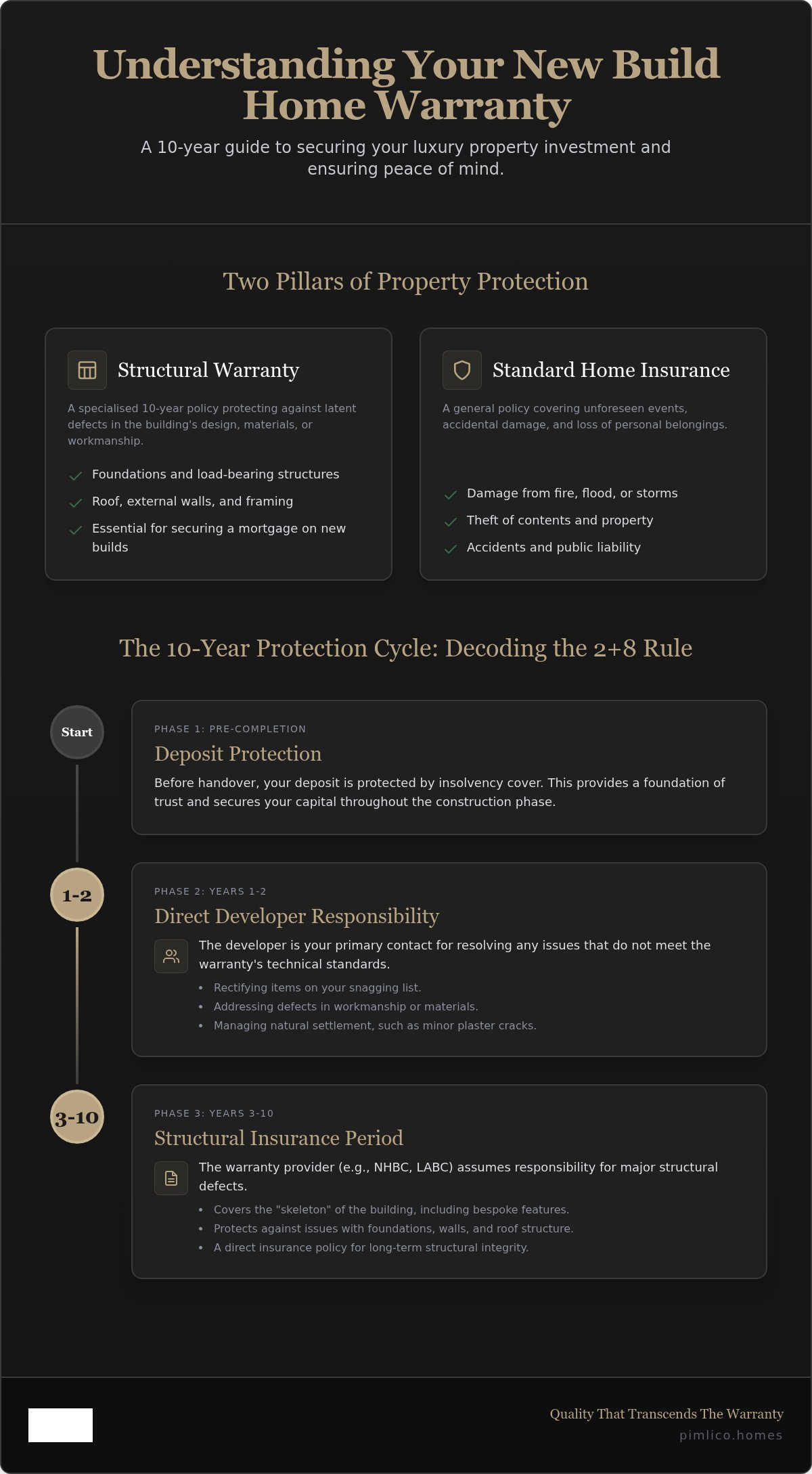
The 10-year warranty is not a monolith. It is a carefully orchestrated cycle of protection that evolves as your property matures. Before you even cross the threshold of your new residence, insolvency cover protects your deposit against the unforeseen. This initial layer ensures your capital remains secure throughout the construction phase, providing a foundation of trust before the first brick is even laid. Once the keys are handed over, the “2+8 rule” takes effect, dividing the decade into two distinct periods of accountability.
A clear grasp of these phases is vital for understanding your new build home warranty. It is the difference between a direct conversation with your builder and a formal claim with an insurance provider. This structure ensures that both the aesthetic finish and the structural integrity of your home are safeguarded by the most appropriate party at every stage of its early life.
The First Two Years: Direct Developer Responsibility
During the first twenty-four months of occupancy, the developer remains your primary point of contact. They are responsible for rectifying any defects that fail to meet the required technical standards. In high-end properties, this often involves managing the natural “settling” of the building. You might notice minor shrinkage cracks in plaster as the structure finds its equilibrium. Whilst FTC guidance on new home warranties offers a useful international benchmark for these expectations, the UK system is bolstered by specific services like the NHBC Resolution Service. This provides an independent path to ensure any legitimate snags are addressed with the care they deserve, maintaining the prestige of your investment.
Years Three to Ten: Structural Insurance Cover
As you enter the third year, the warranty transitions into a structural insurance policy. The provider now takes the lead. This coverage is strictly reserved for major components: the foundations, load-bearing walls, and the roofing system. For homeowners under the NHBC Buildmark scheme, there is a minimum claim value of £1,750 for this period. This threshold ensures the insurance remains focused on significant structural integrity rather than routine wear and tear. It is a period of long-term reassurance, protecting the very bones of your investment against latent defects. At Pimlico Homes, we take pride in the fact that our bespoke luxury homes are engineered to transcend these baseline requirements, often resulting in a decade of ownership defined by nothing but quiet enjoyment.
Beyond the Basics: What Luxury Homeowners Should Look For
Luxury properties are defined by their uniqueness. They often feature expansive glazing, intricate rooflines, and specialised materials that go beyond the remit of volume housebuilding. Consequently, understanding your new build home warranty requires a more nuanced perspective when dealing with bespoke architectural features. A standard policy might cover the basics, but for a high-end property, you must ensure that every non-structural but essential element, such as specialist waterproofing or custom-engineered facades, is fully integrated into the protection plan. These components are vital to the building’s envelope and require specific technical oversight.
For those currently exploring the market, our buying a luxury new build guide provides a detailed breakdown of the specifications that define a premium residence. These details aren’t just aesthetic; they are the foundation of the home’s long-term value and its warranty validity. High-specification materials require a higher standard of installation, and your warranty should reflect that level of care.
Bespoke Elements and Warranty Validity
Unique design features require early engagement with warranty inspectors. Whether it’s a cantilevered staircase or a double-height glass atrium, these elements must be vetted during the design phase to ensure they meet the technical requirements of providers like the NHBC or Premier Guarantee. At Pimlico Homes, we favour Tier 1 materials. This choice is deliberate. Using premium, proven components ensures the structural integrity of the build and simplifies the certification process, ensuring your bespoke luxury home remains a secure asset.
Luxury barn conversions present a specific set of challenges. These projects must marry heritage aesthetics with modern thermal and structural standards. A robust warranty for a conversion is a hallmark of quality, confirming that the original “bones” of the building have been expertly reinforced and insulated to 2026 standards, such as the LABC Technical Manual Version 13. It provides peace of mind that the charm of the past is supported by the engineering of the future.
Maintaining Your Investment
A warranty is a safeguard against defects, not a substitute for care. It’s vital to recognise that policies do not cover general wear and tear or issues arising from a lack of maintenance. The role of the homeowner is that of a guardian. Preserving the “as-new” condition of an executive estate requires a proactive approach. This involves a commitment to the property’s upkeep that mirrors the dedication shown during its construction.
Regular professional gutter cleaning and roof inspections are not merely optional tasks; they are essential for protecting the building’s envelope. Water ingress caused by blocked drainage is often excluded from warranty claims if maintenance has been neglected. By treating your property with the same meticulous care used during its construction, you ensure that understanding your new build home warranty remains a theoretical exercise rather than a practical necessity. Longevity is a partnership between the visionary builder and the dedicated owner.
Navigating the Snagging and Defects Period with Confidence
The moment you receive the keys to a bespoke residence is a milestone defined by achievement. However, the transition from construction to occupancy requires a methodical approach to ensure the long-term integrity of your investment. Understanding your new build home warranty means recognising that the first 24 months are a collaborative period between you and your developer. It’s a ceremony of quality. This phase is governed by the Builder Liability Period, where any deviations from the agreed technical standards are rectified. Clear, documented communication is the cornerstone of this relationship, ensuring every detail is polished to the expected standard of excellence.
Distinguishing between natural settlement and a genuine defect is a vital skill for the luxury homeowner. High-end properties often utilise traditional materials like solid timber and natural stone, which naturally breathe and adjust to their new environment. Fine hairline cracks in plasterwork are typically a sign of the building finding its equilibrium. In contrast, a defect is a failure in workmanship or materials that compromises the property’s performance or aesthetic. A premium developer will provide a clear protocol for reporting these nuances, treating every concern with the gravity it deserves.
The Handover: Your First Step in Warranty Management
The final walkthrough of a luxury detached home is more than a simple inspection. It is an opportunity to verify the architectural precision of the build. During this session, ensure you are provided with a comprehensive folder containing all manuals, warranty certificates for high-spec appliances, and the structural insurance documentation. A developer’s aftercare service is a mark of prestige. It should feel responsive and supportive, acting as a reliable guardian of the property’s quality long after the sale is finalised. This proactive management ensures that the “as-new” condition of your estate is preserved through the first years of occupancy.
Professional Snagging Surveys
Whilst many homeowners rely on their own eye for detail, some choose to commission an independent snagging inspector. For an executive courtyard home, where privacy and prestige are paramount, a professional report can offer a technical perspective. These surveys, which typically cost between £300 and £600 for standard homes, facilitate a smoother repair process by providing an itemised list of technical observations. Under the 2026 update to the New Homes Quality Code, buyers now have greater transparency and enhanced rights regarding pre-completion inspections. This evolution in consumer protection ensures that your high-end property meets the most rigorous standards from day one. To explore how we uphold these standards in every build, we invite you to view our current luxury developments.
The Pimlico Standard: Quality that Transcends the Warranty
True excellence in construction is not measured by the presence of a warranty, but by the lack of a reason to invoke it. Whilst understanding your new build home warranty provides a vital safety net, the ultimate goal is to reside in a property where such protections remain a quiet, unused formality. At Pimlico Homes, we view the 10-year structural policy as a secondary layer of security that sits behind our own rigorous internal protocols. For over 25 years, we’ve cultivated a heritage of precision that often renders standard warranty inspections a mere validation of what we already know to be true.
Our internal quality control processes are designed to exceed the baseline requirements of the industry. We don’t build to meet a code; we build to set a standard. This commitment to artistry ensures that every joint, every finish, and every structural component is a badge of honour. It is a reflection of a home built with permanence in mind. When a property is crafted with such meticulous care, the warranty becomes a silent partner in your investment, offering a decade of reassurance that matches the longevity of the architecture itself.
A Legacy of Excellence
Building a home that stands the test of time requires a philosophy that looks beyond the immediate handover. As a boutique developer, we offer a more intimate and reliable aftercare service than volume housebuilders can provide. We remain deeply invested in the long-term satisfaction of our clients, acting as a reliable guardian of the quality we’ve produced. This dedication has a tangible impact on the future of your property. A clean warranty history, backed by a developer with a 25-year reputation, is a significant factor in maintaining a high resale value. It provides prospective buyers with the same confidence you felt on the day you first stepped through the door.
Your Future in a Pimlico Home
Choosing a residence within our portfolio means embracing a lifestyle of bespoke luxury and executive standards. We invite you to view the 10-year NHBC or equivalent warranty not just as a policy, but as a final summary of the security we provide. It is the closing note in a narrative of excellence that begins with innovative design and ends with your complete peace of mind. We remain supportive throughout the entire process, ensuring that understanding your new build home warranty is a simple, transparent journey. We encourage you to explore the Pimlico Homes collection and discover a future defined by quality that transcends the expected.
Securing Your Architectural Legacy
Mastering the nuances of the 10-year protection cycle ensures that your high-end property investment remains a source of pride rather than a cause for concern. By understanding your new build home warranty, you gain the clarity to navigate the initial builder liability period and the long-term structural insurance phase with absolute confidence. This knowledge, combined with a meticulous approach to the snagging process, preserves the integrity and prestige of your residence for the next decade and beyond.
At Pimlico Homes, we believe that the most reliable guarantee is one rooted in twenty-five years of luxury residential expertise. As specialists in luxury detached homes and bespoke barn conversions, we provide comprehensive 10-year structural warranties on all our properties to complement our own exacting standards of craftsmanship. We invite you to explore the exquisite craftsmanship of our latest luxury developments and discover a home built to endure. Your journey towards a secure and sophisticated future starts with a vision of excellence that we are proud to protect.
Frequently Asked Questions
What is the difference between a builders warranty and a structural warranty?
A builder’s warranty represents the initial two-year period where the developer is directly responsible for rectifying any defects. In contrast, a structural warranty covers the remaining eight years, focusing exclusively on the building’s load-bearing integrity. Understanding your new build home warranty involves recognising this shift from direct builder liability to third-party insurance. Whilst the first phase addresses a wide range of issues, the latter phase is reserved for significant failures in the foundations or walls.
Does my new build warranty cover appliances and heating systems?
Appliances and heating systems are typically covered by the developer during the initial two-year liability period. After this timeframe, protection usually reverts to the individual manufacturer’s guarantees. It’s essential to register your high-specification appliances immediately upon moving into your detached home. This ensures that bespoke kitchen installations and sophisticated climate control systems remain protected by their own dedicated service agreements once the builder’s primary obligation concludes. Manufacturer support often provides the most direct route for repairs.
Are settlement cracks covered under the 10-year structural warranty?
Minor settlement cracks are generally considered a natural part of a new building’s lifecycle and are not covered by the eight-year structural insurance phase. These aesthetic fissures typically appear as the property’s materials adjust to their environment during the first two years. If a crack indicates a deeper failure in the load-bearing “skeleton” of the home, it may qualify for a claim. However, routine shrinkage is a maintenance matter for the homeowner rather than a structural defect.
Can I transfer the home warranty if I sell my property before 10 years are up?
The warranty is tied to the property itself rather than the individual owner. If you choose to sell your residence within the ten-year period, the remaining cover automatically transfers to the new purchaser. This transferability is a significant asset when discussing the resale value of high-end estates. It provides a documented history of quality and insurance-backed security that offers immense peace of mind to any discerning buyer entering the luxury market without requiring complex paperwork.
What happens if my builder goes out of business during the first two years?
If a developer ceases trading, the warranty provider normally steps in to honour the valid claims that would have been the builder’s responsibility. This protection is a core component of understanding your new build home warranty and its role as a safety net. Schemes like NHBC Buildmark include insolvency cover to ensure that homeowners aren’t left vulnerable. It guarantees that the structural standards of your luxury investment are upheld regardless of the developer’s future corporate status.
Is snagging the same as a structural defect?
Snagging refers to minor cosmetic issues or small omissions that are identified during the initial handover phase. A structural defect is a more significant failure to meet the technical requirements defined by the warranty provider. Whilst a snag might be a misaligned tile or a paint blemish, a defect involves a functional failure in the building’s design or materials. Both are handled during the first two years, but only structural defects remain covered by the insurance phase.
Does the warranty cover external landscaping and driveways?
Coverage for external elements is often more restrictive than for the main residence. Driveways and paths are typically covered only if they provide essential access to the home and were completed by the original developer. General landscaping, such as decorative planting or turf, is rarely included in a structural policy. It’s vital to check your specific certificate, as executive courtyard developments may have unique arrangements for communal areas and shared private infrastructure that require separate maintenance agreements.
How do I make a claim on my NHBC Buildmark policy after year three?
To initiate a claim after year three, you must contact the policy provider directly rather than the builder. For an NHBC Buildmark policy, you should prepare evidence of the structural issue for their technical team to review. Keep in mind that for claims made between years three and ten, a minimum claim value of £1,750 applies. This means the cost of the repair must exceed this threshold for the insurance provider to take responsibility for the works.


