
For decades, the seasoned investor’s mantra suggested that character and capital growth were found only within the weathered stone of a period estate. However, in 2026, the most astute portfolios are shifting toward a different kind of heritage. You might find yourself questioning: are new build homes a good investment when compared to the timeless appeal of a traditional manor? It is a valid concern. The allure of history is often weighed against the reality of escalating maintenance costs and the rising energy inefficiencies of older character homes. You deserve a residence that offers prestige without the burden of constant repair.
This guide will reveal why high-specification new build homes now represent a sophisticated alternative to period properties for the discerning long-term investor. We will explore how bespoke architectural scarcity and the upcoming 2027 Future Homes Standards are redefining property value. You will discover how to identify developments that outperform market averages, ensuring your next acquisition provides a low-maintenance lifestyle without sacrificing an ounce of excellence. From the security of a 10-year warranty to the quiet luxury of an executive courtyard, we examine the future-proofed assets that define the modern elite portfolio.
Key Takeaways
- Understand why the initial premium on a high-specification development is a calculated step toward long-term capital appreciation rather than a depreciating cost.
- Discover the data-driven reasons why are new build homes a good investment in 2026, specifically when comparing the operational yield of energy-efficient builds against the maintenance burdens of period properties.
- Learn to identify “architectural scarcity” by prioritising low-density executive courtyards over generic volume developments to ensure your asset remains highly desirable.
- Evaluate how a 10-year warranty and modern construction standards act as essential risk-mitigation tools for a sophisticated property portfolio.
- Explore the role of bespoke craftsmanship and premium materials in creating a legacy home that ages with grace while meeting the rigorous 2027 Future Homes Standards.
Evaluating the Investment Potential of New Build Homes in 2026
The landscape of property acquisition has undergone a fundamental transformation. In 2026, a luxury new build is no longer viewed merely as a residence, but as a high-specification, technologically superior asset. While some investors hesitate at the initial “New Build Premium”, this upfront cost often represents a strategic entry into a market where efficiency and modern standards are non-negotiable. Understanding the fundamentals of real estate investment requires looking beyond the purchase price to the long-term yield and asset resilience. When evaluating whether are new build homes a good investment, the answer lies in the asset’s ability to meet the rigorous demands of the future.
The modern executive is looking for a seamless transition into a home that reflects their status whilst respecting their time. This shift in buyer behaviour has repositioned the luxury new build as a premier choice. It’s about more than just aesthetics. It’s about the integration of smart technology and energy systems that older properties simply cannot accommodate without invasive renovations. Buyers now prioritise operational excellence over the romanticised, often costly, heritage of period estates. Exclusivity remains the cornerstone of this value proposition, where investment value is found in the intersection of privacy and bespoke craftsmanship.
The Concept of Architectural Scarcity
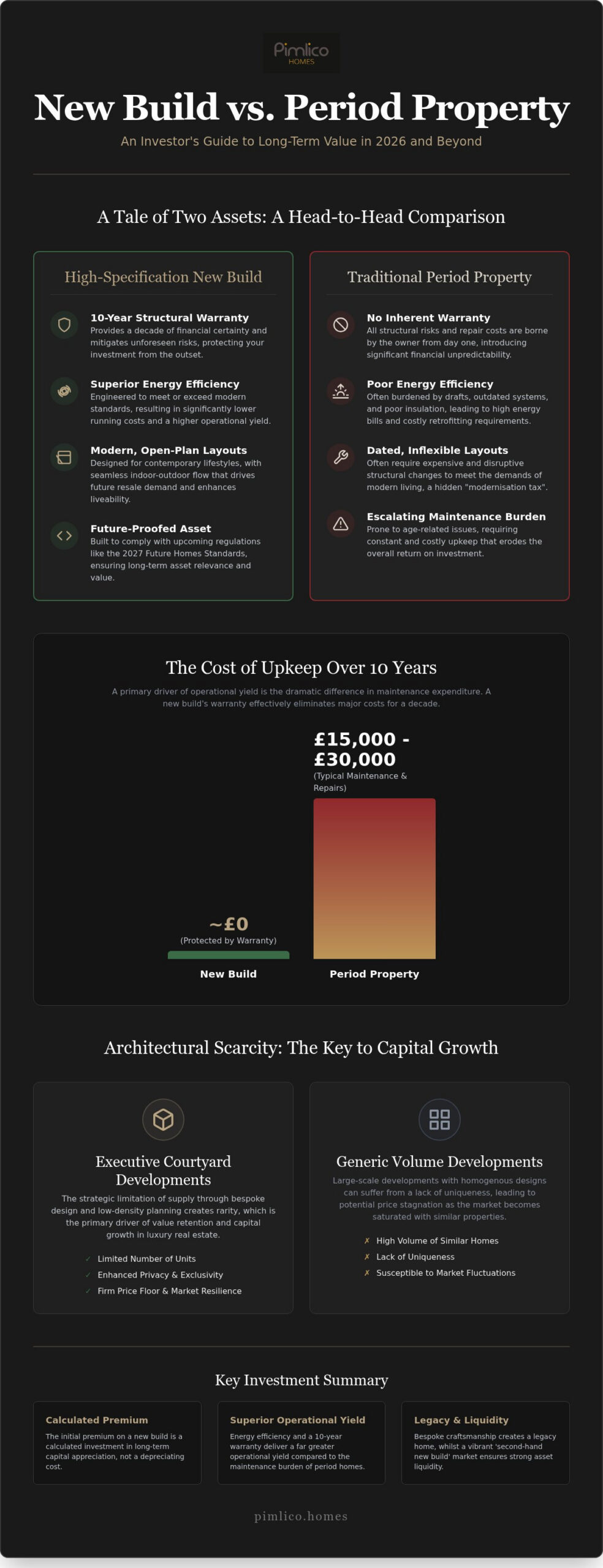
Value is inextricably linked to rarity. Large-scale developments often suffer from price stagnation due to a lack of uniqueness, but limited-run executive developments maintain a firm price floor. This prestige acts as a buffer during market fluctuations. Executive Courtyard Homes exemplify this model by restricting the number of units and focusing on enhanced privacy. Architectural scarcity is the strategic limitation of supply through bespoke design and low-density planning, serving as the primary driver of capital growth in luxury real estate.
Investment Horizons: Short-term vs Long-term
When asking are new build homes a good investment, one must consider the temporal nature of the asset. The first three to five years of ownership are typically characterised by stability. During this period, 10-year warranties act as a robust financial safety net, mitigating the unpredictable risks often found in older properties. This protection allows investors to plan their finances with absolute certainty. Interestingly, a vibrant “second-hand new build” market has emerged. Five-year-old homes that have been meticulously maintained are in high demand, as they offer the benefits of modern construction without the wait times of a fresh development. This secondary market liquidity is a vital component of the overall investment strategy.
The ‘New Build Premium’ vs Long-Term Capital Appreciation
A common misconception suggests that new homes depreciate like a showroom vehicle the moment the keys are handed over. This is a fallacy. Unlike a car, a luxury home sits on an appreciating asset, the land, and benefits from a replacement cost that climbs every year. When asking are new build homes a good investment, one must look at the “move-in ready” premium as an avoidance of the “modernisation tax” that plagues older properties. You’re paying for the elimination of future risk.
Modern floor plans are designed for the way we live now. Open-plan kitchens and seamless indoor-outdoor flows are not just aesthetic choices; they are primary drivers of future resale demand. Period homes often require structural surgery to achieve this level of fluidity, which can be both costly and restrictive. High-specification finishes, from artisanal stonework to bespoke cabinetry, significantly elevate the ceiling price of a development. These details ensure that the home doesn’t just meet the market average but consistently outperforms it in the eyes of future buyers.
The Cost of Modernisation in Period Properties
Retrofitting a century-old structure to reach 2026 standards is an arduous and expensive journey. Research indicates that homeowners of existing properties can expect to spend between £15,000 and £30,000 on maintenance over a ten-year period. In contrast, a new build typically requires only £2,000 to £5,000 during the same timeframe. For a deeper dive into these figures, consult The Ultimate Guide to Buying a Luxury New Build Home in 2026. Buyers increasingly pay a premium to bypass the unpredictable “snagging” and structural surprises inherent in older builds.
Market Resilience of Executive Enclaves
Executive enclaves offer a unique form of market resilience that generic estates cannot match. Gated communities and private roads create a sense of permanence and security that high-net-worth circles value immensely. This curated privacy acts as a robust hedge against local market volatility. When you choose an Executive Courtyard Home, you aren’t just buying square footage. You’re investing in a controlled environment where the standard of neighbouring properties is guaranteed. This collective excellence ensures that are new build homes a good investment remains a resounding yes for those who prioritise long-term capital stability and peace of mind.
Operational Yield: Energy Efficiency and the Cost of Maintenance
The true performance of a property asset is often hidden within the balance sheet of its daily operation. When considering are new build homes a good investment, the operational yield provides a compelling answer that transcends simple resale values. A luxury new build typically achieves an EPC ‘A’ rating, a stark contrast to the ‘D’ or ‘E’ ratings common amongst period estates. This discrepancy isn’t merely an environmental consideration; it represents an “invisible ROI” that bolsters your total return. With energy efficiency levels 30% to 50% higher than older builds, the monthly savings on utility bills act as a consistent, tax-free dividend for the homeowner.
Financial security is further reinforced by the presence of a 10-year NHBC or equivalent structural warranty. This document serves as a robust risk-mitigation tool, protecting the investor from the structural volatility that can haunt owners of older “character” homes. By utilising low-maintenance exteriors, such as artisanal modern brickwork and high-grade composite materials, these properties protect future profit margins. You aren’t just buying a home. You’re securing an asset where the cost of preservation is engineered to be as low as possible.
Future-Proofing Against Legislative Changes
The regulatory landscape is shifting rapidly. With the Future Homes and Buildings Standards coming into effect in 2027, 2026 has become the pivotal year for strategic acquisitions. Inefficient older homes face a growing “brown discount” as they struggle to meet new carbon-ready requirements. Conversely, luxury new builds are increasingly eligible for “Green Mortgages”, which offer preferential interest rates to those purchasing highly efficient properties. Energy efficiency has transitioned from a desirable luxury to a non-negotiable financial necessity for the modern asset holder.
The Zero-Maintenance Window
Investors in high-specification new builds enjoy what we call the “golden decade” of ownership. This is a ten-year period where capital expenditure on repairs and renewals remains near zero. Such predictability allows you to divert funds into other high-yield assets rather than sinking them into roof repairs or damp-proofing. This maintenance-free living is central to the quiet confidence of the Pimlico Homes lifestyle. It ensures that your focus remains on the enjoyment of your home and the growth of your portfolio, rather than the logistics of property management. The result is a future-proofed home with high resale appeal that remains pristine with minimal intervention.
Strategic Selection: Identifying High-Value Executive Developments
Success in property acquisition is rarely the result of chance. It is the product of meticulous due diligence and an eye for architectural intent. To determine if are new build homes a good investment, one must look far beyond the postcode. The distinction between a generic volume development and a bespoke executive estate is profound. It’s the difference between a mass-produced commodity and a curated asset. Investors should begin by evaluating the developer’s track record. A firm with 25 years of industry experience offers a level of security that newer entrants cannot match. This heritage ensures that the craftsmanship is not just skin-deep but built into the very bones of the structure.
Strategic selection involves a five-step appraisal process to ensure long-term desirability:
- Developer Track Record: Prioritise those with a proven commitment to bespoke excellence and longevity.
- Development Density: Favour low-density executive courtyards over high-volume estates to preserve scarcity.
- Specification Level: Inspect the “standard” offering. High-value developments include premium features that others categorise as costly upgrades.
- Communal Aesthetics: Assess the landscaping and entrance. First impressions establish the price floor for future resale.
- Bespoke Potential: Seek homes that can be tailored during construction, turning a property into a one-of-a-kind asset.
The Executive Courtyard Advantage
The layout of a development dictates the lifestyle it offers. Executive courtyards foster an immediate sense of community and security, qualities that high-net-worth buyers are willing to pay a premium for. This scarcity-driven investment strategy limits supply whilst enhancing the psychological value of stature and exclusivity. For a deeper understanding of this model, explore The Allure of Executive Courtyard Homes in the North East. These enclaves act as a protective shell for your capital, ensuring that are new build homes a good investment remains a certainty even in shifting markets.
Barn Conversions: The Hybrid Investment
For those who find themselves torn between history and modernity, Luxury Barn Conversions offer a unique hybrid opportunity. These residences combine heritage charm with the peak efficiency of a 2026 new build, often commanding the highest price-per-square-foot in rural markets. Inside, Modern Barn Conversion Interiors prove that you don’t have to sacrifice refined luxury for rustic appeal. This blend of character and performance creates a highly liquid asset that appeals to a broad spectrum of discerning purchasers.
Future-Proofing Assets through Bespoke Architectural Excellence
The final measure of a property’s worth isn’t found in its first year, but in its fiftieth. Bespoke luxury homes bridge the gap between ‘new’ and ‘character’ by marrying modern performance with the tactile permanence of traditional materials. When discerning clients ask if are new build homes a good investment, they are often searching for an asset that transcends the trend cycle. By utilising premium materials like natural stone, seasoned timber, and high-specification glazing, these homes age with a grace that generic developments cannot replicate. These elements ensure the structure remains a prestigious landmark rather than a dated relic of a specific decade.
Choosing a developer who acts as a visionary creator is the most effective way to ensure are new build homes a good investment for your specific financial goals. A high-specification new build serves as a superior hedge against inflation and rising living costs, primarily because its value is anchored in architectural scarcity and operational efficiency. You aren’t just buying a house; you’re acquiring a future-proofed asset that remains resilient against market volatility whilst providing a sanctuary of unparalleled quality.
The Pimlico Standard of Craftsmanship
At Pimlico Homes, we take our role as the guardian of your property portfolio seriously. Each detached home we create is the result of meticulous care and a commitment to excellence that has been refined over 25 years in the luxury market. This heritage ensures that your investment is built on a solid foundation of expertise and artistry. We invite you to explore our current developments to see how our visionary approach to construction can enhance your investment journey. Our focus on executive courtyard developments ensures that your home remains part of an exclusive, low-density enclave that protects your privacy and your capital.
Securing Your Legacy
There is a significant emotional weight to an investment that serves as a prestigious family seat. A home should be more than a line on a ledger. It should be a source of refined pride. This deep connection between the owner and the property often translates into better preservation and a higher standard of care, which naturally protects the asset’s value over generations. We believe that a home should be a legacy, a testament to success that stands the test of time. Take the next step in curating your portfolio and explore our exclusive developments and secure your bespoke investment today.
Securing Your Future in the Modern Luxury Market
The transition toward high-specification assets in 2026 reflects a deeper desire for permanence and efficiency. We’ve explored how architectural scarcity and the golden decade of zero maintenance redefine the financial landscape. When you look beyond the initial premium, it’s clear that are new build homes a good investment for those who value both prestige and operational yield. A home that meets 2027 standards today is an asset that will only grow in desirability as older properties face the burden of retrofitting. Quality remains the ultimate hedge against volatility.
With 25 years of luxury development expertise, Pimlico Homes focuses on high-specification executive courtyards where bespoke craftsmanship is the standard. This methodical approach ensures your capital is protected by both artistry and innovation. We invite you to discover the prestige and investment potential of Pimlico Homes as you curate your property legacy. Your next acquisition should be more than just a residence. It should be a testament to your discerning vision and a guardian of your long-term wealth.
Frequently Asked Questions
Do new build homes depreciate in value in the first year?
Luxury new builds in exclusive developments rarely follow the depreciation curve of mass-market housing. In the first year, the value’s underpinned by rising construction costs and the inherent scarcity of the plot. While generic estates might experience a short plateau, bespoke homes often see immediate appreciation as the development matures. This stability’s why many high-net-worth investors view these properties as a secure foundation for their portfolios from the moment they receive the keys.
Are luxury new builds a better investment than period properties?
For the modern investor, luxury new builds frequently outperform period properties on a total-return basis. Older homes often hide significant modernisation taxes in the form of structural repairs and poor thermal performance. A new build provides a predictable financial horizon with near-zero maintenance costs for the first decade. This allows you to enjoy a prestigious lifestyle whilst your capital remains protected from the unpredictable expenses that typically plague century-old character estates.
How much does the 10-year warranty impact resale value?
A 10-year structural warranty’s a powerful risk-mitigation tool that directly enhances resale value. It provides the next owner with absolute peace of mind, making the property a far more liquid asset on the secondary market. This guarantee ensures that are new build homes a good investment remains true even as the home reaches its fifth or sixth year. It effectively removes the structural unknowns that often deter buyers from purchasing older, non-guaranteed residences.
What is the expected capital growth for an executive courtyard home?
Capital growth in an executive courtyard’s driven by the strategic limitation of supply. Low-density planning ensures that these homes remain rare, which maintains high demand even during market corrections. The privacy and security of a courtyard layout create a psychological prestige premium that buyers are willing to pay for. This architectural scarcity acts as a robust hedge, helping the property to consistently outperform the wider regional market averages over the long term.
Does the ‘new build premium’ make them bad short-term investments?
The new build premium’s often a reflection of the home’s move-in-ready status and lack of immediate capital expenditure. While very short-term flips under three years might be tighter, the asset remains stable due to its high specification. You’re essentially pre-paying for a decade of zero repairs. In the 2026 market, this certainty’s highly valued by buyers, meaning the home retains its as-new appeal and price floor much longer than standard builds.
How do 2026 energy regulations affect the investment value of older homes?
The 2026 regulatory landscape’s making energy efficiency a financial necessity rather than a preference. Older homes that fail to meet modern EPC standards are increasingly subject to a brown discount in resale value. Future buyers face the prospect of invasive retrofitting to comply with the 2027 Future Homes Standards. Consequently, luxury new builds that are already zero-carbon ready carry a significant value advantage, as they bypass these looming legislative and financial hurdles.
Can I customise a new build to increase its future resale value?
Customising your home during the build process’s a proven way to enhance its future marketability. By selecting bespoke finishes and artisanal materials, you create a unique residence that stands apart from standardised developments. This architectural character bridges the gap between modern efficiency and traditional charm. A home that’s been tailored to a high standard often achieves a higher ceiling price, as it appeals to the emotional desires of the most discerning executive buyers.
Is a bespoke luxury home harder to sell than a standard new build?
A bespoke luxury home’s typically more liquid than a generic build because it offers something irreplaceable. High-net-worth purchasers prioritise uniqueness and craftsmanship over mass-produced uniformity. When are new build homes a good investment is asked in the context of resale, the answer’s found in the property’s ability to captivate a buyer’s imagination. Meticulous design and premium materials ensure the home remains a highly sought-after asset that commands attention in any market condition.


