
Architectural distinction. The pursuit of a home that mirrors your exact lifestyle often feels like a choice between compromise and complexity. You likely feel that a standard floor plan rarely accommodates the nuances of a refined life, yet the fear of spiralling budgets and hidden delays can often stall the most inspired visions. Understanding the cost implications of customising a new build is the first step toward transforming a high-end property into a definitive architectural statement. It’s about moving beyond the basic to create something that’s uniquely yours.
Financial clarity. We’ve crafted this guide to provide the clarity you need to move forward with absolute confidence. You’ll learn how a developer-led approach to bespoke luxury homes ensures financial transparency, protects your completion dates, and ultimately enhances the prestige of your investment. We’ll examine the variables that influence pricing, from structural alterations to artisanal finishes, ensuring your path to a unique property is as seamless as the final result. It’s time to realise your vision without the anxiety of the unknown.
Key Takeaways
- Architectural foresight. Discover the significant advantages of influencing your property’s design off-plan to ensure the foundation aligns with your lifestyle.
- Strategic investment. Gain a clear understanding of the cost implications of customising a new build by distinguishing between structural core changes and high-end aesthetic finishes.
- Resource management. Learn how to navigate the nuances of specialist craftsmanship and material sourcing to maintain quality without compromising your financial strategy.
- Financial discipline. Identify proven methods for managing scope creep and establishing a budget that reflects the true value of a unique, luxury residence.
- Enduring prestige. Understand how a developer-led partnership provides a streamlined path to a bespoke home that secures long-term resale value and personal satisfaction.
Defining the Value of Customisation in Luxury New Builds
Architectural identity starts long before the first brick is laid. For the discerning buyer, a standard specification is merely a canvas; it’s the customisation that creates the masterpiece. While many volume developers offer a limited choice of tiles or carpets, true bespoke luxury involves a fundamental dialogue between the architect and the homeowner. This proactive approach allows you to address the cost implications of customising a new build during the design phase, rather than facing retrospective charges or structural limitations later in the process.
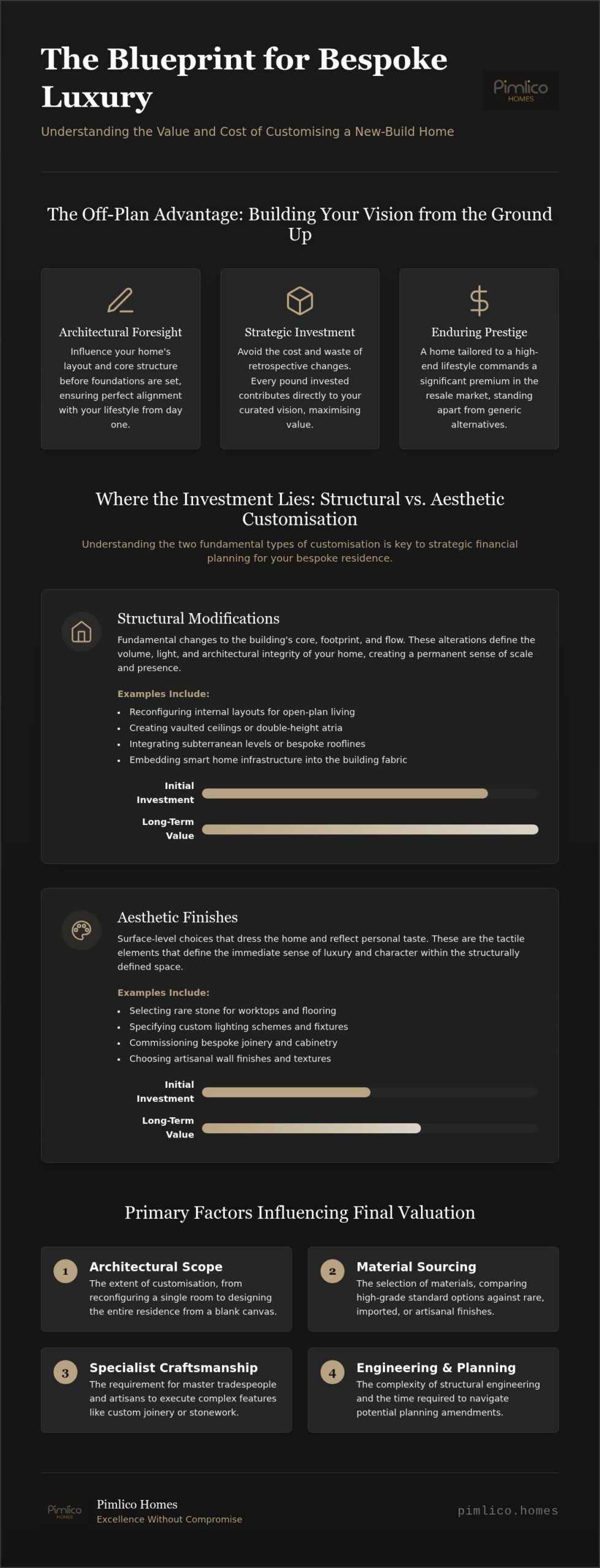
The off-plan advantage is undeniable. By influencing the build before the foundations are set, you avoid the inefficiency of removing pre-installed features or compromising on a layout that doesn’t quite fit your life. It’s a strategic move. Every pound spent contributes directly to a vision that’s been curated specifically for you. The rewards are both emotional and financial. A home tailored to a specific high-end lifestyle often commands a significant premium in the resale market, as it stands out amongst a sea of generic alternatives in executive developments.
The Spectrum of Customisation: From Finishes to Floor Plans
Not all modifications carry the same weight or complexity. Minor alterations might include selecting rare stone for kitchen worktops, specifying custom lighting circuits, or commissioning bespoke joinery that fits seamlessly into a master dressing room. Major customisation moves deeper. This involves reconfiguring internal layouts to create expansive open-plan galleries, dedicated wellness suites, or professional-grade home offices that suit modern executive living. For those seeking the ultimate expression of exclusivity, architectural bespoke options allow for a residence designed entirely from the ground up, ensuring every vista and volume is intentional.
Why 2026 is the Year of the Bespoke Residence
The luxury sector is witnessing a profound shift. Modern buyers aren’t satisfied with opulent replicas; they demand homes that reflect their personal narrative. In 2026, the demand for unique residences has reached a peak as high-net-worth individuals prioritise ‘lifestyle-first’ property acquisitions. Advancements in construction technology now allow for much greater flexibility in structural design. It’s now possible to integrate complex personal requirements, such as subterranean garages or double-height glass atria, with greater precision. It’s an era where the visionary creator can turn abstract dreams into permanent, prestigious reality without the traditional burdens of a self-build project.
Structural vs Aesthetic: Where the Investment Lies
Distinguishing between the skeleton of a home and its final dressing is essential for any discerning investor. The cost implications of customising a new build are most pronounced when you move beyond surface-level aesthetics to alter the building’s footprint or structural core. Whilst an artisanal kitchen is a statement of taste, a vaulted ceiling or a reconfigured wing is a statement of architecture. These fundamental changes define the volume and flow of your living space, creating a sense of scale that’s impossible to replicate through interior design alone.
Efficiency is the hallmark of a well-managed project. Making these structural adjustments during the initial construction phase is significantly more cost-effective than attempting them post-completion. It avoids the waste of removing perfectly good materials and allows for a seamless integration of services. When you consider the long-term valuation, structural customisation often yields a superior return on investment. Space, light, and architectural integrity are permanent assets; they remain desirable long after interior trends have evolved and palettes have changed.
Structural Modifications and Architectural Integrity
Elevating a property from a standard detached house to a bespoke masterpiece often involves complex engineering. Bespoke rooflines, grand double-height entrances, and vaulted ceilings require meticulous planning and specialist trades. These elements don’t just add volume; they add a sense of arrival and permanence. Integrating smart home infrastructure—the invisible nervous system of a modern executive home—must also happen at this stage. Concealing fibre-optics and control systems within the fabric of the building ensures a clean, minimalist finish that’s impossible to achieve through retrofitting. You should also account for the time required to navigate building regulations and potential planning amendments that structural changes might trigger.
The Premium Specification: Materials and Craftsmanship
Once the structural integrity is secured, the focus shifts to the tactile experience of the home. The premium specification is defined by the rarity and provenance of the materials used. Sourcing book-matched natural stone from Italian quarries or sustainable, hand-finished timbers requires a dedicated supply chain. These aren’t just finishes; they’re an investment in artistry. Kitchens and bathrooms remain the primary focus for customisation because they’re the most hard-working spaces in the home. A bespoke culinary space, designed around your specific entertaining style, adds a level of functionality that off-the-shelf solutions simply cannot match. To understand how these elements coalesce, you might choose to explore our bespoke luxury homes to see the standard of craftsmanship expected in a true executive residence. If you’re ready to discuss your own architectural ambitions, you can connect with our specialist team to explore the possibilities of a tailored build.
Primary Factors Influencing the Final Valuation
Precision in budgeting requires an understanding of the forces that shape a final invoice. When you’re pursuing a residence of high distinction, the cost implications of customising a new build are driven by more than just square footage. It’s the intersection of specialist talent, material provenance, and architectural foresight. Every decision made during the design phase ripples through the project’s financial structure, influencing both the immediate capital requirement and the long-term market value of the property.
Master craftsmen don’t work to standard rates. Engaging specialist trades for hand-laid stonework or intricate timber framing naturally commands a premium, but this investment secures a level of finish that mass-market builders simply can’t replicate. In 2026, global supply chains continue to present unique challenges for bespoke sourcing. Rare marbles or specific architectural glazing may be subject to price fluctuations that require a flexible yet disciplined approach to procurement. Prudent buyers also account for specialist design fees. Enlisting architects and interior designers early in the process ensures that customisation enhances, rather than compromises, the building’s structural and aesthetic integrity.
The “Golden Brick” stage represents a critical financial threshold. This is the moment the first brick is laid on the foundations. Decisions made before this point are significantly more cost-effective. Once construction moves beyond this stage, any structural deviations incur exponentially higher costs due to the need for remedial works and potential delays to the wider build schedule.
Sustainable Technology and Energy Efficiency
Future-proofing is a hallmark of the modern executive home. Integrating air source heat pumps, advanced solar arrays, and high-specification insulation requires a higher initial outlay, yet the long-term savings and environmental benefits are substantial. In the 2026 luxury resale market, a high EPC rating has become a primary indicator of prestige. Discerning buyers now view energy efficiency as a non-negotiable component of a high-end property, making sustainable customisation a strategic move for preserving future value.
The Impact of Site Complexity
Every plot carries its own set of variables. Bespoke barn conversions, for instance, often involve higher costs than new build executive homes due to the complexities of working with existing heritage structures and non-standard dimensions. Groundworks and landscaping should also be viewed as an extension of the home’s customisation. Creating a seamless transition between a grand interior and a curated exterior estate requires significant investment in drainage, levels, and mature planting. To better understand how site selection influences your journey, you can read our buying a luxury new build guide for more on site selection and its impact on your final vision.
Strategic Financial Planning for a Bespoke Residence
Financial stewardship is the silent partner of architectural excellence. Navigating the cost implications of customising a new build requires a budget that doesn’t just cover materials, but honours the “premium for the unique.” It’s about allocating resources where they create the most profound impact on your daily experience. A well-structured plan allows you to pursue a grand vision without the friction of financial uncertainty. It’s the foundation of a stress-free transition into your new home.
Discipline is paramount. Scope creep often begins with small, seductive upgrades that collectively challenge the project’s equilibrium. Whilst generic advice from sources like self-build.co.uk often suggests a flat 10% contingency, high-end bespoke developments in 2026 demand a more sophisticated buffer. You must account for the specific volatility of artisanal supply chains and the precise requirements of specialist trades. Staying disciplined whilst pursuing a grand vision ensures that the final result is a source of pride, not a financial burden.
Transparency builds trust. Your payment structure should follow a logical progression: an initial deposit followed by stage payments tied to verifiable construction milestones. This ensures your capital is deployed in direct proportion to the physical progress on site. Protecting this investment is equally vital. Robust structural warranties are a non-negotiable requirement, providing long-term security for your customised assets and ensuring that your bespoke features are covered by the same rigorous standards as the building’s core.
VAT and Tax Implications for Customised Builds
The fiscal landscape of new builds offers distinct advantages for the savvy buyer. In the UK, labour for new residential construction is typically VAT-free, which can provide a significant boost to your customisation budget compared to renovating an existing property. However, high-value bespoke properties often trigger complex Stamp Duty Land Tax (SDLT) considerations that should be calculated early in the process. If you’re customising your residence to include professional-grade executive suites or home offices, there may be further tax efficiencies to explore regarding the business use of your domestic space.
Protecting Future Resale Value
Legacy is measured in longevity. Balancing personal preference with future market appeal is a delicate art. While bespoke detached homes generally command higher prices than standard units, the most successful projects avoid overly niche trends in favour of timeless architectural principles. A home that feels both unique and universally elegant will always find a discerning buyer. To understand how these decisions impact your long-term equity, see our resale value of new build homes north east guide for investment insights. If you’re ready to begin your journey, speak with our consultants to align your vision with a sound financial strategy.
The Pimlico Homes Promise: Excellence Without Compromise
Excellence isn’t a destination; it’s a standard maintained through every phase of construction. At Pimlico Homes, we’ve spent 25 years refining a developer-led approach that places you at the centre of the creative process. This isn’t a traditional builder-client relationship. It’s a partnership between a visionary creator and a discerning buyer. We take the weight of technical complexity off your shoulders, allowing you to focus on the artistry of your future home whilst we manage the intricate logistics of the build.
Transparency is the bedrock of our service. We understand that the cost implications of customising a new build can often feel opaque in the wider industry. Our methodology is different. By establishing clear financial frameworks and procurement paths from the outset, we ensure that your bespoke choices are matched with absolute clarity. There are no hidden surprises. Instead, you’ll find a methodical and deliberate process that respects both your vision and your investment, ensuring that every artisanal detail adds tangible value to your estate.
From Executive Courtyards to Bespoke Barn Conversions
Every architectural style presents its own narrative. Customising a heritage barn conversion requires a master craftsman’s touch to balance original character with modern executive requirements. It’s a rewarding challenge that results in a home of unmatched personality. Conversely, our new-build detached homes represent the pinnacle of modern British architecture, offering a blank slate for contemporary innovation. To understand the breadth of what we achieve, you might discover the allure of executive courtyard homes and explore how these private enclaves offer a masterclass in prestige and customisation potential.
Begin Your Bespoke Journey
The path to a unique property begins with a single, focused conversation. Our process starts with an intensive consultation and feasibility analysis to ensure your ambitions align with structural and financial reality. We don’t just build homes; we curate investments. By blending innovative thinking with traditional values, we ensure your customisation remains a sound financial decision for years to come. There is a quiet confidence that comes with owning a Pimlico home. It’s the security of knowing that your residence was built by a leader in the field who remains dedicated to your long-term satisfaction. We invite you to explore our current portfolio and begin the journey toward a home that is, quite simply, without equal.
Realising Your Architectural Legacy
Architectural identity. Defining your own space is a profound act of creation; it’s the transition from a standard floor plan to a home that mirrors your personal narrative. We’ve seen how prioritising structural integrity over surface-level aesthetics secures a superior return on investment. By making decisive choices before the foundations are set, you protect both your budget and your timeline. Navigating the cost implications of customising a new build shouldn’t be a source of anxiety; it’s a strategic step toward building a property that stands apart amongst standard developments.
Heritage and excellence. At Pimlico Homes, we bring 25 years of architectural excellence to every project. We specialise in high-end detached residences, offering a bespoke developer-led customisation process that removes the traditional burdens from your shoulders. Our master craftsmen are dedicated to ensuring your vision is realised with absolute precision and financial clarity. It’s time to move beyond the ordinary and secure a home that’s as unique as your own life story. We’re here to guide you through every intimate detail of the build.
Discover the Art of Bespoke Living with Pimlico Homes
Frequently Asked Questions
Is customising a new build more expensive than buying a pre-built home?
Customising a new build typically involves a higher initial outlay compared to purchasing a standard, pre-completed property. This premium reflects the bespoke architectural work and superior materials chosen to align with your lifestyle. However, it’s often more financially efficient than retrofitting a standard home, as you avoid the waste and disruption of future structural alterations.
Does customising a new build home affect the mortgage process?
Lenders require a clear valuation based on the final, customised specification rather than a standard model. It’s essential to involve your financial advisor early to ensure the mortgage offer accounts for the total cost implications of customising a new build. Most high-street and specialist lenders will support these projects provided the developer is established and the structural warranties are robust.
What is the most cost-effective way to customise a new build?
Influencing the design during the off-plan stage is the most cost-effective approach. Making decisions before the first brick is laid allows the developer to integrate your requirements into the initial procurement and construction schedule. This proactive strategy prevents the expensive remedial works that occur when changes are requested after the structural core has been completed.
Can I customise a new build home after the construction has started?
Customisation remains possible after construction begins, though the scope becomes increasingly limited as the build progresses. Aesthetic choices like internal finishes and kitchen specifications are often flexible until the later stages. Structural changes, however, become significantly more complex and costly once the foundations and load-bearing walls are in place.
How much should I set aside for a contingency fund when customising?
Establishing a realistic contingency is vital when navigating the cost implications of customising a new build. Whilst standard industry advice often suggests a 10% buffer, high-end projects involving artisanal materials or specialist trades benefit from a more substantial reserve. This ensures you can manage market fluctuations or unforeseen site variables without compromising on the quality of your final residence.
Will customising my home increase its long-term resale value?
Architectural uniqueness is a powerful driver of long-term capital appreciation. A customised home that offers a superior layout or higher specification than its neighbours will naturally command a premium in the executive resale market. Discerning buyers often seek properties that stand out from generic developments, making your initial investment in bespoke features a strategic move for future equity.
Are there VAT savings available when I customise a new build property?
Residential new builds in the UK are generally zero-rated for VAT on labour and most building materials. This fiscal advantage means your customisation budget goes further than it would on a renovation project, where standard VAT rates typically apply. It’s a significant financial incentive that allows for a higher level of specification within the same total expenditure.
How do I ensure my customisations don’t delay the move-in date?
Early decision-making is the most effective way to protect your completion date. By finalising your bespoke requirements during the design phase, the developer can synchronise material orders and specialist labour with the wider construction programme. A developer-led approach ensures that customisations are integrated into the primary schedule, maintaining the steady, methodical rhythm required for a high-end delivery.


