
The most significant investment in a bespoke home isn’t the limestone flooring or the architectural glazing; it’s the preservation of your own time. For many, the dream of a tailor-made residence is often clouded by the daunting reality of managing a site, interpreting the 2026 Building Safety Levy, and ensuring compliance with the upcoming Future Homes Standard. Choosing between a developer-led custom build vs self-build is the first, and perhaps most vital, decision you’ll make on this journey. It’s a choice between holding the compass yourself or trusting a seasoned navigator to steer the project toward excellence.
You likely understand that creating something truly unique requires meticulous attention to detail, yet you don’t want the construction process to become a second career. This executive guide promises to reveal the critical differences between these two paths, ensuring your transition to a bespoke luxury home is as refined as the final architecture. We’ll explore how professional leadership can mitigate the anxiety of building regulations and quality control, providing a clear preview of the timeline and craftsmanship you deserve.
Key Takeaways
- Distinguish between total autonomy and professional partnership to select the level of involvement that aligns with your personal vision.
- Navigate the complexities of the UK land market and learn how to utilise the “Right to Build” register with confidence.
- Evaluate the management realities of a developer-led custom build vs self-build to ensure your project remains a prestigious investment rather than a logistical burden.
- Explore the spectrum of architectural freedom available in custom projects, ensuring your home reflects your unique aesthetic without compromising on structural excellence.
- Identify the route that provides the ultimate certainty of quality, allowing you to enjoy a refined and stress-free journey to bespoke living.
Defining the Bespoke Landscape: Custom Build vs Self-Build
The pursuit of a bespoke home is a declaration of personal legacy. It’s an intricate dance between vision and execution. In 2026, the distinction between a developer-led custom build vs self-build has become the defining crossroads for the discerning homeowner. While one path offers the raw thrill of total autonomy, the other provides the steady hand of a professional partnership. The UK executive market is shifting. High-net-worth individuals are increasingly prioritising certainty of quality and timeline over the exhaustive demands of independent site management.
The Core Characteristics of a Self-Build Project
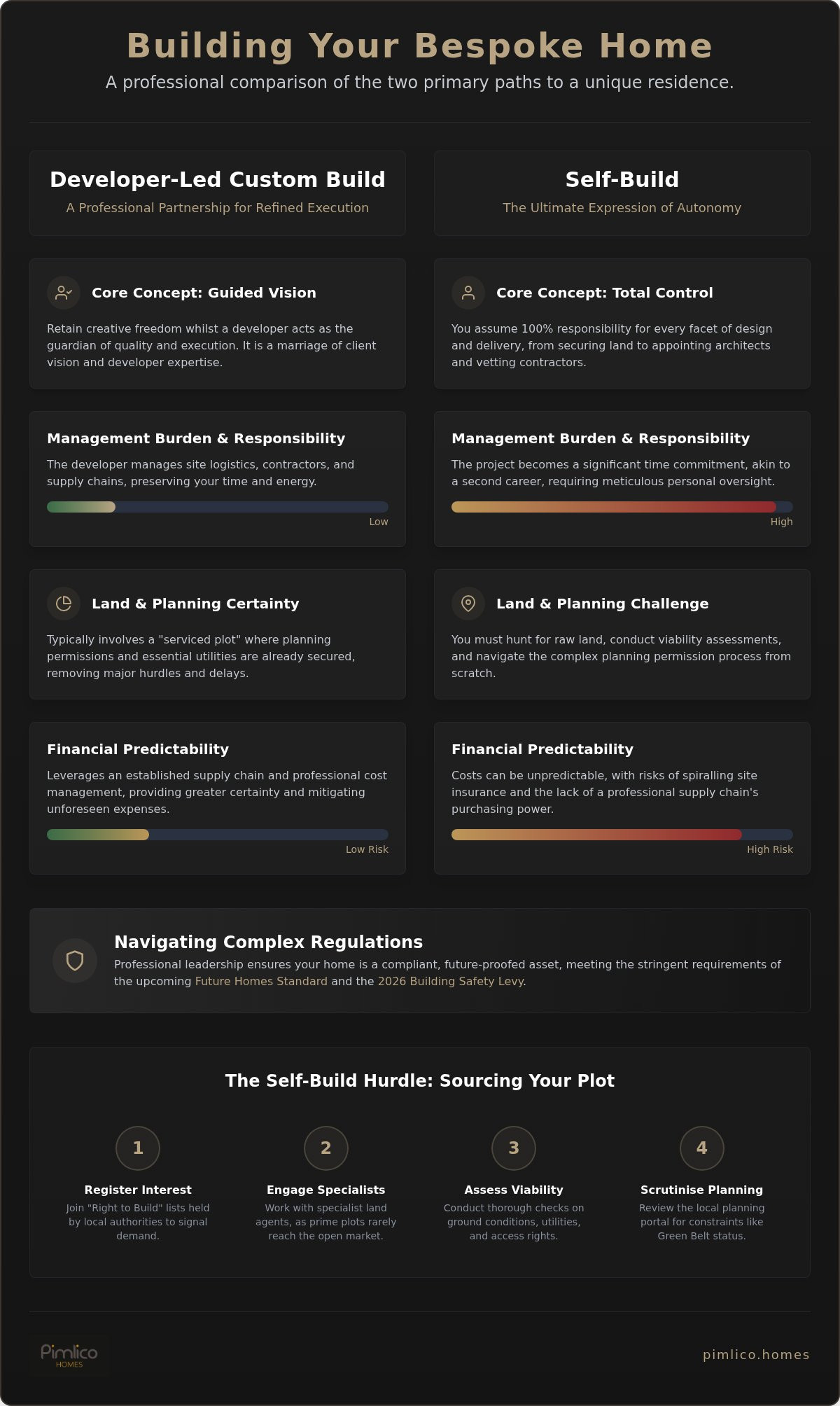
Self-build projects represent the ultimate expression of architectural independence. You secure a standalone plot and assume 100% responsibility for every facet of the design and delivery. This isn’t merely about physical labour; for most executives, it involves a complex spectrum of project management. You’re the one appointing architects, vetting contractors, and navigating the 2026 Building Safety Levy. The allure is absolute control over every architectural nuance. However, the common misconception that this route is always the most cost-effective often fades. When you factor in spiralling site insurance and the lack of a professional supply chain, the financial reality can become unpredictable.
The Rise of the Developer-Led Custom Build
The developer-led model has gained significant traction amongst those who value their time as much as their aesthetic. This approach typically centres on a “serviced plot” where planning permissions and essential utilities are already secured. It removes the logistical friction of land preparation. By leveraging a developer’s established supply chain, you gain access to premium materials and specialist artisans that are often difficult for individuals to source. Defining Custom Build in this context means retaining the creative freedom to shape your home’s identity while the developer acts as the guardian of quality. A custom build is a professional marriage between client vision and developer expertise.
When weighing the merits of a developer-led custom build vs self-build, the decision often rests on where you wish to spend your emotional energy. With the introduction of the Future Homes Standard in 2027, the technical requirements for new builds have never been more stringent. Professional leadership ensures that your home isn’t just a beautiful structure, but a compliant, future-proofed asset. This model offers a sophisticated middle ground, providing the exclusivity of a bespoke luxury home without the traditional construction burden that often accompanies a standalone self-build.
Finding a Plot for a Self-Build Project: The First Hurdle
The foundation of any prestigious residence isn’t concrete; it’s the land itself. In the United Kingdom, finding the perfect canvas is a test of patience and strategic thinking. Prime land is a finite resource, often sequestered by major estates or held in family trusts for generations. This scarcity creates a significant bottleneck in your timeline. When comparing a developer-led custom build vs self-build, the primary differentiator is often the “readiness” of the ground beneath your feet. A self-builder must hunt for raw land, whereas a custom-build client steps onto a stage that is already set for performance.
A Strategic Guide to Sourcing Your Land
- Step 1: Register with the “Right to Build” lists. Local authorities are required to maintain registers of individuals seeking land. According to official government guidance, these lists help councils gauge demand and plan accordingly, though they don’t guarantee a plot.
- Step 2: Engage specialist land agents. High-end plots rarely reach the open market. They are traded in quiet circles through auction houses and private agents who specialise in residential development land.
- Step 3: Conduct viability assessments. Ground conditions, existing utilities, and access rights can turn an idyllic field into a financial drain. You must verify that the site can physically support your architectural ambitions.
- Step 4: Scrutinise the local planning portal. The Planning and Infrastructure Act 2025 aims to speed up delivery, but local constraints like Green Belt status or conservation rules still dictate what you can build.
The Risk Factor: Planning and Permissions
Securing “Outline Planning Permission” is a psychological victory, but it’s only the start of a complex legal journey. Discharging the subsequent “reserved matters” and conditions requires a mountain of technical paperwork and constant dialogue with planning officers. Whilst you manage this, the clock is ticking on your budget. The time cost of navigating these hurdles can add months, or even years, to a project before a single brick is laid. It’s a logistical weight that many executives find incompatible with their professional lives.
A developer-led route mitigates this volatility by offering curated plots within a master-planned environment. These sites come with planning certainty and infrastructure already in place, removing the risk of a flat rejection from the council. If you seek the distinction of bespoke luxury homes without the multi-year search for land, a curated plot offers a far more certain path to your final result. This professional leadership ensures that your energy is spent on design and finish, rather than the bureaucracy of site preparation.
The Financial and Management Reality of Building Bespoke
Financial transparency is the cornerstone of a successful prestigious project. In the nuanced debate of developer-led custom build vs self-build, the “hidden” ledger often dictates the final satisfaction of the owner. Self-builders must navigate the intricacies of VAT reclaims and Community Infrastructure Levy (CIL) exemptions with surgical precision. Mismanaging these administrative layers can erode your capital before the first stone is laid. Conversely, the developer-led model offers the profound security of a fixed-price contract. It shields you from the volatile material costs and labour fluctuations that have characterised the construction industry in recent years.
Budgeting for Excellence
True project investment extends far beyond the cost of bricks and mortar. It encompasses site insurance, specialist surveys, and legal fees that often remain invisible in initial estimates. For those pursuing a pure self-build, a contingency fund of at least 15% is a non-negotiable requirement to absorb unforeseen ground conditions or supply chain delays. This financial volatility is precisely why this buying a luxury new build guide is an essential resource. It provides a blueprint for achieving a high-specification home with total financial certainty, allowing you to focus on the artistry of the build rather than the balance sheet.
Time—The Ultimate Luxury
For the executive, time is a finite currency. A self-build project is, in essence, a second full-time job. It demands a relentless schedule of weekly site meetings, procurement decisions, and contractor vetting. This logistical burden often conflicts with the very lifestyle a bespoke home is intended to support. Choosing a developer-led route allows you to remain the visionary creator without becoming the site foreman. The developer serves as the single point of contact, managing the thousands of micro-decisions that define a construction site.
Quality assurance remains the ultimate litmus test of a bespoke project. In a self-build, the burden of ensuring craftsmanship meets executive standards rests solely on your shoulders. You must be the one to challenge a finish or question a structural detail. In a developer-led custom build vs self-build comparison, a developer with a 25-year heritage acts as your guardian of quality. They bring an established eye for detail and a commitment to longevity that ensures the final result is as prestigious as the initial vision. This professional oversight guarantees that the artistry of your home is never compromised by the pressures of the construction schedule.
Architectural Freedom: Will a Developer Limit Your Vision?
The most pervasive myth in the luxury property market is that a developer-led project necessitates a “cookie-cutter” aesthetic. In reality, the debate of developer-led custom build vs self-build isn’t about the quantity of choice, but the quality of the execution. While a self-build grants you a blank canvas, it also leaves you to solve complex structural puzzles alone. A developer-led approach provides a sophisticated architecture within which you can express your unique identity. You’re invited to dictate the internal configuration, select external materiality, and define the very atmosphere of the residence.
The Bespoke Design Process
True distinction is born from collaboration. Through a series of focused workshops, bespoke luxury homes are meticulously curated to reflect the owner’s specific requirements. This process allows for the seamless integration of high-specification features like smart home automation, sustainable heating systems, and dramatic vaulted ceilings. By working with a developer’s architect, you benefit from “tried and tested” architectural details. These refined solutions ensure that your aesthetic choices are supported by structural longevity and thermal efficiency, particularly as we move toward the Future Homes Standard in 2027.
Preserving Character and Stature
Certain projects demand a level of sensitivity that only a specialist can provide. For instance, luxury barn conversions require a delicate balance between preserving heritage charm and introducing modern amenities. A developer with a 25-year heritage understands how to maintain the stature of a historic site whilst ensuring the interior meets contemporary executive standards. This expertise ensures that your home contributes to a prestigious street scene rather than feeling like a disparate architectural experiment.
Choosing a developer-led route doesn’t mean shrinking your vision. It means providing that vision with a guardian who ensures it is built to last. If you’re ready to begin your journey toward a home that is as unique as your life, explore our bespoke luxury homes to see how we can bring your architectural ambitions to life through a process that respects both your time and your taste.
The Final Verdict: Choosing the Route to Your Dream Home
The choice between a developer-led custom build vs self-build eventually distils into a single question: how do you wish to experience the creation of your legacy? For those with a surplus of time and a deep appetite for technical site management, the self-build path offers a raw, unfiltered connection to the construction process. However, for the discerning executive who values precision and peace of mind, the developer-led model provides a more sophisticated journey. It’s about delegating the friction whilst retaining the creative influence. Legacy isn’t built on stress. It’s built on vision.
The Decision Framework
Success in bespoke living requires a clear assessment of your appetite for risk. A self-build project carries the weight of potential cost overruns and regulatory shifts, whereas a developer-led project offers a shielded environment. You should also consider the long-term resale value of new build homes. Professional craftsmanship and a recognised brand often command a premium in the secondary market. Additionally, the security of a comprehensive warranty and dedicated aftercare provides a level of protection that is rarely achievable through independent contracting. Excellence is never accidental. It’s the result of high standards and professional oversight.
Crafting Your Legacy with Pimlico Homes
Pimlico Homes operates on the belief that the journey to a high-specification home should be as refined as the architecture itself. Our philosophy is rooted in a 25-year heritage of excellence, where we act as the guardian of your vision. We manage the complexities of planning, procurement, and site safety, allowing you to focus on the intimate details that make a house a home. This approach is particularly evident in our executive courtyard homes, which offer a masterful balance of individual privacy and a sense of prestigious community. Your time is your most valuable asset. We protect it.
Selecting a developer-led custom build vs self-build doesn’t mean compromising on uniqueness. It means ensuring that your bespoke vision is delivered with the steady hand of an expert creator. Whether you’re drawn to the character of a barn conversion or the stature of luxury detached homes, the path you choose will define your experience for years to come. We invite you to explore our current collections and take the first step towards a residence that reflects your standing and your style. The choice is yours. The quality is ours.
Securing Your Architectural Legacy
The journey to a bespoke home is one of the most significant investments you’ll ever make. Understanding the nuances of a developer-led custom build vs self-build ensures that this investment yields a result that matches your professional standards. While a self-build offers raw autonomy, a developer-led partnership provides the structural certainty and logistical peace of mind that high-net-worth individuals require. It allows you to remain the creative visionary without the exhaustive burden of site management or regulatory navigation. You’re choosing a path where quality is guaranteed, not just hoped for.
At Pimlico Homes, we bring 25 years of master craftsmanship to every project. Our exclusive executive developments are designed for those who refuse to compromise on either aesthetic or efficiency. We provide comprehensive structural warranties on all new builds, offering a layer of security that independent projects often lack. Your vision deserves a guardian that values excellence as much as you do. We’ve spent decades refining a process that places the client at the centre of the design whilst we handle the complexity of the delivery.
Explore our prestigious portfolio of bespoke luxury homes and discover how we can transform your aspirations into a permanent architectural legacy. Your dream home is within reach, and we’re here to ensure the process is as refined as the final residence.
Frequently Asked Questions
What is the main difference between custom build and self-build?
The fundamental distinction between a developer-led custom build vs self-build lies in the allocation of responsibility and risk. In a self-build, you’re the lead developer, managing every technical and legal detail from plot acquisition to the final brick. A custom build allows you to commission a specialist to deliver your vision on a prepared site. You retain creative influence over the design whilst the developer assumes the burden of construction management and regulatory compliance.
Is it cheaper to self-build or buy from a developer?
While self-building is often perceived as the more economical route, the reality for executive projects involves significant hidden costs. You must account for site insurance, professional fees, and the 2026 Building Safety Levy. A developer-led model provides the security of a fixed-price contract, leveraging an established supply chain to secure premium materials at a certain rate. This financial transparency often makes the developer-led route more cost-effective when your own time is factored in.
Can I still design my own floor plan with a developer-led custom build?
Absolute creative control over your living space is a hallmark of the custom-build model. You can collaborate with the developer’s architectural team to refine the internal floor plan, ensuring the layout perfectly mirrors your lifestyle. Whether you require a double-height entrance hall or a specific configuration for a home office, these bespoke elements are integrated early. This collaborative approach ensures your home is unique whilst benefiting from the developer’s proven structural expertise.
How do I find a plot of land for my self-build project?
Finding a suitable plot requires a multi-faceted strategy due to the scarcity of prime land in the UK. You should start by registering with local authority “Right to Build” lists as required by the Self-Build and Custom Housebuilding Act 2015. Additionally, engaging with specialist land agents and monitoring private auctions can uncover hidden opportunities. For many, the simplest route is selecting a curated plot within a developer-led executive development where the hunt is already complete.
What are the planning risks associated with self-building?
Planning risks for self-builders include the potential for outright rejection or the imposition of restrictive conditions that delay the project. Navigating the Planning and Infrastructure Act 2025 and discharging reserved matters requires constant professional dialogue. In a developer-led custom build vs self-build scenario, the developer has already secured the primary permissions. This removes the uncertainty of the planning portal, allowing you to move straight into the rewarding phase of architectural customisation and material selection.
Does a custom build home come with a structural warranty?
Every prestigious new home delivered by a reputable developer includes a comprehensive structural warranty, typically lasting ten years. This provides essential protection against structural defects and offers peace of mind that an independent self-build may struggle to match without expensive specialist insurance. These warranties are recognised by all major mortgage lenders, which is a vital consideration for the long-term resale value and financial security of your significant life investment.
How long does a developer-led custom build typically take?
A developer-led custom build typically takes between 12 and 18 months from the finalisation of the design to the handover of keys. This timeline is often more predictable than a self-build because the initial hurdles of site preparation and utility connection are already cleared. By following a methodical construction programme, the developer can provide a firm completion date. This certainty allows you to plan your transition to bespoke living with total confidence and minimal disruption.
What is a serviced plot and why is it beneficial?
A serviced plot is a piece of land that is ready for immediate construction, featuring planning permission and essential utilities already at the boundary. This includes water, electricity, gas, and high-speed fibre connections. The benefit is the total removal of the groundwork phase, which is where many self-build projects encounter delays and unforeseen expenses. It provides the perfect foundation for a bespoke luxury home, combining the freedom of design with a professional and reliable infrastructure.


