
A high price tag is often mistaken for a hallmark of excellence. Yet, the most expensive properties aren’t always the most prestigious. In an era where marketing jargon has blurred the lines of real estate, understanding the difference between luxury and premium homes is essential for any serious investor. You’ve likely felt the fatigue of browsing countless brochures that promise “unrivalled quality” only to find standard upgrades and mass-produced finishes. It’s a common frustration to realise that what’s being sold as a masterpiece is actually just a polished version of the ordinary, whilst the true architectural gems remain hidden behind layers of sales talk.
We understand that a multi-million pound investment deserves more than just high-spec appliances. It requires a legacy of craftsmanship. This guide will help you identify where premium finishes end and true architectural luxury begins, ensuring you don’t overpay for “standard” upgrades. We’ll provide a clear framework for auditing property specifications, from the integrity of the architectural bones to the long-term value of bespoke features. You’ll gain the confidence to distinguish between a house that’s merely expensive and a home that’s a genuine work of art, built to endure for generations.
Key Takeaways
- Understand the fundamental difference between luxury and premium homes to ensure your next property investment reflects your true architectural standards.
- Identify the hallmarks of executive courtyard layouts and how they elevate the standard of premium detached residences.
- Recognise the value of bespoke luxury, where every element is designed specifically for the site rather than adapted from a standard model.
- Apply the ‘Touch Test’ to property specifications to move past marketing jargon and evaluate the genuine quality of hardware and joinery.
- Evaluate how architectural exclusivity and unique heritage features impact the long-term resale value of high-end British estates.
Decoding the Jargon: Why the Distinction Between Luxury and Premium Matters
High-end real estate language has shifted. Terms that once signified rarity are now used to describe mere upgrades. In the British market, the vocabulary of property marketing has become increasingly saturated, making it difficult for buyers to separate genuine architectural merit from polished developer templates. Misidentifying these tiers often leads to significant investment errors. You might find yourself paying a “luxury” price for a property that is, in reality, a high-spec “premium” build. Understanding the difference between luxury and premium homes isn’t just an exercise in semantics; it’s a vital tool for capital protection and long-term satisfaction.
The Premium Tier: Excellence within a Framework
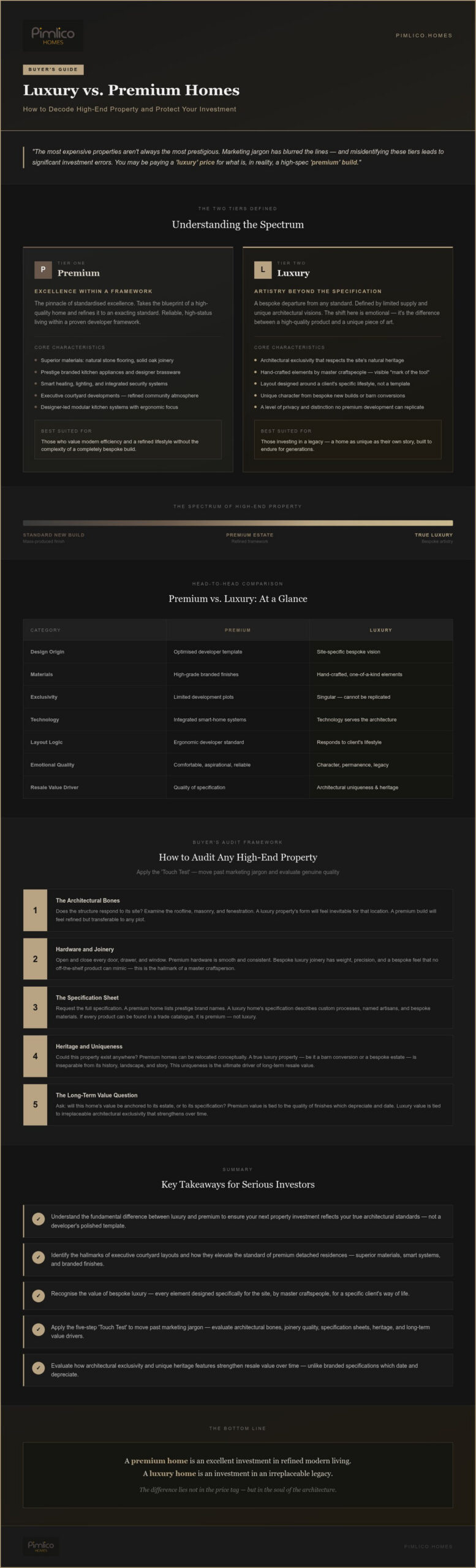
Premium properties represent the pinnacle of standardised excellence. These homes, often found in exclusive executive courtyard developments, take the blueprint of a high-quality detached home and refine it to an exacting standard. The focus here is on the optimisation of comfort. You’ll find superior materials that outshine standard new builds, such as natural stone flooring or solid oak internal doors. Everything is elevated, yet the core structure remains familiar.
Branded finishes play a significant role in this tier. Kitchens are frequently equipped with high-spec appliances from recognised prestige brands, whilst bathrooms feature designer brassware and meticulous tiling. Premium is synonymous with “Executive” living because it offers a reliable, high-status lifestyle within a proven framework. It’s an excellent choice for those who value modern efficiency and a refined community atmosphere without the complexity of a completely bespoke build.
The Luxury Tier: Artistry Beyond the Specification
True luxury is a rare commodity. It moves beyond the checklist of high-end brands to focus on how a space was conceived. Whilst a premium home is an organised upgrade of an existing standard, a luxury home is a bespoke departure from it. This tier is defined by limited supply and unique architectural visions that respond specifically to their geographic positioning and history. It’s the difference between a high-quality product and a unique piece of art.
The shift here is emotional. A luxury barn conversion or a bespoke new build carries a sense of character and permanence that cannot be replicated. It’s not just about what is included in the specification; it’s about the artistry of the design and the meticulous care taken in its execution. These properties often feature:
- Architectural exclusivity that respects and enhances the site’s natural heritage.
- Hand-crafted elements created by master craftspeople that show the “mark of the tool.”
- Layouts designed around a client’s specific lifestyle rather than a developer’s template.
In this space, the property becomes a legacy. It’s a unique expression of taste that offers a level of privacy and distinction that premium developments, by their nature, cannot match. Choosing luxury means investing in a home that’s as unique as your own story.
The Premium Estate: Elevating the Executive Standard
The premium estate is a testament to the power of refinement. It represents a significant leap from the standard market, offering a level of consistency and reliability that discerning buyers demand. When exploring the difference between luxury and premium homes, it becomes clear that the premium tier is defined by the optimisation of a proven framework. These are homes built for modern life, where efficiency and high-spec convenience are woven into the very fabric of the building.
High-Specification Interiors as a Baseline
Inside a premium detached home, the specification serves as the foundation of its value. It isn’t just about having “new” features; it’s about the calibre of those features. The kitchen, for instance, moves away from basic units toward designer-led modular systems that prioritise both ergonomics and aesthetics. Integrated technology is no longer an afterthought. It’s a standard requirement, with smart heating, lighting, and security systems working in harmony to provide a seamless living experience. This focus on modern convenience ensures the home remains functional and desirable for years to come.
Flooring and finishes also mark a distinct shift in quality. Whilst standard builds might rely on high-end composites, a premium residence often features natural stone or solid hardwood. These materials are chosen for their longevity and tactile appeal, providing a sense of permanence that cheaper alternatives cannot replicate. It’s this commitment to material integrity that supports the property’s long-term resale value, as quality materials age with grace rather than showing premature wear.
Community and Stature in Premium Developments
The appeal of a premium home often extends beyond its four walls. The concept of the “Executive Courtyard” has become a cornerstone of high-end community design. These enclaves offer a shared aesthetic that communicates prestige whilst maintaining individual privacy. Landscaping is deliberate. Every tree, shrub, and stone is placed to create a sense of arrival, ensuring that the curb appeal matches the interior quality. This collective excellence creates a secure, aspirational environment that standard residential streets simply cannot match.
This layout provides a secure environment where neighbours share similar values and lifestyle goals. It bridges the gap between a standard residential street and the total isolation of a rural estate. You can explore this concept further by reading about The Allure of Executive Courtyard Homes, which highlights how these designs balance privacy with prestige. Choosing a premium home is a strategic decision, offering a sophisticated lifestyle backed by modern warranties and predictable maintenance. If you’re looking for a residence that combines high-spec finishes with the security of a curated community, our luxury detached homes provide the perfect entry point into elite living.
The Luxury Benchmark: Exclusivity, Artistry, and Bespoke Vision
Luxury is more than a category; it’s a philosophy of creation. Whilst premium homes master the art of the upgrade, true luxury starts with a blank canvas. This is a critical point when evaluating the difference between luxury and premium homes. A luxury property isn’t adapted to a site; it’s designed specifically for it. This site-specific approach ensures that the architecture respects the natural topography and light, creating a residence that feels as though it has always belonged to the landscape. It’s a rejection of the template in favour of the unique.
Architectural Integrity and Bespoke Craftsmanship
Many buyers confuse customisation with bespoke design. In a premium home, you might choose the colour of the granite or the style of the cabinetry. In a luxury build, you influence the very architectural flow of the space. You work alongside a visionary creator to determine how light moves through the atrium or how the transition between indoor and outdoor living is handled. This level of involvement requires a specialist partner. For those seeking this level of detail, The Definitive Guide to Luxury Detached Living explores how modern architectural thinking is reshaping the high-end market. It’s about the realisation of a personal vision that no standard template can provide.
The Luxury Barn Conversion: A Case Study in Character
In the British market, heritage is a powerful currency. Bespoke luxury barn conversions represent the pinnacle of this intersection between history and modernity. These projects aren’t just renovations; they’re delicate balancing acts. They blend original timber beams and weathered stone with the sharp lines of contemporary glass and structural steel. The true luxuries here are volume and light. The soaring heights of a former hayloft or the expansive views through a floor-to-ceiling glass gable create an emotional resonance that a standard new build cannot match. You can see this masterclass in design in our guide to Modern Barn Conversion Interiors.
Exclusivity acts as the ultimate metric of value. There’s a profound psychological weight to owning a one-of-a-kind residence. A premium home might be one of ten similar houses in an enclave, but a luxury property is often unique. This scarcity protects your investment. It ensures that when the time comes to pass the property to the next generation, its value is rooted in its irreplaceable character rather than just its square footage or the brand of its appliances. It’s an investment in artistry that endures.
Beyond the Brochure: How to Audit a High-End Property Specification
Marketing adjectives like “exclusive” or “unrivalled” are often used loosely in property brochures. To truly understand the difference between luxury and premium homes, you must look past the glossy photography. A premium home might look identical to a luxury one in a digital render, but the reality is revealed through a physical audit. Start with the “Touch Test”. Open the internal doors. A luxury home features solid-core, hand-finished joinery that offers a reassuring weight and acoustic privacy. In contrast, a premium home might use high-quality but mass-produced modular doors. Feel the hardware. Solid brass or hand-forged steel handles provide a tactile connection to the building’s quality that hollow, plated alternatives cannot match.
The Specification Audit Checklist
When reviewing a technical specification, look for evidence of bespoke craftsmanship rather than just “high-spec” labels. True luxury is found in the masonry and the invisible details. Check the thickness of the walls and the density of the insulation. These elements define the home’s “quietness”, a hallmark of a superior build. Smart home infrastructure is another key indicator. In a luxury residence, technology is integrated into the architectural plans from day one. It isn’t a collection of “added on” gadgets but a unified system that manages everything from climate to security seamlessly. For a deeper dive into these technical nuances, consult The Ultimate Guide to Buying a Luxury New Build Home.
Sustainability as a Luxury Requirement
Modern luxury is increasingly defined by its environmental footprint. A future-proofed residence must offer more than just aesthetic beauty; it must provide long-term efficiency. High-performance glazing, air-source heat pumps, and integrated solar solutions are no longer optional extras. They are essential components of a home designed to endure. These features protect the property’s value as energy regulations evolve, ensuring your investment remains relevant and responsible.
Ultimately, the developer’s heritage serves as your most reliable warranty. A builder with 25 years of experience understands that luxury is a commitment to excellence that continues long after the keys are handed over. It’s about the relationship between the creator and the client. If you’re ready to move beyond the brochure and explore a home built with genuine architectural integrity, view our latest bespoke luxury homes to see how we define excellence through every brick and beam.
Investing in Excellence: Choosing Between Premium and Luxury
Selecting a residence of this calibre is rarely a simple transaction. It’s the culmination of a life’s work and a statement of personal values. Deciding where your capital is best placed requires a clear understanding of your long-term goals. A premium home is often the smart choice, whilst luxury is the visionary one. The premium tier offers the reassurance of a high-spec, modern environment with predictable maintenance and a refined community setting. It’s a residence built for the present, providing every convenience a modern executive requires without the complexities of a bespoke architectural journey.
In contrast, a luxury home is an investment in a legacy. When you appreciate the difference between luxury and premium homes, you realise that luxury is about owning something that cannot be replicated. It’s the choice for those who prioritise absolute uniqueness and architectural artistry over standardised excellence. Whether you seek the polished reliability of an executive estate or the soulful character of a converted heritage building, your decision should reflect how you intend to experience the space and what you wish to leave behind. It’s about aligning your physical environment with your personal vision of success.
Resale Value and Market Resilience
Market behaviour for these two tiers remains consistently strong, though for different reasons. Premium homes are highly liquid. Their broad appeal amongst high-earning professionals ensures a steady demand, as they represent a known and trusted standard of quality. Luxury homes, however, benefit from the scarcity factor. Because these properties are often one-of-a-kind, they aren’t subject to the same market fluctuations as more common housing stock. A bespoke feature or a unique historical element adds a layer of value that transcends simple square footage. You can explore how these factors influence future valuations in our guide to the Resale Value of New Build Homes.
The Pimlico Homes Standard
We’ve spent 25 years perfecting the art of the high-end build. Our approach is designed to bridge the gap between premium executive living and bespoke luxury. We don’t believe in standard classifications. Instead, we focus on a level of craftsmanship that remains consistent across every project we undertake. From the meticulous planning of our executive courtyard homes to the delicate restoration involved in our luxury barn conversions, our commitment is to the human experience of the end user. We invite you to explore our current developments and see how we translate this vision into stone, timber, and glass. Your next chapter deserves a home built with quiet confidence and enduring prestige.
Securing Your Architectural Legacy
Choosing a home is a defining moment. It marks the transition from seeking mere comfort to establishing a permanent legacy. By understanding the difference between luxury and premium homes, you’ve gained the clarity needed to move past marketing jargon. You now possess a framework to audit every technical detail, from the tactile weight of solid joinery to the seamless integration of environmental tech. Whether you prioritise the refined consistency of an executive courtyard or the bespoke artistry of a barn conversion, your decision is now rooted in technical insight.
Pimlico Homes brings over 25 years of specialist expertise to every project. Our award-winning focus on craftsmanship ensures that each high-spec executive estate we develop is a testament to architectural integrity and excellence. We invite you to explore our exclusive collection of luxury detached homes and bespoke barn conversions to find a residence that truly resonates with your vision. Your journey towards a home of genuine distinction is just beginning. It’s a path that leads to a sanctuary built to endure for generations.
Frequently Asked Questions
What is the most significant difference between a luxury and a premium home?
The most significant difference between luxury and premium homes is the architectural starting point. A premium property is a high-spec refinement of an existing executive template, focusing on superior finishes and branded appliances. True luxury, however, is a bespoke departure from the norm. It’s an original architectural vision designed specifically for its location. Whilst premium offers elevated comfort, luxury provides a one-of-a-kind residence that cannot be replicated elsewhere.
Does a premium home offer the same investment return as a luxury property?
Both tiers offer strong investment potential, yet they behave differently in the UK market. Premium homes are highly liquid assets. Their broad appeal amongst professionals ensures a steady demand and reliable resale. Luxury properties benefit from the scarcity factor. Because they’re unique, they don’t follow broader market trends as closely. Their value is rooted in irreplaceable character and architectural exclusivity, making them resilient during economic shifts.
Are all bespoke new builds considered luxury homes?
Not all bespoke builds reach the luxury benchmark. The term bespoke simply means the property was custom-made to a client’s specification. A home can be bespoke but still use standard materials or lack architectural depth. True luxury requires a combination of bespoke design and uncompromising material integrity. It isn’t just about being custom; it’s about the artistry of the execution and the permanent value of the features chosen.
What architectural features should I look for in a true luxury barn conversion?
Look for a sophisticated balance between heritage structure and modern innovation. A true luxury barn conversion prioritises volume and light, often featuring floor-to-ceiling glass gables and vaulted ceilings. Original timber beams and masonry should be preserved and contrasted with contemporary steel or frameless glass. It’s the seamless integration of these historical elements with high-performance environmental technology that defines a refined rustic luxury residence.
How does the “Executive Courtyard” concept fit into these categories?
The executive courtyard concept acts as a bridge between premium community and luxury privacy. It provides a curated enclave of high-spec detached homes that share a unified aesthetic and secure environment. Whilst the individual homes may follow a premium specification, the collective layout offers an exclusive sense of arrival often associated with luxury estates. It’s an ideal choice for buyers who value both community and prestige.
Is smart home technology a premium feature or a luxury requirement?
Smart home technology has transitioned from a premium upgrade to a luxury requirement. In a premium home, tech is often a collection of high-spec gadgets added to the build. In a luxury residence, the infrastructure is integrated into the architectural plans from the outset. This ensures that climate control, security, and lighting work as a unified system, providing a seamless experience that feels intuitive rather than intrusive.
Why do developers use the terms luxury and premium interchangeably?
Developers often use these terms interchangeably to elevate the perceived value of standard projects. Luxury has become a victim of marketing saturation, frequently used to describe basic upgrades like granite worktops or branded taps. This blurring of lines makes it difficult for buyers to understand the difference between luxury and premium homes. Recognising this jargon is essential to ensure you’re paying for genuine architectural exclusivity rather than just a label.
Can a premium home be upgraded to a luxury standard after purchase?
You can certainly upgrade the finishes of a premium home, but the bones of the property remain standardised. Whilst you might install hand-crafted joinery or bespoke masonry after purchase, you can’t easily change the fundamental architectural flow or the property’s relationship with its site. True luxury is baked into the initial vision. It’s more than a list of high-end materials; it’s the original, site-specific conception of the space.


