
A legacy of permanence. The true value of a bespoke home isn’t found in its architectural lines alone, but in the enduring grace of the materials that form its foundation. Preserving this legacy requires a nuanced approach to cleaning and maintaining natural stone surfaces, moving beyond simple utility into the realm of dedicated stewardship.
The weight of stewardship. It’s natural to feel a sense of protective anxiety over such a significant life investment. You likely understand that these materials are living history, yet the conflicting advice often found in general cleaning blogs leads to more confusion than confidence. We believe that the guardian of a luxury home deserves better than guesswork when it comes to protecting their property’s prestige.
Precision in care. This guide provides a definitive maintenance routine tailored for the discerning eye. You’ll gain the expertise needed to select safe agents and implement a care schedule that protects your home’s lustre and long-term resale value. From the daily ritual to the nuances of professional restoration, we invite you to master the art of stone preservation.
Key Takeaways
- Identify the geological soul of your surfaces to determine whether they require the gentle touch of a calcareous treatment or the resilience of a siliceous approach.
- Adopt the professional practice of blotting rather than scrubbing when cleaning and maintaining natural stone surfaces to preserve their delicate finish.
- Understand the vital role of impregnating sealants in allowing bespoke stone to breathe whilst offering a permanent barrier against moisture.
- Gain the confidence to address blemishes by distinguishing between surface etching and deep-seated stains that require a specialised poultice.
- Ensure your home remains a significant life investment by aligning daily maintenance with the preservation of its ultimate resale value.
Geological Heritage: Understanding Your Stone’s Unique Composition
Natural stone is far from a static element. It’s a living material that continues to interact with its surroundings long after it has been installed in a bespoke luxury home. Unlike synthetic alternatives, stone possesses a geological soul. It reacts to moisture, temperature, and chemical exposure in ways that define its character over time. Successful cleaning and maintaining natural stone surfaces begins with a fundamental respect for this biological reality. You aren’t simply wiping a counter; you’re preserving a piece of the earth’s history.
Porosity is the defining characteristic of this stewardship. Every slab contains a network of microscopic pores that allow the material to breathe. This permeability means that liquids aren’t just sitting on the surface. They’re being invited into the stone’s internal structure. Whilst this breathability is essential for the stone’s longevity, it also dictates the speed at which it absorbs potential contaminants. A deeper understanding stone sealers and how they interact with these pores is vital for any homeowner looking to preserve the pristine nature of their investment.
The most critical factor in stone care is the acid test. Most natural stones are chemically sensitive. Their reaction to pH levels determines which cleaning agents are safe. Using the wrong chemical can lead to irreversible damage, stripping away the lustre that makes high-specification interiors so captivating. It’s a delicate balance that requires precision and knowledge.
Calcareous Stones: The Elegance of Marble and Limestone
Calcareous stones are composed primarily of calcium carbonate. This makes marble, limestone, and travertine exquisitely beautiful but notably sensitive to acidic substances. When an acid, such as lemon juice or a harsh vinegar-based cleaner, touches these surfaces, it creates a chemical reaction that dissolves the calcium. This results in etching. This is a physical dulling of the surface that differs from a simple discolouration or stain. You’ll often find these elegant materials in bathrooms and grand hallways. Their timeless appeal adds significant weight to the home’s prestige, yet their delicate nature requires a meticulous approach to daily care.
Siliceous Stones: The Resilience of Granite and Quartzite
For areas of high activity, such as the kitchens in our luxury detached homes, siliceous stones like granite and quartzite are the preferred choice. These materials are silica-based, offering a level of durability and acid resistance that calcareous stones lack. They’re resilient against most household acids, yet they aren’t invincible. Certain granites are surprisingly porous and can absorb oils, leading to dark shadows if not properly managed. Even these hard stones require a sophisticated touch to ensure they retain their architectural impact for generations. Understanding these geological nuances is the first step in masterful stone stewardship.
The Daily Ritual: Masterful Cleaning Techniques for Pristine Surfaces
Stewardship is not a passive state. It’s an active daily commitment to the materials that define your home’s character. The most profound shift in mindset for any homeowner is moving from a culture of scrubbing to a philosophy of blotting. Scrubbing is aggressive. It can drive microscopic grit into the stone’s surface or prematurely wear down its protective finish. Blotting, by contrast, is a gentle act of lifting contaminants away before they can cause harm.
Success in cleaning and maintaining natural stone surfaces relies heavily on chemistry. Many standard household items are essentially corrosive agents in the context of luxury stone. Vinegar, lemon juice, and bleach might be staples in a general cleaning cupboard, but they’re devastating to marble and limestone. These substances cause immediate chemical reactions that dull the surface. Following professional natural stone care and cleaning advice ensures that your daily efforts contribute to the stone’s longevity rather than its decline.
Dry maintenance is equally vital. Dust and grit act like fine sandpaper underfoot. Regular dust-mopping with a clean, non-treated microfibre mop prevents these abrasive particles from scratching the surface. It’s a simple ritual that maintains the deep lustre of the stone without the need for water or chemicals. This level of meticulous care is a hallmark of those who reside in a luxury executive courtyard home, where every detail is preserved with pride.
The Anatomy of a Safe Cleaning Solution
Precision matters when selecting products. You should look for labels that explicitly state the solution is pH-neutral and specifically formulated for stone. Don’t be misled by “natural” or “organic” branding. Many eco-friendly cleaners use citric acid or vinegar, which are far too acidic for calcareous materials. A soft, clean microfibre cloth is the only tool you need. It’s non-abrasive and highly effective at trapping dust and moisture.
Daily Care for High-Traffic Areas
High-traffic zones require a proactive strategy. When a spill occurs, blot it immediately with a paper towel. Don’t wipe it across the surface, as this only spreads the liquid. In entryways, the use of walk-off mats is a non-negotiable step in protecting the floor from exterior grit. Whether your stone has a polished mirror finish or a soft, honed aesthetic, the correct product choice ensures the original design intent remains clear and undisturbed.
The Protective Barrier: A Masterclass in Sealing and Impregnation
True stewardship distinguishes between the act of cleaning and the deeper responsibility of maintenance. Whilst daily cleaning removes surface debris, maintenance preserves the stone’s structural integrity. Central to this preservation is the use of sealants. There are two primary categories: topical and impregnating. Topical sealants create a visible film or coating on the surface. Whilst they provide a high-gloss finish, they can trap moisture within the stone, potentially leading to spalling or discolouration. For the high-specification interiors found in bespoke luxury homes, we favour impregnating sealants.
Impregnating sealants are sophisticated, sub-surface treatments. They penetrate the stone’s pores to repel oils and water whilst remaining vapour-permeable. This allows the stone to breathe. It ensures that any moisture trapped within the slab can escape as vapour rather than causing internal pressure. This invisible barrier is essential for cleaning and maintaining natural stone surfaces without compromising their geological soul. Relying on a rigid calendar for resealing is a common mistake. Instead, we advocate for usage-based care, where the stone’s actual performance dictates the maintenance schedule.
A reliable way to monitor this performance is by consulting the Natural Stone Institute’s cleaning guide, which emphasises the importance of regular testing. By understanding how your specific stone reacts to its environment, you can ensure it retains its lustre for generations. This proactive approach is what maintains the permanence and artistry of your home’s most significant surfaces. It’s a methodical process that mirrors the careful construction of the home itself.
How to Perform the Water Drop Test
The Water Drop Test is a simple yet definitive method to check your stone’s protection levels. Start by placing a few drops of water on various areas of the surface, particularly in high-use zones. Wait for 15 to 30 minutes. If the water beads on the surface, the sealant is performing its duty. If the stone darkens or the water is absorbed, the protective barrier has been breached. This is your signal that it’s time to reseal to prevent deep-seated staining.
Applying Sealant with Precision
Precision is the hallmark of high-end maintenance. Before applying any sealant, the surface must be meticulously cleaned and allowed to dry completely for at least 24 hours. Any moisture trapped under the seal will cause cloudiness. Apply the sealant evenly using a soft cloth or applicator, ensuring every pore is saturated. Crucially, wipe away any excess liquid before it dries on the surface to avoid a tacky residue. Patience is a virtue here; allow the stone to cure for the recommended time to ensure a permanent, invisible shield.
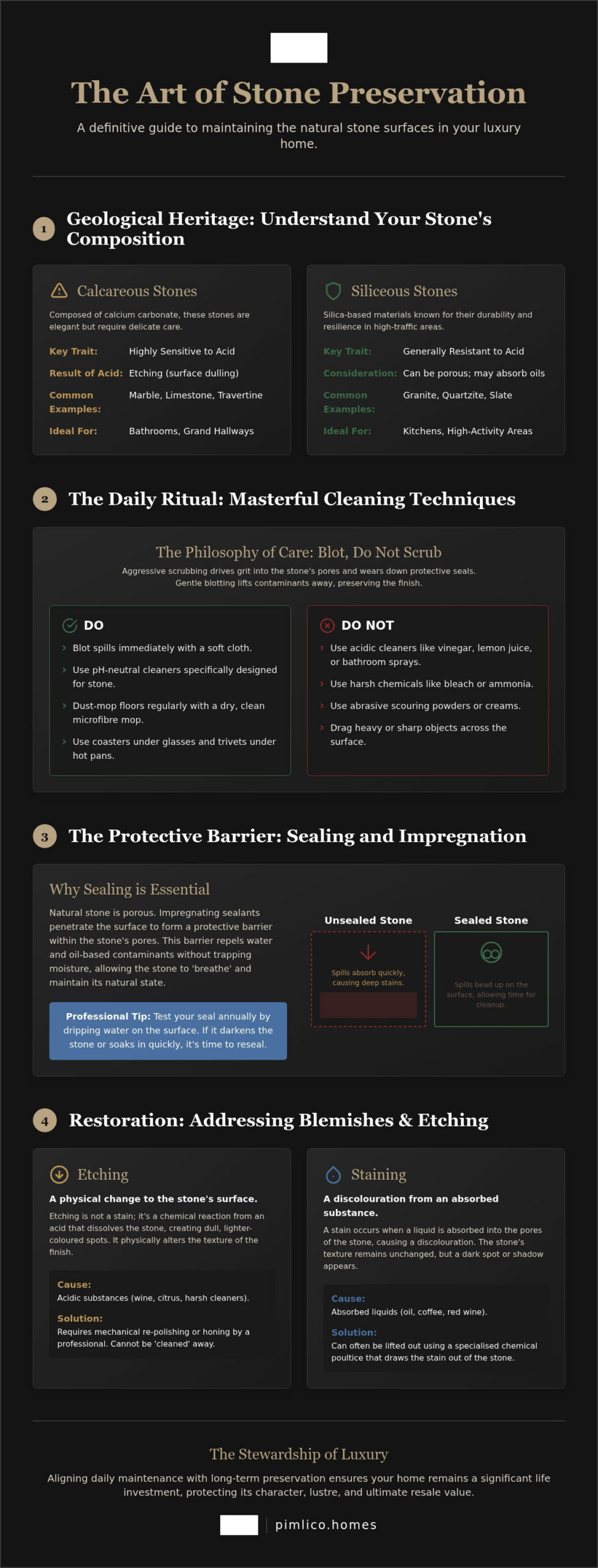
Restoration and Refinement: Addressing Blemishes and Etching
Restoration is an art of patience. It requires a departure from the impulsive desire to scrub. Instead, it invites a methodical, scientific approach to lifting discolouration or smoothing surface imperfections. To succeed, you must first distinguish between a stain and an etch. A stain occurs when a substance is absorbed into the stone’s pores, leaving a dark mark. An etch, however, is a physical surface burn caused by an acidic reaction. Successful cleaning and maintaining natural stone surfaces relies on identifying which of these challenges you face before choosing a remedy.
The science of the poultice is the most effective way to address deep-seated organic stains. This process uses capillary action to draw oils or dyes out of the stone and into an absorbent medium. It’s a slow, deliberate extraction that respects the material’s integrity. By contrast, you should avoid the temptation of abrasive home remedies. Baking soda is often cited in general cleaning blogs, but its grit can worsen etching on polished marble. It acts as a micro-abrasive that strips the finish, turning a minor mark into a permanent scar. At Pimlico Homes, we believe that the enduring beauty of a bespoke luxury home is a testament to both the quality of its construction and the meticulous care of its guardian.
Creating a DIY Poultice for Organic Stains
To lift an organic stain, mix a dedicated stone cleaning powder or a simple absorbent medium like unbleached flour with a small amount of hydrogen peroxide. Aim for a consistency similar to peanut butter. Apply this paste over the blemish, covering it with plastic wrap and securing the edges with tape. Poke a few small holes in the plastic. As the paste dries over 24 to 48 hours, it pulls the stain out of the stone. The drying process is the most critical stage; patience here is vital for a successful result.
Managing Etching on Calcareous Surfaces
Polished marble and limestone are particularly prone to visible etching because their mirror-like finish highlights every imperfection. Honed surfaces, with their soft matte aesthetic, tend to hide minor character marks more effectively. It’s important to recognise the limits of DIY care. Whilst a poultice can lift a stain, it cannot fix a physical etch. If the damage is extensive or deep, you should call a specialist to re-polish the stone. Over time, many owners choose to accept a light patina, viewing minor marks as part of the stone’s unique history and geological soul.
The Stewardship of Luxury: Preserving Long-Term Property Value
A home is more than a residence. It’s a significant life investment. For the owner of a high-specification property, the materials within are assets that require active management. The commitment you show to cleaning and maintaining natural stone surfaces is a quiet declaration of respect for craftsmanship. This level of dedication does more than preserve aesthetics; it directly influences the resale value of new build homes. When a prospective buyer enters a space, the condition of the stone floors and worktops serves as a primary indicator of the property’s overall health and the owner’s attention to detail.
Sophisticated property owners often maintain a maintenance log. This record documents the specific sealants applied, the dates of professional restoration, and the daily cleaning agents used. It acts as a pedigree for the home. In the context of an executive courtyard home, where architectural impact is paramount, such meticulous records provide a sense of security to future guardians. High-specification materials like stone are a central pillar of our buying a luxury new build guide, precisely because they offer a permanence that synthetic materials cannot replicate.
Stone as an Architectural Legacy
The permanence of stone is what gives bespoke luxury homes their sense of heritage. Well-maintained stone tells a story of quality and care. It suggests that the home has been looked after by someone who understands the emotional weight of a significant investment. There’s a profound emotional satisfaction in living amongst perfectly preserved natural materials. You aren’t just occupying a space; you’re participating in a legacy of excellence that will endure for generations.
Conclusion: The Pimlico Standard of Excellence
Luxury is found in the details of maintenance. We’ve moved from a culture of reactive cleaning to a philosophy of proactive stewardship. By understanding the geological soul of your stone and implementing a disciplined care routine, you ensure your surfaces retain their prestige. Don’t view these rituals as a chore. Instead, treat stone as the investment it truly is. At Pimlico Homes, we remain dedicated to supporting you throughout this journey, ensuring that every corner of your home continues to reflect the artistry and excellence of its creation. Master the art of stewardship, and your home will remain a beacon of elegance for years to come.
The Art of Enduring Stewardship
The journey of homeownership is one of constant refinement. By understanding the unique geological soul of your surfaces and adopting a proactive approach to care, you ensure that every slab of marble or granite continues to tell a story of excellence. Mastering the daily ritual of cleaning and maintaining natural stone surfaces ensures your home remains a sanctuary of prestige, protecting its lustre and its long-term resale value for generations to come.
At Pimlico Homes, we bring 25 years of architectural excellence to every project. We specialise in high-specification luxury barn conversions and bespoke executive homes, blending award-winning heritage craftsmanship with modern visionary design. Our commitment to quality doesn’t end when the keys are handed over; it lives on in the meticulous care you provide to the materials that define your residence.
We invite you to explore our portfolio of bespoke luxury homes and discover the standard of excellence that defines our builds. Your home is a masterpiece, and with the right stewardship, its beauty will only deepen with time.
Frequently Asked Questions
Can I use white vinegar or lemon juice to clean my limestone floor?
You must avoid acidic substances like white vinegar or lemon juice on limestone. These liquids react chemically with the calcium carbonate in the stone, causing immediate surface etching and a loss of lustre. For the meticulous task of cleaning and maintaining natural stone surfaces, you should only ever use pH-neutral solutions specifically formulated for stone. Protecting your home’s architectural legacy begins with selecting agents that respect the material’s geological composition rather than stripping its finish.
How often should I professionally seal my granite kitchen worktops?
Frequency is dictated by usage rather than a rigid calendar. Whilst many suggest an annual application, the true requirement depends on the stone’s porosity and daily wear. You should perform the water drop test every six months to verify the integrity of the protective barrier. If water no longer beads on the surface, it’s time to reseal. This proactive stewardship ensures your high-specification kitchen remains a central pillar of your home’s enduring prestige and value.
What is the difference between a stain and an etch on marble?
A stain is a discolouration caused by liquids being absorbed into the stone’s microscopic pores. An etch is a physical surface burn resulting from a chemical reaction with acids. Whilst a stain sits within the material, an etch is a change to the surface texture itself. Distinguishing between them is vital for cleaning and maintaining natural stone surfaces correctly. Stains often require a poultice for extraction, whereas etching typically necessitates professional re-polishing to restore the original finish.
Is it safe to use a steam mop on natural stone tiles?
We advise against using steam mops on natural stone. The combination of intense heat and high pressure can drive moisture deep into the stone’s pores, potentially causing spalling or weakening the bond of your sub-surface sealants. Over time, this aggressive approach can dull the stone’s natural brilliance. A clean microfibre mop paired with a gentle, pH-neutral cleaner remains the gold standard for maintaining the sophisticated aesthetic of your bespoke luxury home without risking its structural integrity.
How do I remove a ring mark left by a wine glass on my stone table?
First, determine if the mark is a stain or an etch. If the wine has left a dark discolouration, a poultice made from an absorbent medium and hydrogen peroxide can often lift the organic pigment. However, if the mark feels dull or rough, it’s likely an etch caused by the wine’s acidity. In such cases, the surface has been physically altered. You’ll need a specialised stone polishing compound or the hand of a professional conservator to restore the table’s elegance.
Can I use a general-purpose disinfectant on my natural stone surfaces?
Most general-purpose disinfectants contain harsh chemicals that are far too aggressive for natural stone. These products often have high acidity or alkalinity which can strip away protective sealants and damage the stone’s surface. To maintain a hygienic environment without compromising quality, look for disinfectants that are explicitly labelled as safe for natural stone and pH-neutral. This ensures you’re protecting your family’s health whilst simultaneously preserving the significant life investment that is your home’s interior.
What should I do if my stone surface has lost its original shine?
A loss of lustre is often caused by a build-up of soap film or microscopic surface scratches. Start with a deep clean using a dedicated stone soap to remove any residue. If the shine doesn’t return, the stone may have suffered from fine abrasion or chemical etching. At this stage, professional mechanical polishing is the only way to restore the original clarity. This process involves using diamond-encrusted pads to gently refinish the surface to its intended architectural brilliance.
Does all natural stone need to be sealed before use?
Whilst most porous stones like marble and limestone require sealing, some exceptionally dense granites or quartzites might not. However, as a guardian of quality, you should never assume a surface is protected. We recommend applying a high-quality impregnating sealant to all new installations to provide an initial barrier against oils and moisture. This acts as a foundation for your maintenance routine, ensuring that your bespoke surfaces are equipped to handle the realities of a modern luxury lifestyle from day one.


