
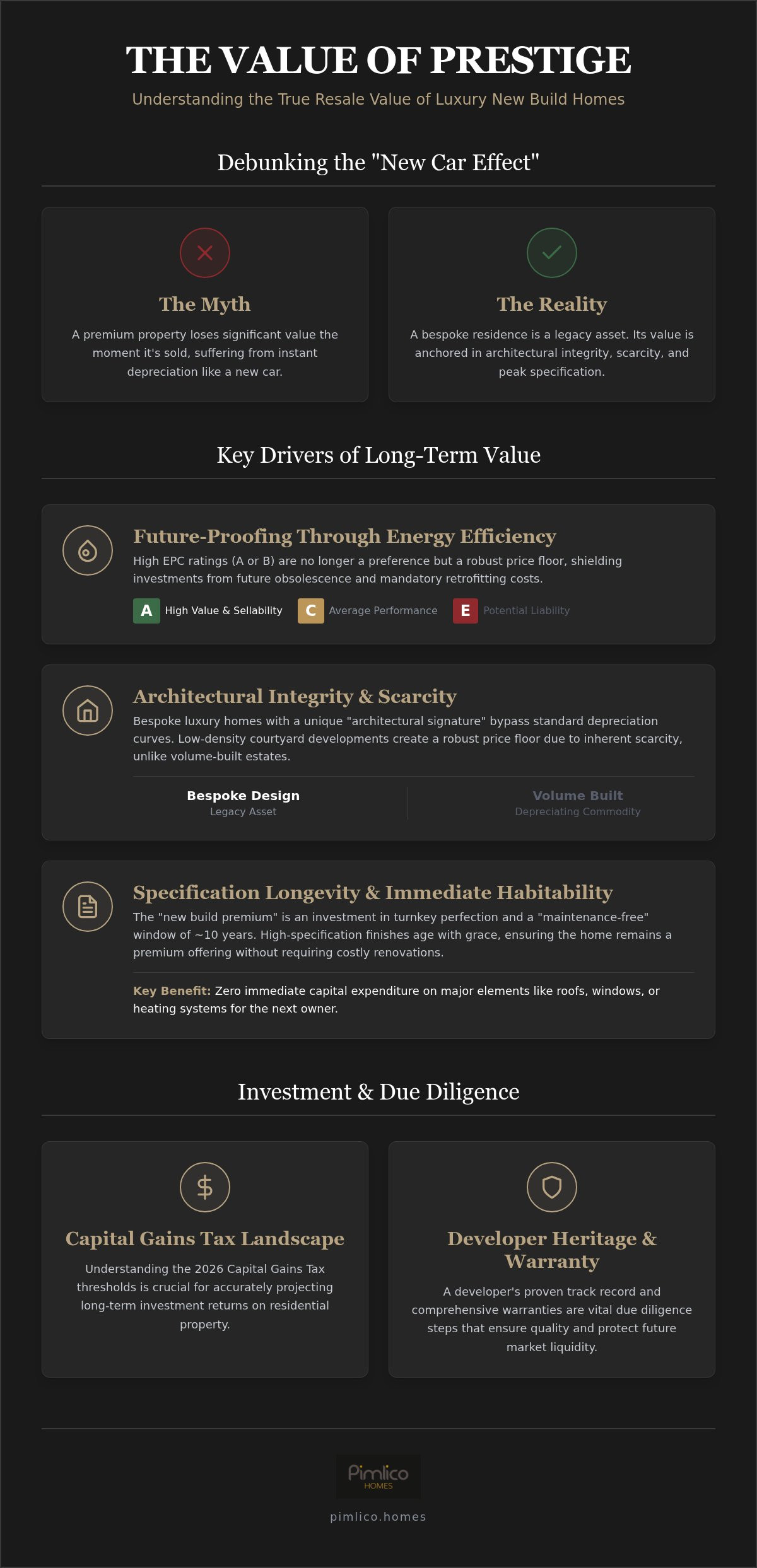
The common assumption that a premium property loses value the moment the keys are handed over is a persistent myth that ignores the reality of architectural scarcity. While some investors fear the “new car effect” of instant depreciation, the actual resale value of luxury new build homes often tells a far more compelling story of capital appreciation. You’ve likely felt that familiar anxiety when considering a modern investment, wondering if the initial premium is a sunk cost or a true asset. It’s a valid concern in a market where quality varies, yet the distinction between a volume-built house and a bespoke residence is where the investment logic shifts.
Architectural integrity. High-specification longevity. This guide explores how these elements transform a residence from a mere dwelling into a legacy asset. You’ll discover why bespoke finishes and smart energy management systems are now the primary drivers of long-term ROI, alongside a clear breakdown of the 2026 Capital Gains Tax landscape for residential investments. We examine the specific features that ensure a property remains desirable for decades, proving that the right new build doesn’t just hold its value; it defines it. From energy ratings to meticulous craftsmanship, we provide the clarity needed to invest with quiet confidence.
Key Takeaways
- Understand how the initial premium on a prestige residence acts as an investment in immediate habitability and architectural integrity.
- Discover why high energy efficiency ratings and bespoke finishes are essential for securing the resale value of luxury new build homes.
- Learn why executive courtyard developments offer a unique privacy premium that protects your capital better than standard volume-built estates.
- Navigate the 2026 Capital Gains Tax landscape to better understand how current thresholds impact your long-term investment returns.
- Recognise why a developer’s heritage and comprehensive warranties are vital due diligence steps for ensuring future market liquidity.
Understanding the “New Build Premium” in the Luxury Market
The “new build premium” is frequently mischaracterised as a transient cost. In the prestige sector, it’s a strategic investment in immediate habitability and peak specification. Whilst volume-built estates might suffer from the “new car effect,” the resale value of luxury new build homes is anchored by a different set of rules. It’s the difference between a mass-produced product and a curated asset. This premium reflects the significant, often overlooked, avoided costs of immediate renovation or structural modernisation. It’s the price of peace. When professional surveyors conduct a real estate appraisal, they recognise that high-specification finishes age with a grace that standard materials cannot match. This “specification longevity” ensures the home remains a premium offering long after the initial sale.
The Value of Immediate Habitability
Modern buyers in the executive market prize time as their most valuable commodity. They seek “turnkey” perfection where every detail is already resolved. The emotional weight of being the first to inhabit a bespoke architectural space is profound. It’s a pristine beginning in a home that hasn’t known compromise. The absence of a complex “snagging history” in high-end builds protects the future reputation of the property. In the luxury tier, a home’s history is as vital as its floorplan. By delivering a flawless experience from day one, these residences secure a higher standing in the second-hand market. Buyers aren’t just paying for a house; they’re paying for the certainty of excellence.
Prestige and the Scarcity Factor
Exclusivity is the engine of value. Low-density executive courtyard homes offer a curated sense of privacy and community that volume estates simply cannot replicate. This inherent scarcity creates a robust price floor. An “architectural signature” ensures the home remains a landmark in its own right. It stands out in the resale market because it’s genuinely unique. Bespoke luxury homes often bypass the standard depreciation curves seen in the wider market. They’re viewed as legacy assets rather than depreciating commodities. This distinction is crucial for investors who recognise that the long-term resale value of luxury new build homes depends on their ability to remain distinct amongst a sea of uniformity. By prioritising low-density layouts over sheer volume, developers ensure that each property retains its status as a rare find in a crowded marketplace. Quality isn’t just a promise; it’s a structural reality that preserves capital.
Key Drivers of Long-Term Resale Value in Premium Properties
The first decade of a prestige residence represents a unique “maintenance-free” window that significantly bolsters the resale value of luxury new build homes. During this period, the property benefits from peak operational efficiency whilst remaining aesthetically contemporary. It’s a sweet spot for ROI. Buyers aren’t just acquiring a home; they’re acquiring ten years of reclaimed time. This period of structural youth means the next owner faces zero capital expenditure on major elements like roofs or heating systems. To understand the essential components of this value, consult our Ultimate Guide to Buying a Luxury New Build Home in 2026 for detailed specification checklists.
Future-Proofing Through Energy Efficiency
Energy efficiency has evolved from a niche preference into a robust price floor. In a tightening regulatory environment, EPC A or B ratings aren’t just labels; they’re shields against future obsolescence. Sustainable heating systems, such as air source heat pumps and integrated solar arrays, increase a home’s “sellability” as we approach 2030 and beyond. High-end buyers are increasingly sophisticated. They recognise several key advantages:
- Regulatory compliance: Avoidance of future mandatory retrofitting costs.
- Operational excellence: Integrated solar and heat pump technology provide long-term energy security.
- Value retention: Homes that meet future standards today command a premium tomorrow.
High-end buyers view period properties as liabilities burdened by a significant “retrofitting tax”. A premium new build offers a definitive energy strategy from the moment the foundation is poured. It’s about financial security as much as environmental stewardship.
High Specification as a Resale Anchor
Quality is felt before it’s seen. Premium materials like natural stone and high-grade timber possess an inherent permanence that synthetic alternatives can’t replicate. Architectural integrity and value are deeply intertwined; a home built with meticulous care retains its allure across market cycles. We prioritise “invisible quality”, the superior soundproofing and thermal mass that define a true sanctuary. This structural excellence ensures the home remains quiet and temperate, regardless of the season. Smart home infrastructure adds a further tech-premium, creating a digital backbone that older homes struggle to support. It’s a future-ready canvas. If you’re seeking a residence designed for longevity, explore our bespoke luxury homes to see how these standards are realised in practice.
Bespoke vs. Volume: Why Architectural Integrity Matters
The trajectory of a property investment is often decided at the drafting table. Whilst volume-built estates provide housing, bespoke developments provide legacy. The resale value of luxury new build homes in the bespoke category typically follows a more resilient path than their mass-produced counterparts. Volume homes are frequently subject to the “next phase” syndrome, where their value is capped by the developer’s own newer, nearby inventory. In contrast, a bespoke residence is a “one of one” asset. It’s an individual statement. For a deeper analysis of how detached properties maintain their market standing, consult our Luxury Investment Guide which provides essential data on detached home performance.
The Privacy Premium of Executive Developments
Privacy is the ultimate luxury. Curated site layouts and gated entrances do more than provide security; they insulate property values from local market fluctuations. There’s a profound psychological value in “prestige by association” within an exclusive enclave. In these settings, detached homes with significant plot sizes consistently outperform semi-detached resales. The layout of an executive courtyard home is designed to minimise overlooking whilst maximising natural light. It’s a deliberate orchestration of space. This focus on low-density living ensures that the environment remains tranquil and sought-after, even as surrounding areas grow more crowded. You aren’t just selling a building; you’re selling a controlled, premium environment.
Character Meets Modernity: Barn Conversions
The allure of a luxury barn conversion lies in its unique footprint. It’s a “one-of-a-kind” asset for resale that blends heritage aesthetics with the structural certainties of a new build. These properties offer the soaring ceilings and exposed beams of a period building, yet they’re underpinned by comprehensive warranties and modern thermal performance. It’s the best of both worlds. There’s an enduring demand for rural luxury that meets contemporary executive standards. A barn conversion provides a sense of place and history that a standard new build cannot replicate. It’s an evocative choice. By combining traditional materials with innovative thinking, these homes capture a segment of the market that prizes character but refuses to compromise on efficiency or structural integrity. They’re built for the discerning eye.
Investment Strategy and Capital Gains Tax Considerations
A prestige residence is more than a home. It’s a cornerstone of a sophisticated investment portfolio. High-quality developments, particularly those in the executive courtyard category, significantly mitigate the risk of “void periods” within a rental-to-resale strategy. Discerning tenants and future buyers alike prioritise the efficiency and security that only a modern, high-specification build can offer. This inherent desirability ensures consistent liquidity. When assessing the resale value of luxury new build homes, one must consider the preservation of capital alongside potential growth. Unlike standard market offerings, these residences tend to retain their allure regardless of broader economic shifts, acting as a stable hedge within a diversified asset base.
Navigating Capital Gains Tax on New Build Sales
For the 2026/2027 tax year, understanding your potential liability is essential for accurate ROI forecasting. Capital Gains Tax on residential property is currently tiered. Basic-rate taxpayers face a rate of 18%, whilst higher and additional-rate taxpayers are subject to 24%. Individual investors benefit from an annual exempt amount of £3,000. It’s vital to remember that the “Primary Residence” exemption typically protects homeowners from these charges on their main dwelling. However, for those holding a property as an investment, meticulous record-keeping is paramount. Acquisition costs and capital improvements, such as bespoke additions or structural enhancements, are often deductible. These expenses can effectively lower your overall tax bill by reducing the taxable gain upon disposal.
The ROI of Luxury Detached Investments
Historical data indicates that high-end detached homes demonstrate remarkable resilience during economic cycles. Whilst the entry-level market may fluctuate, executive homes often remain recession-resistant due to the specific demographics they attract. The “holding period” is a critical factor in this strategy. A window of five to ten years is generally considered the sweet spot for luxury resale. This duration allows the initial premium to be absorbed by market growth whilst the property remains within its low-maintenance prime. In the year to June 2026, UK house prices increased by 2 per cent, yet the premium for new builds remained significant. Average prices for new builds in England reached £381,000 in April 2026, compared to £288,000 for existing stock. This spread underscores the enduring value of modern standards. To explore how these figures translate into a tangible asset, view our current luxury new build homes and begin your investment journey.
Choosing a Developer Committed to Long-Term Value
The developer’s reputation is the bedrock of future liquidity. For a discerning buyer, the provenance of a home is as important as its floorplan. When you conduct due diligence, you’re not just checking bricks and mortar; you’re verifying a legacy of excellence. A developer with a history of quality acts as a silent guarantor for the resale value of luxury new build homes. It’s about trust. If the original creator is known for meticulous care, the second-hand market responds with greater confidence. Discerning buyers recognise that quality is a long-term play. They look for a name that signifies a commitment to excellence that extends far beyond the final inspection.
The Guardian of Quality: Craftsmanship and Heritage
A 25-year track record in luxury development provides a level of security that volume builders can’t replicate. This tenure indicates a deep understanding of how premium materials behave over decades. Comprehensive warranties and robust aftercare aren’t just contractual obligations; they’re vital sales tools for the future. They provide the next owner with absolute peace of mind. The developer’s selection of prime locations also plays a critical role. By choosing sites with inherent land value and natural beauty, the property is insulated from broader market volatility. It remains a best-in-class asset because its foundation was chosen with a visionary’s eye. This strategic approach to land acquisition ensures that the surrounding environment remains as prestigious as the home itself.
Securing Your Legacy with Pimlico Homes
At Pimlico Homes, we view ourselves as guardians of your investment. Our commitment to bespoke design and executive finishes ensures that every residence we create is a unique architectural statement. We don’t build houses; we curate experiences. This focus on craftsmanship directly supports the resale value of luxury new build homes by creating the scarcity that drives demand. We invite you to view our current developments not merely as residences, but as significant long-term investment opportunities. Our team remains accessible to discuss bespoke home building consultations, guiding you through every intricate detail of the process. We take refined pride in our output, ensuring that each home reflects the high standards of its owner. Explore our Executive Courtyard Homes to see how value-driven design translates into a masterclass in privacy and prestige.
Securing a Legacy of Quality
Investing in a prestige residence is a decision that balances immediate lifestyle desires with long-term financial wisdom. We’ve explored how architectural scarcity and energy efficiency act as robust anchors for the resale value of luxury new build homes, ensuring your capital is protected against market shifts. The distinction between a volume-built house and a bespoke residence is clear. True value lies in the meticulous details and the visionary planning of a dedicated creator. It’s about more than just square footage; it’s about the permanence of quality.
With 25 years of specialist luxury development experience, we continue to redefine the executive standard through bespoke craftsmanship. Our homes are built to endure, supported by comprehensive structural warranties that provide absolute peace of mind for both current and future owners. This commitment to excellence ensures that a Pimlico home remains a best-in-class asset for generations. We invite you to explore our vision of modern living, where innovation meets traditional values.
Discover the enduring value of a Pimlico Home, explore our exclusive developments today. We look forward to helping you secure a residence that truly reflects your achievements.
Frequently Asked Questions
Do luxury new build homes depreciate as soon as you move in?
Luxury residences in the bespoke sector typically avoid the immediate depreciation seen in mass-market estates. The “new car effect” is a myth for homes built with architectural integrity and premium materials. High demand for turnkey excellence often results in immediate capital stability. Because these properties are rare, they don’t face the same downward pressure as identical units. The resale value of luxury new build homes is anchored by this inherent scarcity.
How much value does a high-specification kitchen add to a new build resale?
A high-specification kitchen serves as a primary anchor for future demand. It’s often the deciding factor for executive buyers who prize immediate habitability. By integrating bespoke cabinetry and top-tier appliances, you ensure the home remains competitive in the second-hand market. Whilst exact percentages vary, a premium kitchen reduces the negotiation gap by eliminating the need for immediate buyer investment. It’s a hallmark of a best-in-class asset.
Will I have to pay Capital Gains Tax if I sell my luxury new build?
You won’t pay Capital Gains Tax (CGT) if the property is your primary residence. For investment properties sold in the 2026/2027 tax year, the rates are 18 per cent for basic-rate taxpayers and 24 per cent for higher-rate taxpayers. There is a £3,000 annual exempt amount. Meticulous records of bespoke additions are essential. These costs can often be deducted from your taxable gain, lowering your liability.
How do EPC ratings affect the future resale price of a home?
High EPC ratings of A or B act as a robust price floor in a tightening regulatory landscape. As energy costs and environmental standards rise, homes with integrated heat pumps and solar arrays become significantly more desirable. Buyers in 2030 and beyond will pay a premium to avoid the “retrofitting tax” associated with older buildings. Superior energy performance is no longer an optional extra; it’s a fundamental driver of future market value.
Is a luxury barn conversion a better investment than a standard new build?
A luxury barn conversion often provides a superior return because it possesses inherent uniqueness. Standard new builds can suffer from uniformity, whereas a conversion offers a “one-of-a-kind” footprint that commands a premium. You’re combining heritage aesthetics with modern structural warranties. This blend of character and contemporary performance creates a highly liquid asset. It appeals to a discerning demographic that values history without wanting the maintenance burdens of period stock.
What is the “new build premium” and is it worth paying for executive homes?
The “new build premium” represents the cost of immediate habitability and peak specification. For executive homes, this premium is almost always justified by the avoided costs of renovation and the inclusion of advanced technology. It’s an investment in a maintenance-free window that lasts for a decade. The resale value of luxury new build homes remains high because they offer a level of efficiency that older properties simply cannot replicate.
How long should I hold a luxury new build property to maximise ROI?
A holding period of five to ten years is generally considered the sweet spot for maximising your return. This duration allows the property to benefit from market growth whilst staying within its low-maintenance prime. You exit the investment before significant capital expenditure on renewals is required. This strategy ensures the residence remains contemporary and highly attractive to the next buyer. It’s a methodical approach that balances capital appreciation with operational efficiency.
Do executive courtyard developments hold their value better than open estates?
Executive courtyard homes consistently outperform open estates due to their curated privacy and low density. The exclusivity of a gated or restricted-access layout creates a sense of prestige that standard developments lack. This “privacy premium” is a significant driver of long-term value. By limiting the number of residences, developers ensure that supply never outstrips demand. It’s a controlled environment that protects your capital by offering a sanctuary that mass-market estates cannot provide.


